- English
- ePUB (mobile friendly)
- Available on iOS & Android
eBook - ePub
About this book
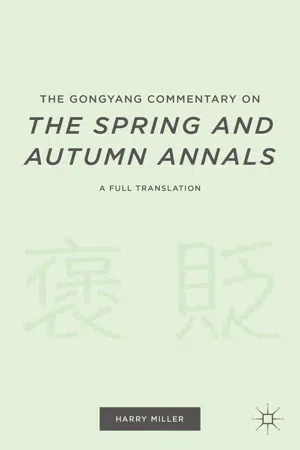
This book is a full translation of the Gongyang Commentary on the Spring and Autumn Annals, a history of the Chinese state of Lu from 722 to 481 BCE, annotated so as to highlight the moral philosophy of its supposed writer, Confucius.
Information
Chapter 1

Duke Yin, Part I
Translator’s summary: This chapter, covering only one year, establishes many of the conventions used thereafter, and it introduces Duke Yin, the first of several praiseworthy men in this book who show some reluctance to assume power. In Yin’s case, he becomes duke only as a de facto regent for his brother Huan. Ominously, though, the chapter also includes the affair of the Earl of Zheng and his brother Duan, which illustrates the corrosive effect that power may have upon brotherly love.
The First Year of Duke Yin’s Reign (722 BCE)
It was the year one, in the spring, during the King’s first month. What is meant by “the year one”? It means the year the ruler began his reign.1 What is meant by “the spring”? It means the beginning of the year. “The King” signifies whom? It signifies King Wen of Zhou.2 Why does the word “King’s” appear before the phrase “first month”? To show that it was the King who established the first month of the calendar. Why stress that the King established the first month of the calendar? To magnify the notion of the Zhou king’s unifying centrality. As for the Duke, why does the record say nothing about his succeeding to the ducal throne? The omission reflects what the Duke would have wanted. How does the omission reflect what the Duke would have wanted? Duke Yin wanted to set the state of Lu to rights and then to yield in favor of Duke Huan. Why would Duke Yin yield in favor of Duke Huan? Because Duke Huan, though young, was noble, and Duke Yin, though senior, was lowborn. Their difference in birth was not obvious and was unknown to the people of Lu. Owing to Duke Yin’s seniority and to his worthiness, the various grand officers supported him and made him duke. If Duke Yin had simply refused the dukedom outright, he could never have been certain that it would pass to Duke Huan; and even if it did, he was afraid that the various grand officers would refuse to serve such a young ruler. Therefore, Yin’s becoming duke was only for the sake of Huan’s becoming duke. Since Yin was senior and, moreover, worthy, why should he not have been duke? Because, while sons of the legal wife are ranked by seniority and not worthiness, sons of concubines are ranked by nobility and not seniority. So why was Huan considered noble? Because his mother was noble. Why is the son considered noble if the mother is noble? The son is noble because the mother is noble; the mother is noble because the son is noble.
During the third month, the Duke met up with Yifu of the state of Zhu Lou and made a pact with him at Mie. What is the significance of the phrase “met up with”? It means joined with. “Met,” “met up with,” and “reached” all imply joining. Why does the record sometimes say “met,” sometimes say “met up with,” and sometimes say “reached”? “Met” simply means convened together; “met up with” implies a bit more eagerness or haste; and “reached” suggests something unavoidable. “Met up with” still connotes a voluntary meeting, while “reached” means that the party that was reached was less than willing.3 Who was Yifu? He was the ruler of Zhu Lou. Why is he identified by his personal name?4 In this case, his personal name is being used as an honorific. Why call him by an honorific? To praise him. Why praise him? For his making a pact with the Duke. Many others also made pacts with the Duke. Why the special praise for Yifu? Because he is praiseworthy. How so? Because he initiated something that produced lasting benefits.5 What is meant by “Mie”? The record notes the names of the places where meetings occurred.
In the summer, during the fifth month, the Earl of Zheng6 subdued Duan at Yan. What does “subdued” mean? It means “killed.” If it means “killed,” why does it say “subdued”? To call attention, through understatement, to the Earl of Zheng’s crime. Why call attention to the Earl of Zheng’s crime? He killed Duan because their mother preferred that Duan be made the ruler. It would have been enough simply to prevent Duan from becoming ruler. Who was Duan? Duan was the Earl of Zheng’s younger brother. Why is he not identified as his “younger brother” here? Because he is being treated here as a head of state.7 Why is the place name specified? Because that was where Duan would have been head of state.8 How come no place name is given in the entry in which men of the state of Qi kill Wuzhi?9 Because that incident took place within the state of Qi’s borders. If the present case, involving someone aspiring to be head of state, had taken place inside his own state, then no place name would have been given. So too, if the present case did not involve someone aspiring to be head of state, even if it did occur outside his state, then no place name would have been given.
In the autumn, during the seventh month, the Heavenly King10 dispatched Zai Xuan to come bearing funerary offerings for Duke Hui’s wife, Zhongzi. What does “Zai” mean? Zai was the man’s office: deputy. What does “Xuan” mean? Xuan was the man’s personal name. Why is the man’s office used as his surname? Because his surname was derived from what he was: a deputy.11 Who was Duke Hui? He was Yin’s late father. Who was Zhongzi? She was Huan’s mother. Why is she not called “Duchess”?12 Because Huan was not yet ruler. What is meant by funerary offerings? It refers to items used during funeral ceremonies. “Funerary offerings” denotes horses and the silken cords used to harness teams of horses together, as well as carriages. Valuable objects and articles of clothing also given at funerals go by other names. If Huan was not yet duke, then why were the feudal lords bringing funerary offerings on behalf of his mother?13 Yin was going to make Huan duke, and so he announced Huan’s mother’s death to the feudal lords. And is that why the whole affair is mentioned here? Yes, it emphasizes Duke Yin’s intentions toward Huan. Why is it said that the Zhou King dispatched Zai Xuan “to come” with the funerary offerings? Because he arrived too late for the funeral.14 Why does the record say, “Duke Hui’s wife, Zhongzi”? The effect is to name two people at once, which is contrary to propriety.15 Why does the record not say “Duke Hui and Zhongzi”?16 Because doing so would obscure the central importance of Zhongzi in this affair.
During the ninth month, a pact was made with men from the state of Song at Su. Who were the people that met up with the men from the state of Song? They were minor officials of the state of Lu.17
In the winter, during the twelfth ...
Table of contents
- Cover
- title
- copyright
- Contents
- Acknowledgments
- Introduction
- Duke Yin, Part I
- Duke Yin, Part II
- Duke Yin, Part III
- Duke Huan, Part I
- Duke Huan, Part II
- Duke Zhuang, Part I
- Duke Zhuang, Part II
- Duke Zhuang, Part III
- Duke Zhuang, Part IV
- Duke Xi, Part I
- Duke Xi, Part II
- Duke Xi, Part III
- Duke Wen, Part I
- Duke Wen, Part II
- Duke Xuan, Part I
- Duke Xuan, Part II
- Duke Cheng, Part I
- Duke Cheng, Part II
- Duke Xiang, Part I
- Duke Xiang, Part II
- Duke Xiang, Part III
- Duke Zhao, Part I
- Duke Zhao, Part II
- Duke Zhao, Part III
- Duke Ding, Part I
- Duke Ding, Part II
- Duke Ai, Part I
- Duke Ai, Part II
- Index
Trusted by 375,005 students
Access to over 1.5 million titles for a fair monthly price.
Study more efficiently using our study tools.
Frequently asked questions
Yes, you can cancel anytime from the Subscription tab in your account settings on the Perlego website. Your subscription will stay active until the end of your current billing period. Learn how to cancel your subscription
No, books cannot be downloaded as external files, such as PDFs, for use outside of Perlego. However, you can download books within the Perlego app for offline reading on mobile or tablet. Learn how to download books offline
Perlego offers two plans: Essential and Complete
- Essential is ideal for learners and professionals who enjoy exploring a wide range of subjects. Access the Essential Library with 800,000+ trusted titles and best-sellers across business, personal growth, and the humanities. Includes unlimited reading time and Standard Read Aloud voice.
- Complete: Perfect for advanced learners and researchers needing full, unrestricted access. Unlock 1.5M+ books across hundreds of subjects, including academic and specialized titles. The Complete Plan also includes advanced features like Premium Read Aloud and Research Assistant.
We are an online textbook subscription service, where you can get access to an entire online library for less than the price of a single book per month. With over 1.5 million books across 990+ topics, we’ve got you covered! Learn about our mission
Look out for the read-aloud symbol on your next book to see if you can listen to it. The read-aloud tool reads text aloud for you, highlighting the text as it is being read. You can pause it, speed it up and slow it down. Learn more about Read Aloud
Yes! You can use the Perlego app on both iOS and Android devices to read anytime, anywhere — even offline. Perfect for commutes or when you’re on the go.
Please note we cannot support devices running on iOS 13 and Android 7 or earlier. Learn more about using the app
Please note we cannot support devices running on iOS 13 and Android 7 or earlier. Learn more about using the app
Yes, you can access The Gongyang Commentary on The Spring and Autumn Annals by H. Miller in PDF and/or ePUB format, as well as other popular books in History & Ancient History. We have over 1.5 million books available in our catalogue for you to explore.