- English
- ePUB (mobile friendly)
- Available on iOS & Android
eBook - ePub
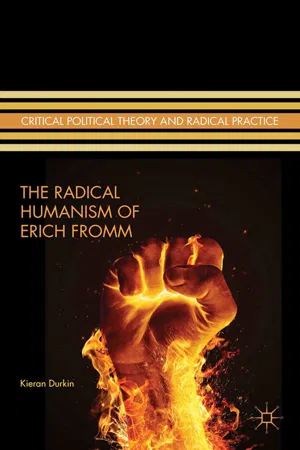
The Radical Humanism of Erich Fromm
About this book
This book, shortlisted for the British Sociological Association's Philip Abrams Memorial Prize (2015), argues that Fromm is a vital and largely overlooked contribution to twentieth-century intellectual history, and one who offers a refreshingly reconfigured form of humanism that is capable of reintegrating explicitly humanist analytical categories and schemas back into social theoretical (and scientific) considerations.
Information
CHAPTER 1
The Life and Writings of a Radical Humanist
Considering the comparative disregard of Fromm’s thought with that of other thinkers from the same period—particularly his Frankfurt School associates and contemporaries, Adorno, Marcuse, Benjamin,1 and also slightly later thinkers such as R. D. Laing, Michel Foucault, Jacques Derrida, etc.—there is particular benefit in engaging in an intellectual biographical account of Fromm at the outset. This is apt not only because of the general lack of awareness with regard to Fromm and his contribution to twentieth-century thought, but also by virtue of the impressive degree of continuity that characterizes his writings. An intellectual biographical sketch can therefore reveal something of the subtle shifts that took place in the development of Fromm’s thought and that contribute to the radical humanist position that emerges from his body of work. Inclusion of a biographical sketch is of particular importance in the case of Fromm in that, as someone for whom human worth was measured by actions and deeds as much as by words, it will reveal something of the extent to which he attempted to enact his philosophy in his personal life, or at least reveal something of his preoccupation with humanism in both theoretical and practical terms. There is also a more utilitarian reason for opening with such a sketch: outlining Fromm’s intellectual biographical details, including a broadly chronological listing of his major publications, will help to situate the discussion of the later chapters in relation to his life, thereby freeing up these chapters for more substantive and unencumbered discussion.
Most of what is written in this chapter has been drawn from Rainer Funk’s Erich Fromm: His Life and Ideas—An Illustrated Biography. Lawrence Friedman’s recent full-length biography—The Lives of Erich Fromm: Love’s Prophet—and some unpublished correspondence sourced from the Fromm archives provided some important and illuminating additions. Other than Funk’s and Friedman’s biographies, there has been relatively little written about Fromm’s life. Although it is true that there are bits and pieces of biography to be found in certain publications, they are generally found in studies of Fromm that are rarely read, or in studies of the Frankfurt School that generally tend to consider Fromm from the point of view of the School itself, and particularly as part of the narrative of his departure from it. I have sought to ensure that Fromm’s role in the early period of the Institut für Sozialforschung features as an important part of the present discussion, but that it does so from the point of view, and as part, of the story of Fromm’s life taken in and of itself.
Beginnings
Fromm was born to Orthodox Jewish parents in Frankfurt am Main on March 23, 1900. His father, Naphtali, a wine merchant, was the son of a rabbi and descended, as did his mother Rosa, from a distinguished line of rabbinical scholars, notable among who was Rabbi Seligmann Bär Bamberger, author of numerous halakhic works and a central figure in the nineteenth-century Orthodox Jewish movement. Crucially, while Fromm was still a child, his great-uncle, Ludwig Krause, a renowned Talmudist from Posen, came to stay in the family home, during which time he gave Fromm his first scriptural lessons. As Fromm makes clear in a rare autobiographical sketch, what interested him in these lessons were the prophetic writings of the Old Testament and, in particular, their vision of “the End of Days” or “Messianic Time”:
I was brought up in a religious Jewish family, and the writings of the Old Testament touched me and exhilarated me more than anything else I was exposed to. Not all of them to the same degree; I was bored by or even disliked the history of the conquest of Canaan by the Hebrews; I had no use for the stories of Mordecai or Esther; nor did I—at that time—appreciate the Song of Songs. But the story of Adam and Eve’s disobedience, of Adam’s pleading with God for the salvation of the inhabitants of Sodom and Gomorrah, of Jonah’s mission to Nineveh, and many other parts of the bible impressed me deeply. But more than anything else, I was moved by the prophetic writings, by Isaiah, Amos, Hosea; not so much by their warnings and their announcements of disaster, but by their promise of the “end of days,” when nations “shall beat their swords into ploughshares and their spears into pruning hooks: nation shall not lift sword against nation, neither shall they learn war anymore”; when all nations will be friends, and when “the earth shall be full of the knowledge of the Lord, as the waters cover the sea.” (2006 [1962]: 2)
These writings, with their vision of an age of universal peace and harmony “between man and man and between man and nature” (1992 [1963]: 212), which made their initial impression on Fromm as early as 12 years of age, offered what was to become a lifelong “inexhaustible source of vitality” (1986 [1983]: 89), testimony to which is strewn throughout his numerous mature writings.
At the age of 16, while attending services at Frankfurt’s Börneplatz synagogue, Fromm made the acquaintance of Rabbi Nehemiah Nobel, the then leader of the Orthodox community and the next decisive influence upon the trajectory of his thought. A former student of Hermann Cohen—who Fromm was to describe later as the ‘last great Jewish philosopher’ (2005: 143)—and a follower of Hasidism, Nobel imparted to Fromm a deeper and an extended understanding of the ideals of the prophets, mixing their thought with ideas from the German Enlightenment, and particularly with Goethe’s idea of humanitarianism (Fishbane, 1997: 12). This example of the fusion of the modern and the old was to greatly influence Fromm, showing him that it was possible to connect the “medieval” (1986 [1983]: 98) environment of his home and family life with the contemporary world without violating the principles of the former in the process. As Fromm was to later remark, in a statement that in many ways captures the tenor of his whole intellectual enterprise, “I became an eager student of everything that created this link between the old and the new” (1986 [1983]: 100).
After the death of Nobel in 1922, Fromm began a period of study with Salman B. Rabinkov, his third and final rabbinical teacher. Formally trained as a rabbi, Rabinkov waived his right to take up office, preferring instead to teach the Talmud to a group of students on a private basis, inclusive of who were Ernst Simon, Nahum Goldman, Salman Schasar, and Hermann Struck (Funk, 1990: 3). During their six years of study together, Fromm and Rabinkov saw each other almost daily, when they would be characteristically engrossed in interpretation and discussion of the Talmud, the Old Testament, and the wider Jewish tradition—particularly Habad mysticism (a form of Hasidism) and the thought of Maimonides and Hermann Cohen. Rabinkov, who was noted as being a man of extreme humbleness, also had strong socialist sympathies, sympathies that, no doubt, influenced both Fromm’s turn to Marxism and the formation of his view of Marx as a secular messianic prophet. Speaking of Rabinkov some years later in a letter to Lewis Mumford (dated April 29, 1975), Fromm remarked of him: “He influenced my life more than any other man, perhaps, and although in different forms and concepts, his ideas have remained alive in me.”2
So important were the ideas of the Judaic tradition to Fromm’s intellectual development that on leaving school his first wish was to go to Lithuania to become a Talmud scholar (Funk, 2000: 17). Only his father’s explicit prohibition, prompted by an apparent desire to ensure that he remain close to the family in Frankfurt, prevented Fromm from realizing his wish. Frustrated in this respect, Fromm embarked on an academic path, setting out initially to study jurisprudence at the University of Frankfurt in 1918 but subsequently transferred to Heidelberg’s Ruprecht-Karls University in 1920, where he finally enrolled in the department of National Economics (which would soon become known as “sociology”). Here Fromm studied under Karl Jaspers, Heinrich Rickert, Hans Driesch and, most importantly, Alfred Weber. Speaking of Weber in a letter to Lewis Mumford (April 29, 1975), Fromm described him, in contrast to his brother Max, as “a humanist not a nationalist, and a man of outstanding courage and integrity . . . the only one of my university teachers whom I considered a real teacher and master.” At university, Fromm attended classes on the history of philosophy and psychology, social and political movements, and the theory of Marxism (Funk, 2000: 50–52). As a result of this period—and in addition to his studies with Nobel and Rabinkov—Fromm became systematically acquainted with the classics of the German intellectual tradition, which included, in addition to the thought of Karl Marx and the philosophical classics, the more contemporary, social scientific thought of Werner Sombart, Ferdinand Tönnies, Max Weber. These modern, Germanic, influences can be said to feature, or at least be implied, in his mature thought, interacting productively with the Judaic ideas he had encountered during his studies with Krausse, Nobel, and Rabinkov.
For his doctoral dissertation, Fromm undertook a study of the social and psychological functions of Jewish Law in the Diaspora community—the Karaite, Reform, and Hasidic sects in particular—attempting to explain how it was that they survived as Jews despite the absence of national religious institutions (Funk, 2000: 56–58). Lacking a developed psychological framework or mechanism to anchor its analysis, the study nevertheless attempted an inquiry into the psychological function of the religious ethos and other forms of solidarity within the Jewish community. Fromm saw—in a manner that clearly presages his later work on social character—how it is that ethical forms are internalized by members of groups and turned into ways of life that become definitive for those groups. Notably, the study concluded with a positive appraisal of Hasidism’s ability to maintain its integrity in face of the ever-increasing encroachment of liberal-bourgeois and capitalistic values (Funk, 1988). During his time at university, alongside Georg Salzberger, a liberal rabbi, Fromm helped set up a Jewish teaching institute (the Freies Jüdisches Lehrhaus), the aim of which was to counteract the widespread ignorance of Jewish religion and history among the Diaspora community. It operated through the provision of free classes taught by—in addition to Fromm and Salzberger—Rabbi Nobel, Franz Rozenweig, Martin Buber, Gershom Scholem, Leo Baeck, and Siegfried Kracauer (Funk, 2000: 41; Funk, 1988).
Despite encouragement from Alfred Weber, Fromm decided against an academic career, a decision motivated primarily by the feeling that it would constrain his development (letter to Lewis Mumford, April 29, 1975). Instead, Fromm’s interests began to move toward psychoanalytic matters—a move that was facilitated in large part through his relationship with Freida Reichmann, a well-known psychoanalyst whom he married in 1926 (hereafter Freida Fromm-Reichmann). A friend since his time in Frankfurt, Fromm-Reichmann’s influence on Fromm was considerable. It was with her that he first underwent psychoanalysis, introducing him to what would become an indispensable framework for his thinking for the remainder of his life. It was with her too that he discovered Buddhist thought, an encounter he would later describe as “one of the greatest experiences in my life” (1986 [1983]: 105). Lastly, it was with her that he would formally renounce Judaism—a renunciation symbolically conveyed through the eating of leavened bread on Passover (Fromm-Reichmann in Funk, 2000: 61).
Prior to this renunciation, Fromm had, together with Fromm-Reichmann, opened a sanatorium in Heidelberg for the specific psychoanalytic treatment of Jewish patients. As part of this venture, Fromm spent a year in Munich with Wilhelm Wittenberg, undertaking psychoanalytic training and attending lectures given by Emile Kraepelin, among others. After this, Fromm spent a period of analysis with Karl Landauer in Frankfurt before moving to Berlin, where he was taught by Hans Sachs and Theodore Reik at the Berlin Psychoanalytic Institute and where he was to open his first psychoanalytic practice in 1928. While in Berlin, Fromm was an attendee at Otto Fenichel’s famous Kinderseminar, a gathering point for young dissident psychoanalysts interested in exploring the relevance of psychoanalysis for matters pertaining to socialism. Other attendees at the regular meetings included Wilhelm and Annette Reich, Edith Jacobson, and George Gero (Jacoby, 1983: 66–69). In addition to this, Fromm was an acquaintance of Paul Federn, Ernst Simmel, and Siegfried Bernfeld, all high-profile psychoanalysts and socialists with whom he shared ideas on the connections between Marxism and psychoanalysis. During this time, Fromm made his first attempts at the public communication of his ideas, publishing a psychoanalytic account of “Der Sabbat” (The Sabbath) in Imago in 1927 and giving lectures on Die Psychoanalyse des Kleinbürgetums (The Psychoanalysis of the Petty Bourgeois), among other subjects (Funk, 2000: 61, 67).
Development and Separation
In 1929, Fromm returned to Frankfurt, where he founded the Frankfurt Psychoanalytic Institute of the South-West German Psychoanalytic Association along with Karl Landauer and Heinrich Meng. In his role at the Psychoanalytic Institute, Fromm taught courses on the relationship between psychoanalysis and sociology, giving a lecture on the same subject at the inauguration of the institute in which he laid out in brief form some of the fundamental ideas of his developing social psychology. In this lecture Fromm particularly stressed the need “to investigate what role the instinctual and unconscious play in the organization and development of society and in individual social facts, and to what extent the changes in mankind’s psychological structure, in the sense of a growing ego-organization and thus a rational ability to cope with the instinctual and natural, is a sociologically relevant factor” (1989 [1929]: 38). Later that year, Fromm was invited, through his connections with Karl Landauer and Leo Löwenthal (a school friend married to Fromm’s former fiancé Golde Ginsburg), to participate in the research program of the Frankfurt Institut für Sozialforschung (hereafter generally “Institut”), which happened to be housed in the same building as the Psychoanalytic Institute. The Institut’s director, Max Horkheimer, had also seen the importance of psychoanalysis for understanding sociological issues, his influence stimulated, in fact, by Löwenthal—who had himself been analyzed by Freida Fromm-Reichmann—and by informal conversations with Fromm and the other members of the Psychoanalytic Institute (Funk, 2000: 72; Jay, 1996: 87). Fromm was immediately given the task of leading an innovative empirical study of the attitudes of German manual and white-collar workers in relation to fascism. The study—the methodology and theoretical focus of which informed the Institut’s The Authoritarian Personality study some twenty years later—purported to have found evidence of unconscious authoritarian and conservative character traits among the supporters of the Social Democratic and Communist parties, pointing toward the relative acquiescence of the general populace that was to characterize Hitler’s reign. For reasons that will be discussed in due course, the study was not published until the 1980s (appearing under the title Arbiter ind Angestellte am Vorabend des Dritten Reiches: Eine sozialpsychologische Untersuchung—subsequently published in English as The Working Class in Weimar Germany: A Psychological and Sociological Study), and Fromm’s pivotal role in the development of authoritarian studies was largely forgotten.
Fromm’s first monograph, Die Entwicklung des Christusdogmas, Eine Psychoanalytische Studie zur Sozialpsychologischen (The Dogma of Christ), was published in 1930, being translated into English in 1963. Exhibiting certain obvious similarities to the previously mentioned criminological studies, Fromm was concerned in this work with the sociopsychoanalytical analysis of the early Christian sects that sought “to determine the extent to which the change in certain religious ideas is an expression of the psychic change of the people involved and the extent to which these changes are conditioned by their conditions of life” (1992 [1963]: 10). Attempting to fuse Marxian and Freudian insights once more, Fromm attempted to map the morphology of Christian Dogma by relating the ideas it conveys, relative to each stage of its development, as expressions of the socioeconomic situation and psychic attitude of its followers (to which end he introduces the explanatory-descriptive idea of “character matrix” common to most members of a particular group, class, or society). In addition to this, Fromm engaged in a theoretical explanation of the rationale behind his proposed psychoanalytic social psychology, especially how it should be used in application and also in terms of how to understand the relationship between individual psychology and social psychology.
Fromm’s next publications were two critiques of the criminal justice system—“Der Staat als Erzieher: Zur Psychologie der Strafjustiz” (“The State as Educator: On the Psychology of Criminal Justice”), which appeared in Zeitschrift für Psychoanalysche Pädagogik in 1930, and “Zur Psychologie des Verbrechers und der strafenden Gesellschaft” (“On the Psychology of the Criminal and the Punitive Society”), which appeared in Imago in 1931. In these articles, which were only made available to an English-speaking audience by Kevin Anderson in Erich Fromm and Critical Criminology: Beyond the Punitive Society,3 Fromm combines Marxian and Freudian analyses to revealing effect. Breaking new ground in the criminological thought of the time by applying Marxian-inspired psychoanalytic thought to the study of crime, Fromm argued in these articles that the criminal justice system fails to realize its stated goals of reform and correction because of that fact that its focus on influencing criminals is pitched at the conscious as opposed to the unconscious level, therefore bypassing the dynamic drives that help structure behavior. Considering the ineffectual nature of penal sanction in this regard, Fromm stressed the legitimating functions of the criminal justice system for the capitalist state, showing how this system sought to “influence the masses psychologically in the sense desired by the rulers” (2000 [1930]: 126–127), and also how the use of power by the police and military could only fulfill its repressive function on the basis of “the psychic readiness of the great majority to adjust to the existing society and to subordinate themselves to the ruling powers” (2000 [1930]: 125).
In 1932, while recuperating from tuberculosis in Switzerland, Fromm was made a tenured director of the Institut, in charge of the fields of psychoanalysis and social psychology (Funk, 2000: 73). His article of that year, “Über Methode und Aufgabe einer Analytischen Sozialpsychologie. Bemerkungen über Psychoananlyse und historischen Materialismus” (“The Method and Function of Analytic Social Psychology”), a further development of the theory laid down in The Dogma of Christ...
Table of contents
- Cover
- Title
- Introduction
- Chapter 1 The Life and Writings of a Radical Humanist
- Chapter 2 The Roots of Radical Humanism
- Chapter 3 Radical Humanist Psychoanalysis
- Chapter 4 Psychoanalytic Social Psychology
- Chapter 5 Anti-Humanism: A Radical Humanist Defense
- Chapter 6 The Renaissance of Humanism
- Conclusion
- Notes
- Bibliography
- Index
Trusted by 375,005 students
Access to over 1.5 million titles for a fair monthly price.
Study more efficiently using our study tools.
Frequently asked questions
Yes, you can cancel anytime from the Subscription tab in your account settings on the Perlego website. Your subscription will stay active until the end of your current billing period. Learn how to cancel your subscription
No, books cannot be downloaded as external files, such as PDFs, for use outside of Perlego. However, you can download books within the Perlego app for offline reading on mobile or tablet. Learn how to download books offline
Perlego offers two plans: Essential and Complete
- Essential is ideal for learners and professionals who enjoy exploring a wide range of subjects. Access the Essential Library with 800,000+ trusted titles and best-sellers across business, personal growth, and the humanities. Includes unlimited reading time and Standard Read Aloud voice.
- Complete: Perfect for advanced learners and researchers needing full, unrestricted access. Unlock 1.5M+ books across hundreds of subjects, including academic and specialized titles. The Complete Plan also includes advanced features like Premium Read Aloud and Research Assistant.
We are an online textbook subscription service, where you can get access to an entire online library for less than the price of a single book per month. With over 1.5 million books across 990+ topics, we’ve got you covered! Learn about our mission
Look out for the read-aloud symbol on your next book to see if you can listen to it. The read-aloud tool reads text aloud for you, highlighting the text as it is being read. You can pause it, speed it up and slow it down. Learn more about Read Aloud
Yes! You can use the Perlego app on both iOS and Android devices to read anytime, anywhere — even offline. Perfect for commutes or when you’re on the go.
Please note we cannot support devices running on iOS 13 and Android 7 or earlier. Learn more about using the app
Please note we cannot support devices running on iOS 13 and Android 7 or earlier. Learn more about using the app
Yes, you can access The Radical Humanism of Erich Fromm by K. Durkin in PDF and/or ePUB format, as well as other popular books in Politics & International Relations & Political History & Theory. We have over 1.5 million books available in our catalogue for you to explore.