This book brings together distinguished scholars, community college practitioners, and emerging leaders to expand upon existing theories, provide reflection on practice, and demonstrate the dynamic nature of community college internationalization. There is a special challenge for United States community colleges to move from selected international programs that impact a few students to sustainable change that influences the entire college community. A key importance is realization that reform is not based on chance, but on intentional designs that are intended to guide future endeavors. The research, case studies, and experiences of the authors in this book are both inspiring and critical in the quest to encourage an academic shift for long-term change that promotes international literacy as an integral component of the community college and celebrates the needs of the changing local communities.
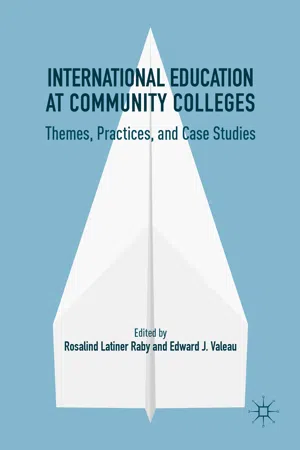
eBook - ePub
International Education at Community Colleges
Themes, Practices, and Case Studies
- English
- ePUB (mobile friendly)
- Available on iOS & Android
eBook - ePub
International Education at Community Colleges
Themes, Practices, and Case Studies
About this book
Information
Topic
EducationSubtopic
Comparative Education© The Author(s) 2016
Rosalind Latiner Raby and Edward J. Valeau (eds.)International Education at Community Colleges10.1057/978-1-137-53336-4_11. Introduction
Rosalind Latiner Raby1, 2, 3 and Edward J. Valeau4, 5
(1)
Educational Leadership and Policy Studies Department, Michael D. Eisner College of Education, California State University, Northridge, USA
(2)
California Colleges for International Education, Los Angeles, USA
(3)
College of Humanities and Sciences, Southern California Campus, University of Phoenix, Costa Mesa, USA
(4)
Hartnell Community College District, Salinas, California, USA
(5)
the ELS Group, LLC, Hayward, USA
We approach this book with 30 years of experience and continuing commitment to the field of community college internationalization. Our first effort resulted in the 2007 New Directions in Community College publication that asked national leaders to define advocacy for community college internationalization, which includes internationalizing curricula, faculty/staff exchanges, international students, study-abroad programs, and partnerships with institutions in other countries. This book allows well-known scholars, community college practitioners, and emerging leaders an opportunity to expand and reflect on existing practices that demonstrate the dynamic nature of community college internationalization.
About 13 million students attend US community colleges. Students enroll for multiple reasons, including to earn their first credential, certificate or degree, to gain multiple credentials to advance their career pathway, to enhance remedial skills, to engage in lifelong education, or prepare to transfer to a four-year college/university. In meeting these diverse student needs, international education varies considerably within and between colleges. Grounding the various international programs is a belief that “it is important that college graduates, whatever their location, be not just globally competitive but also globally competent, understanding their roles as citizens and workers in an international context” (AACC 2012, p. 20).
Unfortunately, of the 1200 US community colleges, too few are internationalized and there is inconsistent benchmarking of which colleges are involved in internationalization efforts. In 2011, the American Council on Education surveyed 239 community colleges and found that less than 25 % had an internationalization plan (ACE 2012). In 2014, Institute for International Education (IIE) Open Doors showed that community colleges served 76,586 international students based on responses from 309 colleges and 4843 study-abroad students based on responses from 85 colleges (IIE 2014). There is no national benchmark for any other kind of international program.
This book assesses prior advancements in the field, current challenges, and where new emphasis needs to be placed to produce viable and sustained results that impact programming across all spectrums. In doing so, the book explores the trajectory of a changing construct that is moving international education from optional to integral (King and Fersh 1983).
Book Themes
This book is divided into two parts. The first explores theoretical constructs to help the reader understand the change process. The second part describes academic and case studies that identify how specific changes inform practice.
Part One: Exploring the Field
In Exploring the Field, authors delineate two theoretical constructs. The first uses theory for advocacy and to ground best practices. Raby and Valeau explore the historical and current applications of why an emphasis on global is not in opposition to the US community college local mission and how to avoid elements that contribute to keeping internationalization sidelined. Bista examines the profiles of community college faculty who are foreign-born, US-born with prior international experiences, and US-born without prior international experiences to show how personal profiles can enhance campus internationalization. Treat defines elements for effective mentoring that enhance mentee learning outcomes. Woodin defines categorical metrics of leadership and policy, organizational resources, curricular, co-curricular, professional development, and international student services to track internationalization progress in a college. Finally, Valeau and Raby build a comprehensive profile of those mid-level managers currently leading international programs to understand their role and importance in the college leadership pipeline.
The second set of theoretical chapters focus on changing practices that, when purposefully directed, can enhance overall student learning. Hagedorn, Pei, and Yan explore how some international students who study at four-year colleges/universities need the extra assistance that they find at the community colleges. They theorize how those elements that serve this population can be expanded to serve other student populations. Hollis and Davis reveal how and why knowledge of Title IX regulations prohibiting sexual assault is needed by international students. They define how to add this knowledge to current advising policies. Zhang depicts how academic advising in general, and appreciative advising specifically can meet international student needs and affect non-traditional learning experiences. Willis explores how purposeful advising in terms of racial, class, and gender dynamics influences peer interactions, student comfort, and ultimately, engagement with faculty. Zamani-Gallaher, Lang, and Leon share how the process of student self-authorship, the internal capacity to define one’s beliefs, identity, and social relations, when added to the study-abroad experience, can enhance student career readiness and advancement.
Part Two: Research and Case Studies
In Research and Case Studies, examples of internationalization are shared from programs in colleges of various sizes in Arizona, California, Florida, Illinois, Indiana, Iowa, Mid-Atlantic, Mid-West, Michigan, New Jersey, Oregon, Texas, Washington, and Wisconsin. These studies are grouped into categories that focus on (a) systemic college change, (b) CEO-directed change, (c) specific programmatic change, and (d) learning from student stories.
Comprehensive internationalization is a term currently used to illustrate how internationalization influences systemic change. Castro-Salazar, Perez, and Merriam examine how a single program established new college procedures and routes of communication that resulted in a comprehensive college-wide plan. Sipe uses regression analysis to represent how three environmental factors, namely setting, student demographics in terms of ethnic diversity, and primary industry in the college’s service area help to promote or discourage institutionalization. These studies reveal how colleges do not operate independently and are affected by internal and external variants.
Leadership theories define the importance of executive officers in charting reforms at community colleges. Vargas uses frames of organizational decision-making to demonstrate how a president transformed and institutionalized a reciprocal faculty and student exchange program. Budd, Serban, VanHook, and Raby use content analysis, informal observations, and seat analysis to clearly show that the chief executive officer’s opinion not only guides reform efforts but can also counter traditional myths about the role of international students in the community college. Rodriguez focuses on content analysis to show how the leadership of the provost and the president can facilitate development of a global learning certificate program whose e-portfolio activity is enhancing overall student learning.
Changes to specific international programs illustrate not only application but also a process through which staff, administrators, and faculty are involved in reform efforts. Bartzis, Kirkwood, and Mulvihill use faculty interviews to compare how faculty-driven efforts at two community colleges impact overall college reform efforts. Cierniak and Ruddy employ faculty/staff survey and policy content analysis to explain the process involved in developing a first-year global learning certificate and the role of collaboration between a university and a community college system. Quezada and Coreiro analyze study-abroad director interviews and web-page analysis to compare how five community colleges provide innovative pedagogies and practices for students of color to participate in study-abroad programs. Rhodes, Raby, Thomas, Codding, and Lynch examine statistics at California and New Jersey community colleges to reveal how the programmatic change of studying abroad influences student success measures.
Finally, the importance of the student voice shows how student reflection can chart student learning and career preparation. Brenner employs ethnography to illustrate the broad spectrum of learning that results from participating in short-term education-abroad programs designed to capitalize on transformative experiences. Miller uses interviews to define elements needed to be adopted by international student advisors to help international students manage cultural and social stress. Thomas uses interviews to explore how education-abroad can be a vehicle for building student global competencies that are attractive to future employers. Combined, these studies show that community colleges are integrally involved in transformative learning based on lived student experiences which are integral to understanding the impact of internationalization and its importance to the mission of the community college.
Moving Forward
There is a special challenge for US community colleges to move from celebration of singular programs that make internationalization available to only a few students to sustainable change that influences the entire college community. This book shows a transformation is occurring in which commitment from all stakeholders is setting the pace for future endeavors. However, without sustained and systemic support for internationalization by all stakeholders, this book and all that has been said will serve only as a footnote and a contribution to the literature on internationalization. The danger is that if we continue to remain insular on internationalization, we further seal our fate and lose our opportunity to lead, thus relegating us to the role of being followers in the global economic competitive arena and race to the top. A key awakening is realization that reform is not based on chance, but on intentional designs created to guide comprehensive reform efforts. As editors, we found the experiences of the authors and their research to be both inspiring and critical in the quest to bring international education to the diverse populations served by US community colleges. We hope that the theoretical and practical commonalities found in this book will be acted upon in future publications of revised Board policies in community colleges and associations across the USA and in innovative programming dedicated to curricula and training our future international education leaders. Such a sustained and ingrained focus will prove the efficacy of this book.
References
American Association of Community Colleges (AACC). (2012). Reclaiming the American dream: A report from the 21st-Century commission on the future of community colleges. April. Washington, DC: American Association of Community Colleges Press. http://www.aacc.nche.edu/21stCenturyReport
American Council on Education. (2012). Mapping internationalization on U.S. campuses: 2012 edition. http://www.acenet.edu/news-room/Documents/MappingInternationalizationUS Campuses2012-full.pdf
Institute of International Education. (2014). Community college data resource. 2013/2014 Open Doors Report on International Educational Exchange. http://www.iie.org/opendoors
King, Maxwell, & Fersh, Seymour (1983). International education and the U.S. community college: From optional to integral. ERIC Junior College Resource Review, Spring, ERIC Number: ED233780.
Exploring the Field
© The Author(s) 2016
Rosalind Latiner Raby and Edward J. Valeau (eds.)International Education at Community Colleges10.1057/978-1-137-53336-4_22. Global Is Not the Opposite of Local: Advocacy for Community College International Education
Rosalind Latiner Raby1, 2, 3 and Edward J. Valeau4, 5
(1)
Educational Leadership and Policy Studies Department, Michael D. Eisner College of Education, California State University, Northridge, CA, USA
(2)
California Colleges for International Education, Los Angeles, CA, USA
(3)
College of Humanities and Sciences, Southern California Campus, University of Phoenix, Costa Mesa, CA, USA
(4)
Hartnell Community College District, Salinas, California, USA
(5)
the ELS Group, LLC, Hayward, USA
International Education
The vast majority of US community college students enroll in educational programs to advance a career pathway that often has labor market value. Most of these programs are terminal and hence, the only opportunity that a student has to gain international knowledge is during studies at the community college. International education is not new to US community colleges. For 60 years, faculty and leaders have understood the benefits of learning beyond borders, be it between local neighborhoods, inter-state, or cross-national. Internationalization is included in curriculum and pedagogy as community colleges define educational programs and student services to serve changing multicultural communities (Raby and Tarrow 1996) and to create new credential and degree requirements to serve changing global employment needs (Treat and Hagedorn 2013). There are now multiple generations of co...
Table of contents
- Cover
- Frontmatter
- 1. Introduction
- 1. Exploring the Field
- 2. Case-Studies and Research Studies
- Backmatter
Trusted by 375,005 students
Access to over 1.5 million titles for a fair monthly price.
Study more efficiently using our study tools.
Frequently asked questions
Yes, you can cancel anytime from the Subscription tab in your account settings on the Perlego website. Your subscription will stay active until the end of your current billing period. Learn how to cancel your subscription
No, books cannot be downloaded as external files, such as PDFs, for use outside of Perlego. However, you can download books within the Perlego app for offline reading on mobile or tablet. Learn how to download books offline
Perlego offers two plans: Essential and Complete
- Essential is ideal for learners and professionals who enjoy exploring a wide range of subjects. Access the Essential Library with 800,000+ trusted titles and best-sellers across business, personal growth, and the humanities. Includes unlimited reading time and Standard Read Aloud voice.
- Complete: Perfect for advanced learners and researchers needing full, unrestricted access. Unlock 1.5M+ books across hundreds of subjects, including academic and specialized titles. The Complete Plan also includes advanced features like Premium Read Aloud and Research Assistant.
We are an online textbook subscription service, where you can get access to an entire online library for less than the price of a single book per month. With over 1.5 million books across 990+ topics, we’ve got you covered! Learn about our mission
Look out for the read-aloud symbol on your next book to see if you can listen to it. The read-aloud tool reads text aloud for you, highlighting the text as it is being read. You can pause it, speed it up and slow it down. Learn more about Read Aloud
Yes! You can use the Perlego app on both iOS and Android devices to read anytime, anywhere — even offline. Perfect for commutes or when you’re on the go.
Please note we cannot support devices running on iOS 13 and Android 7 or earlier. Learn more about using the app
Please note we cannot support devices running on iOS 13 and Android 7 or earlier. Learn more about using the app
Yes, you can access International Education at Community Colleges by Rosalind Latiner Raby, Edward J. Valeau, Rosalind Latiner Raby,Edward J. Valeau in PDF and/or ePUB format, as well as other popular books in Education & Comparative Education. We have over 1.5 million books available in our catalogue for you to explore.