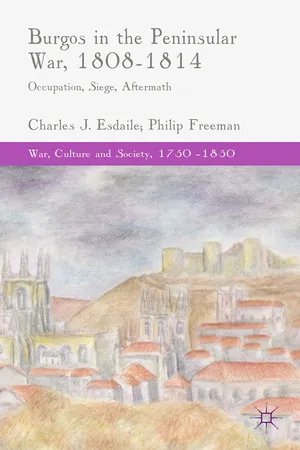
eBook - ePub
Burgos in the Peninsular War, 1808-1814
Occupation, Siege, Aftermath
- English
- ePUB (mobile friendly)
- Available on iOS & Android
eBook - ePub
About this book
For a full month in the autumn of 1812 the 2,000-strong garrison of the fortress the French had constructed to overawe the city of Burgos defied the Duke of Wellington. In this work a leading historian of the Peninsular teams up with a leading conflict archaeologist to examine the reasons for Wellington's failure.
Information
1
Sources and Questions
Occupying a key position in the geography of northern Spain, the city of Burgos played an eventful role in the history of the Peninsular War. Having already witnessed the passage of large numbers of French troops in the direction of Portugal in the autumn of 1807, in November of that year it was among the first of Spain’s cities to play host to a permanent French garrison, whilst in April 1808 it witnessed the fateful journey that took Spain’s rival monarchs to the conference with Napoleon at Bayonne that brought down the Bourbon monarchy, and contributed the very first of the quarter of a million or more lives that formed Spain’s share of the human cost of the attempt to incorporate Iberia into the Napoleonic imperium. In the war that followed, the presence of large numbers of French troops initially saved the city from experiencing the horrors of battle – the insurrection of May 1808, then, was not replicated in Burgos – and in consequence el rey intruso, Joseph Bonaparte, was able to pass through in safety en route to his triumphal entry into Madrid, and, for that matter, to travel back the other way when he abandoned the capital and fled for the safety of the River Ebro in the wake of the battle of Bailén. The liberation that followed, however, was short-lived. Spain’s armies proving incapable of holding back the punishment unleashed upon her by Napoleon in retribution for the loss of Dupont’s army, French forces swept back into the city following a brief battle at the suburban village of Gamonal, and the result was a sack that saw it both thoroughly pillaged and badly damaged by fire. There followed nearly four years of military occupation, in the course of which the built environment was significantly altered and the population was ravaged by epidemic and economic collapse in the midst of a hinterland haunted by swarms of guerrillas and bandits. Nor was this an end of the story: in September 1812 calamity was intensified still further in that, following its victory at Salamanca and subsequent liberation of Madrid, the Anglo-Portuguese army of the Duke of Wellington arrived in the city and besieged the garrison that the retreating French forces had left in the citadel which was the chief result of the short-lived presence of Napoleon in November 1808. The result was much devastation, and all to no effect: Wellington being unable to secure his objectives, the French returned and held the city for another seven months before finally being forced to withdraw in the course of the campaign of Vitoria, though not before they had blown up the mediaeval castle that had formed the nucleus of the citadel they had held on to so grimly the previous year.
Here, then, is a veritable microcosm of the Peninsular War or, to use the Spanish form, the War of Independence, and, as such, Burgos offers itself as a natural subject for a case study in the experience of war and occupation, and all the more so as the area it represents is not one that is covered by the very few regional studies of the war of 1808–1814 that have appeared in English. However, the extraordinary state of preservation of the fortifications constructed by the occupying forces ensures that such a work can be combined with something else, namely a study, first, of the development of a fortress as a fortress, and, second, of the course of the siege of 1812. Let us begin with a consideration of the sources. First and foremost here ought to come the site itself, but, if only because any commentary will make more sense in the wake of a description of the siege, the value of this resource will be examined at a later point. That said, it is appropriate for us to pay some heed to such treatment as it has received at the hands of the historical community, in this case one that may be regarded as being entirely Spanish. In so far as is known, the first history of the castle as such was published by a captain of artillery named Eduardo de Olivier-Copons in the last decade of the nineteenth century, but, while full of detail – it includes, for example, a long account of the siege – it has little to say on the nature of the fortifications, whether ancient, mediaeval or modern, and is, in general, distinctly antiquarian in tone.1 Thereafter, there appeared one or two studies of particular aspects of the site and its history – for a good example one might here mention I. Cadinanos Bardeci, ‘La plaza fuerte de Burgos: 1813 hasta nuestros días’, Revista de Historia Militar, XXV, No. 51 (July, 1981), pp. 55–70 – but it was not until 1991 that anything like a detailed survey of the castle and its fortifications was published. Once again, the author, one Fernando Sánchez-Moreno del Moral, was an army officer, and it has to be said that the book which he produced remains essential to any study of the subject, consisting of, as it does, not just a history of the castle, but also a well-informed survey of the physical remains. Here, for example, is what Sánchez-Moreno has to say about the minor redoubt that defended the northern crest of the Cerro de San Miguel:
Another advanced work . . . was constituted by a small lunette situated on the brow of the hill with a view to covering the declivity and the plain below it. However, this fortification was compromised from the very beginning. In the first place, it is so small that it can only hold fifteen or twenty men or a pair of light field pieces. In the second place, its floor is dug so deep that the interior cannot be seen from the ravelin [of the hornwork]. And, in the third place, its defence could not but have suffered from the fact that it is so far from the major work that should have offered it protection, this last being all the more serious on account of the fact that it had no defence at the rear and could be approached without any difficulty from every direction.2
Quite clearly, then, when the decision was taken to renovate both the castle and the wooded forest-park that now covered the site of the French fortifications, the authorities had access to detailed knowledge of the site that might have proved invaluable in terms of the latter’s development. Lamentably, however, Sánchez-Moreno’s efforts appear to have fallen entirely by the wayside, whilst he himself seems to have been under the impression that the hill on which the castle is situated had already been fortified by the time the French arrived in Burgos in 1808, when, in fact, the fortress as we know it today was entirely the work of Napoleon Bonaparte. At all events, the reconstruction of the site was in effect limited to the rebuilding of the mediaeval castle on lines that bear scant comparison with what is known of the reality, while the proceedings of a major seminar that was held in conjunction with the renovation work in May 1994 offer little that is of interest to students of the Napoleonic period: there is, true, an excellent account of some archaeological work that had recently been conducted in the immediate vicinity of the castle and turned up numerous musket balls, buttons and items of pottery, but Sánchez-Moreno’s analysis of the fortifications adds little to his earlier work, while the chapters on the castle’s role in the Peninsular War and the siege of 1812 are frankly disappointing.3 Still worse, perhaps, when a large-scale exhibition and international congress was organised in Burgos to mark the bicentenary of the Peninsular War in 2008, the area of the castle received none of the attention that might have been expected (for example, the provision of historical signage and way-marked trails), the catalogue of the exhibition containing little more than vague generalisations that might have been written at any time over the past 150 years, whilst in some cases repeating ridiculous legends that should never have been taken seriously in the first place.4
So much for the Spanish historiography, though it is but fair to report that a number of works have also appeared on Burgos’ experience of war and occupation in a more general sense, which will be put to good use at an appropriate moment.5 To turn to its English-language counterpart, for obvious reasons, amongst them lack of access to the Spanish sources and a desire to concentrate on the operations of Wellington’s army, this is above all concerned with the siege. In so far as the written record is concerned, from an early date this has been dominated by the writings of John T. Jones (1783–1843). It is a fact that any discussion of the siege of Burgos has to start with this veteran of the Peninsular War, the author of two different accounts of the war and one who was particularly interested in siege warfare. Indeed, Jones’ influence appears all pervasive. Subtly altered from edition to edition, his history of the sieges undertaken by the British army in the Peninsular War (see below) came to dominate much of the standard historiography: its influence is visible in such authorities as Southey, Napier, Oman and Fortescue (and through them a host of lesser chroniclers), while it was clearly also made use of by French writers such as Jacques Belmas, an engineer officer who produced a history of the sieges conducted or sustained by the French army in Spain and Portugal, this containing a series of appendices that are replete with valuable primary sources, whilst at the same time including a number of details of the defence that can be found nowhere else and must have been gleaned either from men who served at Burgos or accounts that are now lost to us.6 Last but not least, as we shall see, Jones also came to play a key role in the mapping of the siege, his work in this respect continuing to appear with some frequency to this day.7 Yet all this is not without its problems. In a discussion on the way that historians of the 42nd Regiment of Foot (the famous ‘Black Watch’) have traditionally had to consult Stewart’s Sketches of the Character, Manners, and Present State of the Highlands of Scotland; with Details of the Military Service of the Highland Regiments, Ian Davidson recently observed how ‘blind acceptance of the work as the ultimate reference on the history of the regiment had the effect of stultifying further research and of allowing errors to become accepted facts’.8 As will soon become all too clear, alas, this observation might as equally be applied to the influence of John Jones.
The life and career of this officer are reasonably well documented.9 Born in Felixstowe in March 1783, Jones was educated at Ipswich Grammar School after which he entered the Royal Military Academy at Woolwich in 1797. Commissioned in August of the following year as a second lieutenant in the Royal Engineers, his first overseas service was at Gibraltar (1798–1803), and this was followed by a period in England that was spent helping with the construction of coastal defences. By now a captain, in May 1805 he was sent to Malta, thereafter seeing service in both Naples and Sicily, and in January 1807 there followed appointment as adjutant at Woolwich. A year later came the outbreak of the Peninsular War, whereupon Jones was duly sent to Spain as an assistant to General James Leith, the head of a military mission that had been dispatched to the juntas of northern Spain. Returning home after the battle of La Coruña, Jones next served in the Walcheren expedition of 1809, but in March 1810 he was sent to Lisbon, where he assumed responsibility for the construction of the lines of Torres Vedras. In November of the same year he was appointed brigade-major of all the Royal-Engineer officers in the Peninsula and was attached to headquarters, this being a posting which he held until May 1812 (with brevet promotions to major in February and lieutenant-colonel in April 1812) and, further, one that ensured that Jones retained an overview of the engineers’ actions during the war. Jones was present at all the sieges of the Peninsular War that preceded Burgos, and would have been an eyewitness to all of that siege as well had he not been cut down by a French musket ball and subsequently evacuated to Lisbon. There followed a long convalescence, and it was seemingly this last that gave rise to his first efforts to write about the history of the Peninsular campaign. The result of these labours – the Journal of Sieges carried out by the Army under the Duke of Wellington in Spain between the Years 1811 and 1814 (London, 1814) – being a great success, Jones was prompted to write more, and in 1818 there duly appeared his Account of the War in Spain, Portugal and in the South of France from 1808 to 1814. Finally, just before he died in 1843, Jones completed a memoir of his life which was edited by his son, William Jones, and published in a very limited edition for private circulation only.10
Both at the time of the publication of his main works and in subsequent decades, Jones enjoyed a high reputation as an authority on Britain’s Peninsular-War sieges: after all, he was not only an eyewitness, but also an engineer, and, furthermore, one with a considerable reputation who was known to retain Wellington’s support and patronage. It is this which explains why there was, with one or two exceptions, very little critical comment about his work, and why most subsequent accounts of Ciudad Rodrigo, Badajoz, Burgos and San Sebastián use him as their main source (it should, however, be pointed out that his general history of the war was quickly eclipsed by subsequent works, such as that of William Napier: it was, indeed, even described by Oman as being ‘slight’). Yet in doing so, despite the fact that the matter is clearly one of some importance, most writers have failed to take into account, first, the reasons why Jones wrote his history of the sieges, and second, how his version of events changed subtly between each of the three different editions in which it appeared (i.e. those of 1814, 1827 and 1846). Meanwhile, in the same way, because of its limited circulation, few have used the information contained in Jones’ autobiography, this last being especially disappointing because, with respect to at least the operations at Burgos, he has much to say, some of it very trenchant, which runs counter to what he wrote in the various editions of the Sieges. As to how far these last differed from one another, we see a number of minor changes – the moving around of a few paragraphs and the deletion of certain material, such as a critique of the army’s engineering services as they stood in 1814, that could be seen as having become dated or politically unwise (one should remember here that Jones continued to rise up the military hierarchy, eventually attaining the rank of major general) – and, perhaps more importantly, the addition of large amounts of fresh information, whether in the form of a greater degree of precision in describing certain events, added incidental detail or the inclusion of wholly new sections: clearly, then, Jones was in touch with the burgeoning historiography, both British and French, whilst it is also probable that many of his readers contacted him with fresh information. We do not, then, have a static statement, while the work of amendment was also driven by a certain shift of emphasis, in that the original text was primarily didactic in its purpose – it can be seen as a manual of siegecraft – and the later editions as pieces that were more historical in character (we learn, for instance, much more about individual acts of valour and, by extension, more about the human experience of siege warfare).
That said, the three editions always retained at their heart the particular purpose with which Jones had embarked on his work in 1812, this being one that conditioned their structure and the range of information which they contained. Appreciation that there was such a purpose has rarely been shown by those who have used his work, and yet the fact that such a purpose existed is self-evident. Thus, in the preface to the first edition Jones explained how the costly and often inefficiently conducted sieges of Ciudad Rodrigo and Badajoz and the failure at Burgos ‘must be a matter of surprise and regret to every reflecting mind’, and all the more so given the fact that Wellington’s army was so clearly superior to the French in open warfare.11 So, Jones asked, why did the French have the upper hand when it came to siege warfare? Was it the fault of the British artillery? Was it because of the deficiencies in its corps of engineers? Or was it due to other factors? Jones thought the technical branches were not culpable, and was intent on proving this to be the case. As he wrote,
The wish to explain the causes thereof, and to make generally evident that they arose out of peculiar circumstances attending those sieges in the hope that it will assist to prevent the same causes from producing similar results on other services, where the circumstances which gave rise to them in Spain are not equally imperious, has been the chief inducement to this publication.12
However, Jones was not just content with making vague allusions to ‘peculiar circumstances’ related to the problems of waging war in the Iberian Peninsula. On the contrary, he was not scared of pointing the finger. In the preface to the 1827 edition of the Journal, then, Jones was quite specific that its 1814 predecessor had been written with ‘the avowed purpose of drawing general attention to the very inefficient composition and inadequate strength of the siege establishments of the empire, which certainly at that period had the effects of rendering our attacks at fortified places far less certain and less powerful than our natural advantages, great resources, and liberal military expenditure entitled the nation to expect’.13
In one sense, then, Wellington’s gunners and engineers were indeed responsible for the tale of woe represented by the sieges of the period 1811–1814, but, if so, it was not their fault, the fact being, first, that the British government had been very slow to provide its army with the tools that were required to oust the French from the Peninsula (an effective siege train did not arrive in the Peninsula until the autumn of 1811; equally, the old Corps of Royal Military Artificers was not converted into the Corps of Royal Sappers and Miners until 1812, whilst the first of its companies to take the field did not land in Lisbon until the close of the year), and, second, that, with regard to Burgos in particular, Wellington had not made adequate ...
Table of contents
- Cover
- Title Page
- Copyright
- Contents
- List of Figures
- Series Preface
- Preface and Acknowledgements
- 1. Sources and Questions
- 2. Beginnings
- 3. Occupation
- 4. The March
- 5. The Siege
- Postscript: 1813 and After
- Appendix 1: The Archaeology
- Appendix 2: The Cartography
- Appendix 3: The Fortress of Burgos Today
- Notes
- Select Bibliography
- Index
Trusted by 375,005 students
Access to over 1.5 million titles for a fair monthly price.
Study more efficiently using our study tools.
Frequently asked questions
Yes, you can cancel anytime from the Subscription tab in your account settings on the Perlego website. Your subscription will stay active until the end of your current billing period. Learn how to cancel your subscription
No, books cannot be downloaded as external files, such as PDFs, for use outside of Perlego. However, you can download books within the Perlego app for offline reading on mobile or tablet. Learn how to download books offline
Perlego offers two plans: Essential and Complete
- Essential is ideal for learners and professionals who enjoy exploring a wide range of subjects. Access the Essential Library with 800,000+ trusted titles and best-sellers across business, personal growth, and the humanities. Includes unlimited reading time and Standard Read Aloud voice.
- Complete: Perfect for advanced learners and researchers needing full, unrestricted access. Unlock 1.5M+ books across hundreds of subjects, including academic and specialized titles. The Complete Plan also includes advanced features like Premium Read Aloud and Research Assistant.
We are an online textbook subscription service, where you can get access to an entire online library for less than the price of a single book per month. With over 1.5 million books across 990+ topics, we’ve got you covered! Learn about our mission
Look out for the read-aloud symbol on your next book to see if you can listen to it. The read-aloud tool reads text aloud for you, highlighting the text as it is being read. You can pause it, speed it up and slow it down. Learn more about Read Aloud
Yes! You can use the Perlego app on both iOS and Android devices to read anytime, anywhere — even offline. Perfect for commutes or when you’re on the go.
Please note we cannot support devices running on iOS 13 and Android 7 or earlier. Learn more about using the app
Please note we cannot support devices running on iOS 13 and Android 7 or earlier. Learn more about using the app
Yes, you can access Burgos in the Peninsular War, 1808-1814 by C. Esdaile,P. Freeman in PDF and/or ePUB format, as well as other popular books in History & European History. We have over 1.5 million books available in our catalogue for you to explore.