This book contends that the Chinese economic reform inaugurated since 1978 has been a top-down passive revolution, in Gramsci's term, and that after three decades of reform the role of the Chinese state has been changing from steering the passive revolution through coercive tactics to establishing capitalist hegemony. It illustrates that the labour law system is a crucial vehicle through which the Chinese party-state seeks to secure the working class's consent to the capitalist class's ethno-political leadership. The labour law system has exercised a double hegemonic effect with regards to the capital-labour relations and state-labour relations through four major mechanisms. However, these effects have influenced the Chinese migrant workers in an uneven manner. The affirmative workers have granted active consent to the ruling class leadership; the indifferent, ambiguous and critical workers have only rendered passive consent while the radical workers has refused to give any consentat all.
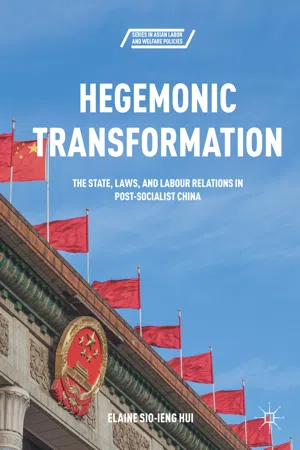
eBook - ePub
Hegemonic Transformation
The State, Laws, and Labour Relations in Post-Socialist China
- English
- ePUB (mobile friendly)
- Available on iOS & Android
eBook - ePub
Hegemonic Transformation
The State, Laws, and Labour Relations in Post-Socialist China
About this book
Information
© The Author(s) 2018
Elaine Sio-ieng HuiHegemonic TransformationSeries in Asian Labor and Welfare Policieshttps://doi.org/10.1057/978-1-137-50429-6_11. Putting the Chinese State in Its Place: The March from Passive Revolution to Hegemony
Elaine Sio-ieng Hui1
(1)
School of Labor and Employment Relations, Pennsylvania State University, 501B, Keller Building, University Park, PA 16802, USA
1 Research Question and Overarching Framework
The Chinese party-state has been studied in a wide range of academic fields. Usually employing a comparative approach, transition studies is interested in China’s state-socialist history, its path of socio-political and economic reform , and the role of the state in the transition to a market economy (Gallagher 2005b; McMillan and Naughton 1992). The Chinese state’s significant capacity to maintain steady economic growth has attracted attention from economics and development studies (Oi 1995; Wu et al. 2013). Its authoritarian features and the possibilities of democratic transition are the foci of political science (McCormick 1990; Goldman 1994). The poor working conditions in China’s global factories and the rise of the new working class and its relations with the party-state are regularly debated in the field of sociology and labor studies (Pun and Chan 2012; Pun et al. 2010). Beyond the national level, China’s growing influence in the international realm has driven international relations scholars to delve into the characteristics of its party-state (Beeson 2009; Zheng 2005). Like these investigations, the Chinese state is one of the key subjects of inquiry in this book. I argue that the Chinese economic reform begun in 1978 is a top-down passive revolution , to borrow the words of Italian Communist theoretician Antonio Gramsci (1971, 1988), and that after almost four decades of capitalist reform, the post-socialist Chinese state has been transforming from forcefully steering the country’s passive revolution into assisting the capitalist class to build up hegemony (i.e., cultural, moral, and political leadership). Within this framework, I further argue that the labor law system, which has undergone substantial reform, is a crucial means through which the Chinese party-state has attempted to secure the working class’s consent to the ruling class .
The shift from the socialist mode of production to the capitalist mode of production in China should be understood as a ‘passive revolution ’ or ‘revolution from above’. The term was coined by Gramsci to understand the differences between the French revolution and the Italian Risorgimento. Gramsci points out that the former was actively initiated by the popular masses and led by the bourgeois, and that it resulted in a transition into a capitalist state; but the Italian Risorgimento came about through a passive revolution that was marked by state-engineered social and political reform built upon the ruling class’s domination rather than popular support, which led to ‘an institutional framework consonant with capitalist property relations’ (Morton 2007, 610). According to Gramsci , a passive revolution leading to a capitalist social formation is usually backed by the domination of and forces possessed by the ruling class , which occurs, however, without much capacity to acquire the subaltern’s consent to capitalist development. Gramsci argues that passive revolution is usually concurrent with two other political phenomena: trasformismo and caesarism. Trasformismo refers to co-opting the working class’s leaders in such ways that the exploited class is put into a politically passive position (Merrington 1968). Caesarism refers to a situation in which a strong individual political figure intervenes to resolve conflicts between antagonistic social forces (Buci-Glucksmann 1980).
Passive revolutions that have taken place in various economic and political settings have been examined in detail, including Mexico (Morton 2003), Russia (Van der Pijl 1993), South Korea (Moore 2007), Japan (Kelly 2002), Turkey (Hendrick 2009), and Senegal (Fatton 1986). Cox (1983) highlights that passive revolution is a concept that is ‘particularly apposite to industrializing Third World countries’, wherein a hegemonic dominant class that is supported by the subordinate class is usually absent. I find this concept useful for analyzing China, which has been in a similar situation that Cox has described. In fact, Gray suggests that post-socialist China has been experiencing a passive revolution in which the Chinese party-state ‘took upon itself the leading role in the reorganization of social relations commensurate with a restoration of capitalism ’ (Gray 2010, 456). My position aligns with Gray’s, holding that China’s economic reform is a passive bourgeois revolution, which has been guided by strong state intervention. However, as will be explained, I go beyond Gray’s argument to suggest that the Chinese ruling class has been seeking to acquire workers’ consent to its rule, i.e., constructing capitalist hegemony. Moreover, my approach to the Chinese state also transcends the perspectives of the authoritarian state, developmental state, and corporatist state, as will be explicated in Sect. 2, by taking the ideological role of the Chinese state seriously.
During the state-socialist period, Marxism–Leninism and Maoism were the ruling ideologies; they served as the sources of political legitimacy for the Chinese Communist Party (CCP) and helped mobilize the working class and peasants to support the state. Some scholars even suggest that the Maoist state was hegemonic in the sense that many people bought into the socialist ideas (Chau 2005). However, to cope with economic stagnation and declining political legitimacy of the state in the aftermath of the Cultural Revolution, Deng Xiaoping, from the second generation of leadership in the People’s Republic of China (PRC), kicked off the top-down capitalist revolution in 1978, or what he called the second revolution of China. 1 At the national level, the party-state forcefully dismantled work units (danwei) and rural communes (renmin gongshe), rolling back workers’ and farmers’ welfare provision such that they were forced into the capitalist market to sell their labor power. Thus, the socialist working class was decomposed and then remade into the exploited class of the capitalist system (see Chap. 3). At the international level, understanding China’s passive revolution against ‘a world-historical context of uneven and combined development’ (Morton 2007, 612–613), its open door policies and incorporation into global capitalism were concurrent with the overproduction crisis that occurred during the 1970s in the West. Attempting to boost their profits, many foreign corporations adopted the ‘spatial fix’ strategy (Silver 2003) by investing in China. As a result, the capitalist class, composed of foreign capitalists, cadres-turned-capitalists, private domestic capitalists, and state-capitalists, all of whom were absent in the state socialist era, were gradually recreated in the reform period and become key market players (see Chap. 3).
Despite lingering official slogans and rhetoric, Marxism–Leninism and Maoism are no longer the CCP’s dominant ideologies; they are neither put into real practice, nor does the general populace still believe in them. Since its ideological capacity has been shrinking and no capitalist class has been ready to exercise ethico-political leadership during the early stage of this passive revolution , the party-state has relied mainly on domination and naked power to steer the capitalist reform; the most prominent example being its use of grave violence to clamp down on the Tiananmen democratic movement in 1989 and the autonomous workers’ organizations formed around that period, such as the Workers’ Autonomous Federation, Free Labour Union of China, the League for the Protection of the Rights of Working People, the Workers’ Forum, and the Chinese Workers’ Autonomous Alliance (Warner 1996; Lau 1997).
However, the implementation of capitalist reform for close to four decades has resulted in the exploitation of workers on an unheard-of scale (Chan 2001; Pun 2005), which in turn has triggered tremendous labor unrest (Lee 2007); to continue ruling mainly through coercion will be politically hazardous for the party-state. Labor protests against unfair treatment in the workplace, protests against land expropriation and housing demolition, and protests over environmental issues are three principal forms of social unrest in contemporary China. 2 It was estimated that as of May 2014 the total number of mass incidents, the official government term for peoples’ protests , was above one hundred thousand per year, among which labor and environmental protests altogether constituted approximately 30%. 3 According to a labor advocacy group, there were 1171 strikes and protests in the 18 months leading up to December 2013 4 ; that amounts to more than 2 strikes taking place every day. In the past, worker grievances were mainly concerned with managerial corruption, layoffs by state-owned enterprises (SOEs), wage defaults, compensation for workplace injuries, overtime payments, corporal punishment and so forth (Chan 2001; Lee 2007; Chen 2003). Recently, democratic elections in ...
Table of contents
- Cover
- Frontmatter
- 1. Putting the Chinese State in Its Place: The March from Passive Revolution to Hegemony
- 2. The Gramscian Approach to the Chinese State
- 3. The Legal Foundation for Changing State–Capital–Labor Relations
- 4. Workers’ Active Consent
- 5. Workers’ Passive Consent
- 6. Workers’ Refusal to Consent
- 7. Conclusion: The Chinese State, the Law, Labor Relations, and Hegemony
- Backmatter
Trusted by 375,005 students
Access to over 1.5 million titles for a fair monthly price.
Study more efficiently using our study tools.
Frequently asked questions
Yes, you can cancel anytime from the Subscription tab in your account settings on the Perlego website. Your subscription will stay active until the end of your current billing period. Learn how to cancel your subscription
No, books cannot be downloaded as external files, such as PDFs, for use outside of Perlego. However, you can download books within the Perlego app for offline reading on mobile or tablet. Learn how to download books offline
Perlego offers two plans: Essential and Complete
- Essential is ideal for learners and professionals who enjoy exploring a wide range of subjects. Access the Essential Library with 800,000+ trusted titles and best-sellers across business, personal growth, and the humanities. Includes unlimited reading time and Standard Read Aloud voice.
- Complete: Perfect for advanced learners and researchers needing full, unrestricted access. Unlock 1.5M+ books across hundreds of subjects, including academic and specialized titles. The Complete Plan also includes advanced features like Premium Read Aloud and Research Assistant.
We are an online textbook subscription service, where you can get access to an entire online library for less than the price of a single book per month. With over 1.5 million books across 990+ topics, we’ve got you covered! Learn about our mission
Look out for the read-aloud symbol on your next book to see if you can listen to it. The read-aloud tool reads text aloud for you, highlighting the text as it is being read. You can pause it, speed it up and slow it down. Learn more about Read Aloud
Yes! You can use the Perlego app on both iOS and Android devices to read anytime, anywhere — even offline. Perfect for commutes or when you’re on the go.
Please note we cannot support devices running on iOS 13 and Android 7 or earlier. Learn more about using the app
Please note we cannot support devices running on iOS 13 and Android 7 or earlier. Learn more about using the app
Yes, you can access Hegemonic Transformation by Elaine Sio-ieng Hui in PDF and/or ePUB format, as well as other popular books in Politics & International Relations & Political History & Theory. We have over 1.5 million books available in our catalogue for you to explore.