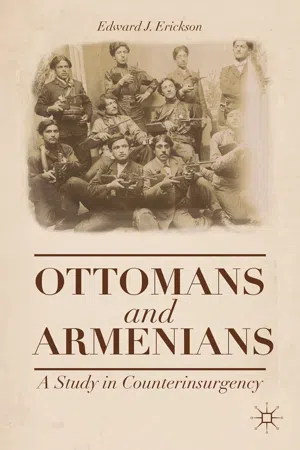
Covering the period from 1878-1915, Ottomans and Armenians is a military history of the Ottoman army and the counterinsurgency campaigns it waged in the last days of the Ottoman empire. Although Ottomans were among the most active practitioners of counterinsurgency campaigning in the late-nineteenth and early-twentieth centuries, in the vast literature available on counterinsurgency in the early twenty-first century, there is very little scholarly analysis of how Ottomans reacted to insurgency and then went about counterinsurgency. This book presents the thesis that the Ottoman government developed an evolving, 35-year, empire-wide array of counterinsurgency practices that varied in scope and execution depending on the strategic importance of the affected provinces.
- English
- ePUB (mobile friendly)
- Available on iOS & Android
eBook - ePub
About this book
Information
C H A P T E R 1
Insurgency by Committee
The repeated failures to carry out the reforms . . . coupled with the methods of slow or wholesale “elimination” of which the Armenians have been the victims during the last thirty-five years have driven many of them to join or form revolutionary societies.
—Mr. Fitzmaurice, British Embassy, Constantinople, August 10, 19131
INTRODUCTION
The rise of late-nineteenth-century armed revolutionary committees (or societies) in the Ottoman Empire occupies a significant place in the literature of the relationships between the Ottoman state and its subject peoples. However, revolutionary committees were not unique to the Ottoman Empire, or even to the repressive multinational empires of the age, and appeared in the democracies as well. In fact, the character of insurgency in Europe, including the ways in which it was organized, planned, and executed, changed dramatically in the middle of the nineteenth century, when the inspiration for insurgency shifted from something that centered on a response to oppression to something that was centered on, and driven by, ideology and national identity. This change sprang not from deliberate and intensive doctrinal theorization and debate, but was rather more of an outcome of the age of Napoleon and the changing conditions brought about by the implementation of what came to be called the Concert of Europe.
In addition to containing France after the fall of Napoleon, the victorious European coalition partners sought to contain the French idea of nationalism, which threatened to infect the subject peoples of the continental empires. At the Congress of Vienna in 1815, Austrian prince August von Metternich forged an agreement between the monarchs of Europe to safeguard the old regimes against popular revolts. Known as the Concert of Europe, the monarchs pledged military cooperation between themselves in order to maintain their thrones against internal revolution. In turn, the willingness of monarchs to support one another by armed interventions with their armies made it increasingly difficult, if not impossible, for insurgent peoples or revolutionary groups to operate openly and successfully. The large-scale and poorly organized failed revolutions of 1830 and 1848 were proof of this and drove nails into the coffin of open rebellion. As a consequence, European revolutionaries and insurgents went underground and adopted new organizational architectures and tactics, which allowed them to survive and continue operations. Of note was the nearly simultaneous emergence of the Nihilist movement in Russia and the anarchist movement in Italy.2 This was then followed by the evolution of a system of revolutionary committees, operating in secret, motivated by ideology and nationalism, and determined to use violence to advance their agendas.
In the wake of failed uprisings, Nihilism emerged in Russia after the Crimean War when intellectuals rejected the idea of legal gradualism as a means of societal change. Secret societies, such as the Circle of Tchaikovsky and the People’s Will, that embraced the idea of violence to achieve political change were formed. Embedded in the Nihilist movement was the concept of “propaganda by deed” or the dramatic violent act, such as assassination or bombing, designed to strike fear into the mechanisms of authority (the assassination of Czar Alexander II in 1882, for example).3 Radicalized workers and intellectuals also formed secret societies in Italy in 1869, which became known as the Anarchist Movement. The Anarchists, like the Nihilists, embraced violence and the idea of propaganda by deed. Anarchism soon spread to many countries, including France, Germany, and the United States, where because of its secretive nature, the authorities found it difficult to suppress.
In the Ottoman Empire, the philosophies, organization, and tactics of the Nihilists and Anarchists were adopted by ethnic Christian minorities as a vehicle by which they might achieve independence or autonomy. Two such groups of subject peoples, in particular, became associated with these ideas as the empire entered the twentieth century—the Armenians and the Macedonians. This chapter traces the origins and evolution of the Armenian and Macedonian revolutionary movements, which to the Ottomans were known simply as the “committees.”
THE RISE OF THE COMMITTEE SYSTEM
Historically, revolts had been ongoing in the Ottoman Empire almost since its inception, but new waves of insurrections swept the empire in the nineteenth century, particularly in the Balkans between 1821 and 1878. The Balkan revolts were built around recently constructed nationalist identities and were quite successful in dismembering the empire’s European provinces. In the classic sense, these movements were driven more by misrule and oppression than by ideology. Unfortunately for the Ottomans, the Congress of Vienna excluded the Ottoman state from the Concert of Europe and the Ottomans were left isolated from the military assistance available to the monarchs of Europe. Moreover, in some cases, European nations actively assisted the Christian subjects of the Ottoman sultan in overthrowing Ottoman rule. Notable examples included British support for the Greeks and Russian support for the Serbs, Romanians, and Bulgarians.
After 1878, a second wave of revolts swept through the Ottoman Empire, and the most notable were the Albanians who rose up in 1880, the Armenians in 1894, 1904–1905, and 1909, the Cretans in 1896, the Macedonians in 1896, the Kurds in 1908, and the Arabs in Yemen and the Hijaz as well as the Libyan Sanussi in the early twentieth century. The second wave of insurrections was driven, in part, by perceptions of Ottoman weakness as well as by a worldwide surge of political agendas based on nationalist identity. Most of the insurrections in the second wave were unsuccessful in achieving independence, but often led to great power interventions and interference in Ottoman domestic affairs.4 This chapter will focus on the evolution of the Macedonian and Armenian revolutionary nationalist groups into well-organized and effective hierarchical systems of revolutionary committees.
The Congress of Berlin in 1878 left significant numbers of Christian ethnic minorities within the Ottoman Empire, who quickly and stridently demanded independence or union with their respective motherlands. Moreover, certain clauses of the treaty itself were designed to reform the empire’s treatment of its Christian minorities. In particular, Article 23 obligated the sultan to reform the administration of the Balkan provinces, which when incompletely and sluggishly implemented by the Ottoman government directly led to discontent and unrest. After 1878, in Ottoman Macedonia,5 and in the densely populated Armenian eastern provinces of Ottoman Anatolia, a number of groups emerged who fought the Ottomans (and among themselves) in attempts to gain control of the provinces. This situation coincided with the rise of what might be termed the “modern guerrilla organization,” which was a result of the introduction of Russian Nihilism and Italian anarchism into radicalized revolutionary groups. These organizations were known to the Ottomans as committees, because of their tightly constructed organizational architecture, and their members were likewise known as Komitacıs (literally a member of a secret political organization and the word most commonly used by the Ottomans to describe the groups themselves).6 The groups were organized hierarchically in a military-like chain of command that extended from the top echelons down to local village levels. They were generally formed initially outside of the empire by exiles or revolutionaries, who supported terrorist activity inside the Ottoman provinces.
Megerdich Portukalian formed the first internal committee (the Armenakans or the Armenagans) in Van in 1885. External committees were formed by the Armenians in Geneva in 1887 (the Hunchakian or Social Democratic Party) and in Tiblisi in 1890 (the Dashnaktsutiun or the Armenian Revolutionary Federation, ARF), which adopted extremely aggressive terrorist policies.7 These two groups consolidated a preexisting network of decentralized revolutionary cells that were well armed and ideologically motivated. After 1892, the Armenian revolutionary organizations held world congresses, issued manifestos and proclamations, and secretly organized and trained military formations inside the Ottoman Empire.8 At the same time, the external committees organized internal, and ostensibly peaceful, counterpart political committees inside the Ottoman Empire itself. These committees were legal, operated openly and were often composed of prominent locals such as teachers, priests, businessmen, and mayors.9 The internal committees encouraged nationalism and promoted military activity, which was presented as self-defense against repression. Thus, the Armenian committees evolved a dual organizational architecture consisting of both legal political organizations and secret armed military cells.10 The Armenian revolutionary structure then became the template used by other rebellious ethnic groups in the empire, and particularly for the Macedonians in the Balkans, to form their own revolutionary organizations.
THE RISE OF THE ARMENIAN COMMITTEES
The roots of the formally organized Armenian committees reach back to the early 1880s when a group of young Armenians led by Khachadour Geregtsian and Garabed Neshikian formed a clandestine organization in Erzurum.11 This marked the beginning of the change from brigandage to revolutionary activity. The group called itself “Defender of the Homeland” and was dedicated to the purchase of weapons and military training. Several hundred Armenians were members and were organized into a decentralized structure of ten-man cells.12 They established contact with fellow Armenians in Tiblisi and received assistance and weapons. Meetings were frequent and revolutionary groups gathered strength in Erzurum, Tiblisi, Yerevan, and Baku. By 1888, the movement coalesced in Tiblisi by establishing an organization called “Young Armenia,” which was organized into “Droshak” or military cells.13 Shortly thereafter, the Armenakan Party (Armenagan) established itself as a political party whose purpose was to “win for the Armenians the right to rule over themselves through revolution.”14 The activities of the Armenian committees were concentrated in the core provinces of the Ottoman Empire as shown in map 1.1.
The Armenakans began spreading revolutionary propaganda, smuggling arms, organizing military units, and, occasionally, engaging in armed action. The party was organized in groups of cells, under the direction of the Central Body, which all had both active and auxiliary members.15 The group came to the attention of the authorities in May 1889, when a firefight broke out near Van in which two prominent Armenakan leaders were killed. Papers disclosing revolutionary objectives and letters to local supporters were found on the dead bodies.16 According to Louise Nalbandian, “The Armenakans did not stop at mere defensive action, but also incited trouble and committed terroristic acts.”17 Hunted and persecuted by the Ottoman authorities, the party disintegrated and went underground. Although later reconstituted, by 1896, it was replaced by successor activist organizations.
The Social Democrat Hunchakian Party formed in Geneva in August 1887 was the first of the Armenian socialist political parties. Its founders were heavily influenced by the revolutionary articles in...
Table of contents
- Cover
- Title
- Introduction
- 1 Insurgency by Committee
- 2 Counterinsurgency in the Empire’s Core
- 3 Counterinsurgency in the Periphery
- 4 A Template for Destruction
- 5 Invisible Armies
- 6 Readiness for War
- 7 Irregular War in Caucasia and in the Levant
- 8 Enemies Within
- 9 A New Course of Action
- 10 After math
- Appendix A: The Relocation Antitheses
- Notes
- Bibliography
- Index
Trusted by 375,005 students
Access to over 1.5 million titles for a fair monthly price.
Study more efficiently using our study tools.
Frequently asked questions
Yes, you can cancel anytime from the Subscription tab in your account settings on the Perlego website. Your subscription will stay active until the end of your current billing period. Learn how to cancel your subscription
No, books cannot be downloaded as external files, such as PDFs, for use outside of Perlego. However, you can download books within the Perlego app for offline reading on mobile or tablet. Learn how to download books offline
Perlego offers two plans: Essential and Complete
- Essential is ideal for learners and professionals who enjoy exploring a wide range of subjects. Access the Essential Library with 800,000+ trusted titles and best-sellers across business, personal growth, and the humanities. Includes unlimited reading time and Standard Read Aloud voice.
- Complete: Perfect for advanced learners and researchers needing full, unrestricted access. Unlock 1.5M+ books across hundreds of subjects, including academic and specialized titles. The Complete Plan also includes advanced features like Premium Read Aloud and Research Assistant.
We are an online textbook subscription service, where you can get access to an entire online library for less than the price of a single book per month. With over 1.5 million books across 990+ topics, we’ve got you covered! Learn about our mission
Look out for the read-aloud symbol on your next book to see if you can listen to it. The read-aloud tool reads text aloud for you, highlighting the text as it is being read. You can pause it, speed it up and slow it down. Learn more about Read Aloud
Yes! You can use the Perlego app on both iOS and Android devices to read anytime, anywhere — even offline. Perfect for commutes or when you’re on the go.
Please note we cannot support devices running on iOS 13 and Android 7 or earlier. Learn more about using the app
Please note we cannot support devices running on iOS 13 and Android 7 or earlier. Learn more about using the app
Yes, you can access Ottomans and Armenians by Edward J. Erickson in PDF and/or ePUB format, as well as other popular books in History & European History. We have over 1.5 million books available in our catalogue for you to explore.