eBook - ePub
Eismitte in the Scientific Imagination
Knowledge and Politics at the Center of Greenland
- English
- ePUB (mobile friendly)
- Available on iOS & Android
eBook - ePub
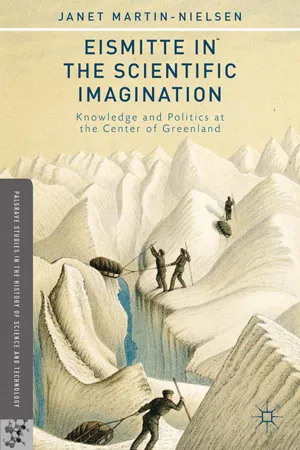
Eismitte in the Scientific Imagination
Knowledge and Politics at the Center of Greenland
About this book
Since the 18th century, Greenland's geometric center, Eismitte, has been one of the most forbidding but scientifically rich locations in the Arctic. Tracing its history from European contact through the Cold War, this study shows how Eismitte was the setting for scientific knowledge production as well as diplomatic maneuvering.
Information
Chapter 1
A Land Apart
Greenland in the Historical Imagination
On the last day of July 1878, Danish naval officer and Arctic explorer Jens Arnold Diderich Jensen cast his eyes on a jagged mountain rising improbably out of Greenland’s ice sheet, its gray shape encircled by a dazzling frozen sea of white.1 Jensen and his three companions had reached the foot of the nunatak a week earlier, utterly exhausted after a grueling 60-kilometer trek from southern Greenland’s Frederikshaab Glacier. For 11 days, the party negotiated minefields of crevasses, deep azure chasms plunging down into the ice and into darkness, barely able to see through eyes wet and stinging from snow blindness. Their reward—a view into Greenland’s sweeping interior—was delayed seven long days by gale force winds that whipped across the island, bringing mounds of fresh snow and confining the four men to their cramped tent. “The next morning, the weather was thankfully clear and I rose at once to the cairn, where I had an excellent view over the country,” wrote Jensen: “to the east rose the immense flat extent of the ice sheet, as far as the eye could see, always higher and higher, until it merged with the sky . . . [To the west] a row of large dark mountain tops loomed sternly, inhibiting the progression of the ice.”2 Adrift on the ice sheet, Jensen and his men stared in wonder at the rocky nunatak which, with delicate white and yellow poppies quivering in the wind, a small bird, and some spiders, “seemed to us a paradise.”3 “The discovery of these, the ice-free peaks of subglacial mountains, faintly coated with earth, gave rise to a curious and exciting idea,” wrote Laurence P. Kirwan, director of the Royal Geographical Society, nearly a century later: “Might there not be deep in the interior of Greenland not ice but stretches of cultivable land, rich agricultural land where corn and grass might grow in the midst of this desiccated field of ice?”4
That the interior of Greenland was such a mystery as late as the end of the nineteenth century speaks of the almost unfathomable difficulties of accessing and traveling over the ice sheet. Despite repeated attempts to penetrate the island, Hinrich Rink—the Danish geologist and colonial administrator who was considered the “final court of appeal on all questions touching Greenland”—adopted a tone of weary acceptance when he told the American Philosophical Society in March 1885 that “its interior can be considered as not yet visited by travelers.”5 Norwegian polar explorer Fridtjof Nansen concurred, noting that “the interior of that continent has remained a mystery to Europeans as well as to the Eskimos, and many are the opinions and suggestions which have been put forth as to its real nature.”6 Greenlanders feared the ice sheet, which to them was the realm of supernatural beings, and avoided journeying or hunting on it.7 And as the nineteenth century drew to a close, European and North American explorers still struggled to understand the great island, undecided as to the extent of its ice coverage and even uncertain as to the northernmost reaches of its landmass. “Of course we all have a general idea of Greenland,” explained American explorer Robert E. Peary upon his return from Greenland at turn of the century, and “yet the actual facts are so different from anything existing in lower latitudes, so entirely dissimilar from anything with which we are personally acquainted, and which we might use as a foundation from which to start our conception, that I doubt if one in ten even of the best-read has a true conception of the actuality of this great arctic island continent.”8
The traveler who makes it to Greenland’s shores first encounters a ring of craggy mountains and plunging fjords, a rocky ribbon ranging in width from eight to 130 kilometers encircling the island and forming a veritable barrier between the Arctic seas and the great ice sheet. The sounds and fjords of Greenland’s coast, continued Rink in his American address, “represent the only highways; where they end, the vast glacier that covers the whole interior begins, and this has only exceptionally been ascended by travelers.”9 Rising hundreds of meters above sea level, dividing life from the lifeless ice, known from unknown, the solid ice walls of Greenland’s glaciers were anthropomorphized by early travelers: “Here was a plastic, moving, semi-solid mass, obliterating life, swallowing rocks and islands, and plowing its way with irresistible march through the crust of an investing sea,” wrote American explorer Elisha Kent Kane upon encountering northwestern Greenland’s Humboldt Glacier in the middle of the nineteenth century.10 Ascending onto the ice sheet, the traveler is greeted by a frozen landscape, monochromatic and silent except for the wind, and littered with dangerous crevasses. “The traveler across its frozen wastes, traveling as I have week after week,” Peary continued, “sees outside of himself and his own party but three things in all the world, namely, the infinite expanse of the frozen plain, the infinite dome of the cold blue sky, and the cold white sun—nothing but these.”11
At the very center of this enigmatic island lies Eismitte, literally middle ice: a location, which, although not named until 1930, pulled on the minds of explorers for centuries, distant, alien, and, for the longest time, unattainable and unknowable. No settlement, no town, not even an identifiable geographical feature marks Eismitte off from the rest of the sweeping ice sheet, a vast frozen expanse 40 times as large as metropolitan Denmark. Rather, Eismitte represents a holy grail in polar exploration: to penetrate Greenland’s interior to the very middle, to stand as far from any coast as possible, to be at “the end of the world,” in the words of French polar explorer Paul-Emile Victor.12 This book is the story of Eismitte.
“Arctic Work Is Not Quite a Picnic”13: Penetrating the Great Island
The first European attempt to penetrate into Greenland’s interior came on April 25, 1728, when Danish Major Claus Enevold Paars set out from Godthaab (now Nuuk) to cross the ice sheet with a small party of men and officers. Godthaab, on Greenland’s southwestern coast, had been founded earlier that year as the new seat of the small and ill-fated Danish colony in Greenland.14 Sent by King Frederik IV of Denmark with some two dozen soldiers, their wives and children, Paars’s orders were “to cross Greenland on horseback from the west coast, and when he reached the east coast to build a fortress, found a colony, and take care of the old Norsemen who were thought still to survive.”15 After two days of trekking up from Ameralik Fjord, a long finger of water protruding into the interior just south of the colony, “we came to the ice mountain at midday on the third day,” Paars wrote—but upon ascending the glacier he and his party encountered a maze of crevasses plunging deep into the ice.16 “After advancing for a few hours in great danger of our lives all further progress became impossible,” continued Paars in his vivid account of the expedition: “when we realized no further progress was possible we sat down on the ice, fired nine Danish shots from our rifles, and drank to the health of our most gracious king a glass of brandy, an honor which had never before taken place on a glacier,” before turning back to Godthaab. Paars’s failed mission to cross the ice sheet did, however, yield an enticing description of Greenland’s interior: it is “like looking at the wild sea where no land can be seen. From the ice sheet, there is nothing to see except the sky and glittering ice . . . sharp-edged like white sugar candy.”
The next attempt at crossing the island did not come for another quarter century. In the summer of 1751, Lars Dalager, a Danish trader based in Frederikshaab (now Paamiut), a trading post at Greenland’s southern tip, was captivated upon hearing of “a new discovery made . . . by a Greenlander who had been so high up while out hunting that he could see distinctly, he said, the old Kablunak mountains on the eastern side.”17 Dalager immediately resolved to journey across the ice sheet to find the long-lost Østerbygd, or Eastern Settlement, established by the Norse in 985 and now thought to have disappeared during the fifteenth century.18 At the beginning of September, Dalager—accompanied by the hunter and his daughter—ascended onto the ice sheet from a deep fjord on the southern side of Frederikshaab Glacier. Finding themselves amidst a minefield of crevasses, the party took more than seven hours to cover the first eight kilometers. At the top, the hunter pointed out ice-free peaks in the distance, the supposed eastern coast of the island. In fact, these were the same nunataks that Jensen would camp at the foot of over a century later. But Dalager and his companions never made it to the rocky mountains, forced to turn back when their footgear gave out: “although each of us was provided with two good pairs of boots for the journey, they were already worn out by the sharpness of the ice and stones [and] we were as good as barefoot,” wrote Dalager after his return to Frederikshaab.19 “I cannot here fail to mention,” he added, “with what appetite I emptied a whole bottle of Portuguese wine that evening, after which I fell asleep until the following day at noon.”
For a century after Dalager’s journey, there was no further exploratory work on the ice sheet. In the middle of the nineteenth century, Hinrich Rink—the geologist and colonial administrator—carried out a remarkable voyage along the coast between Upernavik, midway up the western side of Greenland, and Julianehaab (now Qaqortoq), on the island’s southern tip.20 With the publication of his new geographic and geological maps of the island, Rink drew scientific attention to Greenland’s great ice sheet, or, as he called it, Indlandsisen (the inland ice).21 That ice sheet, Rink asserted, supplied the Arctic and North Atlantic oceans with their great icebergs—calving, by his calculations, eight to ten million cubic feet of ice every year. In Europe, Rink’s description of the enormous glacial forces at work in Greenland added fuel to the ongoing debates over Ice Age theories (and, in particular, the idea that vast swaths of northern Europe had once been covered by ice). Rink’s work awakened new interest in Greenland’s ice sheet and set in motion a series of renewed attempts to penetrate its interior.
The three decades following the elaboration of Rink’s ideas—from the 1860s until the 1880s—saw more traffic than ever before on Greenland’s ice sheet.22 In 1870, Finnish-Swedish geologist and mineralogist Adolf Erik Nordenskiöld penetrated 64 kilometers inland from Godthaab and spent seven days on the ice sheet before abandoning his attempt to cross the island at its narrow southern end. Nordenskiöld went on to gain fame by conquering the Northeast Passage, sailing from Sweden around the north coast of Eurasia to East Cape (now Cape Dezhnev), but his desire to validate his long-held belief that Greenland’s interior held an ice-free Arctic Eden was never far from his mind. He returned to the ice sheet in 1883, better equipped and with a larger party of nine, and managed the furthest penetration to date, traveling 230 kilometers inland before being forced back by ferocious weather.23 Despite seeing no signs of fertile pasturelands, his belief in an ice-free interior was unshaken. Three years later, Robert E. Peary, then a young engineer in the US Navy, claimed to have penetrated 180 kilometers inland with skis and snowshoes before turning back due to inadequate provisions.24 With a close eye on these efforts, Rink—now retired, in failing health, and living close to his daughter in Christiania (now Oslo)—asked, “Can it be expected that Greenland once will be crossed from west to east or vice versa?”25 He answered his own question: “I am convinced that this will be accomplished,” he wrote, and he was proven true three years later when Fridtjof Nansen, then 26 years old, achieved the first crossing of the island.
Rather than starting from the Danish settlements on Greenland’s western coast and heading towards the wild eastern side of the island, as all attempts to date had done, Nansen proposed to cross the island in the opposite direction. “If we started from the west coast of Greenland I was quite sure we should not be able to cross, for then we should have the flesh-pots of Egypt behind us,” he recounted after the fact: by beginning from the east, all temptation to return would evaporate, the only choices being, in Nansen’s words, “death or the west coast of Greenland.”26 Armed with his trusty skis (which, as a Norwegian, formed part of his national consciousness) and two months’ worth of supplies packed on lightweight sledges, and joined by five companions chosen for their skiing abilities, Nansen and his party began their crossing on August 15, 1888, from Umivik, at the mouth of a long fjord due east of Godthaab. Facing problems all too familiar to those who came before him—treacherous crevasses, soft snow, and violent winds that prevented all progress for days at a time—Nansen soon altered his course, deciding to head directly for Godthaab (400 kilometers away) instead of Christianhaab (now Qasigi...
Table of contents
- Cover
- Title
- Introduction The Edge of the World, the End of the World
- Chapter 1 A Land Apart
- Chapter 2 Taming the Ice Sheet
- Chapter 3 The Longest Trek
- Chapter 4 It Has Completely Changed
- Epilogue A Conspicuous Absence
- Notes
- Bibliography
- Index
Trusted by 375,005 students
Access to over 1.5 million titles for a fair monthly price.
Study more efficiently using our study tools.
Frequently asked questions
Yes, you can cancel anytime from the Subscription tab in your account settings on the Perlego website. Your subscription will stay active until the end of your current billing period. Learn how to cancel your subscription
No, books cannot be downloaded as external files, such as PDFs, for use outside of Perlego. However, you can download books within the Perlego app for offline reading on mobile or tablet. Learn how to download books offline
Perlego offers two plans: Essential and Complete
- Essential is ideal for learners and professionals who enjoy exploring a wide range of subjects. Access the Essential Library with 800,000+ trusted titles and best-sellers across business, personal growth, and the humanities. Includes unlimited reading time and Standard Read Aloud voice.
- Complete: Perfect for advanced learners and researchers needing full, unrestricted access. Unlock 1.5M+ books across hundreds of subjects, including academic and specialized titles. The Complete Plan also includes advanced features like Premium Read Aloud and Research Assistant.
We are an online textbook subscription service, where you can get access to an entire online library for less than the price of a single book per month. With over 1.5 million books across 990+ topics, we’ve got you covered! Learn about our mission
Look out for the read-aloud symbol on your next book to see if you can listen to it. The read-aloud tool reads text aloud for you, highlighting the text as it is being read. You can pause it, speed it up and slow it down. Learn more about Read Aloud
Yes! You can use the Perlego app on both iOS and Android devices to read anytime, anywhere — even offline. Perfect for commutes or when you’re on the go.
Please note we cannot support devices running on iOS 13 and Android 7 or earlier. Learn more about using the app
Please note we cannot support devices running on iOS 13 and Android 7 or earlier. Learn more about using the app
Yes, you can access Eismitte in the Scientific Imagination by J. Martin-Nielsen in PDF and/or ePUB format, as well as other popular books in History & North American History. We have over 1.5 million books available in our catalogue for you to explore.