- English
- ePUB (mobile friendly)
- Available on iOS & Android
eBook - ePub
About this book
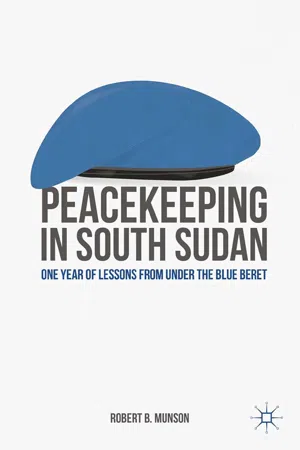
A scholarly perspective of a soldier's own challenges working in the United Nations Mission in South Sudan (UNMISS). This work examines how regional/cultural knowledge and language ability contribute to improved leadership in a UN operation, based on the author's own experiences as a staff officer in South Sudan.
Information
CHAPTER 1
As a Guinea Pig in South Sudan
I stepped off the aircraft in Entebbe, Uganda: in Africa once again. The U.S. Air Force simply gave me orders and sent me on my way; I was an American soldier stepping off onto Ugandan soil. I came to Africa to do an Army job and as I got further from my Air Force “tribe” I merged into the American military “tribe” with soldier as the simplest description. Uganda was to be just a brief introduction before continuing to my final posting in South Sudan. During my preparation, I often wondered if I would really do anything worthwhile while in South Sudan. Would I be defending our nation or national interests? Would I be helping people? Would I contribute to a greater project?
I am a U.S. Air Force officer, but by virtue of having been a reservist, I have spent only about two-thirds of my time in the Air Force on active duty. I’m an academic, a profession often critical of the policies and methods of the U.S. government. Yet, I have participated in these activities from the inside doing my best to advance U.S. policies under several different administrations, albeit at a fairly junior level. Perhaps most importantly I am a husband, a father, and a Christian.
Understanding the reasons behind defending your country during World War II would seem to have been much simpler than today. In the 1940s, a threat to the American way-of-life both appeared in Europe and directly attacked us in the Pacific. During the Cold War in the all-volunteer military, an officer’s attention focused toward the major “enemy”: the Soviet Union. In the past few years, hundreds of thousands have served heroically in Iraq and Afghanistan; thousands lost their lives. Many fellow soldiers paid the ultimate price for their service to the country. Now as a professional officer, how do I believe that my service is worthwhile?
The prelude to my story here began in December 2011 when I found out my turn had come up to be deployed for at least a year, somewhere. Since this notice came with little information and I did not want to wait and perhaps get little actual notice, I took matters into my own hands and volunteered to work for the United Nations in South Sudan. I wanted to go back to Africa and I had been interested in working for the United Nations so this seemed a perfect fit. With any deployment, I would be leaving my family for at least a year; this, though, is part of a military life.
A virtual THUD echoed through my computer as the emails arrived. It was February and my preparation began in earnest when the Air Force sent me two long predeployment checklists. I had volunteered and I knew the lists were coming. The military bureaucracy, however, still has a power to oppress when you’re faced with six pages of tasks to do along with your usual work. After completing the checklists and winding up my job at the Pentagon, I was off to three weeks of predeployment training at Quantico Marine Corps Base. Our class of future UN peacekeepers listened to speakers and took part in active training such as self-defense and driving four-wheel-drive vehicles in the forest of West Virginia. Our training ended with several more lectures and then our commander sent us out the door with a few thoughts. He emphasized how, even though we would be working for the United Nations, we first serve the United States: The American chain of command comes first. But he emphasized that as peacekeepers we are also U.S. military diplomats. Above all, though, we should “give an honest American effort. The American people expect nothing less!” This advice would prove useful in the months ahead.
After our training ended, I had a couple of days with my family before they returned me to Quantico and turned me over to the U.S. Army for my ride to the airport. I hugged Laura and my three kids good-bye and I was off on my trip into the world of the United Nations in South Sudan, beginning in Africa with my nighttime arrival in Uganda.
But, the story really began not with my arrival in Africa in the depth of the night but many years before. Where I was and who I was were products of where I had been before. As a historian and sometimes-anthropologist, I could not get past this simple question of identity. Most important, I am a husband and a father. I am also a U.S. Air Force officer and an academic. I served on active duty in the Air Force after college, but then became a reservist and went to graduate school. Along the way I spent much time in Africa, traveling and working. On 9/10 (i.e., the day before September 11, 2001) I arrived in Abuja, Nigeria, to work in the U.S. Embassy’s Office of Defense Cooperation. I left Nigeria, got married, and returned to Africa several months later. This time, though, I did not wear a uniform; I went to Tanzania to carry out my PhD field research.
This short résumé of my life is important for the story below as it provides the framework and colors the challenges, frustrations, and even fun in South Sudan. I was there overtly as a soldier, an Air Force officer, and a peacekeeper. I volunteered to serve with the United Nations Mission in South Sudan (UNMISS) and live in Juba for a year as a military staff officer. But, I was not simply going to do the work of an officer on a multinational military staff; I brought larger questions with me. I came with a goal of figuring out how I could better complete my assignment. I wanted to see how my academic background and my experience in Africa could help me do a better job for the United Nations.
In the past ten years the Department of Defense, the Air Force, and outside critics have often written how the military must concentrate more on learning languages, understanding cultures, and acquiring the ability to work better with people from many other nations. The military must be more “cross-culturally competent” in order to more effectively work across the globe.1 The Department of Defense’s vision succinctly states “The Department will have the required combination of language skills, regional expertise and cultural capabilities to meet current and projected needs.” I thought I could serve as a good “guinea pig” to see how my past, my experiences, and my knowledge might make this a reality. How could I use my academic education and skills to better fill my position on the UN mission military staff? What additional insight would they give me? For this assignment, I believed that three aspects of my background stood out as most important.
First, I was an Air Force officer. After four years of college and participation in the Reserve Officers Training program, the Air Force commissioned me as a second lieutenant. I came onto active duty and went to Texas for training during the first Gulf War and was then fortunate to be sent to Europe for my initial assignment. At this time, shortly after the end of the Cold War, we had no idea how much longer the U.S. would keep troops in Europe so I wanted to serve there before it was too late. Ramstein Air Base, not far from the French border in western Germany, became my home for the next five years.
This time at Ramstein gave me the opportunity to learn German. Despite being in a region of Germany heavily influenced by English with thousands of Americans, I got to know the people much better through their own language. After five years I was ambivalent about remaining on active duty and wanted to continue my adventures in Europe. I had no significant relationships nor debts to pull me in one direction or the other. When I found out that German universities did not charge tuition, I saw this as a great opportunity. I transitioned into the Air Force Reserve and started my studies at Universität Leipzig in Germany. My education would thus be the second defining aspect of my background.
In two years I graduated with a Magister Artium (close enough to abbreviate MA in the United States) in African studies and political science. For the degree, I added Kiswahili to my German, further enlarging my appreciation for languages. I enjoyed school and I decided to extend my education at this point. I applied to PhD programs in African history. After a number of acceptances, rejections, and hard decisions, I landed at Boston University. This turned out to be an excellent choice and defined the third important aspect of my background—an academic mind-set.
My studies in Boston progressed and I carried out dissertation field research in Tanzania, using both Kiswahili and German. My dissertation concerned landscape change in northern Tanzania during the German colonial period. This was a study of environmental history concentrating on imported crops as well as how the growth of Christianity in the region influenced the acceptance of the changes.2 After leaving Tanzania, I lived with my wife near Munich, writing my dissertation and teaching at Ludwig-Maximilians-Universität. Looking down the road, at this time I planned to remain an Air Force reservist and eventually enter the academic world professionally.
Our lives often go, though, in unforeseen directions. Our first daughter came along and the Air Force offered me a chance to attend Air Command and Staff College at Maxwell Air Force Base in Montgomery, Alabama, for a year in-residence. This eventually led back to Air Force active duty but with a different perspective on that service due to the intervening experiences. Nonetheless, my academic life did not cease. I started revising the dissertation, hoping to publish it, and taught for the Air Force. In many respects, this was the best of both worlds.
Several years later in the spring of 2012 as I arrived in Juba, I was an Air Force officer but more advanced in rank, age, and experience. The latter, though, included a deeper respect for education—a love of learning and a deeper appreciation of the value of languages, literature, and diverse insight into life. The academic mind-set further emphasized my education. The mind-set is harder to describe. From my experience in grad school, I saw how one was “trained” in academia to often look first from a theoretical viewpoint and then apply this to the world as it is. An academic often has the luxury of seeing issues in black and white. Others, such as nongovernmental organization (NGO) staff members, military officers, development officials, or diplomats, face challenges to be solved in short periods of time and tend to view everything in a stark middle gray. Academics often have the luxury to be “pure” since they face issues in the mind and on paper and do not have to work in the messy world of dealing with real peoples’ often divergent and self-contradictory lives, views, and actions on a short schedule.
Oftentimes this difference becomes apparent when, on one hand, some concentrate on research, writing, and publishing. Others, though, attempt to apply the knowledge in the messy realm of philanthropic organizations, NGOs, militaries, development, and other bureaucracies and produce an outcome on the ground, among people. Nonetheless, the academic world—and certainly African studies which I know best—has much valuable insight and thinking to contribute, including a wide diversity of interpretation and perspective.
In studying African history, I concentrated on environmental history, which gave me a greater understanding of how other cultures interpret the environment. These perspectives are often completely foreign to the usual day-to-day American perceptions. In the United States, we love forests and see deforestation as bad. However, in many places forests are untamed lands full of dangers and problems. While doing field research on Mt. Kilimanjaro, I spoke to people who told me how they appreciated the value of cleared land for coffee or maize, not the wild, untamed forested land where snakes and leopards hid. Forests still occupied small river valleys and the upper reaches of the mountain and wild animals remained an ever-present danger. Many outside observers saw the disappearance of the wild forests on the mountain as a loss; many of the local people viewed the economic advance as a gain while also realizing and living with the problems of reduced availability of firewood. Cognizance of these varying perspectives helps one avoid blinders when working on actual problems and gives a more interesting texture to life.
In my studies I also became very aware of the great cultural, ethnic, and religious differences in Africa. Africans often understand these differences in other ways than we do in the West, accepting much more fluidity between seemingly disparate groups. In general, Americans see ethnic differences as cemented in stone. Often in Africa, one can slide back and forth between ethnic groups with these groups being less important than other bonds. I saw this nicely on Mt. Meru in northern Tanzania. The Arusha people farm on the mountain but are related to the nomadic Maasai cattle herders of the plains. Historically, the groups of the young men initiated together trumped other differences such as mode of life, location, or ethnic differences the “Arusha” or “Maasai” labels tended to imply.
With this background, I felt as if I straddled several worlds. On one hand, I was in the position of the anthropologists hired by the U.S. military in Afghanistan.3 Based on my scholarship, field research, and experiences in Africa I could understand the local cultures and situations better than others. Perhaps then I could work better in this environment and interpret it to others. I was also a uniformed member of the U.S. Air Force, not a hired academic or civilian employee, but an integral part of the officer corps. I subscribed to, understood, and internalized much of the military’s mind-set. I knew how it operated from the inside; I was not an outsider coming in to advise but an insider trying to do better. The U.S. military is respected for fighting, but most recently in Afghanistan and Iraq it had to take on the added role of nation building. I was perhaps more inclined to the latter and saw the advantage of taking time to help construct a nation—a mission more akin to what I believed we would have in the United Nations’ hands in South Sudan.
From this perspective, I came up with two main questions to answer or guide me during my tenure as a guinea pig in UNMISS. First, I wanted to find out how I could better understand the situation around me in South Sudan. How would my background help me better appreciate the people around me, both South Sudanese and UN employees? How could I better comprehend what was happening? I wanted to better understand not just the large events, but the small, unique things that might only take up two lines in a paper or may not be noticed at all. Second, I wanted to figure out if I could do a better job with this background understanding. How could I apply my knowledge to more successfully carry out my duties? Would I be more effective if I understood and led differently? Could I lead my guys better? And how would I do that?
In essence I wanted to apply my background—rich in cultural studies, language, and historical knowledge—to my position as a staff officer to see how greater “cultural competency” could help me do a better job. I was my own guinea pig to see how the general U.S. military thesis that more cultural education could help improve performance in the operations would work. Certainly this would be far from a blind scientific investigation or free of my own prejudices, but I hoped I could observe the importance of academic learning versus military technical training and provide good insight into peacekeeping as an American soldier.
Over the following 12 months, I actively considered the two questions. Finding answers is never easy nor painless and the answers one finds are often not as significant as the trip made to discover them. Stated in a different way, my journey through one year in South Sudan was a search, in my small way, to discover a new perspective—or at least a perspective I understood better—on peacekeeping and U.S. military service in Africa. I continually asked myself if my background and experiences really helped in my service as a staff officer with the United Nations.
In the past, at times I wandered across Africa (and Europe) with a goal but not so much with a reason other than to observe and enjoy the travel. Here I had a goal but I wasn’t sure what my journey would be, now subsumed by a large, new bureaucracy and international force; I stood somewhere in the middle. How would I understand my voyage and how could I travel it m...
Table of contents
- Cover
- Title
- Copyright
- Contents
- List of Maps and Figures
- Acronyms and Abbreviations
- Introduction and Acknowledgments
- 1 As a Guinea Pig in South Sudan
- 2 Does the United States Do Peacekeeping?
- 3 Why Are We Here?
- 4 There Is No Intelligence in the UN: Working for UNMISS
- 5 J-5: Where Hope Was (Often) a Plan
- 6 Does PoC Mean “Protection of Cattle”?
- 7 Two Flags, Two Perceptions: Life in UNMISS
- 8 Living an UNMISS Life in Juba and South Sudan
- 9 UN-English and Other Curious Habits
- 10 Christianity Does Not Stay in the Church
- 11 I’m Here, They Are There
- 12 Tying It All Together
- Notes
- Bibliography
- Index
Trusted by 375,005 students
Access to over 1.5 million titles for a fair monthly price.
Study more efficiently using our study tools.
Frequently asked questions
Yes, you can cancel anytime from the Subscription tab in your account settings on the Perlego website. Your subscription will stay active until the end of your current billing period. Learn how to cancel your subscription
No, books cannot be downloaded as external files, such as PDFs, for use outside of Perlego. However, you can download books within the Perlego app for offline reading on mobile or tablet. Learn how to download books offline
Perlego offers two plans: Essential and Complete
- Essential is ideal for learners and professionals who enjoy exploring a wide range of subjects. Access the Essential Library with 800,000+ trusted titles and best-sellers across business, personal growth, and the humanities. Includes unlimited reading time and Standard Read Aloud voice.
- Complete: Perfect for advanced learners and researchers needing full, unrestricted access. Unlock 1.5M+ books across hundreds of subjects, including academic and specialized titles. The Complete Plan also includes advanced features like Premium Read Aloud and Research Assistant.
We are an online textbook subscription service, where you can get access to an entire online library for less than the price of a single book per month. With over 1.5 million books across 990+ topics, we’ve got you covered! Learn about our mission
Look out for the read-aloud symbol on your next book to see if you can listen to it. The read-aloud tool reads text aloud for you, highlighting the text as it is being read. You can pause it, speed it up and slow it down. Learn more about Read Aloud
Yes! You can use the Perlego app on both iOS and Android devices to read anytime, anywhere — even offline. Perfect for commutes or when you’re on the go.
Please note we cannot support devices running on iOS 13 and Android 7 or earlier. Learn more about using the app
Please note we cannot support devices running on iOS 13 and Android 7 or earlier. Learn more about using the app
Yes, you can access Peacekeeping in South Sudan by R. Munson in PDF and/or ePUB format, as well as other popular books in Politics & International Relations & Diplomacy & Treaties. We have over 1.5 million books available in our catalogue for you to explore.