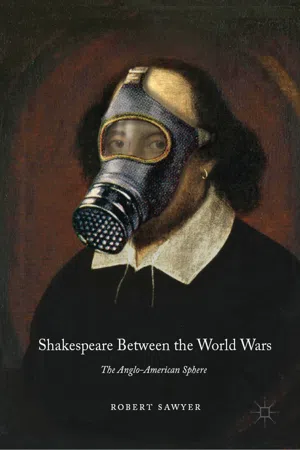
Shakespeare Between the World Wars draws parallels between Shakespearean scholarship, criticism, and production from 1920 to 1940 and the chaotic years of the Interwar era. The book begins with the scene in Hamlet where the Prince confronts his mother, Gertrude. Just as the closet scene can be read as a productive period bounded by devastation and determination on both sides, Robert Sawyer shows that the years between the World Wars were equally positioned. Examining performance and offering detailed textual analyses, Sawyer considers the re-evaluation of Shakespeare in the Anglo-American sphere after the First World War. Instead of the dried, barren earth depicted by T. S. Eliot and others in the 1920s and 1930s, this book argues that the literary landscape resembled a paradoxically fertile wasteland, for just below the arid plain of the time lay the seeds for artistic renewal and rejuvenation which would finally flourish in the later twentieth century.
- English
- ePUB (mobile friendly)
- Available on iOS & Android
eBook - ePub
About this book
Information
© The Author(s) 2019
Robert SawyerShakespeare Between the World Warshttps://doi.org/10.1057/978-1-137-58218-8_11. Introduction
Robert Sawyer1
(1)
Literature and Language, East Tennessee State University, Johnson City, TN, USA
Robert Sawyer
“Where we see [the past as] a chain of events,”
the Angel of History “sees one single catastrophe,
which unceasingly piles rubble upon top of rubble.”
Walter Benjamin, “On the Concept of History” 1
End Abstract Confronting his mother Gertrude during the closet scene in Shakespeare’s Hamlet , the Prince of Denmark challenges her not only to “[r]epent what’s past,” specifically the mistakes she has committed concerning her new husband Claudius, but he also begs her to “avoid what is to come,” by not repeating similar transgressions in the future. 2 Occurring almost exactly midway in Hamlet, this central scene looks back to the past even while trying to focus on the future, all captured in an infinite moment in the dramatic present. While Gertrude seems in most productions to heed Hamlet’s advice, it is worth focusing for a moment on the liminal space of that singular scene, as it anticipates another historical lull between senseless carnage and widespread destruction.
This pause in the play, immediately following the death of Polonius and the psychic reunion of the Queen and the Prince, not only countenances the dark comic relief of Hamlet dragging the counselor’s guts around Elsinore, but also allows us as auditors to catch our breath, even though we sense that this “peace” on stage may just be a short interval in a drama which is in a state of perpetual conflict, both militarily and familially, external and internal, political and psychological. It is even possible that the forced “intermission” in Hamlet’s production of “The Mousetrap” only two scenes earlier anticipates this respite. 3 But just as those living in the Anglo-American sphere between 1920 and 1940, the players in the tragedy and the anxious audience know this hiatus may only last as long as it takes to modify the scenery, to change the costumes or uniforms, or to alter the participants. It is this in-between space, a pause which does not quite refresh, on which my book focuses.
Such a parallel space in time took place between the two World Wars, a brief period where further bloodshed of the recent past, whether the nine million soldiers killed in World War I (called the Great War until 1939, after the start of World War II), or the dramatized deaths of King Hamlet and Polonius, might be avoided in the future. In Shakespeare’s play, as well as in the arena of global events, accelerating aggression and ever-increasing violence occurs before any type of lasting peace can hold, so the attempt to “avoid what [was] to come” was clearly frustrated. Yet, during this intense pressured moment—when Hamlet confronts his mother, or in the historical Interwar period worldwide—a gap between the “accidental” deaths of the past and the “casual slaughters of the future,” in Horatio’s summation, 4 some resolution does appear to have been reached, even though it would take events far in the future, the reign of Fortinbras on the one hand, and the world peace following World War II on the other, to achieve any type of order or calm.
Just as the closet scene can be read as a productive period bounded by destruction and determination on both sides, I show that the Interwar era was equally positioned. Instead of the dried, barren earth depicted by T. S. Eliot and others in the 1920s and 1930s, I suggest the literary landscape of the Interwar or Interbellum era resembled a paradoxically fertile wasteland, particularly in relation to Shakespearean scholarship and production. For just below the arid plain of the time lay the seeds for renewal and rejuvenation, even if it would take half a century or more for many of them to bloom. While many of these Shakespearean artistic endeavors tried in vain to prevent a second world conflict, it is worth remembering that political proclamations and signed agreements in the Interwar period also failed to forestall that crisis, including the Treaty of Versailles in 1919, the League of Nations in 1920, the Locarno Treaty of 1925, and the Kellogg-Briand Pact of 1928. 5
Shakespeare sets Hamlet in a geopolitical landscape which reflects and refracts the international upheaval of the time period, and one which anticipates the disruption which will occur over this same European terrain three hundred years later in the period between the World Wars. This area, which stretches from Denmark to Norway, from Sweden to Poland, and which also includes characters traveling to and from France, England, and Germany, is also the frontier of the Thirty Years War (sometimes referred to instead as a series of wars), which began only two years after Shakespeare’s death in 1616, finally concluding in 1648. 6
While the Thirty Years War was “catastrophic” in Europe more generally, in Germany specifically, “the war was an unmitigated catastrophe.” 7 And the Treaty of Westphalia, which superficially stilled the weapons of war in 1648, was, not unlike the Treaty of Versailles in 1919 where my book begins, merely a “rearrangement of the European map ready for the next war.” 8 In fact, one recent historian, Kevin Cramer, refers to the period between 1914 and 1945 as “A Second Thirty Years’ War” for Germany, even if the “fratricidal gore” had spread beyond its own borders. He also suggests that the earlier conflict during Shakespeare’s time significantly contributed to “Germany’s bellicose self-righteousness” in the Interwar period because the Thirty Years War “tormented the German historical imagination.” 9 In other words, the conflict in the 1600s was so influential and detrimental to the German psyche that its traumatic aftermath significantly influenced German attitudes and decisions prior to and during World War I.
It seems entirely possible that more savvy spectators of Hamlet may have heard Horatio’s speech as a double allusion, both to the events in the drama and as a reference to the broader space of nationalistic conflict in the 1600s. Further, if we suspect Shakespeare was not fully aware of broader, if not border, political implications of expansive geographical space, why would his acting company select “The Globe” as the name for their theater, only a year before his most famous tragedy seems to have been first performed in that particular space in Southwark? As we will see when we turn to our main focus on Shakespearean actors, directors, and critics in the Interwar period (approximately 1920–1940), they too employ plays such as Hamlet to reflect on the political events of the time. When we fast forward to the twentieth century, we discover that the same European locales in Shakespeare’s politically plagued tragedy erupt with similar discord during the Interwar period when, as before, it was keenly felt that this period was only a pause “between” two difficult worlds, a space not unlike the Victorian Matthew Arnold’s intensely felt in-betweenness, as he too “wander[ed] between two worlds, one dead / The other powerless to be born.” 10
Of course, the other major nation to play a role in this interregnum in the early twentieth century was the USA, a country where Donald Trump occupies the White House, and whose isolationist, if not nearly fascist agenda, will be considered in detail in Chapter 6 of this work. Even while composing this paragraph in 2018, the CNN news headline reads: “Australia baffled by Trump,” as has been the case with many other European nations, as well as with countries on our own border such as Mexico and Canada. 11 So we too now understand the feeling of wandering between a lost world and an unthinkable era to come as some rough beast slouches toward tyranny and control.
My subtitle for the book uses the term “Anglo-American Sphere” to refer specifically to the USA and to the UK. The expression, however, usually designates all the regions in the Americas in which English is the main language and which British Culture and the British Empire have had significant historical, ethnic, linguistic, and cultural impact. But my book also uses the term “Sphere” in its more political shading in the phrase, “Sphere of Influence (SOI)”; in the field of international relations, a sphere of influence (SOI) is usually a spatial region over which a state or organization has a level of cultural, economic, military, or political exclusivity. While some type of formal alliance or other treaty obligations might exist between the two entities, the influence can often be more obvious in the pressure of economic power. I specifically extend this notion to the “Shakespeare Sphere” in the “Coda” of my book.
But it would be remiss not to mention Jürgern Habermas’s notion of a different type of “sphere,” that of the so-called public sphere, a group which “arises as part of civil society, incorporating adults who have gained maturity and intellectual autonomy in another of its parts, the family” 12 ; they can then participate in public debates in numerous locations, from the grounds of governmental institutions, to public universities, to the media itself. Such a force could also produce the “idea of ‘counterpublics,’ which contested the hegemonic construction of dominant publics.” 13 Of course, this presupposes the idea of a democratic society, so it is null and void in some of the countries we travel through in this book.
“It’s not that what is past casts its light on what is present,” Walter Benjamin wrote, nor does the “present” shine “its light on what is past.” 14 Instead, such moments produce an “image … wherein what has been comes together in a flash with the now to form a constellation.” 15 In other words, the connection between the distant past of the Bard, the recent past of Benjamin, and the ongoing present shares many catastrophic mergings. And not unlike the Brexit vote in the summer preceding the US election of Trump , the constellation of images and words in my mind as I write this are the s...
Table of contents
- Cover
- Front Matter
- 1. Introduction
- 2. Criticism in the UK: The Bard of Britannia
- 3. Criticism in the USA: The Institutionalization of Shakespeare in the USA
- 4. Shakespeare Productions in the USA: The Voices and Sounds of America’s Shakespeare
- 5. Shakespeare Productions in the UK: A Sense of Return—“‘Tis Here, ‘Tis Here, ‘Tis Gone”
- 6. Conclusion: Transnational Shakespeare, Then and Now
- Back Matter
Trusted by 375,005 students
Access to over 1.5 million titles for a fair monthly price.
Study more efficiently using our study tools.
Frequently asked questions
Yes, you can cancel anytime from the Subscription tab in your account settings on the Perlego website. Your subscription will stay active until the end of your current billing period. Learn how to cancel your subscription
No, books cannot be downloaded as external files, such as PDFs, for use outside of Perlego. However, you can download books within the Perlego app for offline reading on mobile or tablet. Learn how to download books offline
Perlego offers two plans: Essential and Complete
- Essential is ideal for learners and professionals who enjoy exploring a wide range of subjects. Access the Essential Library with 800,000+ trusted titles and best-sellers across business, personal growth, and the humanities. Includes unlimited reading time and Standard Read Aloud voice.
- Complete: Perfect for advanced learners and researchers needing full, unrestricted access. Unlock 1.5M+ books across hundreds of subjects, including academic and specialized titles. The Complete Plan also includes advanced features like Premium Read Aloud and Research Assistant.
We are an online textbook subscription service, where you can get access to an entire online library for less than the price of a single book per month. With over 1.5 million books across 990+ topics, we’ve got you covered! Learn about our mission
Look out for the read-aloud symbol on your next book to see if you can listen to it. The read-aloud tool reads text aloud for you, highlighting the text as it is being read. You can pause it, speed it up and slow it down. Learn more about Read Aloud
Yes! You can use the Perlego app on both iOS and Android devices to read anytime, anywhere — even offline. Perfect for commutes or when you’re on the go.
Please note we cannot support devices running on iOS 13 and Android 7 or earlier. Learn more about using the app
Please note we cannot support devices running on iOS 13 and Android 7 or earlier. Learn more about using the app
Yes, you can access Shakespeare Between the World Wars by Robert Sawyer in PDF and/or ePUB format, as well as other popular books in Literature & European History. We have over 1.5 million books available in our catalogue for you to explore.