- English
- ePUB (mobile friendly)
- Available on iOS & Android
eBook - ePub
About this book
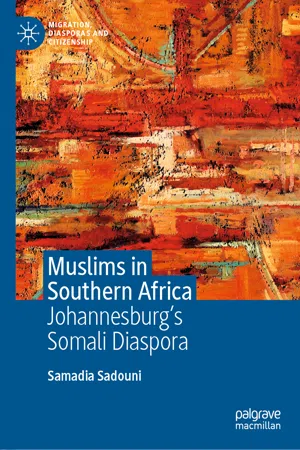
This book presents a socio-historical analysis of the Somali Muslim diaspora in Johannesburg and its impact on urban development in the context of Somali migrations in the Southern African Indian Ocean region from the end of the 19th Century to today. The author draws on a combination of archival and ethnographic research to examine the interlocking processes of migration, urban place-making, economic entrepreneurship and transnational mobility through the lens of religious practice and against the background of historical interactions between the Somali diaspora and the British and Ottoman Empires. Comparison with other Muslim diasporas in the region, primarily Indians, adds further depth to an investigation which will shed new light on the Somali experience of mobility and the urban development of South Africa across its colonial, apartheid and democratic periods. The politics of race, imperial and post-imperial identities, and religious community governance are shown to be key influencing factors on the Somali diaspora in Johannesburg. This sophisticated analysis will provide a valuable resource for students and scholars of urban geography, the sociology of religion, and African, race, ethnic and migration studies.
Information
© The Author(s) 2019
Samadia SadouniMuslims in Southern AfricaMigration, Diasporas and Citizenshiphttps://doi.org/10.1057/978-1-137-46708-9_11. Introduction
Samadia Sadouni1
(1)
University of Lyon, Sciences Po Lyon, Lyon, France
Migrants to South Africa historically came from all over the world, forming what Bishop Desmond Tutu termed the “rainbow nation”.1 New waves of migration in post-apartheid South Africa have challenged the definition of the nation-state and the sense of community belonging in the democratic country. The case of Muslim migrations, and especially African Muslim migrations, requires the writing of a new history of Muslim settlement and integration in South Africa.2 The integration of Somalis in South African society since the 1990s has raised new questions about the diversity of Islam, its contribution to shaping South African nationhood and its role in the mobilisation of social and economic resources among community migrants.
Somalis have become one of the major groups of African Muslim migrants in Johannesburg.3 The civil war and conflicts in Somalia have precipitated a humanitarian crisis that has forced Somali migrants into different parts of the world. Human Rights Watch rated Somalia in 2008 as the “most ignored tragedy in the world” (Minter and Volman 2009), with nearly 1.5 million Somalis considered as internally displaced and half a million becoming refugees, some of whom have found in South Africa a place of settlement or of transition.
An examination of the narratives of the journeys taken by Somali refugees from Somalia to South Africa leads to an understanding of the multi-layered Somali identity in the wider context of immigration to the city of Johannesburg. The civil war in Somalia, forced migration and transnational mobility have structured Somali modes of socialisation in the new South Africa. The experiences of Somali migrants en route to South Africa have informed their encounters with Johannesburg’s urban context.4
However, this book is not only an analysis of Somali migrant trajectories to the new South Africa, but is also a historical account of how the metropolis of Johannesburg was shaped by migrant flows—one of which is Somali—in the Southern African Indian Ocean region, which is considered here as a transnational social field (Glick Schiller et al. 1992). Indeed, from its beginning, the village of Johannesburg, founded in 1886 (Thompson 1990) and which evolved from a gold mining camp into a modern global city, was born out of cross-imperial capital interests and identities, as well as ethnicities from Africa and the Indian Ocean region. Its growth and development need to be understood in terms of its location at the crossroads of the Southern African Indian Ocean region that has been shaped simultaneously by the colonial state, the rise of European capitalist interest in the mineral riches of the Transvaal (which became the commercial centre of the region), the religious and merchant networks and the flows of European and non-European migrations. Somalis show us how Johannesburg, since its beginnings as a colonial city, has always been charaterised by an embedded cosmopolitanism (Bose and Manjapra 2009). However, what does cosmopolitan Johannesburg mean? Is it made up of people, empires, politics, economics, religions, migrations, resistance? Actually, all these dimensions as infinite ways of being play a role in shaping the urban context in which Somalis live in Johannesburg has evolved. An interdisciplinary viewpoint is crucial to understanding the interconnections between Somali religious identity, migration trajectories and urban integration in a transnational social field.
The religious expressions and identities of Somali migrants are shaped by urban context, but more than that by learnt socialisation based on a memory of an earlier presence. This is, however, largely a lost memory . Memory and urban identities are linked and have oriented our study of Muslims in Southern Africa. The Somali presence in Johannesburg is not only a matter of post-apartheid ethnography but an untold story of Johannesburg and Somalis together. In terms of space and time, Somali itineraries were shaped by early twentieth century imperialism—that is to say, by British and Ottoman imperial politics, race and conflicts. The arrival of the first Somalis in Southern Africa was part of the British imperial space. With steamship maritime routes, the Somali diaspora developed in the nineteenth century through the recruitment of Somali sailors by the British. Nonetheless, here we address the imperial land route used by Somalis on their way to Johannesburg to find employment as miners and domestic workers of British military officers. Thus, the mineral extraction companies and military expeditions were the two main channels that brought Somalis to Johannesburg.
This book has three main objectives: (1) to describe a new written history of Johannesburg through the analysis of waves of Somali migrations to the city; (2) to consider and study Johannesburg as the inland connection with the Southern African Indian Ocean region through the case of Somalis in an historical and transnational perspective; (3) to show how this urban history can help us to understand Somali contemporary life and governance from below. These three dimensions are not only linked but intersected by the religious factor. Somalis consider themselves, in the past and today, firstly as Somali Muslims. Islam formed part of the early globalisation in the Indian Ocean region and age of European colonial imperialism. It is within this transnational religious perspective that Somali religious life in Johannesburg will be analysed.
Therefore, we need to consider Somali Muslim immigration in the Southern African Indian Ocean region through the religious lives of the migrants in a minority situation and in terms of the Social Science Research Council (SSRC) project—a New York-based study on the “Religious Lives of Migrant Minorities” (see Vásquez and DeWind 2014)—in the specific urban context such as the metropolis of Johannesburg and reflect on Islam as a transnational urban phenomenon.5
The nearly one hundred Somalis who settled in Johannesburg in the early 1900s came as auxiliaries of the British army during the Anglo-Boer War (1899–1902). Somalis who had worked as miners in Rhodesia also found their way to Johannesburg. The study of the different waves of post-apartheid Muslim migration in South Africa remains a burgeoning academic field. The historical perspective adopted by the academic literature on Muslim migrations in South Africa provides a very good analysis of the Indian and Malay immigrations that represent the majority, nearly 90%, of Muslims in the country,6 and which played a major role in the human geography of the Southern African Indian Ocean region. But what of the untold stories of Somali migrations to Southern Africa from the end of the nineteenth century? We still need to analyse earlier Muslim migrations, even if they were small in number, as in the case of the Somalis, who nevertheless had an impact on Johannesburg urban life.
The Somali diaspora in Johannesburg needs to be addressed in the same way that the issues of Muslim slaves in the Cape in the seventeenth century, Indian indentured labourers in Durban in the nineteenth century and the freed Zanzibari slaves who settled in Durban were finally addressed by academics over the past two decades. Somalis were part of an extraordinary history of imperial negotiations in the newly created city of Johannesburg. The representative of the Ottoman empire played a role in guaranteeing Somalis a better position in the racial architecture of the colonial city ruled by the British empire. At that time, they were not classified as a distinct Somali racial group, but had been integrated into the Cape Malay group by the Transvaal authorities.
We analyse this process of racial classification induced by the specific context of racial history in Johannesburg (see Chapter 3). The Cape Malay identity is therefore far more complex when we take into account the story of Somali migrants in the colonial Transvaal whose political fate was also linked to the minority status of Indians in the country. By studying Somalis in Johannesburg over the course of a century, we can look at the nature of the ways that religion as transnational identities and urbanity are transformed by historical and contemporary social processes. Therefore, this introductory chapter aims to explicitly introduce the method for analysing Somali migration trajectories, community building through place-making and the role of religion in the process of racial territorialisation in the city of Johannesburg. A new history of Johannesburg needs to be told that takes into account earlier Somali migration and observes the continuities and discontinuities with the migrant mobilisation of twenty first-century Somalis.
1 Method
This research began within the broad conceptual framework of a migration project conducted by the SSRC , between 2006 and 2010, on the interplay between religion, migration and diversity in the analysis of the religious lives of migrant minorities in an urban site and through the themes of their journeys , place-making and movement within a transnational framework. My task in the team of researchers led by site co-ordinator Thomas Blom Hansen was to research African Muslim migrants. I found that the Somali issue raised interesting and heuristic questions linked to community–community relations between Somalis and South African Indian Muslims. Moreover, Somalis have the particularity of having spread to different parts of South Africa as small-business entrepreneurs whose urban mobility contributed to shaping trans-urban social fields. However, through the fieldwork, I came to realise, thanks to lengthy semi-conducted interviews and regular contacts with Zuleikha, a Somali refugee mother, that Somalis have a memory of an earlier presence in Johannesburg. Furthermore, I observed the experience of migrants and how the city can be considered a “practice-walking”, in Michel de Certeau’s terms, for the Somali search for their earlier sense of urban belonging.
Zuleikha left South Africa in 2014 and migrated to the USA as a refugee. She is now in Colombus, Ohio, with her family. South Africa can be at the same time a place of resilie...
Table of contents
- Cover
- Front Matter
- 1. Introduction
- 2. The Context of Indian Ocean Spatiality
- 3. Muslim Cosmopolitanism in Question
- 4. Racialisation from Below: Race and Place-Making in the New South Africa
- 5. Religious Community Governance in Solidarity
- 6. Tablighi Jama’at and Urban Religious Order
- 7. From the “Right to the City” to the Right to the Nation
- Back Matter
Trusted by 375,005 students
Access to over 1.5 million titles for a fair monthly price.
Study more efficiently using our study tools.
Frequently asked questions
Yes, you can cancel anytime from the Subscription tab in your account settings on the Perlego website. Your subscription will stay active until the end of your current billing period. Learn how to cancel your subscription
No, books cannot be downloaded as external files, such as PDFs, for use outside of Perlego. However, you can download books within the Perlego app for offline reading on mobile or tablet. Learn how to download books offline
We are an online textbook subscription service, where you can get access to an entire online library for less than the price of a single book per month. With over 1.5 million books across 990+ topics, we’ve got you covered! Learn about our mission
Look out for the read-aloud symbol on your next book to see if you can listen to it. The read-aloud tool reads text aloud for you, highlighting the text as it is being read. You can pause it, speed it up and slow it down. Learn more about Read Aloud
Yes! You can use the Perlego app on both iOS and Android devices to read anytime, anywhere — even offline. Perfect for commutes or when you’re on the go.
Please note we cannot support devices running on iOS 13 and Android 7 or earlier. Learn more about using the app
Please note we cannot support devices running on iOS 13 and Android 7 or earlier. Learn more about using the app
Yes, you can access Muslims in Southern Africa by Samadia Sadouni in PDF and/or ePUB format, as well as other popular books in Social Sciences & Demography. We have over 1.5 million books available in our catalogue for you to explore.