Chapter 12 of this book is open access under a CC BY license.
eBook - ePub
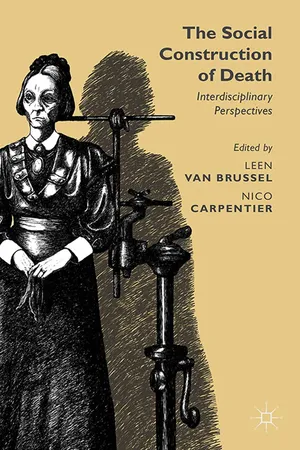
The Social Construction of Death
Interdisciplinary Perspectives
- English
- ePUB (mobile friendly)
- Available on iOS & Android
eBook - ePub
The Social Construction of Death
Interdisciplinary Perspectives
About this book
Information
Subtopic
Film & VideoPart I
The Social Construction of Death
1
A Discourse-Theoretical Approach to Death and Dying
Leen Van Brussel
Death, signs of: Relaxing of facial muscles, producing rather staring eyes and gaping mouth. Loss of curves of the back, which becomes flat against the bed or table. Slight discoloration of the skin, which becomes a waxy-yellow hue, and loses its pink transparency at the fingertips. (Medical dictionary, cited in Ball, 1976)
Introduction
Death is one of the most pervasive phenomena of the social, and sometimes is described as ‘the only certainty in life’. Death is indeed often considered the ultimate biological essentialism; the moment at which humanity’s obsession with control finds an absolute limit (Giddens, 1991), a view that seems to result in a privileging of realist and materialist approaches over constructivist and idealist treatments. Obviously, the bodily condition labelled death has a materialist dimension; it is an event/process that exists and occurs independently of human will, thought, and interpretation. We cannot reduce death to the way it is socially and culturally interpreted, but at the same time death remains loaded with meaning and we cannot detach it from the processes of social construction (Carpentier and Van Brussel, 2012).
In this chapter, we focus on the social construction of the medicalised death, referring to a variety of medical decisions made at the end-of-life, for a high proportion of today’s deaths are indeed directly linked to medical decision making (see for instance Cohen et al., 2008; Slomka, 1992). The permissibility of medical interventions in the dying process is subject to fierce political, medical, and ethical discussions, which are often structured around signifiers such as ‘dying with dignity’ and ‘dying autonomously’ through which the end-of-life is given meaning – often entailing quite polarised stances towards particular end-of-life interventions such as euthanasia and assisted suicide. In this chapter we deploy the discourse theory of Laclau and Mouffe (1985), embedded within a social constructionist research paradigm, as the backbone for a theoretical and empirical reflection on the construction of the medicalised death and the end-of-life.
This chapter first sets forth a theoretical analysis, where discourse theory offers a lens through which the contemporary debates on end-of-life decision making can be understood and situated within specific dynamics of fixity and fluidity, emphasising the contingent while allowing sufficient space for (temporary) fixation. Concretely, I use a twofold argument for the contingency of the discourse of (the medicalised) death, which is based on two interlocking genealogies that illustrate the changing meanings of death over time. I first argue that a medical–rationalist discourse of death has (to a high degree) been replaced by a medical–revivalist discourse. Secondly, I focus on the historical changes in the articulation of a medicalised good death and argue that a late-modern good death is defined dominantly in terms of the signifiers of control, autonomy, dignity, awareness, and heroism.
The chapter then goes on to illustrate the empirical usability of discourse theory in the field of thanatology with an analysis of Belgian print media coverage of three euthanasia cases that derived considerable media attention in Belgium.
Here, I draw from the theoretical analysis of the articulation of death and the good death to support an empirical discourse-theoretical analysis that follows the methodological principles of qualitative content analysis. The analysis shows how three main discourses – the discourse of autonomy, the discourse of hedonism, and the discourse of independence – are imported into journalistic texts and sheds light on the way these discourses privilege certain articulations of the good death over others.
Situating Laclau and Mouffe’s discourse theory
In order to analyse the construction of the medicalised death, I draw from Laclau and Mouffe’s discourse theory (1985), which brings in a specific definition of discourse. Rather than regarding discourse ‘merely as a linguistic region within a wider social realm’, Laclau and Mouffe offer a broader conceptualisation of discourse that ‘insists on the interweaving of semantic aspects of language with the pragmatic aspects of actions, movements and objects’ (Torfing, 1999, p. 94). This broad definition of discourse can be described as discourse-as-representation or discourse-as-ideology, in contrast to approaches that use the discourse-as-language definition of discourse (Carpentier and De Cleen, 2007, p. 277). The notion of the big-D Discourse offers another way to position Laclau and Mouffe’s approach; in contrast to the little-d discourse or a language-in-use definition of discourse, it refers to ‘different ways of thinking, acting, interacting, valuing, feeling, believing, and using symbols, tools, and objects in the right places and at the right times’ (Gee, 1999, p. 13). At the same time, Laclau and Mouffe’s discourse theory is specific, given its post-structuralist ontology and its use of particular concepts to describe the mechanics of discourse.
An especially important concept for our analysis of the discourse of death is the concept of articulation, which also brings in the logics of contingency. Articulation is defined as ‘any practice establishing a relation among elements such that their identity is modified as a result of the articulatory practice’ (Laclau and Mouffe, 1985, p. 105). For discursive elements that relate to the subject, Laclau and Mouffe use a specific notion: the subject position, which refers to the way subjects are positioned within a discursive structure (Laclau and Mouffe, 1985, p. 115). Crucial to Laclau and Mouffe’s discourse theory is that discourses have to be partially fixed, since the abundance of meaning would otherwise make any meaning impossible: ‘a discourse incapable of generating any fixity of meaning is the discourse of the psychotic’ (Laclau and Mouffe, 1985, p. 112). The articulation of elements produces discourses that gain a certain, and very necessary, degree of stability, which is enhanced by the role of privileged signifiers or nodal points. Torfing (1999, pp. 88–89) points out that these nodal points ‘sustain the identity of a certain discourse by constructing a knot of definite meanings’. At the same time, the field of discursivity has an infinite number of elements that are not connected to a specific discourse. Due to the infinitude of the field of discursivity and the inability of a discourse to permanently fix its meaning, then, discourses are always liable to disintegration and re-articulation, which produces contingency. Through the struggle for meaning ‘in a field crisscrossed by antagonisms’ (Laclau and Mouffe, 1985, pp. 135–136), and through the attempts to create discursive alliances (Howarth, 1998, p. 279; Howarth and Stavrakakis, 2000, p. 14), discourses are altered. In contrast, when a discourse eventually saturates the social as a result of a victorious discursive struggle, stability emerges and a discourse, or set of discourses, can become hegemonic. When this is the case, a dominant social order (Howarth, 1998, p. 279), or a social imaginary, is created, which pushes other meanings beyond the horizon.
But this stabilisation, or sedimentation, is temporal; there is always the possibility of resistance, of the resurfacing of a discursive struggle.
Discourse theory and the contingency of death
On the following pages, I adopt Laclau and Mouffe’s discourse theory, as briefly outlined above, to theorise the construction of death and the construction of the good death within a medical context. I want to argue, more specifically, that a medical-rational discourse that was dominant until the mid-twentieth century, has become rearticulated in late modernity, when a medical-revivalist discourse started to dislocate it. This impacted on the construction of the good death and the way the dying person is positioned within this discourse.
Constructing death: the medical-rational and the medical-revivalist alternative
In the early middle ages and before, according to Aries (1974, 1981), death was ‘tame’; a familiar part of life not to be feared. The modernisation process, Aries (1981) argues in his well-known death-denial thesis, was accompanied by a shift from this tamed death towards an increasing denial of death. Aries asserts that from the beginning of the twelfth century, attitudes to death started to transform alongside the emergence of individualism. Tracing the history of death-related rituals, he noted another major transformation in attitudes towards death in the mid-nineteenth century, when the dying patient was – under the control of the doctor – moved to the hospital to die in an institutionalised setting rather than at home (see also Lupton, 2010, p. 48). Drawing on Foucault’s work on medicine and the body, Aries (1981, p. 562) states that death became hidden, mystified, and ‘driven into secrecy’.
He argues that the modern forbidden death reflects a ‘brutal revolution’ in our attitudes towards death and dying (Aries, 1974, p. 86). The tamed death was supplanted in modernity by a death that was consigned to medical care, as Illich (1975, p. 180) similarly asserts. Elias (1985, p. 85) remarks that ‘Never before, have people died so noiselessly and hygienically as today [ ... ]’. According to supporters of the death-denial thesis, a new discourse of death thus emerged in modernity, and death began to be articulated as indecent, wild, dangerous, dirty, and polluting (Bauman, 1992, p. 136) and needing to be sanitised.
However, arguing that death was denied seems to neglect that this articulation should be regarded as specific. Starting from this idea, Armstrong (1987) adopts a more discursive reading to challenge argumentations of the death-denial thesis, asserting that since the mid-nineteenth century, there has been a discursive explosion around death and dying, with the removal of death from the private to the public sphere of which the death certificate can be regarded as a key discursive symbol. The removal of the dying to hospitals, Armstrong (1987, p. 652) argues, rendered death into a publicly controlled event: ‘In the old regime knowledge of death was restricted to within earshot of the church bell: beyond there was silence, in the new regime no death was to be unknown.’ Arguably, it was not the simple replacement of speech by silence; rather, a new discourse of death emerged, which Walter, Littlewood, and Pickering (1995, p. 581) summarise as ‘Death is publicly present, but privately absent.’ Unlike the death-denial thesis, counter-arguments assert that in the new epoch, a multitude of voices – including those of clinicians and pathologists – subjected the corpse to in-depth scrutiny to detect the ‘true’ cause of death (Armstrong, 1987, p. 652). Hence, instead of characterising the modern period as an epoch of death denial, it should be described as an epoch when death was constructed in a medical–rationalist way.
In the modernist logic of medical–rationalism, dying was articulated as instrumentalist and impersonal; the dying processes became a technical matter, bereft of their existential and personal significance. Because of the strong belief in medical progress, death was often regarded as an extreme example of illness (Seale, 1998, p. 77). Thus, the medical–rationalist discourse constructed the dying subject as no more than a carrier or an exemplar of disease.
This construction of death marked an important reconfiguration of what could and could not be said about death and dying. From the late eighteenth century, a tendency developed to withhold the prognosis of imminent death from patients. Physicians and nurses were not trained to care for the dying and were uncomfortable with the idea of their patients dying. This led to a situation where the medical staff and the patient’s family knew the truth about the patient’s condition, but withheld it from the dying patient (Connor, 2009, p. 3). According to Aries, this was ‘the lie’ that dominated doctor–patient relationships between the mid-nineteenth and mid-twentieth century. Again, such a ‘death-denial’ argument neglects a crucial discursive dimension; a lie exists only in relationship to a regime of truth (that is the ‘types of knowledge a society accepts and makes function as true’; Foucault, 1980, p. 131). Arguably, what is considered a lie in one particular society is not necessarily identified as such in another society, that has another ‘regime of truth’. To keep death a secret, Armstrong (1987) argues, was legitimate because it was believed that patients relied on the hope that the secret allowed. The silence was desired by the doctors who did not want to speak of death because it was distressing to them, and by the patients who did not want to be confronted with their worst fears (Armstrong, 1987, pp. 653–654). As the regime of truth began to transform during the late 1950s, the ‘secret’ was exposed as a ‘lie’ (Armstrong, 1987, p. 653).
Arguably, this was a major shift, from believing that it is in the patient’s best interest to be kept ignorant of his or her condition, to believing that if patients are to participate in the organisation of their dying process, they must be told the truth about their condition (Walter, 1994, p. 31). In many Western countries today, dying patients’ basic human rights are often considered to be violated if they lack the knowledge to make their own end-of-life decisions. Patients need the right to know about their condition and to have control over their dying processes (Kearl, 1989, p. 438).
This new discourse, dominant in late modernity, can be termed the medical–revivalist death discourse. Within this discourse of death, death (again) becomes something that should be talked about without embarrassment. Gradually, the former ‘conspiracy of silence’ regarding death has been condemned. This has resulted in a shift from the ‘interrogation of the corpse’ to the ‘interrogation of the dying patient’ who openly talks about his dying process without fearing or denying death (Armstrong, 1987). From this point, Williams (2003, p. 131) asserts, ‘the truth of death ceased to be located in dark recesses of the silent corpse, and instead became embodied in the words and deeds of the dying patient’. Several practices and organisations have emerged during the last decennia, which have responded and contributed to the changed discourse of death. One of these is the provision of modern day hospices directed towards ‘managing the anguish of the dying patient’ (Prior, 1989, p. 12). Others include legal–political developments such as laws on euthanasia that stress the value of reflexive and conscious planning of one’s dying process. This aspect of reflexive and conscious planning is central to the medical–revivalist discourse of death which emphasises this planning as a project of self-identity for the dying person (Seale, 2000).
It could be argued, then, that (as in pre-modern societies) death continues to be a public affair, but, at the same time, the medical institutions have not disappeared, which, according to some critics (Williams, 2003, p. 131; Somerville, 2001), causes death still often to remain hidden behind the walls of the hospital, or, more recently, the hospice and the care home. Regardless of this visibility–invisibility debate, it seems to be clear that a number of revivalist trends that have emerged in recent decades are seriously challenging the medicalised and rationalised death and are becoming dominant in shaping contemporary discourses on the good death (Walter, 1994; Williams, 2003, p. 134).
Constructing the good death
The shift from medical–rationalist discourses to medical–revivalist discourses has impacted on the evaluative–hierarchical components that distinguish between good and bad deaths. While some components of a good death can be considered hegemonic and universalised (such as a death following a long and fulfilled life, during which children have been raised and provided for (see Seale, 2004)), there have been some considerable changes...
Table of contents
- Cover
- Title
- Introduction
- Part I The Social Construction of Death
- Part II Death in Popular Media
- Part III Political and Ethical Dimensions of Death
- Part IV ‘Governing’ Death and the Dead
- Afterword: The Social Construction of Death: Reflections from a Quantitative Public Health Researcher
- Index
Trusted by 375,005 students
Access to over 1.5 million titles for a fair monthly price.
Study more efficiently using our study tools.
Frequently asked questions
Yes, you can cancel anytime from the Subscription tab in your account settings on the Perlego website. Your subscription will stay active until the end of your current billing period. Learn how to cancel your subscription
No, books cannot be downloaded as external files, such as PDFs, for use outside of Perlego. However, you can download books within the Perlego app for offline reading on mobile or tablet. Learn how to download books offline
Perlego offers two plans: Essential and Complete
- Essential is ideal for learners and professionals who enjoy exploring a wide range of subjects. Access the Essential Library with 800,000+ trusted titles and best-sellers across business, personal growth, and the humanities. Includes unlimited reading time and Standard Read Aloud voice.
- Complete: Perfect for advanced learners and researchers needing full, unrestricted access. Unlock 1.5M+ books across hundreds of subjects, including academic and specialized titles. The Complete Plan also includes advanced features like Premium Read Aloud and Research Assistant.
We are an online textbook subscription service, where you can get access to an entire online library for less than the price of a single book per month. With over 1.5 million books across 990+ topics, we’ve got you covered! Learn about our mission
Look out for the read-aloud symbol on your next book to see if you can listen to it. The read-aloud tool reads text aloud for you, highlighting the text as it is being read. You can pause it, speed it up and slow it down. Learn more about Read Aloud
Yes! You can use the Perlego app on both iOS and Android devices to read anytime, anywhere — even offline. Perfect for commutes or when you’re on the go.
Please note we cannot support devices running on iOS 13 and Android 7 or earlier. Learn more about using the app
Please note we cannot support devices running on iOS 13 and Android 7 or earlier. Learn more about using the app
Yes, you can access The Social Construction of Death by Leen Van Brussel, Nico Carpentier, Leen Van Brussel,Nico Carpentier in PDF and/or ePUB format, as well as other popular books in Media & Performing Arts & Film & Video. We have over 1.5 million books available in our catalogue for you to explore.