- English
- ePUB (mobile friendly)
- Available on iOS & Android
eBook - ePub
About this book
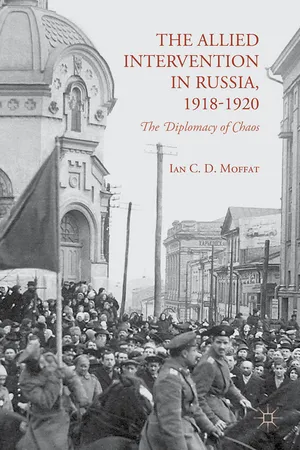
This work explores the reasons for the Allied intervention into Russia at the end of the Great War and examines the military, diplomatic and political chaos that resulted in the failure of the Allies and White Russians to defeat the Bolshevik Revolution.
Trusted by 375,005 students
Access to over 1.5 million titles for a fair monthly price.
Study more efficiently using our study tools.
Information
1
Introduction
International Relations and National Goals
Chaos has many names: anarchy, pandemonium, tumult, turmoil or, as the Oxford English Dictionary defines it, utter confusion. There is no better example than in the debacle that was the Allied intervention in Russia during and immediately after the Great War. This chaos was self-inflicted by the Allies themselves. People in positions of power caused this chaos through naiveté, wilful ignorance, egotism and personal aspiration disguised as national policy. Still, the very great challenges could not have been anticipated, as the operations in Russia were the first attempt at joint command among so many nations on such a grand scale. Even on the Western Front in France and Belgium, joint command was not implemented until after Germany’s 1918 March offensive, which nearly broke the Allied lines on the Western Front. Only then did the British accept a French Supreme Commander to direct the Allied armies on the Western Front. Even in this life-or-death struggle in the heart of Western Europe, chaos still reigned in both diplomacy and military strategy. This was truer still in Russia.
The Allied strategic objectives in Russia changed over the course of three distinct time periods. From the first Russian Revolution in March 1917 to the November Bolshevik Revolution is the first distinct period and represents the time when the Allies endeavoured to keep Russia in the war as an active ally. From the November 1917 Bolshevik Revolution to the November 1918 armistice on the Western Front, the second period, the Allies tried first to prevent the Bolsheviks from making a separate peace with the Central Powers and, failing that, to re-establish an Eastern Front. The last phase is from after the 1918 armistice to the fall of the last Whites in the Crimea in 1920. This was the time of greatest change in the attitude of individual Allied Powers towards Russia. Before the armistice, there was a concerted effort by all the Allies to win the Great War. Every strategy was directed to that ultimate goal. After the armistice, the Allies had no agreed collective aim and efforts were often directed to national goals rather than to agreed common ends. In all three periods, however, chaos engulfed all the efforts of the Allies, the Central Powers and Russians of all stripes. From 1917 to 1920 Britain remained the driving force for intervention despite both British Prime Minister Lloyd George’s antipathy towards military action and US President Woodrow Wilson’s efforts to have the United States become the pre-eminent nation of the Western World. However, the Allied intervention in Russia was an extension of, and had its origins in, the Great War.
Great War Overview
The world conflagration of 1914–18 was fought globally. The Triple Entente – the British Empire, France and Russia (the Allies) – was pitted against the Central Powers led by Germany and included the Austro-Hungarian Empire and the Ottoman Empire. Other nations joined either side. The most powerful and influential of these was the United States, which sided with the Entente in 1917.
Initially the Allies had hoped for a quick and decisive victory that they thought lay in the apparent strength of Russia. Both the French and the British expected that, by holding Germany to a standstill in the West, the Russian steamroller would come from the East and overwhelm the Central Powers. However, poor leadership, inadequate logistics and a lack of industrial capacity dissipated the Russian strength, which was based on vast manpower.1 Political unrest in Russia, advanced and compounded by the war, sapped the Russian potential. After March 1917, the Russian asset was now a liability.2 Revolution turned Russia into an inward-looking nation whose ordinary people detested the ongoing war. The March 1917 socialist revolution was superseded by Lenin and his Bolsheviks in November. The Bolsheviks believed in world revolution and were convinced that it would occur if only they could hold on to power. Originally, Lenin expected the revolution to start immediately in Germany and Central Europe and to spread to the western democracies. To ensure that this occurred, Lenin was willing to cede territory and treasure, first to Germany and later to the Allies, if this meant that the Bolsheviks retained power. To Lenin, all that would be given up would be returned with the coming of world revolution. This belief endangered the Allied cause and added to the Allied Powers’ concerns resulting from setbacks in France, Belgium and Italy.
Initial Actions
By the end of 1917, with monumental casualties still rising on the Western Front, no victory in sight and Russia faltering, the desperate Allies debated the need to launch a full-scale military intervention in the Russian Empire. In the beginning, individual Allied powers landed their troops at various locations in Russia to achieve limited national goals.3 A few influential and dedicated British officers, for example, initiated small-scale operations to gather intelligence on the obscure developments in the hinterlands of South Russia and the Ottoman Empire.4 However, this and other Allied interventions grew beyond their original limited intent.
The major impetus for the grand military intervention came from the stasis that had developed on the Western Front. The failure of the Allies to advance despite the bloodletting of the Somme and Verdun in 1916, coupled with the continuing failures of the Chemin des Dames offensive, the Italian Campaign and Passchendaele, together with the collapse of the Russian Front in 1917, all contributed to the impasse. How to break the stalemate became the strategic question. With France’s population fully committed to the fighting in their native land and the United States not yet fully mobilized, it fell to Britain to be the driving force to solve the strategic problem.
In Britain, since the beginning of the war, there had been two factions in the Cabinet, the Western school and the Eastern school.5 The Westerners believed the war could only be won by putting all effort into the Western Front. The Easterners, led by Winston Churchill and David Lloyd George, First Lord of the Admiralty and the Chancellor of the Exchequer respectively in Herbert Asquith’s Liberal government in 1914–15, believed France should only be a holding position while the major effort was put into fighting on the peripheries “to kick out the props from under Germany”.6 Strategy oscillated between the two extremes until the beginning of 1916 when the disasters of Gallipoli and Mesopotamia shattered the hopes of the Eastern school that success might be achieved at less cost than in France.7 The Eastern Strategy only re-emerged at the end of 1916 with the appointment of Lloyd George as Prime Minister and after the operational failures of that year on the Western Front. Failing massive and immediate assistance from the United States, it seemed improbable that a decisive Allied victory could be achieved. Though this attitude was not universal, there were growing numbers of British politicians who began to think that victory was not worth the price in blood and treasure, and the strongest of these was David Lloyd George.8
Faced with this deteriorating military situation, both Britain and France decided that the Eastern Front had to be re-established to prevent Germany from transferring more troops westward. However, this decision was not universally accepted, nor was it easily implemented. Neither Britain nor France had sufficient reserve manpower to open another Front by themselves, nor was there anywhere in Russia to which Allied troops could easily gain access in order to re-establish that Eastern Front. Lack of manpower dictated the need for diplomacy among the Allies and the United States. It also required that Britain discuss matters with its Imperial partners, especially Canada. All these negotiations delayed the implementation of Allied interventions until 1918. And the largest intervention, the one to Siberia, did not occur until the Great War was nearing its end.
Action was also delayed by Germany’s almost successful March 1918 Michael offensive on the Western Front. Nevertheless, the interventions did occur and continued for over a year after the November 1918 armistice. Significantly, and a major contributor to chaotic diplomacy, the raison d’être for intervention changed after the formal ceasefire. “The Armistice destroyed at a stroke the principal motivation of the Western Governments … for intervening in the Russian Civil War.”9
What had been a strategic military imperative to re-establish the Eastern Front quickly became a battle against Bolshevism for some of the Allies. Others saw it as interference in the birth of an independent nation. Still others saw it as the honourable support of people who had been allies from the start of the War. As a result, the differing aims of each ally often caused those members to hamper and defeat each other’s goals. Without a concerted and unified effort, the Allied intervention was destined to fail.
National Policies
Britain
Allies often have differing goals and motives. The men who made British strategic policy during the Great War had matured in the late nineteenth century when Russia and France were Britain’s imperial rivals. Even though allied with these past competitors, Britain remained suspicious of their post-war ambitions and sought a peace settlement that not only weakened Germany, but would also ensure that neither Russia nor France became sufficiently powerful to threaten the British Empire or the European balance of power.10 This war aim coloured Brit...
Table of contents
- Cover
- Title
- Copyright
- Contents
- List of Plates
- List of Maps
- Acknowledgements
- List of Abbreviations
- Chapter: 1 Introduction
- Chapter: 2 Year of Crisis, 1917
- Chapter: 3 Stalled Intervention – North, South, East and West
- Chapter: 4 US–Japanese Rivalry in Siberia
- Chapter: 5 The Allies Act – Murmansk and Archangel
- Chapter: 6 Too Few, Too Late – The Caucasus, the North and Siberia, Summer 1918
- Chapter: 7 Disaster for the Misunderstood – Anti-Bolshevik Support in North Russia, August–November 1918
- Chapter: 8 Friends or Enemies Together? Allies in Siberia, Summer 1918
- Chapter: 9 Dying in Russia While Others Debate, October 1918–January 1919
- Chapter: 10 Vision versus Reality: The Paris Peace Conference and Russia, January–February 1919
- Chapter: 11 Retreat, Abandonment and Bolshevik Victory, February–April 1919
- Chapter: 12 Allied Evacuation and White Victories, March–June 1919
- Chapter: 13 Allied Retreat and White Defeat, May–October 1919
- Chapter: 14 Red Triumph and White Humiliation, July 1919–November 1920
- Chapter: 15 Conclusion
- Appendix. People Involved in Allied Intervention into Russia, 1918–1920
- Bibliography
- Index
Frequently asked questions
Yes, you can cancel anytime from the Subscription tab in your account settings on the Perlego website. Your subscription will stay active until the end of your current billing period. Learn how to cancel your subscription
No, books cannot be downloaded as external files, such as PDFs, for use outside of Perlego. However, you can download books within the Perlego app for offline reading on mobile or tablet. Learn how to download books offline
Perlego offers two plans: Essential and Complete
- Essential is ideal for learners and professionals who enjoy exploring a wide range of subjects. Access the Essential Library with 800,000+ trusted titles and best-sellers across business, personal growth, and the humanities. Includes unlimited reading time and Standard Read Aloud voice.
- Complete: Perfect for advanced learners and researchers needing full, unrestricted access. Unlock 1.5M+ books across hundreds of subjects, including academic and specialized titles. The Complete Plan also includes advanced features like Premium Read Aloud and Research Assistant.
We are an online textbook subscription service, where you can get access to an entire online library for less than the price of a single book per month. With over 1.5 million books across 990+ topics, we’ve got you covered! Learn about our mission
Look out for the read-aloud symbol on your next book to see if you can listen to it. The read-aloud tool reads text aloud for you, highlighting the text as it is being read. You can pause it, speed it up and slow it down. Learn more about Read Aloud
Yes! You can use the Perlego app on both iOS and Android devices to read anytime, anywhere — even offline. Perfect for commutes or when you’re on the go.
Please note we cannot support devices running on iOS 13 and Android 7 or earlier. Learn more about using the app
Please note we cannot support devices running on iOS 13 and Android 7 or earlier. Learn more about using the app
Yes, you can access The Allied Intervention in Russia, 1918-1920 by I. Moffat in PDF and/or ePUB format, as well as other popular books in History & British History. We have over 1.5 million books available in our catalogue for you to explore.