eBook - ePub
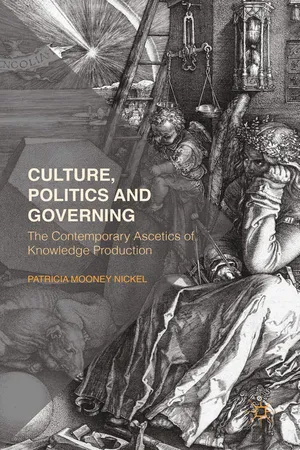
Culture, Politics and Governing
The Contemporary Ascetics of Knowledge Production
- English
- ePUB (mobile friendly)
- Available on iOS & Android
eBook - ePub
About this book
Culture, Politics, and Governing: The Contemporary Ascetics of Knowledge Production is a critical, interdisciplinary approach to how the practices that govern the production of knowledge and culture have material consequences for how we experience everyday life.
Information
1
Introduction: The Politics of Ascetics and Governing
It all started the day I quit. In December 2001, I resigned from a position as a tenured professor at a large Arizona university, and settled back in to my old stomping grounds of Fort Worth, Texas. I knew that, at best, this move would leave me a gap of eight months or so until I might or might not locate the next academic position in the fall of 2002.
Jeff Ferrell
For many authors and artists seeking institutional affiliation today, Jeff Ferrell’s decision to leave a position as a tenured professor in order to live as a dumpster diver and trash picker1 may seem extraordinary. This is not only because tenured positions are hard to come by, but also because the path of the academic career is such that if one decides to forego institutional affiliation one is often disqualified from future institutional affiliation. The rules governing these types of decisions are complex enough that the ascetic engines of academia – The Chronicle of Higher Education and Chronicle Vitae – dedicate significant space to advising those who struggle with the question of what I discuss in this book as the contemporary ascetics of knowledge production: the ethic of practice valued by the institutions with which producers of knowledge must be associated in order to be successful as well as the practices implicitly valued in the knowledge that they produce.
This book is only tangentially related to Ferrell’s substantive work, which, like his choice to resign from a tenured position, challenges the ascetics of both knowledge production and cultural production. However, the substantive topic considered here is directly related to Ferrell’s career and the careers of other academics and artists. In spite of what I observe to be the highly disciplined environment of knowledge production, today Ferrell is once again a tenured professor. Although a rare case, Ferrell’s “existential ethnography”2 demonstrates that knowledge production and cultural production are not only governing or governed activities, but also sites of resistance.
One may reasonably ask how an investigation into the lives of academics can improve everyday life for those outside of the academy. Building on the Frankfurt School, Michel Foucault, and third-generation critical theory,3 I argue that knowledge production – whether it involves the production of research articles or the production of art exhibits – is politically important. When, in 2014, he was asked to explain the low, perhaps fatal, quality of medical care provided for US veterans, Kenneth Kizer, a former Under Secretary for Health in the Department of Veterans Affairs, referred directly to a set of policies that emerged from the “new public management” (NPM) scholarship. Propagated by scores of knowledge producers in both the US and the UK from the late 1980s onward,4 NPM advocated “running government like a business”5 and it was supported by “NPM jobs” in academia, “NPM articles” in scholarly journals, and an institutionalized “NPM curriculum.”6 In 2006 Fortune magazine was reporting that these reforms had resulted in the achievement of the modern dream in health care: “The seamless integration of science, information, and compassion is the dream of modern health care. Scenes like these are not fantasies, however, but daily realities at the Veterans Health Administration, the federal agency that is the most wired and cost-effective health system in the land.”7 By 2014, The Washington Post was reporting that “up to 40 veterans may have died while awaiting treatment at the Phoenix hospital and that staff, at the instruction of administrators, kept a secret list of patients waiting for appointments to hide delays in care.”8 In an interview with The Washington Post, Kizer – “a reformer appointed by President Bill Clinton” who embraced “performance data” – explained that “the measures have become the end. As opposed to a means to an end.”9 The measures to which Kizer refers were the result of reforms based upon scholarship that translated the market assumptions of neoliberalism – ontological assumptions – into the practice of government policy. The production of knowledge is political and has political consequences.10
It is not only knowledge produced by academics that has consequences for how we experience everyday life; when considering how we are governed it is equally important to consider cultural production, which, because of its ascetic impact, I treat as a form of knowledge production.11 As the founders of Cultural Politics note in their introduction to the journal, the question that needs to be advanced is “what is cultural about politics and what is political about culture.”12 Whether it is a museum exhibit that teaches us how to discipline our bodies – “Investigate Health! gives visitors the opportunity to peek into a world of research devoted to studying the factors that impact our health and to discover how we have the power to affect our own wellness”13 – or a morning television show that celebrates “expert makeovers,” in the course of our everyday lives we are inundated with governing messages. As I have argued in my analysis of the ascetic production involved in celebrity philanthropy,14 cultural celebration of dispositions (philanthropic, healthy, well-coiffed) conveys the message that such dispositions are valuable and who or what is celebrated as valuable tells us something about what present relations of governing demand and thus reward (valorize). A core argument of this book is that cultural products, because they too become taken-for-granted bases for action (ascetics) for those who seek to be celebrated (valorized), are also knowledge products that tell us what is possible and how we therefore ought “to be” in the world (ontology). In his analysis of cultural critique, Theodor W. Adorno writes, “Not only does the mind mould itself for the sake of its marketability, and thus reproduce the socially prevalent categories. Rather, it grows to resemble ever more closely the status quo even where it subjectively refrains from making a commodity itself.”15 This is a critical point: potentially ascetic knowledge is positioned in a hierarchy of value that is based on the reproduction of governing social categories.
The ways in which the production of ascetic knowledge – that knowledge, including culture, that instructs us what practices we ought to value and reproduce – is governed have concrete implications for the way our everyday lives are governed. In this collection of essays I critically explore governing as it is practiced through the production of knowledge. This production often involves the valorization of that which governs our sense of the proper disposition toward and reproduction of the present. I locate governing practices in the intersecting circuits of formal knowledge production and everyday cultural encounters and argue that knowledge production and cultural production are related as ascetic knowledge.
My argument assumes that as producers of ontological bases for action, intellectuals, including both authors and artists, are targets of governing. Intellectuals not only constitute knowledge, but are constituted in their pursuit of knowledge.16 This approach to the practice of governing builds on critical theory, especially the interdisciplinary tradition that rejects the idea that we can understand political practice within the disciplinary (ontological) categories of state (political science), economy (economics), and society (sociology).17 Together, the five portraits explored in the following chapters recommend a shift in the study of governing from its varying onto-disciplinary locations to the critique of concrete practices, including knowledge production, ontological production, institutionalization, and valorization. In this introductory chapter I briefly position my approach to each of these practices as the politics of ascetics and governing. Many of the broad claims made here require further substantiation, which takes place in the following chapters.
There are several reasons why I chose to focus on ascetics rather than the equally important critical traditions of ideology, hegemony, domination, or discipline, all of which help us to understand how knowledge and culture govern and which inform several chapters in this book. As a scholar, I felt that my previous work had, at least for the moment, exhausted what I had to contribute to the discussion of these concepts in relationship to governing. More substantively, ascetics helped me to think about how practices that govern the subject become valued – the implication being that I think that the way in which subjects are governed depends in large part on the valorization of practices upon which the status quo depends. I am concerned with the ways in which the contemporary politics of ascetics as they are specifically related to knowledge and culture are practices of governing.
My inquiry into ascetics begins with Foucault’s question, asked in a 1982 lecture: “How is the relationship between truth-telling (veridiction) and the practice of the subject established, fixed, and defined? Or, more generally, how are truth-telling and governing (governing oneself and others) linked and connected to each other?”18 My argument that the contemporary ascetics of knowledge production are significant to contemporary politics stems from this recognition that those involved in the production of knowledge (savoir) are simultaneously involved in the production of the self and also in the production of the ontological and epistemological bases for constructing subjectivity as a target of governing. This is to say, “labor performed in order to know”19 is ascetic labor, but it also produces ascetics that are in turn valorized by those institutions charged with legitimating knowledge.
Foucault argued that politics today is a question of politics of the self.20 If the politics of the self originate in the production of knowledge, then it is especially important to politicize the practices and techniques of knowledge-producing selves. Foucault’s keen insight into the relationship between knowledge production and technologies of the self21 helps me to understand the relationship between knowledge and governing. In a 1978 interview with Duccio Trombadori22 Foucault asks: “Couldn’t a science be analyzed or conceived of as an experience, that is, as a particular relationship that is established in such a way that the subject itself of the experience might be altered? To put ...
Table of contents
- Cover Page
- Half Title Page
- Title Page
- Copyright
- Contents
- List of Figures
- Acknowledgments
- 1 Introduction: The Politics of Ascetics and Governing
- 2 Academies of Exhibition and the New Disciplinary Secession
- 3 The Man from Somewhere: Author, Affiliation, and Letterhead
- 4 The Institutionalization of Author Production and the Performance Imperative as an Ontological Fiction
- 5 Celebration and Governing: The Production of the Author as Ascetic Practice
- 6 Matterphobia and Matterphilia: Artistic Discourse and Ascetic Production
- 7 The Conclusion as the Contemporary Ascetic of Knowledge Production
- Notes
- References
- Index
Trusted by 375,005 students
Access to over 1.5 million titles for a fair monthly price.
Study more efficiently using our study tools.
Frequently asked questions
Yes, you can cancel anytime from the Subscription tab in your account settings on the Perlego website. Your subscription will stay active until the end of your current billing period. Learn how to cancel your subscription
No, books cannot be downloaded as external files, such as PDFs, for use outside of Perlego. However, you can download books within the Perlego app for offline reading on mobile or tablet. Learn how to download books offline
Perlego offers two plans: Essential and Complete
- Essential is ideal for learners and professionals who enjoy exploring a wide range of subjects. Access the Essential Library with 800,000+ trusted titles and best-sellers across business, personal growth, and the humanities. Includes unlimited reading time and Standard Read Aloud voice.
- Complete: Perfect for advanced learners and researchers needing full, unrestricted access. Unlock 1.5M+ books across hundreds of subjects, including academic and specialized titles. The Complete Plan also includes advanced features like Premium Read Aloud and Research Assistant.
We are an online textbook subscription service, where you can get access to an entire online library for less than the price of a single book per month. With over 1.5 million books across 990+ topics, we’ve got you covered! Learn about our mission
Look out for the read-aloud symbol on your next book to see if you can listen to it. The read-aloud tool reads text aloud for you, highlighting the text as it is being read. You can pause it, speed it up and slow it down. Learn more about Read Aloud
Yes! You can use the Perlego app on both iOS and Android devices to read anytime, anywhere — even offline. Perfect for commutes or when you’re on the go.
Please note we cannot support devices running on iOS 13 and Android 7 or earlier. Learn more about using the app
Please note we cannot support devices running on iOS 13 and Android 7 or earlier. Learn more about using the app
Yes, you can access Culture, Politics and Governing by P. Nickel in PDF and/or ePUB format, as well as other popular books in Social Sciences & Social History. We have over 1.5 million books available in our catalogue for you to explore.