eBook - ePub
Theatre/Performance Historiography
Time, Space, Matter
- English
- ePUB (mobile friendly)
- Available on iOS & Android
eBook - ePub
About this book
How do the ethical implications of writing theatrical histories complicate the historiographical imperative in our current sociopolitical context? This volume investigates a historiography whose function is to be a mode of thinking and exposes the inner contradictions in social and ideological organizations of historical subjects.
Information
Subtopic
HistoriographyI
The Space of Formations
1
Performing Speciation: The Nature/Culture Divide at the Creation Museum
Angenette Spalink and Scott Magelssen
This essay concerns the historiographic constructions of time, space, and matter as produced and performed by Answers in Genesis, a nonprofit Christian apologetics ministry, in its Creation Museum, “[a] state-of-the-art 70,000 square foot museum” in Petersburg, Kentucky. The museum “brings the pages of the Bible to life”1 by steering its visitors through slick displays and interactive exhibits, effectively mobilizing visitors’ bodies to “bring to life” the story of young-earth creationism, a literal interpretation of Judeo-Christian scriptures that maintains the earth is only a little over six thousand years old. Creation Museum visitors find not only biblical simulations with animatronic dinosaurs sharing the garden of Eden with Adam and Eve, they also encounter a reconstruction of “Lucy,” the hominid fossil scientists identify as an early ancestor of contemporary humans (figure 1.1). Rather than standing upright like an early human, however, the Creation Museum’s figure hunches in a simian pose, knuckles dragging, spine parallel to the ground. Through exhibits like Lucy, the museum, while recognizing the existence of fossils as evidence of life forms that no longer inhabit the earth, positions itself against science’s view of the earth as billions of years old, and of the earth’s life forms—especially human beings—as the current state of millions of years of evolutionary change.
The Lucy exhibit is an example of the Creation Museum’s view of a divinely ordained separation between humans and animals, both a cause and a symptom of an entrenched discursive divide between nature and culture, traceable to the time of the composition of Genesis. Lest anyone believe that human and nonhuman animals exist on a continuum or share a genealogy, the Lucy exhibit, along with depictions of the Fall and Noah’s Ark, reifies the biblical mandate that Man shall have dominion over the earth. The anthropocentric striation of humans and animals into hierarchical tiers across time relieves humans of accountability for not treating other living creatures as equals, and, by extension, for not addressing the world’s ecological problems. Given current threats to the earth and its atmosphere, such a position is anathema to a more progressive position, which recognizes the potential for the Creation Museum’s cosmology to sanction irreparable damage to the earth. The purpose of this essay is not, however, to advocate for more progressive conceptions of time, space, and matter that seek to erase such discursive constructions, but, rather, to discuss the ways in which these conceptions—and, indeed, counterpositions—are maintained, performed, and policed by particular institutions or languages of intelligibility. To engage this discussion is to recognize that the historiographic systems put into practice by the Creation Museum not only perpetuate damaging perceptions of the cosmos, they serve corporate, political, and religious agendas.
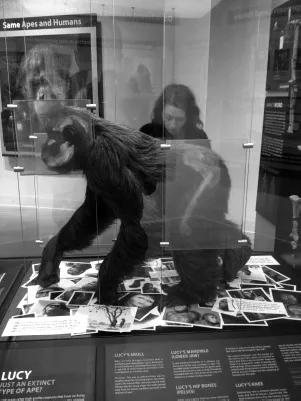
Figure 1.1 Lucy at the Creation Museum. Photo by Scott Magelssen.
Theatre and performance scholars have established a fruitful academic foundation from which to launch an analysis of the performance practices of the Creation Museum. John Fletcher’s Preaching to Convert: Evangelical Outreach and Performance Activism in a Secular Age places the practices of the Creation Museum (which he describes as a blend of Jurassic Park and the Smithsonian) in the category of activist performance—an evangelical strategy to win over and convert the hearts and minds of audience members in a global theological war. An even larger function of these performances, however, is to reify the beliefs of many Creation Museum visitors, namely, that God’s unalterable word is the more fundamental truth. Fletcher identifies this logic as “preaching to the converted.”2 In Sensational Devotion: Evangelical Performance in Twenty-First Century America, Jill Stevenson posits that the Creation Museum, and other performative enterprises that share the museum’s political and religious agendas, engage in what she calls “evangelical dramaturgy,” a set of practices “designed to foster embodied beliefs that respond to specific devotional needs and priorities.” These practices, contends Stevenson, “constitute a worldview even as they reinforce it.”3 In addition to the discussions offered by Fletcher and Stevenson, we maintain that an analysis of the historiographic constructions of time, space, and matter is fundamental to understanding the performances of the Creation Museum, thus we interrogate here the Creation Museum’s performative exhibition practices by engaging conceptions of time, space, and matter as informed by the philosophy of immanence advanced by Gilles Deleuze and Felix Guattari. We then use these conceptions to expose and critique the systems by which the Creation Museum understands and presents the world.
With the editors and other contributors to this volume, we recognize that time, space, and matter are not only produced by historiography, but that the historiographic project occupies and is the time, space, and matter it produces. We understand time to be the mode of thinking by which we assimilate and structure events into narrative order. We take matter (in the present context) to refer to the materiality of the cosmos, and the ways in which that materiality is categorized and policed vis-à-vis time and space by institutional practices. In this regard, we offer a couple of different conceptions of space. One is the way we understand the abstraction of time as occupying a spatial trajectory (a line, a plane, an intersection or fold, etc.). The other is the arena in which discursive constructions are performed and activated in an institutional “place” (here, the Creation Museum).
The popular paradigmatic apprehension of time is structured by a Cartesian and Hegelian linearity in which events occur along a linear continuum of precise and homogenous instants, and the accumulation of these instants over elapsed time gives a forward pitch to past, present, and future.4 Deleuze and Guattari focus upon the constructedness of these conceptions and position our understanding of the past not as a line of development, as it is apprehended in the Cartesian/Hegelian model, but as a field or plane that contains all possibilities. History and time, that is, the past and present, are all part of the same plane. Events do not happen as the culmination of chains of cause-and-effect, but emerge at spatial “junctures” within the field. In these spatial terms, the event and the state of affairs meet and intersect as two vectors: the vector of the multiplicity of possibilities of events and the vector of the multiplicity of states of affairs. The states of affairs actualize the event at the juncture between the two vectors, and the event, in turn, absorbs the states of affairs. Neither the event nor the state of affairs can be reduced to itself, as if apart from its other term in the relation, because “a state of affairs cannot be separated from the potential through which it takes effect and without which it would have no activity or development.”5 The event, in other words, is the actualization of a multiplicity of possibilities within a state of affairs.
In this philosophy, to conceive of distinct and autonomous categories of plants, animals, humans, and other organisms appearing in sequential order through a kind of linear process of causality is untenable. Rather, plants, animals, humans, and other organisms are perceived as sharing a plane of immanence and as existing in various and continued states of becoming. Using a historiographic approach to the past informed by the Deluzio-Guattarian notion of “human-becoming-animal,” we suggest that, rather than inhabiting a nature-culture binary, human and animal are discursive constructs grounded in their own particular historicities. “Affects are precisely these non-human becomings of man,” write Deleuze and Guattari in What Is Philosophy?”6 Philosophy, they continue, is an exploration of the virtual possibilities of what things are capable of becoming and the ways in which they are capable of transforming, and science is that which is concerned with the actualization of the virtual, exploring the “states of affairs” and the means by which these actual concrete bodies relate to other material objects.
“States of affairs” actualize an event or concept, concretizing a virtual possibility or becoming that resided in the plane of immanence. Deleuze and Guattari describe states of affairs as “actualities, even though they may not yet be bodies or even things, units, or sets. They are masses of independent variables, particles-trajectories or signs-speeds.”7 In the case at hand, these variables might include the range of biological taxa diffused across a geographical landscape at a specific temporal snapshot, the spatial and temporal relationships between these taxa, and the conditions that shape the materiality of biological forms and enable them to shift and change. It follows that, in a philosophy of immanence, we apprehend both humans and animals as concepts on the plane of immanence that have become/are becoming actualized through intersections with these “states of affairs,” thus moving from the realm of the virtual and philosophical to the scientific. Scientists understand the materia...
Table of contents
- Cover
- Title
- Introduction
- Part I The Space of Formations
- Part II Temporal Matter
- Part III Material Spaces
- Notes on Contributors
- Index
Trusted by 375,005 students
Access to over 1.5 million titles for a fair monthly price.
Study more efficiently using our study tools.
Frequently asked questions
Yes, you can cancel anytime from the Subscription tab in your account settings on the Perlego website. Your subscription will stay active until the end of your current billing period. Learn how to cancel your subscription
No, books cannot be downloaded as external files, such as PDFs, for use outside of Perlego. However, you can download books within the Perlego app for offline reading on mobile or tablet. Learn how to download books offline
Perlego offers two plans: Essential and Complete
- Essential is ideal for learners and professionals who enjoy exploring a wide range of subjects. Access the Essential Library with 800,000+ trusted titles and best-sellers across business, personal growth, and the humanities. Includes unlimited reading time and Standard Read Aloud voice.
- Complete: Perfect for advanced learners and researchers needing full, unrestricted access. Unlock 1.5M+ books across hundreds of subjects, including academic and specialized titles. The Complete Plan also includes advanced features like Premium Read Aloud and Research Assistant.
We are an online textbook subscription service, where you can get access to an entire online library for less than the price of a single book per month. With over 1.5 million books across 990+ topics, we’ve got you covered! Learn about our mission
Look out for the read-aloud symbol on your next book to see if you can listen to it. The read-aloud tool reads text aloud for you, highlighting the text as it is being read. You can pause it, speed it up and slow it down. Learn more about Read Aloud
Yes! You can use the Perlego app on both iOS and Android devices to read anytime, anywhere — even offline. Perfect for commutes or when you’re on the go.
Please note we cannot support devices running on iOS 13 and Android 7 or earlier. Learn more about using the app
Please note we cannot support devices running on iOS 13 and Android 7 or earlier. Learn more about using the app
Yes, you can access Theatre/Performance Historiography by R. Bank, M. Kobialka, R. Bank,M. Kobialka in PDF and/or ePUB format, as well as other popular books in Media & Performing Arts & Historiography. We have over 1.5 million books available in our catalogue for you to explore.