eBook - ePub
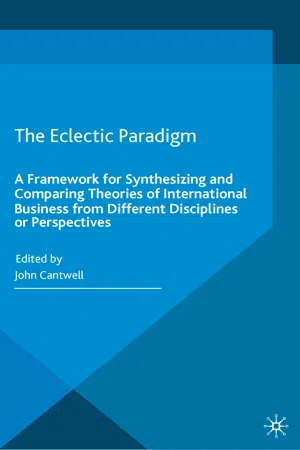
The Eclectic Paradigm
A Framework for Synthesizing and Comparing Theories of International Business from Different Disciplines or Perspectives
- English
- ePUB (mobile friendly)
- Available on iOS & Android
eBook - ePub
The Eclectic Paradigm
A Framework for Synthesizing and Comparing Theories of International Business from Different Disciplines or Perspectives
About this book
To help to promote a greater conversation between those interested in the theoretical explanation of IB activities from various different backgrounds or starting points, this book offers a special Collection of JIBS articles which concern the foundations and the application of the eclectic paradigm.
Information
1
An Introduction to the Eclectic Paradigm as a Meta-Framework for the Cross-Disciplinary Analysis of International Business
John Cantwell
A major aim of this book on the eclectic paradigm is to enable scholars coming to the International Business (IB) field from a cognate discipline, perhaps for the first time, to be able to connect their own way of thinking about IB issues to a framework for IB analysis that is already well established in our field. It is also hoped that this collection of chapters originally published in the Journal of International Business Studies (JIBS), the leading journal in the IB field, will help to remind mainstream IB scholars of how the framework of the eclectic paradigm has emerged and developed, and of the contribution that JIBS has played in this development.
As is well known among IB scholars, the eclectic paradigm was first incarnated as the eclectic theory (by John Dunning in 1977), but rather quickly metamorphosed into a paradigm (Dunning, 1988, 2001), or a meta-framework for the conduct of IB analysis and IB concept or theory building. While Dunning had initially been caught up in the enthusiasm of the early days of the genesis of the IB field to suggest a ‘general theory’ of the multinational enterprise (MNE) and the international production that MNEs organize around the world, he soon appreciated that the synthesis he proposed was instead a means by which the various relevant theories of IB could be identified (according to which question was being asked), and then suitably combined or compared as appropriate. The different theories of IB at that time, and subsequently, can be characterized as addressing selected aspects of the ownership (O), location (L) and internalization (I) advantages that are necessary for the emergence, growth and evolution of international production under common control and coordination across borders. Hence, the eclectic paradigm is also known as the OLI paradigm, and it provides a structure for bringing together and applying various kinds of theories of IB (Dunning, 1990).
Thus, the eclectic paradigm distinguishes between influences on IB activities associated with the nationality of ownership (O) or the foreign origin of firms engaged in IB, the extent of the internalization (I) of markets across borders which affects the boundaries of the MNE, and the characteristics of the host location(s) (L) in which IB activities are sited. In other words, the eclectic paradigm is essentially about how to appropriately combine issues of firm network-derived and home country inherited capabilities (O), transaction costs (I), and the resources, capabilities and institutions of locations as host production sites (L). This analytical structure has laid a common foundation for a progressive conversation between different perspectives on IB that enables an increasing interchange to be conducted across various streams of research that might otherwise have found it difficult to relate to one another. While originally the eclectic paradigm helped us to bring together and compare mainly economic theories of IB, today its greater value is as a framework that has the potential to enable us to relate to one another IB theories derived from ideas taken from different disciplines and constructed at different levels of analysis. To help promote a greater conversation between those interested in the theoretical explanation of IB activities from various different backgrounds or starting points, we are pleased to offer this special collection of JIBS articles that help to trace out the foundations and the potential applications of the eclectic paradigm.
The origins of the eclectic paradigm
Without yet using the terminology of the eclectic paradigm, in his earlier work Dunning’s (1958, 1970) analytical reasoning about the determinants of international production had been based on explanations of O and L advantages, and accounts of how such O and L factors may interact with one another over time. This focus on theories of O and L advantages was true of most of the pioneering studies that established the IB field in the 1950s and 1960s, including the contributions of others such as Hymer, Kindleberger, Reddaway or Vernon. The center of empirical attention in those years was the growth of US MNE operations in Europe, and the primary concern was most often with explaining aggregate patterns of foreign direct investment (FDI) and their relationship with international trade and the balance of payments. Explanations were provided for the interaction between home country and parent company (O) and host country (L) conditions in driving an expansion of FDI, and as a means of examining the likely impacts on home and host countries as well as on MNEs. While Dunning, Vernon and especially Hymer did theorize about the MNE and the growth of the MNE as a firm, this was generally placed in the wider context of understanding the overall implications of FDI and its likely home and host country effects. Hence, the theory of the firm, such as it was in that early period of theorizing about IB, was seen as part of the study of a wider system of relationships at a country level, and so I advantages were not a prominent part of analysis at that time, although they were incorporated in an early form into Hymer’s (1960) story (see e.g., Horaguchi and Toyne, 1990).
Most of the criticisms that have been leveled at the eclectic paradigm derive essentially from continuing to treat as if it was a theory in itself, or as if it has been designed to address some specific target category of research questions about IB in the way that an individual theory should do. In this chapter, we will show how instead the eclectic paradigm has proved remarkably flexible in its application as an encompassing or meta-framework to facilitate our capacity to draw on some quite different theories and thus to answer the very diverse range of IB research questions that have been asked, as the focus of attention in the field has shifted over time with changes in the realworld IB environment. In the early days of the IB field in the 1950s and 1960s, the era of post-war growth and the expansion of international trade and investment in North America and Europe, the combination of (theories that reflected) the O and L prongs of what was to become the OLI paradigm were effective in addressing the questions then being asked, which centered on the home and host country determinants and effects of FDI.
Accordingly, in those days analysis was conducted mainly at a country or a cross-industry level, and focused most often on the interaction between groups of firms (at a national level or at an industry level) and countries as home or host to FDI. In this period of IB theory, L advantages were mainly construed at a host country level (although Dunning had some interest in the sub-national regional and the European-wide levels as well), and O advantages were typically thought of as incorporating elements that were non-firm-specific, such as the advantages of US firms due to the benefits of the US institutional environment and its home country business system. Scholars were concerned with the effects of FDI on the balance of payments position of countries and the productivity of domestic industries. Representative of this classical perspective in the IB field were studies such as those of Dunning (1958) or Reddaway (1970) in the UK, of Hufbauer and Adler (1968) or Bergsten, Horst and Moran (1978) in the USA, of Safarian (1969) in Canada, and of Brash (1966) in Australia. The product cycle model of Vernon (1966) and Hirsch (1967) also represented a particular explanation of the progressive interaction between the O advantages of US-owned firms and the L advantages of host European locations that was especially designed for the context of the growth of US FDI in Europe in the 1950s and 1960s (see Dunning and Cantwell, 1982, and Cantwell, 1989).
The O and L constructs used in the eclectic paradigm are best formulated in a dynamic and evolutionary manner, as befits their origins in an era in which scholars were primarily concerned with the transformative effects on economies and societies of the growth of FDI and the associated emergence and evolution of MNEs. O advantages refer to capabilities that are generated by a firm or within the business network that it controls and orchestrates (including abroad), or capabilities that derive from its home country origins. This concept of capability generation should be understood from a process-based perspective, meaning that the relevant capabilities must be continuously created and recreated in a process over time. The competitive process never stands still. L advantages represent the advantages to production (by any active firm) in a host location, which enhance the degree of innovative and entrepreneurial dynamism in an area that facilitates the generation of and access to location-specific capabilities in the host environment. Explained this way, it is apparent that O and L advantages co-evolve with one another. This continuous interaction between O and L considerations has led some scholars that take a comparative static outcome-based perspective on IB issues (rather than a holistic evolutionary process-based view) to suggest that O and L are conceptually indistinct and over determined, since over time O and L factors mutually influence each other. However, this interdependence is precisely why we need a broad analytical framework that depicts the key elements of the overall structure of the complex evolving system of IB activity as it develops and changes through historical time.
It also follows that the conceptual boundaries are placed differently in the eclectic paradigm compared to Rugman and Verbeke’s (1992) subsequent framework of firm-specific advantages (FSAs) and country-specific advantages (CSAs), which latter typology was designed for the narrower purpose of the more specific subject area of the international strategic management of the MNE. As the internal advantages of a particular enterprise or MNE, FSAs are just one component of the O advantages comprised of the internal and external capabilities accessible by an IB network, or which capabilities are held in the aggregate among some collective group of firms. L advantages incorporate not just host country CSAs, but also the geographic advantages of sub-national host clusters or provincial areas or global city regions, and the advantages as host sites of supra-national regions (which Rugman and Verbeke have also discussed at length in their assessment that MNEs may have regional rather than global structures, but this strand of work lies outside their FSA-CSA framework). Nor is the eclectic paradigm confined to the perspective of outward FDI (as misleadingly suggested by Rugman, 2010). Outward and inward FDI are obviously two sides of the same coin, and O advantages reflect the outward FDI side of that coin while L advantages take up the inward FDI side. The eclectic paradigm is equally applicable to an analysis of either outward or inward FDI, and more to the point it pertains to the processes of interaction between the two. We can just as well ask questions about the firms of a given home country investing in multiple international locations (outward FDI), as we can ask about a given location as host to incoming firms from multiple different countries of origin (inward FDI).
In the remainder of this Introduction we will see how the eclectic paradigm has been successfully developed and adapted to the changes in scholarly interest that have come about with some substantial shifts in the IB environment since the 1960s. A key reason why the eclectic paradigm has retained and indeed enhanced its relevance is that changes in the complex system of IB activities are not wholly revolutionary changes that have simply overthrown and displaced or eliminated what went before. Rather they are evolutionary changes that have built upon earlier characteristics but reshaped those enduring aspects through creating a new synthesis that has embodied the old IB features within a new and more complex form. This type of continuous transformation or cumulative process of path-dependent change in the nature of IB activities can only be fully understood and appreciated at a system-wide level. Following the global political economy orientation of much of the early IB research from the late 1950s to the early 1970s, from the mid-1970s we moved into the age of the theory of the firm in IB scholarship. Then from the 1980s we experienced the age of international asset-seeking or knowledge-seeking strategies in a world of knowledge-driven capitalism. From the 1990s onwards we have seen an age of more open and informal IB networks, or what Dunning (1995) termed alliance capitalism. This most recent change was to lead to a fundamental change in the nature of the leading actor in IB activity itself, namely the MNE. Each of these real-world changes has led to some consequent refinements in the way in which we think about and apply the concepts of O, L and I advantages to IB.
The age of the powerful hierarchical large firm, and rising industrial concentration
One strand of IB literature in the 1960s had already been cast at the firm level. The most notable contribution in this respect was that of Hymer (1960), who asked the question of why some established national firms move abroad once they have attained a certain share of the domestic market in their industry. As is well known and on which there is by now a most extensive literature (see e.g. Ietto-Gillies, 2012), Hymer’s primary answer to this question was the pursuit of market power by individual firms, repeating abroad a process of colluding with selected others and building a dominant market position in their own right just as they had achieved initially at home. Hymer was writing in an era when it was the conventional wisdom that large firms were efficient organizers of production systems, which enterprises were thus liable to become ever more economically powerful and to be responsible for a gradual but steady increase in industrial concentration. Galbraith’s (1967) vision of the new industrial state, in which the administrative planning of large firms displaced the earlier market coordination of activities conducted through the price mechanism was characteristic of the tenor of this period. Meanwhile a new generation of organization theorists, most notably Chandler and Williamson, used evidence from business history as well from contemporary business contexts to explain the evolution of more efficient structures of managerial hierarchies in the large firm, from a unitary form (U-form) to a multidivisional (or M-form) structure (Chandler and Redlich, 1961, Chandler, 1962, 1977, Williamson, 1964, 1971). In Chandler’s vision the more successful international experiences of capitalist growth in the twentieth century, and especially of course the success of American capitalism, were grounded on the organizational or administrative effectiveness of the kinds of managerial coordination that could be attained in large firms. This he termed the role of the ‘visible hand’ in contrast to Adam Smith’s famous reference to the ‘invisible hand’ of market coordination.
Hymer incorporated much of this received intellectual wisdom of his time into his accounts of IB expansion (see Cantwell and Zhang, 2009). While his main line of argument focused on the exercise of market power by MNEs in their final product markets reaching across national boundaries, as a supplementary rationale Hymer (1960) contended that under conditions of market imperfections (which of course he believed to be the norm) the firm may substitute itself for or internalize intermediate product markets. He elaborated upon this aspect of his discussion more extensively in a subsequent paper (Hymer, 1968). Dunning was influenced by Hymer in the early 1970s, and so he too began to increasingly address similar firm level questions about the nature of the MNE (see especially Dunning, 1973). Indeed, this was part of a wider trend in IB scholarship at that time, as the focus of attention shifted from the country effects of FDI to firm or MNE level issues. This would lead in the mid-1970s to the explicit formulation of the general framework for the analysis of IB provided by the eclectic paradigm, incorporating the I component of the triumvirate of OLI factors alongside the longer established O and L elements (Dunning, 1977). Dunning first became aware of the concept of internalization from the work of McManus (1972) (see Dunning, 2001), who provided the first fully fledged articulation of this idea in general circulation, since Hymer’s (1968) article was not as yet widely known. The principle that the MNE exists because under certain conditions it can reduce transaction costs by internalizing intermediate product markets was made fashionable in the IB field by Buckley and Casson (1976).1
In analyses ...
Table of contents
- Cover
- Title
- Copyright
- Contents
- List of Figures and Tables
- 1 An Introduction to the Eclectic Paradigm as a Meta-Framework for the Cross-Disciplinary Analysis of International Business: John Cantwell
- 2 Toward an Eclectic Theory of International Production: Some Empirical Tests: John H. Dunning
- 3 The Eclectic Paradigm of International Production: A Restatement and Some Possible Extensions: John H. Dunning
- 4 Political Aspects of MNE Theory: Jean J. Boddewyn
- 5 Reappraising the Eclectic Paradigm in an Age of Alliance Capitalism: John H. Dunning
- 6 Is Dunning’s Eclectic Framework Descriptive or Normative? : Lance Eliot Brouthers, Keith D. Brouthers and Steve Werner
- 7 Is Knowledge Power? Knowledge Flows, Subsidiary Power and Rent-Seeking Within MNCs : Ram Mudambi and Pietro Navarra
- 8 An Evolutionary Approach to Understanding International Business Activity: The Co-evolution of MNEs and the Institutional Environment : John Cantwell, John H. Dunning and Sarianna M. Lundan
- 9 A Dynamic Capabilities-Based Entrepreneurial Theory of the Multinational Enterprise: David J. Teece
- Index
Trusted by 375,005 students
Access to over 1.5 million titles for a fair monthly price.
Study more efficiently using our study tools.
Frequently asked questions
Yes, you can cancel anytime from the Subscription tab in your account settings on the Perlego website. Your subscription will stay active until the end of your current billing period. Learn how to cancel your subscription
No, books cannot be downloaded as external files, such as PDFs, for use outside of Perlego. However, you can download books within the Perlego app for offline reading on mobile or tablet. Learn how to download books offline
Perlego offers two plans: Essential and Complete
- Essential is ideal for learners and professionals who enjoy exploring a wide range of subjects. Access the Essential Library with 800,000+ trusted titles and best-sellers across business, personal growth, and the humanities. Includes unlimited reading time and Standard Read Aloud voice.
- Complete: Perfect for advanced learners and researchers needing full, unrestricted access. Unlock 1.5M+ books across hundreds of subjects, including academic and specialized titles. The Complete Plan also includes advanced features like Premium Read Aloud and Research Assistant.
We are an online textbook subscription service, where you can get access to an entire online library for less than the price of a single book per month. With over 1.5 million books across 990+ topics, we’ve got you covered! Learn about our mission
Look out for the read-aloud symbol on your next book to see if you can listen to it. The read-aloud tool reads text aloud for you, highlighting the text as it is being read. You can pause it, speed it up and slow it down. Learn more about Read Aloud
Yes! You can use the Perlego app on both iOS and Android devices to read anytime, anywhere — even offline. Perfect for commutes or when you’re on the go.
Please note we cannot support devices running on iOS 13 and Android 7 or earlier. Learn more about using the app
Please note we cannot support devices running on iOS 13 and Android 7 or earlier. Learn more about using the app
Yes, you can access The Eclectic Paradigm by John Cantwell in PDF and/or ePUB format, as well as other popular books in Business & Business Strategy. We have over 1.5 million books available in our catalogue for you to explore.