eBook - ePub
Critical Theology against US Militarism in Asia
Decolonization and Deimperialization
- English
- ePUB (mobile friendly)
- Available on iOS & Android
eBook - ePub
Critical Theology against US Militarism in Asia
Decolonization and Deimperialization
About this book
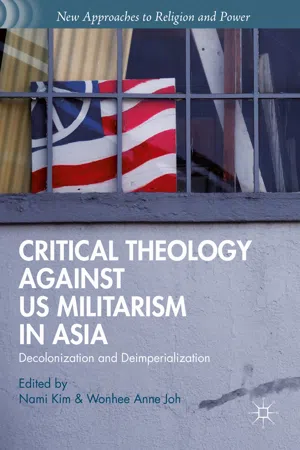
Drawing on cultural studies scholar Kuan-Hsing Chen's threefold notion of decolonization, deimperialization, and de-cold-war, this book provides analyses of the interrelated issues concerning the relationship between Christianity and the United States' imperialist militarism in the Asia Pacific. Contributors explore the effects of US imperialist militarism on the formation of Asian and Asian American collective subjectivity and inter/intra subjectivity. The book investigates the ways in which Christianity (broadly defined), in its own complexity, has been complicit in maintaining and reinforcing US imperialist military agendas in both national and international contexts. Conversely, the volume also discusses the various sites and instances where Christianity has managed to serve as a force of resistance against US imperialist militarism.
Information
Topic
Theology & ReligionSubtopic
Christian Theology© The Author(s) 2016
Nami Kim and Wonhee Anne Joh (eds.)Critical Theology against US Militarism in AsiaNew Approaches to Religion and Power10.1057/978-1-137-48013-2_11. Postcolonial Loss: Collective Grief in the Ruins of Militarized Terror
Wonhee Anne Joh1
(1)
Garrett-Evangelical Theological Seminary, Evanston, IL, USA
Open grieving is bound up with outrage, and outrage in the face of injustice or indeed of unbearable loss has enormous political potential…Whether we are speaking about open grief or outrage, we are talking about affective responses that are highly regulated by regimes of power and sometimes subject to explicit censorship.—Judith Butler, Frames of War: When Is Life Grievable ? 1
Theological inquiry…bespeaks a deep affective attitude toward a historical process on the part of the human being.—Walter Benjamin, The Arcades Project
The military empire of the US can be called the “dynamic engine of American history.” 2 The Korean War is an important part of this engine of history. To deny this would be to foreclose and also deny that American military empire is a global and transnational reality across geopolitical space and time. Recognizing the breadth of this spectrum opens spaces for transnational work to address connective sites of transnational histories, which are generated as a result of US imperial militarism across such sites as Laos, Cambodia, Vietnam, the Philippines, Guam, Hawai’i, Okinawa, and numerous others in Asia, West Asia, and the Pacific. 3
This chapter’s critical Christian theology engages US militarism by first turning to the context of the Korean War and its ongoing traumatic aftermath. This requires acknowledgment of loss in the postcolonial plight of contemporary Koreans and Korean Americans. 4 Thus, in subsequent sections, I explore that plight and loss with the aid of trauma theory before bridging into key related notions of affect theory (grief, grievability, mourning). This is no mere trafficking in negativity and despair. It is, as Butler writes in the above quote, “to tap the enormous political potential” unlocked by what she also calls “open grieving bound up with outrage, and outrage in the face of injustice.” 5 I will also show how a critical Christian theology engaging US militarism can unlock this “enormous political potential” by theorizing the spectral power of the cross in distinctive ways. In this sense, this chapter is an exercise in critical Christian theology, and thus is like the “theological inquiry” that Benjamin describes above, one bespeaking “a deep affective attitude toward a historical process.” The chapter, then, follows an arc of interpretation of the Korean War and its aftermath, to postcolonial perspectives on collective trauma and affective registers like grief, rage, and mourning, and then to the ways a spectral theory of the cross catalyzes resistance to the ways of the US imperial state today.
The Korean War and Aftermath
I begin my commentary on the Korean War with a quote from Ends of Empire by Jodi Kim, “What does it mean to want to represent or ‘remember’ a war that has been ‘forgotten’ and erased in the U.S. popular imaginary, but that has been also trans-generationally seared into the memories of Koreans and Korean Americans, and experienced anew everyday in a still divided Korea?” 6 For Kim, the Korean War signals not only the traumas and arbitrary and violent separations of self, family, and state in addition to other forms of loss, but also displays that the Korean War is a problem of “Cold War knowledge that saturates both American nationalist discourse and Korean America’s public or ‘admitted’ knowledge about the conditions of possibility for its very formation in the post-1945 conjuncture.” 7 The significance of Kim’s analysis of the Korean War is that it surfaces counter-narratives, indeed an entire “unsettling hermeneutic of Korean War” that not only shows a naïve retrieval of glorious war memories, but also inscribes an epistemological project that seeks to foreclose knowledge about how Cold War discourse continues imperial projects of the US. Kim’s analysis questions all this, and in so doing reveals a counter-imperial narrative that is radically different from the usual Cold War discourse that privileges imperial power. 8
Because in the US the Korean War is often “the forgotten war,” let us consider some of its basic features. It is estimated that the Korean War resulted in 4 million casualties, of which 2 million were civilians. The numbers are staggering, and they represent a higher percentage of population lost by Koreans than what the US lost in World War II. Historian Bruce Cummings notes that a total of 36,940 Americans lost their lives in the Korean War. Some 92,134 Americans were wounded in action, and even now, more than 8176 are still reported missing. South Korea sustained 1 million deaths, 312,836 casualties, including nearly a half-million dead. These are in addition to deaths suffered by other US allies. Estimated North Korean casualties were approximately 2 million, including 1 million civilians and half-million soldiers. Another 900,000 Chinese soldiers lost their lives in combat. 9 After three years, in 1953, a cease-fire agreement was signed and brought forth the “demilitarized zone” (DMZ) that separates the Koreas as North and South. Of course, these numbers do not really point to a more holistic picture of who/what was lost as a result of this war. These figures are premised on discrete identifiable figures but do not account for other unseen, unaccounted, and obscured “side-shows.” As Viet Thanh Nguyen notes, there are “human losses, financial costs, and capital gains,” and points to ways that a war neither knows nor respects borders and boundaries. 10 No peace treaty has yet been signed and Korea is technically still in a state of war. 11 It has been over 60 years now and still no end in sight. In the ruins of devastation, unprecedented economic reconstruction, militarized alliances, and compromises have followed. Further, if it is indeed the case that Korea has become what Kuan–Tsing Chen refers to as now a “sub-imperial” nation in Asia (“sub-” vis-à-vis the imperial power of the US), it is crucial that we explore questions of critical memory and works of mourning and the practices of hope that also often have been foreclosed for South Korea, which is given this “sub-imperial” role.
In 2001 I visited Korea and went to the DMZ after 25 years in the US. Little did I realize then that my visit to the DMZ also was an event of witnessing the traumas of the Korean War. As Suk-Young Kim notes, “…the zone between two Koreas stands as a monument to stalemate; an anachronism that memorializes not only the prolonged separation of a once-unified nation but also a longing for the lost other half…For both South and North Koreans, one of the reasons the DMZ figures so prominently as national trauma is that so few are able to cross it.” 12 In this, the DMZ figures in the lingering war traumas. While distanced by time and space from the Korean War, it became clear in my visceral response that the Korean War and its subsequent aftermath continue to haunt even those whose formation is in the diaspora. 13 Edwidge Danticat’s observation accurately describes my own experiences in the US and in Korea:
There are many ways that our mind protects us from present and past horrors. One way is by allowing us to forget. Forgetting is a constant fear in any writer’s life. For the immigrant writer, from home, memory becomes an even deeper abyss. It is as if we had been forced to step under the notorious forgetting trees, the sabliyes, that our slave ancestors were told would remove their past from their heads and dull their desire to return home. We know we must pass under the tree, but we hold our breath and cross our fingers and toes and hope that the forgetting will not penetrate too deeply into our brains. 14
To return to Korea and find myself at the DMZ was to witness the persistent wounds of “scorched earth” policy that had been deployed against the land and its peoples doing the Korean War. The visit enabled my better understanding of the flight by many South Koreans to the US, which some people dismiss as simply a matter of pursuing “the American Dream” and fleeing to the “Promised Land.” 15 Not only did the policies during the war indiscriminately scorch the land and left it in “smoldering ruin” by several players 16 and the peoples but they also left searing marks indicating the legacy of war’s afterlife. 17 Affective life shaped by destructions of war haunts even the generations distanced through space and time from that historical event. I will say more about this later. The aftermath of my experience at the DMZ and its haunting affective remainder continue to allow me to link both the intimate and the familial with political and historical vectors, and to restore connections suspended by time, place, and politics. I understand this familiar memory that circulates in many Korean and Korean American people as “wounded identification,” of which Palestinian American scholar Lila Abu-Lughod speaks. This form of “wounded identification” allows me to enter provisionally into not only the world/s of those who directly experienced the Korean War but also the worlds of its aftermath and also the world that I now inhabit. 18 Perhaps it is because of my positioning within the diaspora, 19 distanced by time and space from Korea and the Korean War yet living in the heart of the US empire, that it is possible to begin to articulate the complex interaction “between the affects of belonging and the politics of entitlement in a diasporic world, rethinking and retheorizing the complex interactions between loss and reclamation, mourning and repair, departure and return.” 20 It is critical for each of us interested in questions of belonging, of roots and routes, to examine the affective aftermath and the continuing effects of the Korean War as well as the continuous and inextricably intimate relation between Korea, the US, and Korean America. Only then will we be able to create space for the persistent power of nostalgia and the magnetism of the idea of belonging, and even the obsession with roots in relation, always in relation, to our geopolitical historical convergences. Rather, this dual recognition—the war is simultaneously significant but also not exceptional—forges a way toward an ethical commitment that takes seriously the differential effects of war and dispossession, of migration and the new hegemonies and power structures that are “formed within diasporic communities and gendered and raced conceptions of the relationships between routes and roots in the self conception of displaced peoples.” 21
So, why does the Korean War still matter today? Why should the Korean War still be significant for the work that remains when it comes to war? Perhaps because the Korean War is what really set in motion the Cold War ideology that morphed into the War on Terror. All the while, the division of Korea and cease-fire still remain. The Korean War, technically, is still the longest war and may provide a critical lens for understanding the dynamic and complex ways that war makes for alliances that are difficult to disentangle. While for many Americans it is known as the Forgotten War, for Koreans, it is known as the Unending War or the Unforgotten War. This war matters because it has not ended and because of the haunting presence as well as the recent Obama administration’s “Pacific Pivot” or “rebalance” strategy toward Asia-Pacific region. Beginning in the fall of 2011 the Obama ad...
Table of contents
- Cover
- Frontmatter
- 1. Postcolonial Loss: Collective Grief in the Ruins of Militarized Terror
- 2. Militarism, Masculinism, and Martyrdom: Conditional Citizenship for (Asian) Americans
- 3. Demilitarizing Haunted Genealogies as Transgenerational Affective Work of the Holy Ghost
- 4. (Un)Making Mothers, Orphans, and Transnational Adoptees: The Afterlife of the Vietnam War in Aimee Phan’s We Should Never Meet
- 5. A Mission of Biopower: The United States Colonizes the Philippines
- 6. Killing Time
- 7. The Impasse of Telling the “Moral Story”: Transnational Christian Human Rights Advocacy for North Koreans
- 8. A Thief, a Woman, a People of the Land: Exploring Chamorro Strategies of Incarnation
- 9. Faith-Based Popular Resistance to the Naval Base in Gangjeong of Jeju: Transforming Militarized US–Korea Relations for Peace and Justice
- Backmatter
Trusted by 375,005 students
Access to over 1.5 million titles for a fair monthly price.
Study more efficiently using our study tools.
Frequently asked questions
Yes, you can cancel anytime from the Subscription tab in your account settings on the Perlego website. Your subscription will stay active until the end of your current billing period. Learn how to cancel your subscription
No, books cannot be downloaded as external files, such as PDFs, for use outside of Perlego. However, you can download books within the Perlego app for offline reading on mobile or tablet. Learn how to download books offline
Perlego offers two plans: Essential and Complete
- Essential is ideal for learners and professionals who enjoy exploring a wide range of subjects. Access the Essential Library with 800,000+ trusted titles and best-sellers across business, personal growth, and the humanities. Includes unlimited reading time and Standard Read Aloud voice.
- Complete: Perfect for advanced learners and researchers needing full, unrestricted access. Unlock 1.5M+ books across hundreds of subjects, including academic and specialized titles. The Complete Plan also includes advanced features like Premium Read Aloud and Research Assistant.
We are an online textbook subscription service, where you can get access to an entire online library for less than the price of a single book per month. With over 1.5 million books across 990+ topics, we’ve got you covered! Learn about our mission
Look out for the read-aloud symbol on your next book to see if you can listen to it. The read-aloud tool reads text aloud for you, highlighting the text as it is being read. You can pause it, speed it up and slow it down. Learn more about Read Aloud
Yes! You can use the Perlego app on both iOS and Android devices to read anytime, anywhere — even offline. Perfect for commutes or when you’re on the go.
Please note we cannot support devices running on iOS 13 and Android 7 or earlier. Learn more about using the app
Please note we cannot support devices running on iOS 13 and Android 7 or earlier. Learn more about using the app
Yes, you can access Critical Theology against US Militarism in Asia by Nami Kim, Wonhee Anne Joh, Nami Kim,Wonhee Anne Joh in PDF and/or ePUB format, as well as other popular books in Theology & Religion & Christian Theology. We have over 1.5 million books available in our catalogue for you to explore.