eBook - ePub
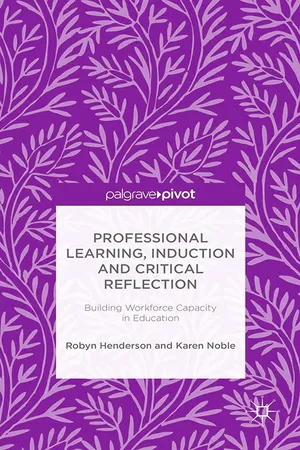
Professional Learning, Induction and Critical Reflection
Building Workforce Capacity in Education
- English
- ePUB (mobile friendly)
- Available on iOS & Android
eBook - ePub
Professional Learning, Induction and Critical Reflection
Building Workforce Capacity in Education
About this book
How should a teacher be taught? This book suggests that it is necessary to move away from the highly technicist and one-size-fits-all approaches to teaching in order to instil confidence throughout a teacher's training. Instead a pedagogy of induction should engage the student in their profession from the outset of their studies.
Information
Topic
EducationSubtopic
Education Administration1
A Pedagogy of Induction: Building Capacity
Abstract: Henderson and Noble introduce a design-based research project conducted over seven years in a regional university in Australia. The research was designed as part of five scholarly teaching-learning projects. Some projects were established initially to address the attrition of early career teachers, by creating opportunities for professional induction and transition to the world of work. The projects inform thinking that initial teacher education programs should include a strong focus on professional learning and that such an approach will build workforce capacity over time. The chapter highlights the need for individuals to identify as members of the profession from the commencement of their Education studies, to ensure that their transition to the world of work is well supported and that the teacher workforce is sustainable.
Keywords: design-based research; initial teacher education; professional induction; professional learning; transition; workforce capacity building
Henderson, Robyn and Karen Noble. Professional Learning, Induction and Critical Reflection: Building Workforce Capacity in Education. Basingstoke: Palgrave Macmillan, 2015. DOI: 10.10579781137473028.0004.
Introduction
The ideas for this book started about seven years ago, when our thinking about induction and professional learning in Education brought us to consider what we regarded as challenges for those working in initial teacher education. We were interested in how and when pre-service educators (students in the discipline of Education) began to think and act like ‘teachers’. We were concerned when we heard statistics that suggested that the attrition of ‘new’ teachers was high and that many pre-service educators would not stay long term in the teaching workforce, despite their four years of Education study (Ewing & Manuel, 2005; Verstegen & Zhang, 2012).
Pre-service educators in Australia study Education at university, enrolling in a specified number of courses, which focus individually on what are regarded as critical learnings for future teachers. Most initial teacher education programs include courses about lifespan development and learning, curriculum and pedagogy, assessment and reporting, literacy and numeracy, and so on. Yet, we all know that the expected outcomes of initial teacher education are much more than this seemingly compartmentalised learning. When ‘new’ teachers move or transition into the profession, they are expected to be able to draw together all of their learnings and to work with ‘whole’ learners and ‘whole’ curricula. In teacher education programs, sometimes it is assumed that pre-service educators will know automatically how to integrate their vast knowledge from across courses, or that their professional experience, often called ‘prac’, will provide opportunities for them to do this. We see these assumptions as sometimes problematic.
At graduation, pre-service educators are expected to be ready to make the transition from university student, or pre-service educator, to professional teacher. However, if we are serious about wanting students to be, know and do (Gee, 1996) teaching, and to be able to integrate all that they know about teaching in a seamless way, then a transition or induction to the profession at the end of university study seems a little late. Our feeling – and, when we began to think about professional induction, it was no more than a feeling – was that induction into the teaching profession needed to start at the beginning of Education study, rather than being left until the end. Professional induction from the outset, where pre-service educators could learn how to think, be, do and know (Gee, 1996) like teachers, seemed to be an idea worthy of investigation. This seemed important in light of evidence that the attrition rate of teachers has been high, with as many as 40 per cent of beginning teachers leaving or intending to leave the profession within five years of becoming a teacher (Ewing & Manuel, 2005; Verstegen & Zhang, 2012).
Such alarming statistics were a stimulus for us to think further about what learning might be useful for pre-service educators in our University context. As teacher educators, we wanted to ensure that pre-service educators were prepared to tackle whatever challenges teaching was likely to present, particularly in today’s climate of uncertainty, insecurity and unpredictability (Edwards, Ranson, & Strain, 2002). Initially, we wanted to enhance teaching and learning, but we also planned to incorporate research so that our work was research informed. We decided on a design-based research approach (Barab & Squire, 2004; The Design-Based Research Collective, 2003; Wang & Hannafin, 2005) which melded teaching and learning with research and allowed us to incorporate a strong focus on critical reflection (Macfarlane, Noble, Kilderry, & Nolan, 2006). We used the latter as a tool for students as well as for monitoring and assessing our own actions. In taking this approach, we set out to extend theoretical understandings beyond our local context (Barab & Squire, 2004).
This book, then, tells the story behind our professional induction project that has continued to morph as we have extended into new contexts. We see our approach, which provides a focus on process rather than content, as an important way to enhance professional learning and induction. Over time, our ideas have moved beyond the initial needs of our own context (Barab & Squire, 2004) – in relation to professional induction for pre-service educators – to consider the transfer of these ideas to professional learning more generally as an approach to building workforce capacity. Critical reflection has remained a mainstay. The result of our practice and research is what we have called a pedagogy of induction.
In this book, we describe the design-based research that has informed our work encompassing professional induction, professional learning and critical reflection. This first chapter outlines some insights into the context within which we operated. It then explains our chosen approach of design-based research, the multifaceted-research project that we conducted over seven years, and the five teaching-learning projects around which the research was shaped.
The broad educational context
As teacher educators, our work is located in the higher education context of an Australian university. In education, today’s world is dominated by mechanisms that measure and compare. It is clearly evident in Australia that neoliberal discourses have been operating in higher education and initial teacher education for some time. Our work as teacher educators has been impacted by the necessity for compliance with the requirements for teacher registration and teacher professional standards (Allard, Mayer, & Moss, 2014; Falabella, 2014). Yet despite these regulatory and accountability measures, recent political statements continue to pronounce teaching quality as a major social concern. In 2014, for example, an announcement by Australian Education Minister Christopher Pyne instigated a review of teacher education. According to Pyne (2014), teacher education is not ‘attracting the top students into teacher courses’ and ‘courses are too theoretical, ideological and faddish’. Pyne’s criticism of teacher quality and effectiveness and his push for teachers to be better prepared for classrooms frame teacher education in narrow and deficit terms. Indeed, from such a perspective, not only are graduating teachers regarded as deficient; so too are the teacher educators who teach them.
Pronouncements such as Pyne’s, which focus narrowly on teacher effectiveness (Skourdoumbis, 2014), imply that there is a simple solution for what would seem to be a complex problem. Improving teacher effectiveness, for example, seems to be regarded as a panacea for all things wrong with teacher education and graduating teachers. Unfortunately, experience suggests that such simplistic solutions are often accompanied by reductionist approaches to curriculum and even teaching. What concerns us is that this context is the one that our pre-service educators will face as they move into the teaching workforce. We see it as important that they have deep understandings about their future ‘work’ as teachers/educators and that they are able to articulate what they do and why. We base our thinking about professional induction on the assumption that future teachers will need to deal with the complexities of the teaching role as well as the complexities of the changing contexts of education.
It was in such times that our project originated and continues. Underpinning our project was our thinking that, through understanding the nexus between theory and practice and regarding themselves as members of the teaching profession from the beginning of their Education study, pre-service educators – future teachers – could collaboratively develop an ability to be, do and know teaching (Gee, 1996).
The research design
As already explained, our research project is an example of design-based research (Barab & Squire, 2004; The Design-Based Research Collective, 2003; Wang & Hannafin, 2005), drawing together our aims as practitioners (teachers of pre-service educators) and researchers. This form of research enabled us to incorporate both pragmatic and research aims (Wang & Hannafin, 2005) and to theorise practice and learning. It also assisted us to extend our work into various contexts with empirical evidence to support our actions. In doing this, we have been flexible in our use of methodologies and we have built theory as we have improved our own educational practice (The Design-Based Research Collective, 2003; Wang & Hannafin, 2005).
In using design-based research as our approach, we adopted the five principles described by Wang and Hannafin (2005). Firstly, our work was pragmatic, addressing practical issues that we regarded as important within the context of teacher education. We wanted to be sure that our students – pre-service educators – had opportunities to consider what have been called problems of practice (Ball & Cohen, 1999; Lampert, 1985) and to become cognisant of multiple ways that teachers might address such issues in their daily work. In other words, we wanted pre-service educators to engage with the types of issues that teachers face, whether they be problems that might occur in everyday practice (The Design-Based Research Collective, 2003), daily decision-making, pedagogical issues (Lampert, 1985), or contentious issues and topics that are taken up in the public arena as worthy of debate.
Secondly, our research was grounded in a real-life context. Our initial aim was to enhance opportunities for pre-service educators to synthesise aspects of their learning and to make clear links between theory and practice, but we also planned to investigate those opportunities and the outcomes for students by conducting research. Our project explored theoretical issues and practice, building on a research base about critical reflection (for example, Henderson, Noble, & Cross, 2013; Macfarlane et al., 2006; Ryan, 2012) and collaborative learning (for example, Gee, 1996; Lave & Wenger, 1999).
Thirdly, our work incorporated an iterative design. As Wang and Hannafin (2005) identified, research-based design incorporates iterative cycles that encompass design, action, reflection and analysis, and redesign. Our practice was revised and refined as we reflected critically on what we were doing and the outcomes. With the integration of practice and research and the ongoing redesign, modification and refinement that were embedded in our approach, flexibility was necessarily a characteristic of our work. It was important to remember that design-based research takes place in real-life settings where predictability is never guaranteed (Barab & Squire, 2004). We always operated with a particular process in mind, but to others it may have seemed that our plans were in a form that Wang and Hannafin may have described as ‘insufficiently detailed’ (p. 7). However, this was essential to the way we wanted to work and the outcomes we wanted to achieve.
Fourthly, we drew on a range of methods to ensure that our research was responsive to the needs and issues that arose (Wang & Hannafin, 2005). We used a range of data collection tools, as will be explained in the next section, and a range of theoretical resources, in keeping our plan for our work to be informed by multiple perspectives. This will be evident through the chapters that follow.
Finally, context was an important component of our research approach. The projects we instigated were designed specifically for the teacher education context within which we were working, and changes to our approach were deliberately context-specific. However, as we began to work across different contexts within our University, we started to realise that the processes were probably transferable to professional learning contexts outside the University. As will be discussed in Chapter 6, our various projects indicated possibilities for transferability.
The research project
Over a seven-year period, we used a design-based research approach (Barab & Squire, 2004; The Design-Based Research Collective, 2003; Wang & Hannafin, 2005) to examine and theorise our practice. Although we discuss research in this section and our teaching-learning projects in the next section of this chapter, this separation is an artificial one. Our teaching-learning and research were inextricably connected, but we have separated them here for the sake of clarity and ease of reading.
Our design-based research served three main purposes: to inform our current practice, to feed forward to our future practices and generate ideas for learning innovation, and to provide theories that could be shared with others (The Design-Based Research Collective, 2003) to enhance knowledge and theorisation beyond our local context. In order to accomplish these aims, we had multiple, participatory roles. We were teachers and facilitators of learning, designers and innovators, and researchers.
Most of our research was conducted in the University where we worked. Our work began initially in teacher education within a regional Australian university. However, as will become apparent in the section about our teaching-learning projects, we have extended into a global context, into another area of higher education, and into a schooling context where the focus was the professional learning of teachers. In all, five teaching-learning projects have informed our research.
We used multiple methods for collecting data during the projects. We privileged social interactions with participants as the major sources of qualitative data. These social practices (Mills, 2001), traditionally the techniques of ethnography, included informal conversations, focus-group discussions and semi-structured interviews with participants, as well as video- and audio-recorded discussions that occurred during some of the projects. These data were transcribed for analysis. We also used surveys and we kept extensive field and observation notes, which included our own reflections both in and on action (Schön, 1983).
The model of critical reflection (Macfarlane et al., 2006) that informed our teaching-learning practice also informed our research practice. The use of this model meant that we were analysing data continuously throughout the teaching–learning projects. This was important to the iterative process of data analysis that is part of both design-based research and critically reflective teaching practice. Our critical reflections incorporated the steps of theorising and thinking otherwise (Macfarlane et al., 2006), which worked to achieve the aims that were stated earlier: to inform our current practice, to feed forward to our future practices and generate ideas for learning innovation, and to build theory as a way of sharing our work beyond the local context and contributing theoretically to the field. To achieve our aims, we drew on a range of analytical tools. This will become evident throughout the remaining chapters.
The teaching–learning projects
This section describes the teaching–learning projects that have been the focus of the research that informs this book. As has already been explained, over the past seven years we have been developing an approach to professional induction and a pedagogy of induction. In total, we have been involved in five projects which, although different in many aspects, have c...
Table of contents
- Cover
- Title
- 1 A Pedagogy of Induction: Building Capacity
- 2 Foundations of a Pedagogy of Induction
- 3 Using Place and Space to Deconstruct and Confront
- 4 Theorising a Pedagogy of Induction
- 5 Thinking Otherwise about Professional Induction
- 6 Building Workforce Capacity Collaboratively
- References
- Index
Trusted by 375,005 students
Access to over 1.5 million titles for a fair monthly price.
Study more efficiently using our study tools.
Frequently asked questions
Yes, you can cancel anytime from the Subscription tab in your account settings on the Perlego website. Your subscription will stay active until the end of your current billing period. Learn how to cancel your subscription
No, books cannot be downloaded as external files, such as PDFs, for use outside of Perlego. However, you can download books within the Perlego app for offline reading on mobile or tablet. Learn how to download books offline
Perlego offers two plans: Essential and Complete
- Essential is ideal for learners and professionals who enjoy exploring a wide range of subjects. Access the Essential Library with 800,000+ trusted titles and best-sellers across business, personal growth, and the humanities. Includes unlimited reading time and Standard Read Aloud voice.
- Complete: Perfect for advanced learners and researchers needing full, unrestricted access. Unlock 1.5M+ books across hundreds of subjects, including academic and specialized titles. The Complete Plan also includes advanced features like Premium Read Aloud and Research Assistant.
We are an online textbook subscription service, where you can get access to an entire online library for less than the price of a single book per month. With over 1.5 million books across 990+ topics, we’ve got you covered! Learn about our mission
Look out for the read-aloud symbol on your next book to see if you can listen to it. The read-aloud tool reads text aloud for you, highlighting the text as it is being read. You can pause it, speed it up and slow it down. Learn more about Read Aloud
Yes! You can use the Perlego app on both iOS and Android devices to read anytime, anywhere — even offline. Perfect for commutes or when you’re on the go.
Please note we cannot support devices running on iOS 13 and Android 7 or earlier. Learn more about using the app
Please note we cannot support devices running on iOS 13 and Android 7 or earlier. Learn more about using the app
Yes, you can access Professional Learning, Induction and Critical Reflection by R. Henderson,Karen Noble in PDF and/or ePUB format, as well as other popular books in Education & Education Administration. We have over 1.5 million books available in our catalogue for you to explore.