Ane OhrvikMedicine, Magic and Art in Early Modern NorwayPalgrave Historical Studies in Witchcraft and Magichttps://doi.org/10.1057/978-1-137-46742-3_1
Begin Abstract
1. Finding Knowledge
Ane Ohrvik1
(1)
University of Oslo, Oslo, Norway
End Abstract
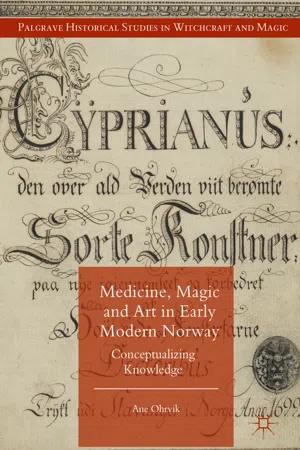
In the mid-nineteenth century F. C. Mülertz was minister in Moland in Telemark County. At this time the villagers were complaining of a man living in Moland who was notorious for his sorcery and for owning a Black Book. The minister decided to ease the villagers’ torment and put an end to the sorcerer’s practice. One day, while the Black Book owner was away from home, Mülertz instructed two assistants to collect the book from his house. From that day on, the Black Book entitled Cyprian correct Free Arts published and printed in Wittenberg Anno 1509 remained in Mülertz’ keeping until his death.1 At some point Mülertz must even have regarded the book as his—not as a confiscated object in his custody—as he added ‘Belongs to F. C. Mülertz’ to its inner cover .2
This study is about that Black Book (see Fig. 1.1) and about the many other books that were written in Norway during the early modern period, which were given similar titles and were part of similar practices . Their makers came from different social and cultural backgrounds and occupied very different positions, from parishministers , military personnel, farmers, medicinal practitioners to travellers . They all shared a desire to compile and write down pieces of knowledge they found useful, resulting in individually tailored compilations reflecting each writer’s interests and needs. The books were entitled Black Book (Svartebogen) and Cyprian (Cyprianus).
Fig. 1.1
The title page of the confiscated book from Telemark. The book is in octavo format and contains sixty-eight pages of recipes, formulas, charms and advice ranging from how to cure toothache and snake bites, how to silence your enemy in court, how to be freed of all evil, how to get people to like you and how to be invisible to animals and birds. Judging by the handwriting, the book was probably written around 1800, and the owner from whom the book was confiscated may very well also have been the initial writer of the book. As is evident from the picture, the writer’s literacy skills were limited. NB MS 8640e, National Library of Norway, Oslo
These writings were given a structure and form . Remedies and recipes were structured by paragraph heading, number and chapter and sometimes presented in a lucid table of contents at the beginning or end of the book. Head titles, introductions and statements of authorship were often placed at the beginning of the book, presenting the knowledge that followed. Furthermore, the text was organised in a concrete, material form —a book—held together by an exclusive leather binding with decorative imprints or by plain soft paper covers and thread sewn through the spine. In this way, the knowledge encompassed by the books was given a concrete, material expression. How these books express themselves and are conceptualised as books of knowledge in material form and with introductory statements, constitutes the main question of this study. Based on a collection of Norwegian Black Books dated to 1650–1850 the aim is to examine how knowledge is presented.
The presentation of knowledge in the Black Books takes different forms. The books are not merely a reflection of the knowledge held by individuals in early modern Norway , and of how this knowledge was compiled and written down. They also reflect how individual writers chose to present this knowledge as materialobjects and texts—as books to be read. I study how these books express, articulate and conceptualise knowledge, that is, how they express themselves as texts. At the same time , I study the books from a comparative cultural and historical perspective with a view to understanding and placing them in time and space.
The articulation of knowledge in the Black Books is viewed as an authorisation strategy to empower and sanction the knowledge. Material features such as binding, format and size contribute to the authorisationprocess by reflecting different conceptions of knowledge. Introductory statements such as titles , prefaces and tables of contents further articulate knowledge by identifying , describing and structuring the content of the books, thus pointing towards specific interpretations of knowledge . All these elements are scrutinised in this study not with the aim of studying the formulas and recipes constituting the main body of text, but rather the authorisation of this knowledge, conceptualised through the material form and introductory textual statements preceding it. The material and textual starting point represents a threshold between the content of the books and the cultural network of knowledge practices of which the books are a part. This viewpoint enables me to focus on the articulation of these knowledge traditions and on how this connection is executed both materially and textually.
Knowledge is situated and carries references. The situating of knowledge in the Black Books is viewed through material and textual expressions pointing to past and present experiences and practices . This study illuminates these references, determines what they entail and analyses their form , meaning and function in the books. One concrete expression of this situating process is their material and literary form as books, which places the Black Books in the history of books. It is my firm conviction that the literary relationship is crucial to understanding why Norwegian Black Books appear as they do, their authorisation strategies and how knowledge is presented.
Manuscripts, Books and Black Books
The terms manuscript, book and Black Book will all be used as references to my material. I acknowledge that their meanings differ and could be seen as contradictory, so I will briefly explain how the terms are understood and used here.
A manuscript is defined by the handwritten text it contains. My material is thus classified as manuscripts, since they only comprise of handwritten texts, which differ from texts that have been produced using a printing press. While a manuscript can represent anything from a single piece of paper to a collection of many, a book is defined by its cohesive nature, comprising a set or collection of sheets, either blank or inscribed in some way, fastened together to hinge the sheets at one side.
Within the field of book history research, definitions of what constitutes a book are often narrower (see discussion below). They often presuppose a certain dissemination of the book, which is mostly related to whether it is printed or not. Additionally, the number of authors and subjects of a text may influence its definition . Such demarcations would make it difficult to define my material as books. However, I find such understandings of what constitutes a book both anachronistic and meaningless with regard to the present corpus . They were made as books by their makers , conceived of as books by their users and, perhaps most importantly, referred to and called books by their owners. Co...
Table of contents
Cover
Front Matter
1. Finding Knowledge
2. Knowledge Cultures
3. Making Knowledge
4. Attributing Knowledge
5. Identifying Knowledge
6. Situating Knowledge
7. Instructing Knowledge
8. Organising Knowledge
9. Conceptualising Knowledge
Back Matter
Trusted by 375,005 students
Access to over 1.5 million titles for a fair monthly price.
Study more efficiently using our study tools.
Frequently asked questions
Yes, you can cancel anytime from the Subscription tab in your account settings on the Perlego website. Your subscription will stay active until the end of your current billing period. Learn how to cancel your subscription
No, books cannot be downloaded as external files, such as PDFs, for use outside of Perlego. However, you can download books within the Perlego app for offline reading on mobile or tablet. Learn how to download books offline
Perlego offers two plans: Essential and Complete
Essential is ideal for learners and professionals who enjoy exploring a wide range of subjects. Access the Essential Library with 800,000+ trusted titles and best-sellers across business, personal growth, and the humanities. Includes unlimited reading time and Standard Read Aloud voice.
Complete: Perfect for advanced learners and researchers needing full, unrestricted access. Unlock 1.5M+ books across hundreds of subjects, including academic and specialized titles. The Complete Plan also includes advanced features like Premium Read Aloud and Research Assistant.
Both plans are available with monthly, semester, or annual billing cycles.
We are an online textbook subscription service, where you can get access to an entire online library for less than the price of a single book per month. With over 1.5 million books across 990+ topics, we’ve got you covered! Learn about our mission
Look out for the read-aloud symbol on your next book to see if you can listen to it. The read-aloud tool reads text aloud for you, highlighting the text as it is being read. You can pause it, speed it up and slow it down. Learn more about Read Aloud
Yes! You can use the Perlego app on both iOS and Android devices to read anytime, anywhere — even offline. Perfect for commutes or when you’re on the go. Please note we cannot support devices running on iOS 13 and Android 7 or earlier. Learn more about using the app
Yes, you can access Medicine, Magic and Art in Early Modern Norway by Ane Ohrvik in PDF and/or ePUB format, as well as other popular books in History & European History. We have over 1.5 million books available in our catalogue for you to explore.