This book examines the development of Welsh devolution in the context of great economic and political uncertainty. Drawing on research carried out over more than a decade, it explores whether Welsh devolution has developed the capacity to resist internal and external pressures and to continue to pursue a distinctive political and policy agenda.
eBook - ePub
Devolution and Governance
Wales Between Capacity and Constraint
- English
- ePUB (mobile friendly)
- Available on iOS & Android
eBook - ePub
About this book
Information
Topic
Sciences socialesSubtopic
Politique comparée1
Devolution in Wales between Capacity and Constraint
Abstract: Cole and Stafford provide a timely examination of territorial governance and political capacity within the context of economic crisis and political change. The chapter examines the core research question: are contemporary European states – subject to powerful and converging economic, ideational and institutional pressures – driven to enforce new forms of territorial convergence? Focussing on the case of Wales, the chapter introduces the material and constructed dimensions of territorial governance and political capacity in order to provide a multi-dimensional analysis. As well as providing this analytical framework, Cole and Stafford examine the development of devolution in Wales since its introduction in 1999 and place these devolved governance arrangements within the wider comparative context.
Cole, Alistair, and Ian Stafford. Devolution and Governance: Wales between Capacity and Constraint. Basingstoke: Palgrave Macmillan, 2015. DOI: 10.1057/9781137436719.0005.
Introduction
The introduction of devolution by the Labour Government in 1999 fundamentally recast the territorial governance of the United Kingdom. Indeed, Bradbury and Le Galès (2008, p.203) note that ‘gone are the days when the view could still go relatively unchallenged that the UK was a unitary and centralised state, mostly homogeneous and integrated despite minor territorial differences’. The introduction of devolution reinvigorated debates regarding the extent to which the United Kingdom, in both the pre- and post-devolution settings, could be characterised as a ‘unitary state’, ‘union state’, ‘quasi-federal state’ or ‘state of unions’ (Mitchell, 1996, 2004, 2009; Bradbury, 1997, 2006; Bogdanor, 2003; Gamble, 2006). This book is first and foremost about Wales in an asymmetrical United Kingdom at a time of great economic and institutional uncertainty.
This process of state ‘rescaling’ has also been identified as part of a wider European trend which has arguably led to the redistribution of responsibilities between multiple levels of governance, both upwards to supranational organisations, notably the European Union (EU), and downwards to regional and sub-national territories (Rodriguez-Pose and Gill, 2003; Lidström, 2007; Lobao et al., 2009). As Loughlin (2007, p.386) argued, this process of the rescaling of responsibilities and functions across different levels of government ‘needs to be situated in the context of broader economic, political and administrative transformations that underlie the new complexity of territorial governance’. The influential but slippery concept of multi-level governance has sought to capture this complex array of phenomena (Hooghe and Marks, 2001; Bache and Flinders, 2004). The book broadly frames Welsh governance in a comparative and multi-level context, drawing on fieldwork carried out in Wales and three cognate regions (Brittany, Andalucía and Wallonia) in France, Spain and Belgium as part of the Leverhulme Trust’s International Network on ‘Territorial Governance in Western Europe: Between Convergence and Capacity’.1
In her significant contribution to the multi-level governance literature, Piattoni (2010, p.257) argues that processes of vertical and horizontal state rescaling associated with the concept are framed and mediated by state traditions or the ‘competences, knowledge and values that are associated with specific territorial jurisdictions’. The model of devolution adopted within the United Kingdom, for example, was characterised by a high degree of asymmetry, reflecting the contrasting pre-devolution contexts within England, Northern Ireland, Scotland and Wales (Bogdanor, 1999; Mitchell, 2009). Jeffery (2007, p.101) contends that the piecemeal and asymmetric nature of devolution – combined with the absence of a ‘normative underpinning for the post-devolution UK State’ – meant that ‘it is unclear amid the UK’s asymmetries and flexibilities where the limits to constitutional tinkering are, where the boundaries of legitimate devolved aspirations lie in the context of a shared statehood’. Indeed it is almost impossible to understand the processes and factors which have shaped the evolution of devolution in Wales since 1999 in isolation from wider debates regarding the constitutional future of the United Kingdom and in recent years the debates regarding Scottish independence and the continued failure to address the ‘English Question’ (Hazell, 2008; Wyn Jones et al., 2013). This book takes into account the need to engage in varying levels of analysis in order to capture the originality of Welsh governance in a comparative and multi-level context.
Most writing on devolution in the first decade emphasised legal powers, shared or incomplete competencies, executive devolution, intergovernmental relations and the development of Wales as a quasi-polity (Laffin et al., 2000; Morgan and Mungham, 2000; Rawlings, 2003; McAllister, 2005; Trench, 2007; Bradbury, 2008; Wyn Jones and Scully, 2012). These important dimensions are not absent from this book, but our core aims are rather different. We do not engage in extensive normative, political or legal reflection into likely institutional futures or identity configurations. Nor do we provide a detailed electoral sociology of the evolution of the social groups supporting or opposing devolution or voting for specific parties in elections. This field has been extensively covered elsewhere, notably by our colleagues Wyn Jones and Scully (2012). Instead the research explores the context of economic crisis, institutional uncertainty and comparative soul-searching that prevailed at the time that most of the empirical investigation took place (November 2012–July 2013).
Rather than frame devolution in terms of an inexorable progress towards a political or institutional end-game, this book emphasises contingency, doubt and dependency upon exogenous forces (Scotland, United Kingdom, EU) as much as endogenous dynamics. In particular, the book provides an examination of how conflicting pressures towards convergence and divergence have shaped the devolutionary project. First and foremost, has the economic crisis undermined or reversed the seemingly relentless trend towards devolution? Or has it, at least, limited the extent to which sub-national regional administrations are able to pursue policy variation?
The book draws on an analysis of official documents and on twenty-five core semi-structured interviews conducted in 2012–2013 in relation to three cognate groups: devolved government, sub-national or regional state actors; representatives of professional and policy communities in the fields of public finance and secondary education; and elected representatives with competence in the field, controlled for by party affiliation. The analysis also draws on earlier periods of fieldwork conducted by the two authors – in order to capture longitudinal contrasts and evolutions – though it is primarily based on the fieldwork carried out between November 2012 and July 2013.2 These interviews were analysed using computer assisted qualitative data analysis software and quotation marks are used throughout to identify key issues highlighted by this analysis. The method adopted was the most appropriate one for the task in hand. Individual interviews provide important evidence about the conduct of relationships, fuller accounts than possible in any written documents. Interviews were also valued in cognitive-normative terms as perceptions of reality articulated by actors to make sense of their role and fuse personal, institutional and professional experiences. Consistent with interpretive frames, we see no contradiction between these institutionalist and cognitive-normative dimensions (Della Porta and Keating, 2008; Bevir and Rhodes, 2003). The resulting narrative provided a mix of material and constructed realities about the evolution of Welsh devolution.
Devolution in Wales: an evolutionary perspective
The evolving nature of the devolution settlement within Wales has more than matched the characterisation of devolution by Ron Davies (1999), the former Secretary of State and architect of devolution, as ‘a process not an event’ and has existed in a state of almost permanent revolution (see Table 1.1). The latest stage in the incremental development of devolution within Wales was signalled by the resounding ‘Yes’ vote in the referendum on the Assembly’s law-making powers on 3 March 2011 (Stafford, 2011; Wyn Jones and Scully, 2012). The new powers conferred on the Assembly as a result of the referendum have been characterised as representing ‘a qualitatively different constitutional settlement for Wales’ in comparison to the limited form of ‘executive devolution’ established by the Government of Wales Act 1998 or the intermediate stage of legislative powers introduced by Part 3 of the Government of Wales Act 2006 (Miers, 2011, p.27). Under the latter arrangements the Assembly was given primary legislative powers over a limited range of matters within 20 policy fields and it was able to add matters with the consent of the UK Parliament (Navarro and Lambert, 2007). In contrast, the Assembly’s new powers, outlined in Part 4 of the 2006 Act, enable the National Assembly for Wales for the first time to develop primary legislation within all of the 20 devolved policy areas without reference to Westminster. However, these arrangements are still fundamentally shaped by the underlying principle of ‘devolution by inclusion’ rather than the general legislative competence or reserved powers model which characterises devolution in Scotland and Northern Ireland and remains subject to a range of exclusions (Miers, 2011, p.32).
TABLE 1.1 Milestones in the evolution of the Welsh devolution settlement
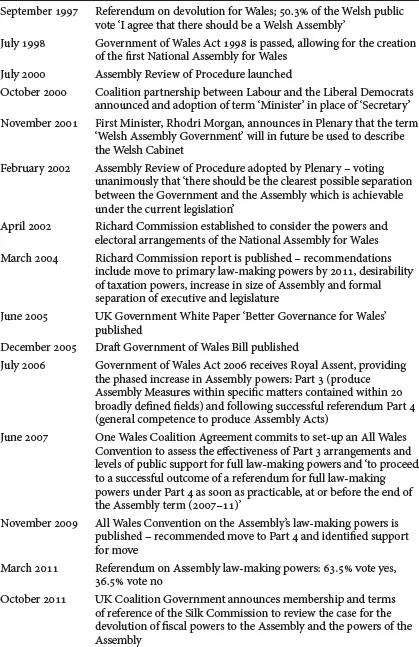
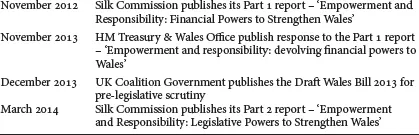
The margin of the 2011 ‘Yes’ vote (63.5 per cent voting ‘yes’, 36.5 per cent voting ‘no’) provided greater weight to the argument that devolution could increasingly be seen as the ‘settled will’ of the Welsh electorate and to a degree laid to rest the ghosts of the failed 1979 referendum and the wafer thin majority delivered by the 1997 referendum (National Assembly for Wales, 2011). However, the extent to which the post-2011 referendum settlement will endure ‘for some years to come’, as argued by Paul Murphy, the former Secretary of State for Wales, or simply mark another staging post in Welsh devolution’s journey remains open to question (BBC, 2011a). The election of the Conservative-Liberal Democrat Coalition Government at the UK level in May 2010 potentially introduced a brake on Welsh devolution given the Conservative Party’s historical antipathy to devolution and the threat of political incongruence in driving a deterioration of intergovernmental relations (Wyn Jones and Royles, 2012). However, Wyn Jones and Scully (2012, p.162) argue that the tortuous progress of the first decade of devolution could be chiefly attributed to ‘one-partyism’ within Wales and Labour’s position of power at Westminster, which dictated that ‘all the major decisions on the models of devolution to be pursued have been made within the Labour Party; the decisions made have reflected the internal politics and balance of forces within that party’. The introduction of full party political incongruence following the 2010 General Election could be seen as simply replacing a set of intra-party constraints with an inter-party dynamic.
The UK Coalition Government’s Programme for Government included commitments to introduce a referendum on further Welsh devolution and, depending on the result of the referendum, ‘establish a process similar to the Calman Commission for the Welsh Assembly’ (HM Government, 2010, p.28). In October 2011, following the successful March referendum, the Coalition established the all-party Commission on Devolution in Wales, chaired by Paul Silk, former Clerk to the National Assembly for Wales. The Silk Commission was established to ‘review the present financial and constitutional arrangements in Wales’ and its work was divided into two core parts (Commission on Devolution in Wales, 2011; see Figure 1.1).
The Silk Commission published its report on taxation and borrowing powers in November 2012 and made 33 recommendations including providing the Welsh Government with the capacity to borrow to fund capital projects and manage volatility in tax revenue, the partial devolution of income tax powers subject to a referendum and the devolution of a range of smaller taxes, such as stamp duty, landfill tax and long haul air passenger duty (Commission on Devolution in Wales, 2012 – explored in further depth in Chapter 3). The Coalition Government’s response to the Silk Commission’s initial recommendations was mixed. In his June 2013 Spending Review, George Osborne, Chancellor of the Exchequer, restated the government’s support for the devolution of borrowing powers to fund improvements to the M4, the primary transport route into South Wales (HC Deb, 2013). However, the Coalition Government failed to meet its self-imposed deadline for responding to the Part 1 recommendations in ‘Spring 2013’ and finally published its response in November 2013 (HM Treasury and Wales Office, 2013).
Part 1: Financial Accountability
To review the case for the devolution of fiscal powers to the National Assembly for Wales and to recommend a package of powers that would improve the financial account...
Table of contents
- Cover
- Title
- 1 Devolution in Wales between Capacity and Constraint
- 2 Team Wales: Narratives of Small Country Governance and Constructed Divergence
- 3 Welsh Devolution and Public Services in a Period of Economic Crisis
- 4 Wales and the Challenges of Multi-level Governance
- Conclusion Devolution in Wales: Future Challenges
- Bibliography
- Index
Trusted by 375,005 students
Access to over 1.5 million titles for a fair monthly price.
Study more efficiently using our study tools.
Frequently asked questions
Yes, you can cancel anytime from the Subscription tab in your account settings on the Perlego website. Your subscription will stay active until the end of your current billing period. Learn how to cancel your subscription
No, books cannot be downloaded as external files, such as PDFs, for use outside of Perlego. However, you can download books within the Perlego app for offline reading on mobile or tablet. Learn how to download books offline
Perlego offers two plans: Essential and Complete
- Essential is ideal for learners and professionals who enjoy exploring a wide range of subjects. Access the Essential Library with 800,000+ trusted titles and best-sellers across business, personal growth, and the humanities. Includes unlimited reading time and Standard Read Aloud voice.
- Complete: Perfect for advanced learners and researchers needing full, unrestricted access. Unlock 1.5M+ books across hundreds of subjects, including academic and specialized titles. The Complete Plan also includes advanced features like Premium Read Aloud and Research Assistant.
We are an online textbook subscription service, where you can get access to an entire online library for less than the price of a single book per month. With over 1.5 million books across 990+ topics, we’ve got you covered! Learn about our mission
Look out for the read-aloud symbol on your next book to see if you can listen to it. The read-aloud tool reads text aloud for you, highlighting the text as it is being read. You can pause it, speed it up and slow it down. Learn more about Read Aloud
Yes! You can use the Perlego app on both iOS and Android devices to read anytime, anywhere — even offline. Perfect for commutes or when you’re on the go.
Please note we cannot support devices running on iOS 13 and Android 7 or earlier. Learn more about using the app
Please note we cannot support devices running on iOS 13 and Android 7 or earlier. Learn more about using the app
Yes, you can access Devolution and Governance by Alistair Cole,Ian Stafford in PDF and/or ePUB format, as well as other popular books in Sciences sociales & Politique comparée. We have over 1.5 million books available in our catalogue for you to explore.