- English
- ePUB (mobile friendly)
- Available on iOS & Android
eBook - ePub
About this book
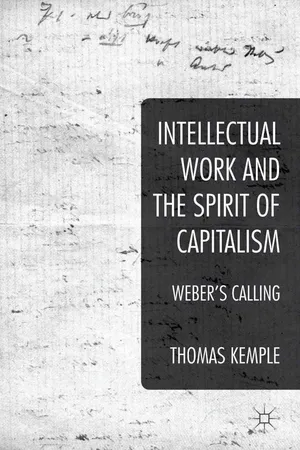
This book offers a unique and accessible way of conceptualizing the vocations of art, science, and politics in the capitalist world through an examination of some neglected features of the work of the scholar who first traced their origins and consequences in 'the West': Max Weber.
Information
Part I
Faust’s Study
The adolescent did almost no work for school, and only occasionally paid attention in class. In Tertia he secretly read all forty volumes of the Cotta edition of Goethe during class hours. He was always the youngest and the weakest in class. He remembered being ‘lazy as sin’, devoid of any ambition. He despised any kind of ‘position hunting’. He was not uncivil to his teachers, but he did not really respect them, and he often discomfited them by asking questions they were unable to answer.
(Marianne Weber, 1988:47–8)
And this the man that in his study sits.
(Christopher Marlowe, The Tragicall History of Doctor Faustus, Prologue)
1
Polemical Arts of Speaking Sociologically: Weber’s Lectern
Weber was a master of speaking without notes, a man who made the most remote things so immediate that he appeared to have just witnessed them himself, and he achieved great effects by simple means, seemingly without effort, art or rhetoric, although he did have a marvellous voice.
(Marianne Weber, 1988:309)
Despite Marianne Weber’s claim that her husband ‘did not care about the systematic presentation of his ideas’ and that he ‘attached no importance whatever to the form in which he presented’ them, I want to follow Isabelle Kalinowski’s (2005:241–68) suggestion and argue that the formal structure of his ideas, as they are expressed through the medium of speech and inscribed in print, is inseparable from their substantive content, theoretical importance, and rhetorical effect. Here and throughout this book my main examples will be Max Weber’s lectures on ‘Politics as a Vocation’ (1919) and ‘Science as a Vocation’ (1917–19), and his remarks on ‘Technology and Culture’ (1910–11). The latter in particular provides a useful point of entry into the literary and rhetorical dimensions of the scholarly vocation insofar as the transcribed and published proceedings of these remarks convey what Marianne Weber valued so highly as ‘the freshness and simplicity of the spoken word’ (1924:iii). Where each of these improvised and sometimes cryptic discussions on a range of themes offers a distinctive insight into the larger problematic (Fragestellung) of the vocations of modernity, they also display Weber’s exemplary ability to give virtuoso performances in speech and writing. I want to show how the form of Weber’s lectures and spoken commentaries display and perform an effort to distinguish the voice of sociology from the cacophony of arguments made in the name of scientificity, common sense, or professional respectability. I argue that, considered together, these lectures express, exemplify, and enact a claim regarding the validity and value of speaking sociologically about the most urgent or at least interesting issues of the present.
In an effort to create an institutional space for sociological research in the last decade of his life, Weber accepted invitations to address diverse academic readerships and public audiences to try to foster discussion among disciplines and publics while clarifying the parameters of his own field as both a distinctive method of research and a discursive genre of communication (Kaesler, 2002:159–62). His remarks on these occasions are concerned with determining the limits of scholarly thought and speech, and the possibilities of sociological writing and research, exploring their constraints and potential often by not respecting the separations between intellectual disciplines and specialized scholarly discourses (Todorov, 1976–77:59). Self-proclaimed sociologists, such as Weber’s friend Georg Simmel, nevertheless felt compelled to concede that sociology did not yet occupy an acknowledged place in the system of the sciences, as if this way of thinking is still closer to common sense than to disciplinary knowledge. As Simmel argued in the preface to his path-breaking collection of studies, Soziologie, published in 1908, the task of establishing the methods and objectives of sociology had yet to be accomplished and so cannot be presumed from the outset (1992:11). That to some extent this state of affairs still prevails today is evident from the separate discussions of methods and theories that often feature in many contributions to the field, even those that appeal to or build upon predecessors.
Weber’s initial objective in these pieces is to differentiate the tasks of sociology and other cultural sciences from the politically motivated investigations and morally charged arguments that typically characterize everyday, artistic, scientific, or political discourse. Thus he invokes the principle of value-freedom (Wertfreiheit) on each occasion – implicitly or explicitly – as a methodological postulate and a rhetorical rule for governing both the substantive content of empirical investigations and the formal conduct of intellectual discussions. This postulate defines the art of speaking sociologically, and at the same time is conditioned by criteria of value-relevance (Wertbeziehung), an acknowledgment that standards of public importance, cultural significance, and scientific interest are shaped by institutional requirements and the personal concerns of speakers, writers, listeners, and readers. These polemical performances invoke value-freedom while at the same time engaging in tactics of attack and defence, strategies of argumentation, displays of inspiration, and attempts at experimentation.
My objective here is to enumerate some of the ways in which these pieces typify the transformation of speech-acts into text-work, and to examine how they transpose discursive techniques into interpretive understanding as itself a mode of social action. Aristotle provides the classic starting point for this pragmatic approach to discourse with his definition of the rhetorical arts (techne) as ‘the ability [dynamis] in particular instances to see and comprehend [theoresai] the available means of persuasion’ (1991:36). This definition can be understood to include the arts, techniques, or skills (techne) involved in learning to hear (akouein), argue, and communicate across various contexts of utterance and reception. As a method for thinking about discourse and persuasion, rhetorical study is a necessary complement and counterpart (antistrophos) to the techniques of dialectical reasoning and demonstration (1991:28). For instance, when Weber makes a case promoting sociology as authorized discourse on matters of social, historical and cultural significance, he both conforms to and departs from the typical conditions of speech situations identified in classical rhetoric, specifically with respect to:
1.the ethos of the person speaking, in light of the speaker’s presumed sincerity or acknowledged reputation, stature or attitude, personal character or disposition, demonstrated skill or perceived ‘charisma’, and the like;
2.the logos of the occasion of utterance, including its features as a communicative situation intended to be meaningful, reasonable, and accurate or in view of how utterances are formulated to be effective, affecting, and moving;
3.the pathos of the audience, with respect to their prior expectations or presumed competencies, their supposed sympathies or anticipated responses, their interests or dispositions, and so on.
The meanings of these Aristotelian terms both differ from and overlap with modern usage, in that the notion of ethos has now taken on broader meaning as the worldview of an epoch or group of people; logos for us more narrowly denotes a ruling principle of rationality and intelligibility; and pathos is more commonly used in the more precise sense of a state of emotional arousal or empathy, often with tragic connotations. Broadly speaking, however, we can say that to reach an understanding, speakers and listeners must in some way be attuned to these shared dimensions of sense-making that constitute the preconditions for any communicative situation or meaningful social setting.
To be sure, these dimensions of speech are not always given equal emphasis or made explicit in particular contexts, since the actual character of the relationship between speakers and listeners ultimately hinges upon the demands of the occasion, which may be more or less explicit, as Erving Goffman (1981) has shown. For example, when Weber is called upon to offer a detailed reply to a lecture entitled ‘Technology and Culture’ by his colleague, Werner Sombart, he tacitly acknowledges the scholarly reputation (ethos) of the principal speaker and himself as respondent, while explicitly employing the tools of ‘sociological’ reasoning (logos) that they share with their audience (pathos). By contrast, ‘Science as a Vocation’ and ‘Politics as a Vocation’ were given at the invitation of an independent student group, and each lecture is presented as an address by an erudite expert (ethos) to a relatively non-specialized yet educated audience (pathos) concerning broad cultural themes which carry both personal and professional meaning to speaker and listeners alike (logos). On each occasion the speaker addresses an evident tension between taking a scholarly approach to an assigned topic and the need to consider the expectations and sensibilities of the audience – and perhaps anticipated future readers as well – with various competencies, concerns, and commitments. To manage these tensions, Weber goes beyond his delegated role as speaker and authorized knower (ethos) to address issues of general significance (logos) that will evoke the trust and appeal to the interests and even good humour (pathos) of his actual listeners and implied readers.
To make these features of sociological speech legible, in what follows I outline some conventions that typically characterize the scholarly lecture (whether scripted or improvised) as a communicative act aimed at reaching an understanding, as distinct from (but in some ways analogous to) political oratory and artistic performance. To show how the protocols of scholarly debate and sociological discussion are enacted at the intersection of the written text and spoken discourse, I go on to examine Weber’s symptomatic quotation of a maxim taken from Goethe’s Faust in the two vocation lectures in terms of how they employ these techniques on the plane of what I am calling sociological allegory. As spoken and written utterances, these citations both address and exemplify broader questions concerning the generation of relatively autonomous worlds that are both real and imagined, simultaneously fictional and factual. By moving between original and virtual contexts of utterance and reception, I aim to show how Weber’s linguistic conduct in these speeches exemplifies the dilemmas of his own scholarly calling as well as a larger extra-discursive problematic concerning the cultural vocations of modernity.
‘Fellow Students!’
Like the English word ‘lecture’, the German Vorlesung, which refers more specifically to a lecture given within a course or series, suggests a kind of scripted ‘reading aloud’ to listeners, just as Vortrag, which designates a talk or oral performance of some kind given on a particular occasion, implies that spoken gestures or words are ‘carried forth’ to an audience from a prepared script or text. In a lecture entitled ‘On the Future of Our Educational Institutions’, the young Friedrich Nietzsche emphasizes the oral rather than visual character of the traditional academic lecture, the function of which is to plug listeners into a vocally and textually mediated circuit of institutions:
If a foreigner desires to know something of the methods of our universities, he asks first of all with emphasis: ‘How is the student connected to the university?’ We answer: ‘By the ear, as a hearer.’ The foreigner is astonished. ‘Only by the ear?’ he repeats. ‘Only by the ear,’ we again reply … One speaking mouth with many ears and half as many writing hands – there you have to all appearances, the external academic apparatus; the university engine of culture set in motion.
(in Kittler, 2010:20–1)
Although Nietzsche could not have imagined the audiovisual lecture hall or wireless seminar room of today’s mechanized universities, he stresses the simultaneously acoustic and textual character of the auditorium or Hörsaal (literally, ‘hearing-room’) as a place where a reader speaks (usually from written notes) while listeners write. Whether improvised or scripted, interactive or monologic, instructive or moralizing, a lecture or ‘talk’ (Rede in less formal German) generally involves an attempt to understand (verstehen) as well as a process of reaching an understanding (Verständigung) through the mixed media of talk and text designed to facilitate speaking and writing, reading and listening.
In certain respects, these conventional ideas about the lecture also inform the scholarly field that Weber delineates under the name ‘interpretive sociology’ (verstehende Soziologie) in broadly rhetorical and pragmatic terms:
Understanding [Verstehen] denotes the interpretive grasp of:
(a)what was historically [or is] actually intended in an actual individual case, or
(b)what a broadly based sociological observation might conclude was, or on average, was intended, or
(c)a pure type (ideal type) of a frequently recurring phenomenon that constructs meaning or a meaning-context scientifically (‘ideal typically’). (ES2.I, ¶1:9; 2004:316; see also Appendix D).
This analytical distinction between modes of ‘interpretive understanding’ marks off a continuum from specific to general meanings, from particular events to abstract ideas, and can include any act or utterance, from ordinary speech to the formal propositions of the professional sociologist (Drysdale, 1996:79). The meaning (Sinn) and significance (Bedeutung) of a particular word, sentence, or discourse can only cohere, hang together, or make sense within certain contexts of understanding or interpretation (Sinnzusammenhänge): as a singular moment in a particular time and place; as a recognizable pattern across multiple circumstances; or as a recurring phenomenon abstractly conceptualized for analysis and explanation from a scientific point of view. Considered as an occasion of ‘understanding’ from these perspectives, a lecture may be interpreted as an event held at a particular place and time (‘ “Science as a Vocation,” 7 November 1917, Steinicke Kunstsaal, Munich’, as announced in the local newspaper); as expressing certain themes or intentions (part of a series on ‘intellectual work’, in this case, on the inner and outer conditions of scholarly life); and as idealtypically employing certain replicable conventions (an opening appeal, an ordered set of arguments, and a concluding peroration) that, considered together, allow us to compare ideal elements and recurring empirical features evident across various occasions (see appendixes A, B, and C).
In contrast with what Weber implies, these levels of understanding do not necessarily terminate in the abstract formulations and ‘objective’ explanations of the detached analyst. Rather than following a linear direction from common sense to scientific analysis, they may be treated as ‘mutually accountable’, so that the task of the sociologist is to cross-check the obviousness (Evidenz) of taken-for-granted meanings in everyday life with the epistemological objectives of certainty (Gewissheit) formulated according to scientific criteria of validity (Geltung) (O’Neill, 1995:157–76). Alfred Schutz has pioneered the radicalization of Weber’s ‘postulate of subjective understanding’ – the notion that inquiry must begin from the meanings and values that actors actually attach to social life – by arguing that scientific canons of logic, conventions of clarity, and methods of proof and verification can in some sense be made mutually comprehensible with respect to the contexts of significance and criteria of relevance provided by commonsense knowledge:
Each term used in a scientific system referring to human action must be so constructed that a human act performed within the life-world by an individual actor in the way indicated by the typical construction would be reasonable and understandable for the actor himself, as well as for his fellow-men.
(1964:85)
Schutz’s supplementary ‘postulate of adequacy’ reminds us that sociological understanding involves accounting for how claims to truth, certainty, and comprehensibility draw their meaning and significance from the worlds they describe or attempt to explain. In particular, his argument asks us to consider how intended meanings pronounced in a scientific context are inadequate or incomplete until they are addressed to a listening public that makes sense of them, or to anticipated readers who can be expected to understand them in some way as ‘reasonable’.
In short, giving and receiving a lecture involves both an act of understanding and an active process of reaching an understanding. Of course, reaching an understanding (Verständigung) does not always lead to a unifying consensus or harmonious agreement (Einverstänis), but may just as likely involve contesting the conditions under which a dispute can be fought; debating the terms by which a decision is carried out; or exposing the primary division on which a judgement (Urteil) can be made (Derrida, 1988). For instance, Weber and his listeners or readers may either agree or argue over whether the word ‘technology’ should be understood loosely as technique or narrowly as machinery; whether science in its modern sense can still be pursued as a traditional path to the good life or only as a means to attain intellectual clarity; or whether sociologists should define the modern state in terms of its monopoly on the means of legitimate violence rather than its role in the provision of welfare. In any case, Weber’s comments on these themes do not presume upon a consensus, even as they also establish some common ground and shared competence as a tacit frame of mutual reference. That is, even as they invoke a communicative situation of shared understanding and of adequacy at the level of meaning, they also open up a discursive field of battle (in the sense of the Greek polemos) and engage in fighting words performed as polemical acts and arts of speaking sociologically.
Approached from this double aspect as ...
Table of contents
- Cover
- Title Page
- Copyright
- Contents
- List of Figures
- Preamble and Acknowledgements
- Introductory Remarks: Sociological Allegory in the Age of Weber
- Part I: Faust’s Study
- Part II: Tolstoy’s Keynote
- Interim Reflections: Intellectual Work and the Spirit of Capitalism
- Appendix A – Sombart versus Weber on ‘Technology and Culture’ (1910–11)
- Appendix B – The Free Students Federation and ‘Intellectual Work as a Vocation’ (1917–19)
- Appendix C – Lecture notes for ‘Politics as a Vocation’ (1919)
- Appendix D – Outline of the interpretive sciences of action: Economy and Society (1910–20)
- Appendix E – Schema for the historical-comparative sociology of world culture: The Economic Ethics of the World Religions (1904–20)
- Bibliography
- Name Index
- Subject Index
Trusted by 375,005 students
Access to over 1.5 million titles for a fair monthly price.
Study more efficiently using our study tools.
Frequently asked questions
Yes, you can cancel anytime from the Subscription tab in your account settings on the Perlego website. Your subscription will stay active until the end of your current billing period. Learn how to cancel your subscription
No, books cannot be downloaded as external files, such as PDFs, for use outside of Perlego. However, you can download books within the Perlego app for offline reading on mobile or tablet. Learn how to download books offline
Perlego offers two plans: Essential and Complete
- Essential is ideal for learners and professionals who enjoy exploring a wide range of subjects. Access the Essential Library with 800,000+ trusted titles and best-sellers across business, personal growth, and the humanities. Includes unlimited reading time and Standard Read Aloud voice.
- Complete: Perfect for advanced learners and researchers needing full, unrestricted access. Unlock 1.5M+ books across hundreds of subjects, including academic and specialized titles. The Complete Plan also includes advanced features like Premium Read Aloud and Research Assistant.
We are an online textbook subscription service, where you can get access to an entire online library for less than the price of a single book per month. With over 1.5 million books across 990+ topics, we’ve got you covered! Learn about our mission
Look out for the read-aloud symbol on your next book to see if you can listen to it. The read-aloud tool reads text aloud for you, highlighting the text as it is being read. You can pause it, speed it up and slow it down. Learn more about Read Aloud
Yes! You can use the Perlego app on both iOS and Android devices to read anytime, anywhere — even offline. Perfect for commutes or when you’re on the go.
Please note we cannot support devices running on iOS 13 and Android 7 or earlier. Learn more about using the app
Please note we cannot support devices running on iOS 13 and Android 7 or earlier. Learn more about using the app
Yes, you can access Intellectual Work and the Spirit of Capitalism by Thomas Kemple in PDF and/or ePUB format, as well as other popular books in Politics & International Relations & Political Philosophy. We have over 1.5 million books available in our catalogue for you to explore.