eBook - ePub
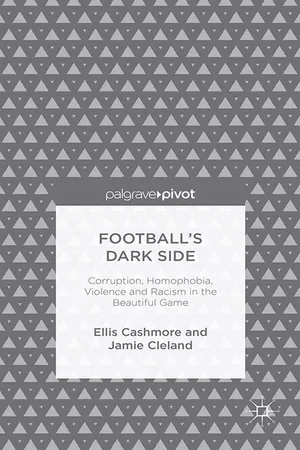
Football's Dark Side: Corruption, Homophobia, Violence and Racism in the Beautiful Game
- English
- ePUB (mobile friendly)
- Available on iOS & Android
eBook - ePub
Football's Dark Side: Corruption, Homophobia, Violence and Racism in the Beautiful Game
About this book
Association football is the richest, most popular sport in history with a multicultural global following. It is also riven with corruption, racism, homophobia and a violence that has for decades resisted all attempts to tame it. Cashmore and Cleland examine football's dark side: the unpleasant, sleazy and downright nasty aspects of the sport.
Information
1
Introduction
Abstract: Not only is associationtball the world’s most popular participation and spectator sport, but it is also the most ethnically, nationally and religiously complex. It is so genuinely multicultural that if one were to design a sport to reflect accurately the ethnic diversity of the world, it would resemble football. The sport’s world governing organization represents 209 national associations, 54 from Europe, 53 from Africa, 45 from Asia, the others from the Americas. But the sport has a dark side: it is riven with corruption, homophobia, violence and racism that seemingly can’t be tamed. In this chapter, the authors announce their intention to explore football’s dark side through the thoughts of the people who follow it – fans.
Cashmore, Ellis and Jamie Cleland. Football’s Dark Side: Corruption, Homophobia, Violence and Racism in the Beautiful Game. Basingstoke: Palgrave Macmillan, 2014. doi: 10.1057/9781137371270.0002.
Disorder, destruction and injury
Association football is the most popular game in the world. Historically, it is at its peak of global popularity: practically every nation watches and plays a game that has its origins in wild and raucous medieval ball games played in English villages on religious holidays. Its rules codified and institutionalized by England’s Football Association (FA) in 1863, the sport diffused to continental Europe and South America in the first half of the twentieth century, then to Africa and Asia. FIFA, the acronym for Fédération internationale de football association, was formed in 1904 as the governing organization for the football-playing world. It now represents 209 national football associations, 54 from Europe, 53 from Africa, 45 from Asia and the others from the Americas. The final game of FIFA’s World Cup tournament of 2010 in Souh Africa was screened in every country and reached 3.2 billion people around the world, or 46.4 per cent of the global population (based on viewers watching a minimum of over one minute of coverage).
The sport has received lavish attention from writers. Autobiographies and coffee table books share space on the bookshelves with the scholarly analyses of psychologists, anthropologists, sociologists and sport scientists. Critical inspections have exposed iniquities in both the governance of the sport and its operations. Andrew Jennings’ Foul! The Secret World of Fifa: Bribes, Vote Rigging and Ticket Scandals (2006) and Badfellas: Fifa Family at War (2003) by John Sugden and Alan Tomlinson are among them. This book is part of this tradition – though with a difference. Rather than look exclusively at the impropriety, if not downright criminality, of those charged with the responsibility of running the global game, we examine the sport as a whole.
On the surface, football is as glamorous as any branch of the entertainment industry, its top players vying with movie stars and rock musicians for a place on the A-list, its fans committed with a zeal that makes fans of other sports seem almost indifferent by comparison. Originating amid the industrial revolution in the nineteenth century, it survived two world wars, and, indeed between them established an international competition that now vies with the Olympic Games as the most prestigious tournament in sport. As several academic studies have shown, it commands the dedication of its followers with a sense of obligation rivalled only by that of the church.
Seen this way, football is a blessing, bringing happiness, unity, fulfilment and excitement to millions. But there is another side to the sport. The spectacle of young working-class men kicking makeshift balls in what seemed a parody of the games played in public schools, such as Eton, Harrow and Rugby, in the 1840s, alarmed many. “Street football,” writes historian Hugh McLeod, was “seen as a source of disorder, destruction of property and sometimes severe injury to participants” (2013: 112). This may have been the first attribution of social problem status to what was after all innocent amusement. Since then, the sport has been identified as the source of all manner of unwelcome developments. Often the attributions have been spurious, but sometimes there are grounds for believing football has been culpable.
For instance, football has never properly rid itself of a type of violence that had been integral to its history. The concerns cited by McLeod have never totally disappeared and, even in the present, violence remains part of football’s makeup (events in Bristol, England, in Autumn 2013, confirmed this.) Practically every country where association football is played has experienced some form of crowd violence, often resulting in injuries, sometimes in deaths. The most tragic incident in football history occurred in 1964 when 318 people were killed and over 500 injured in Lima at a game between Peru and Argentina. It is known as the Estadio Nacional disaster.
For all its pretensions to be a multicultural sport that brings together diverse cultural groups into the football family, association football is a white man’s sport. It was created by white men, for white men and remains largely in the control of white men. There is a “white establishment,” as Jonathan Long and Kevin Hylton call it, “a white establishment that is allowing black players to play its white game” (2002: 99).
The sport has diversified, particularly since the 1960s: 17 African countries entered the qualification process for the 1966 FIFA World Cup. But it has also wrestled with a current of racism that has run through football’s culture. It’s almost unbelievable that racism appears in a sport with such a multicultural character, but, somehow, it survives and, depressingly, flourishes in some parts of the world. The sport’s governing organizations have squirmed in embarrassment as the fans on whom they ultimately depend have expressed bigotry that sits oddly in a sport that prides itself on its inclusivity.
Racism isn’t the only irrational antipathy that thrives in football. Homophobia, the aversion to homosexuality and gay people, presents another challenge. The problem is somewhat amorphous in the sense that there are no discernible targets. As football culture appears to prohibit gay players from coming out, there are few tangible targets for homophobic abuse. Football may yet be the last major sport to boast that it harbours no prejudices. It stands to reason that in a sport played by about 200,000 professionals, only a few have declared themselves to be gay. It can be reasonably assumed that football is a prohibitive environment for gay people.
No major sport is virginally pure. Boxing has an epic history of skull-duggery; baseball has had more than its fair share of scandals. Even the gentlemanly sport of cricket has a full set of skeletons in its closet. We could list every sport and find episodes, cases or enduring scandals it would rather forget or submerge. Football is no different in this respect. We could easily have written about the dark side of practically any globally popular sport; but we chose the most globally popular.
Reason? Since 2010, we have developed an online research platform that allows us to understand what football fans think and feel about, well, practically anything regarding sport. Once on the platform, the fans can state their opinions, advance arguments, hazard guesses, make observations, analyse problems, propose solutions, imagine, surmise, propound, venture, submit and just make known what they think. We have designed the questions we pose on topfan.co.uk in a way that provokes comment rather than offers checkbox answers. Over the years, we have themed projects, some of them on other areas of cultural life away from football, but most of them on what we consider the big issues of the day. Starting with a project on homophobia in football, we progressed through all the territories we will be covering in this book, enabling us to draw a picture of the football landscape as seen through the eyes of fans. It is a unique vista. Collectively, 10,000 fans have contributed to the picture we present in this book. We combine this with our own commentary which we hope keeps the text cogent and intelligible; but the arguments are driven by the evidence we have gathered from fans.
This makes the book a hybrid: not a straightforward monograph based on empirical material, nor a textbook that conforms to any established standard, nor even an essay that focuses on a particular subject though without the need to support every argument with proof. In fact, it isn’t even a book in the conventional sense of the word: Football’s Dark Side is available only online and, as such, is designed to be read on a screen rather than paper. As we use evidence generated online throughout, this is a complementary format.
A perfect example of fair play?
Beware of leaders who want to explain what should be self-evident: sport is a force for good. “Children need strong values to grow up with, and football, being a team sport, makes them realize how essential discipline, respect, team spirit and fair play are for the game and for life,” asserted Sepp Blatter.
Of course, children need strong values and, of course, respect, team spirit and fair play are moral precepts no one would dare question. But when Blatter, the president of football’s international governing organization, advanced the sport he represented as an exemplar of such precepts, he sounded like the owner of a lap dancing club preaching the virtues of celibacy.
Blatter was speaking at the annual meeting of FIFA’s Fair Play Day in 2010. FIFA was formed in 1904 and is based in Zurich, Switzerland. “I expect players, officials and fans to set a perfect example of fair play,” declared Blatter. Even by the standards of sports organizations’ leaders, this seemed a futile hope; and if it was, as Blatter said, an expectation, it was a naïve one.
Blatter’s predecessor João Havelange, who headed FIFA between 1974 and 1998, was one of the leading figures in the history of association football’s governing organization. He took over the governing body in 1974 and remained in an honorary position after Blatter took over in 1998. In May 2013, a FIFA internal ethics committee report served as final confirmation of Havelange’s long suspected complicity in bribery. The report indicated he personally received over £1 million, though about £150m was estimated to have changed hands illicitly in a corruption case that stretched back to 1992. Havelange, by then 96, had resigned his honorary position in the organization a month before. The case raised serious doubts over world football’s governing federation’s integrity. It was far from the first time FIFA and, indeed the sport, had been at the centre of a major scandal: the first major case was in 1915, when a game between Manchester United and its arch-rival Liverpool was fixed in a way that allowed players to take advantage of betting odds.
The game has an almost iconic place in football’s history: barely staving off relegation, the hapless Manchester team pulled off an upset 2–0 win over Liverpool, then riding high. The Liverpool team’s apparent lackadaisical approach prompted the referee to raise suspicions in his official match report to the English Football Association. The FA’s investigation concluded seven players – four Liverpool and three Manchester – were guilty of conspiring to fix the match and take advantage of 7–1 odds. Compounding the offence, the Gaming Act of 1845 prohibited gambling in Britain; off-track gambling didn’t become legal until the liberalizing reform of 1960.
Unlike the majority of other major sports that had their origins in Britain, football had no amateur ethos to protect. Cricket, rugby, tennis, track-and-field and many other sports were devotedly amateur and committed to amateur ideals. Football had officially been a professional sport since 1885 and, unofficially, for many years before. Players competed for money, not the kind of prize money pugilists fought for, but wages paid by the clubs. Like their American counterparts in baseball, the players were often poorly paid and sought to supplement earnings through gambling. Around the same time as the Manchester United-Liverpool fix, baseball had its much better known betting case known as the Black Sox Scandal, of 1919. Eight players from the Chicago White Sox were accused of throwing the series against the Cincinnati Reds; all of the players involved were banned from baseball because of their links to gamblers.
Since then baseball has become accustomed to scandals and crises of one kind or another, though football has largely escaped stigma, either by denials or by claiming cases of matchfixing have been isolated and unrepresentative. In truth, venality has been as much part of the sport as goalposts and offside. Every sport that has either embraced, welcomed or just tolerated professionalism has had to contend with an incontrovertible truth: money corrupts.
No one has ever believed football is a sport for choirboys or squeaky-clean players whose worst vice is a nicotine patch. Equally no one likes to believe that football is a sport purged of goodness. But it probably is. Since the Manchester United–Liverpool case, there have been instances of matchfixing, bungs, bribed referees and several other kinds of transgressions. Between 2008 and 2011, Europol (European Police Office – the European Union’s law enforcement agency that handles criminal intelligence) said it had identified 680 suspicious games, of which 380 took place in Europe. The matches included World Cup qualifiers and the European Champions league.
This seemed to square with an earlier confession by German referee Robert Hoyzer, who, in 2005, owned up to having rigged games. The German Football Federation found Hoyzer, along with five other defendants, guilty of matchfixing; they were imprisoned. Germany was one of five European nations implicated in an investigation by Europol into the extent of matchfixing in Europe and beyond. We will document this and many other cases in the chapters to come; cumulatively they offer an image of a sport that embraced professionalism in 1885 and has lived with the consequences since. Where money goes, corruption it seems follows.
Impossible to come out
Two months before the Havelange case, in a completely unrelated incident, the American-born football player Robbie Rogers, who had played for Leeds United, among other clubs, announced he was retiring at the surprisingly young age of 25. The reason was not an incapacitating injury or a dramatic loss of form: he timed his coming out with his resignation simply because he believed his life would be intolerable as a gay man in a professional world where, ostensibly, there were no other gays. As a gay man, Rogers felt it was time to make his sexuality known. There were no other openly gay players in professional football at the time, and he felt his life would be intolerable. It seemed a regrettable but plausible reason, though one that made professional football culture appear an unremittingly bigoted environment. “In football it’s obviously impossible to come out – because no-one has done it. No one,” he declared.
Gay players had been conspicuously absent from association football. Every so often, a former player would publish a biography in which he would make a long-delayed announcement. The East German player Marcus Urban was one such player: his Hidden Player: The Story of the Gay Footballer Marcus Urban (Versteckspieler: Die Geschichte des schwulen Fußballers Marcus Urban), described how he retired from football in the 1980s when his career was peaking solely because he felt the pressure to conceal his sexual identity had become intolerable: “The choice was soccer or my life.” In common with many athletes, Urban opted to come out only after the end of his competitive career, which was, as he admits, abbreviated by the torment of having to hide his proclivities.
Only one professional footballer had ever come out while he was playing, and, even then, under duress: when, in 1990, Justin Fashanu was told that a British newspaper was ready to run a story about his alleged affair with a male politician, he took pre-emptive action, selling his disclosure to the media. A born-again Christian, Fashanu was found hanging in 1998; he had committed suicide. After his death, no other professional player declared himself gay during his active playing career. American basketball player Jason Collins made history by becoming the first openly gay NBA player and semi-professional Anton Hysén att...
Table of contents
- Cover
- Title
- 1 Introduction
- 2 Corruption
- 3 Homophobia
- 4 Violence
- 5 Racism
- 6 Conclusion: Why Study the Dark Side?
- Bibliography
- Index
Trusted by 375,005 students
Access to over 1.5 million titles for a fair monthly price.
Study more efficiently using our study tools.
Frequently asked questions
Yes, you can cancel anytime from the Subscription tab in your account settings on the Perlego website. Your subscription will stay active until the end of your current billing period. Learn how to cancel your subscription
No, books cannot be downloaded as external files, such as PDFs, for use outside of Perlego. However, you can download books within the Perlego app for offline reading on mobile or tablet. Learn how to download books offline
Perlego offers two plans: Essential and Complete
- Essential is ideal for learners and professionals who enjoy exploring a wide range of subjects. Access the Essential Library with 800,000+ trusted titles and best-sellers across business, personal growth, and the humanities. Includes unlimited reading time and Standard Read Aloud voice.
- Complete: Perfect for advanced learners and researchers needing full, unrestricted access. Unlock 1.5M+ books across hundreds of subjects, including academic and specialized titles. The Complete Plan also includes advanced features like Premium Read Aloud and Research Assistant.
We are an online textbook subscription service, where you can get access to an entire online library for less than the price of a single book per month. With over 1.5 million books across 990+ topics, we’ve got you covered! Learn about our mission
Look out for the read-aloud symbol on your next book to see if you can listen to it. The read-aloud tool reads text aloud for you, highlighting the text as it is being read. You can pause it, speed it up and slow it down. Learn more about Read Aloud
Yes! You can use the Perlego app on both iOS and Android devices to read anytime, anywhere — even offline. Perfect for commutes or when you’re on the go.
Please note we cannot support devices running on iOS 13 and Android 7 or earlier. Learn more about using the app
Please note we cannot support devices running on iOS 13 and Android 7 or earlier. Learn more about using the app
Yes, you can access Football's Dark Side: Corruption, Homophobia, Violence and Racism in the Beautiful Game by Ellis Cashmore,J. Cleland in PDF and/or ePUB format, as well as other popular books in Social Sciences & Criminology. We have over 1.5 million books available in our catalogue for you to explore.