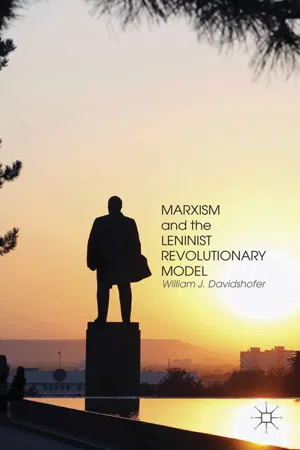
- English
- ePUB (mobile friendly)
- Available on iOS & Android
eBook - ePub
Marxism and the Leninist Revolutionary Model
About this book
This book explores Marxist and Leninist revolutionary theory. Topics include: the philosophical dialectic, historical materialism, the revolutionary movement, and Communist cadre political rule in the socialist state. Emphasis on Lenin's wartime political treatment of imperialism, national self-determination, and socialism in one country.
Information
CHAPTER 1
Foundations of Marx’s Thought
Biography of the Young Karl Marx
Karl Marx (1818–1883) was born into a solid middle-class family and grew up in the city of Trier (Trèves in French) in the Rhineland area of Germany. His father was a middle-rung government bureaucrat. At the age of 25, in 1843, Marx married Jenny von Westphalen. They remained a devoted couple throughout their lives, with a family of five children, one of whom died at an early age. The family had to endure a rather harsh life because Marx, after completing his formal education, immediately embarked upon a career of revolutionary writing that left him with no stable source of income and led government officials to consider him as a persona non grata. At times the Marx family was assisted financially by Frederick Engels (1820–1895), whose father was a well-off industrialist. Marx had met Engels for the first time in 1844. Engels, who became Marx’s lifelong collaborator, was distinguished for his own intellectual writings.
From an early age Marx showed signs of being a brilliant intellectual, and, at the age of 17, at the behest of his father, he enrolled at the University of Bonn to study law. The city of Bonn, located in the Rhineland, had a reputation for a bohemian lifestyle, to which the young Karl Marx seemed to be naturally attracted. Marx’s father therefore thought it better for his son to continue his study of law at the University of Berlin, because it would be a more conservative environment for a serious, professional approach to academics. However, the University of Berlin had become a breeding ground for a radical-Left strain of Hegelian philosophical thought; the change of universities therefore proved to be a miscalculation on the part of the elder Marx. His son immediately switched to the study of philosophy and became identified with the radical-Left strain of Young Hegelian philosophical thought.
Marx completed his doctoral dissertation at the University of Jena in 1841 at the age of 23. His dissertation dealt with classical materialist philosophy. It showed a preference for the voluntaristic materialism of Epicurus (342–270 BC) over the deterministic materialism of Democritus (460–357 BC). His advocacy of a voluntaristic materialism would later play a prominent role in Marx’s notion of revolutionary praxis.
In October 1842, Marx accepted a position as editor of Rheinische Zeitung (Rhineland Daily), a newspaper supported by industrialists who wished to clear away the feudal economic restrictions of landlords’ political power blocking the full-fledged development of capitalism in Germany. Marx used that role to embarrass the government about its economic policies in a way that would promote the political cause for the establishment of liberal democracy, which the capitalist industrial class saw as a movement in line with their interest in full-fledged political rule. Eventually, Marx’s articles prompted the government to suppress the newspaper in March 1843. Marx then agreed to become editor of a publication to be called Deutsch-Französische Jahrbücher (German-French Yearbooks), to be published in Paris. The publication would combine Left-wing Hegelian philosophical thought with rising French socialist thought. While awaiting his marriage to Jenny von Westphalen, Marx spent the summer and fall of 1843 at the family summer house of his fiancée, reviewing articles submitted for publication in the German-French Yearbooks. Then in the fall 1843, Marx and his wife relocated to Paris. Already influenced by Ludwig Feuerbach’s materialist framework of Hegelian thought, it was at this time that Marx was able to also thoroughly review the writings of the German Young Hegelians, Bruno Bauer and Moses Hess, and the French socialist, Pierre Proudhon.
The Framework of “Self-Consciousness” in Hegelian Philosophy
The substance of Hegelian philosophy was set forth by Georg Wilhelm Friedrich Hegel (1770–1831) in four of his basic works: Phenomenology of the Spirit (1807), Science of Logic (1816), Philosophy of Right (1824), and Philosophy of History (1831). Our concern with Hegelian philosophy focuses on the theme of “self-consciousness” (selbstbewusstsein), which Hegel first developed in Phenomenology of the Spirit. Self-consciousness refers to the thought of the human subject taking itself to be the object of its consciousness rather than being a contingent object of otherness in the sense consciousness of material necessity of physical nature. As such, self-consciousness in Hegelian philosophy was the basis of a free, self-determining human subject. Under the general heading of “Self-Consciousness” in Phenomenology of the Spirit, Hegel first treats the quest for the “Truth of Self-Certainty” of consciousness in the destruction of the very world of sense consciousness as the basis of a contingent consciousness. The subject tries to achieve this consciousness through the annihilation of physical nature through human consumption under the heading of “desire,” as in the appetite for food. But this proves to be ineffective because desire is forever regenerating, and the reality of an external world of physical nature ever apparent. Thus in his following section under the heading of “Independence and Dependence of Self-Consciousness: Lordship and Bondage,” Hegel declares that what self-consciousness must do to validate itself as an independent self-consciousness, that is, as a free, self-determining human subject, is to recognize its universal identity with other self-conscious human beings as a universal self-consciousness, and that must be done by having that universal self-consciousness validated in being recognized by other human beings. Hegel therefore writes: “Self-consciousness exists in and for itself when and by the fact that, it so exists for another; that is, it exists only in being acknowledged.”1
Following such logic the mutual recognition of self-conscious subjects would seem to be in order and Hegel previewed such a mutual recognition in the expression of an “‘I’ that is ‘We’ and ‘We’ that is ‘I.’”2 The mutual validation of self-consciousness would find expression in the mutual respect for the rights of others as free, self-determining human beings, in identifying with self. Hegel expresses this mutuality in the following terms:
The first does not have the object before it merely as it exists primarily for desire, but as something that has an independent existence of its own, which, therefore, it cannot utilize for its own purposes, if that object does not of its own accord do what the first does to it. Thus the movement is simply the double movement of the two self-consciousnesses. Each sees the other do the same as it does; each does itself what it demands of the other, and therefore also does what it does only in so far as the other does the same. Action by one side only would be useless because what is to happen can only be brought about by both.3
This proposition clearly draws on the neo-Kantian principle of mutual respect for the dignity of the human being, requiring that each individual subject be treated as an end in itself and never simply as a means to the ends of another.4
Self-Consciousness in the Narrative of Lordship and Bondage
Such mutual recognition of personhood does not come about easily, however, as in the logic of the philosopher. Rather it occurs only through a long process of historical struggle and development through the dialectic of human conflict, which Hegel elaborates in greatest detail in Philosophy of History. In the section of the Phenomenology titled “Independence and Dependence of Self-Consciousness: Lordship and Bondage,” Hegel broaches an opening framework to the dialectic of historical human conflict that would form a seminal foundation to Karl Marx’s later philosophical construct of historical materialism.
Hegel’s account of the Lordship and Bondage narrative begins with a life-and-death struggle between two self-conscious subjects in a raw state of nature. While there are conflicting interpretations of Hegel’s account of why such a life-and-death struggle must be so, the best interpretation seems to be the following scenario: one self-consciousness must put his life at risk at the hands of another self-consciousness to prove to the other self-consciousness that he is worthy of recognition as a free, self-determining human subject, that is, to prove that he is not a contingent object of sense consciousness tied to the physical necessity of life. At the same time, he must spare taking the life of the other self-consciousness because a corpse cannot validate his own self-consciousness. But at this point, he does not accord the vanquished self-consciousness the rights of a free, self-determining person, because respect for such rights would limit the absolute freedom of the victor. Instead the victor subjects the vanquished to his own bondage.5
The outcome of the Lordship and Bondage relationship is one in which the servitude of the labor of the bondsman is made to serve the physical needs of the lord. But here there is a dialectical turnabout in the status of both the lord and the bondsman. On the one hand, the lord in securing the obedience of the bondsman does not achieve any genuine sense of self-consciousness. There can be no genuine validation of the self-consciousness of the lord by the bondsman because the bondsman has compromised his own self-consciousness as a free, self-determining subject in accepting his own servitude, and hence the capacity to validate the self-consciousness of the lord. At the same time, the bondsman in his forced service to the lord does experience a unique sense of his own self-consciousness in his labor. In the objects that he fashions for the Lord from physical nature the bondsman sees his own thought as a human subject taking itself to be the object of his consciousness: he sees in the creativity of his craftsmanship a reflection of his own intellect and will, a self-made world of his own self-identity. Hegel writes of the labor of the bondsman:
in fashioning the thing, he [the bondsman] becomes aware that being-for-self belongs to him, that he himself exists essentially and actually in his own right. The shape does not become something other than himself through being made external to him; for it is precisely this shape that is his pure being-for-self, which in this externality is seen by him to be the truth. Through this rediscovery of himself by himself, the bondsman realizes that it is precisely in his work wherein he seemed to have only an alienated existence that he acquires a mind of his own.6
Commenting on what he terms the “models and archetypes” of the craftsmanship created by the bondsman in his labor for the lord, the Hegelian scholar, Charles Taylor, writes: “He [the bondsman] thus sees in the world of objects made by him the reflection of himself as a universal, as a thinking being. This passage [of the consciousness of the bondsman into a self-consciousness] shows how much Hegel’s philosophy...
Table of contents
- Cover
- Title
- 1 Foundations of Marx’s Thought
- 2 Marx: Historical Materialism and Economics
- 3 Marx: The Revolutionary Movement and State
- 4 Lenin: The Revolutionary Party and Movement
- 5 Lenin: Imperialism and National Self-determination
- 6 The April Theses and The State and Revolution
- 7 Soviet Rule under Lenin
- Epilogue Marxist and Leninist Revolutionary Theory Compared
- Index
Trusted by 375,005 students
Access to over 1.5 million titles for a fair monthly price.
Study more efficiently using our study tools.
Frequently asked questions
Yes, you can cancel anytime from the Subscription tab in your account settings on the Perlego website. Your subscription will stay active until the end of your current billing period. Learn how to cancel your subscription
No, books cannot be downloaded as external files, such as PDFs, for use outside of Perlego. However, you can download books within the Perlego app for offline reading on mobile or tablet. Learn how to download books offline
Perlego offers two plans: Essential and Complete
- Essential is ideal for learners and professionals who enjoy exploring a wide range of subjects. Access the Essential Library with 800,000+ trusted titles and best-sellers across business, personal growth, and the humanities. Includes unlimited reading time and Standard Read Aloud voice.
- Complete: Perfect for advanced learners and researchers needing full, unrestricted access. Unlock 1.5M+ books across hundreds of subjects, including academic and specialized titles. The Complete Plan also includes advanced features like Premium Read Aloud and Research Assistant.
We are an online textbook subscription service, where you can get access to an entire online library for less than the price of a single book per month. With over 1.5 million books across 990+ topics, we’ve got you covered! Learn about our mission
Look out for the read-aloud symbol on your next book to see if you can listen to it. The read-aloud tool reads text aloud for you, highlighting the text as it is being read. You can pause it, speed it up and slow it down. Learn more about Read Aloud
Yes! You can use the Perlego app on both iOS and Android devices to read anytime, anywhere — even offline. Perfect for commutes or when you’re on the go.
Please note we cannot support devices running on iOS 13 and Android 7 or earlier. Learn more about using the app
Please note we cannot support devices running on iOS 13 and Android 7 or earlier. Learn more about using the app
Yes, you can access Marxism and the Leninist Revolutionary Model by W. Davidshofer in PDF and/or ePUB format, as well as other popular books in Politics & International Relations & Political Philosophy. We have over 1.5 million books available in our catalogue for you to explore.