- English
- ePUB (mobile friendly)
- Available on iOS & Android
eBook - ePub
About this book
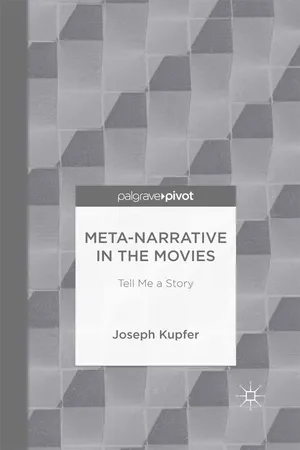
Meta-Narrative in the Movies investigates narrative theory through close analysis of films featuring stories and storytelling. The cinematic interpretations investigate the role of story creation in knowing ourselves and planning our future, in structuring social relationships, and in sharpening our experience of popular culture.
Information
Subtopic
Art General1
Narrative Theory, Intelligibility and the Good Life
Abstract: Philosophical discussion of the importance of narrative has blossomed during the past several decades, propelled by Alasdair MacIntyre’s insightful work in After Virtue. MacIntyre argues that without some narrative structure, the lives and actions of individuals will be lacking in intelligibility. Actions and events need to be formulated as episodes in a narrative to have meaning, whether for us individually or for social groups. At its most ambitious, narrative theory claims that persons simply are narrative constructions or are constituted through narrative. The more modest view holds that people typically view their lives through the prism of stories and doing so is advantageous in diverse ways. The position taken in the book falls in between these two extremes: narrative is needed for self-understanding, decision-making and social interaction.
Keywords: evaluative criteria; narrative theory; self-understanding; self-creation; social relationships; revision
Kupfer, Joseph. Meta-Narrative in the Movies: Tell Me a Story. Basingstoke: Palgrave Macmillan, 2014. DOI: 10.1057/9781137410887.0005.
Narrative, identity and self-understanding
Before we pursue narrative through films that thematize stories and storytelling, we need a working understanding of narrative theory. This theoretical outline will then be elaborated upon as we interpret the films. Philosophical discussion of the nature and importance of narrative has proliferated during the past several decades, much of it in response to Alasdair MacIntyre’s insightful analysis in After Virtue. Narrative theory, narratology, harbors a range of position. At its most ambitious, narratology makes the ontological claim that human beings simply are narrative constructions or are constituted through narrative. Nietzsche may have been an early advocate of this view, when he counsels us to “be the poets of our own life.”1 As Alexander Nehamas reads Nietzsche, we create ourselves through a personal narrative modeled on literature. The self is well wrought depending upon the extent to which it captures the coherence possessed by “perfect literary characters.”2 Contemporary philosophers offer a similar endorsement of the ontological contribution of narrative. Charles Taylor argues that, “our interpretation of ourselves is constitutive of what we are.”3 This is an extreme position, one that must answer several difficult objections.
At its most modest, narrative theory holds that people often view their lives with the help of stories and that doing so yields diverse advantages for deliberation and action. The idea is that narrative may clarify or guide on a piecemeal basis, given a particular situation or aim, but narratives are not necessary to connect discrete events or to bestow meaning on our lives as a whole. We are employing a mid-level, MacIntyrean view. It takes a moderate stance on the role of narrative in self-creation, but a robust position on the place of narrative in understanding human action and personhood. Because the intelligibility of people and their actions is more central for our purposes, we will begin with it.
We cannot function as agents or persons without relying upon a story about ourselves, even though that story is incomplete and revisable. On the phenomenological plane, we experience ourselves in narrative terms and narrative is essential to understanding ourselves and other people. MacIntyre argues that recourse to storytelling is needed to make the actions and lives of individuals intelligible. In order for behavior to be seen as the actions of people, it must be understood as purposeful, as the expression of intention and motivation. Understanding people and their actions depends upon the creation of a matrix of episodes integrated into a story.4 Only through narrative can actions be driven by reasons and not merely causes. Only through narrative can these reasons be hooked up to one another, as well as to relevant desires and emotions. The incidents of a life must fit together within the story of a person whose purposes and intentions give them meaning; therefore, we require “a concept of a self whose unity resides in the unity of a narrative.”5 This is why MacIntyre argues that, “narrative history of a certain kind turns out to be the basic and essential genre for the characterization of human actions.”6 Creating a narrative for ourselves, then, is necessary to self-understanding.
Because stories provide the context for meaning, we cannot first identify events or episodes and then stitch them together into a narrative. Instead, they are from the outset individuated and understood as part of a narrative because “what counts as a distinct event in one narrative may not in another.”7 Narrative supplies a web of social relationships, desires and purposes that individuate occurrences, making them stand out as these particular events within the undifferentiated flow of experience. The same is true of persons. Persons are understandable only when their actions are organized as a story, however partial or provisional. We are not understandable at a single time/slice, but must be situated within a larger perspective replete with sequences of actions and the purposes that motivate them.
For the most part, our personal narratives are implicit and unarticulated; however, as Marya Schechtman points out, they must be articulable when called for, or called forth, by circumstances.8 When faced with major decisions about the direction of our lives, or when other people challenge our choices, for example, we must summon up a self-narrative. Schechtman goes so far as to say that as accountable agents we are obliged to recognize our reason-giving, narrative-telling responsibility in a morally freighted situation. In a legal setting, for instance, it is just such a reason-filled narrative that is being demanded of us when we are asked what we were doing in the vicinity of a crime, or why we performed a particular action. At work, for another example, we are required to provide a narrative to account for our absence from an important meeting or for our deviation from a received directive.
What about the view that narrative makes a strong contribution to who we are, that we create or shape ourselves through our personal stories? Nietzsche was one of the first to contend that narrative is essential to the integration of one’s self as well as to the coherence of one’s actions and projects. Alexander Nehamas interprets the Nietzschean imperative to give “style” to one’s character as “the continual process of integrating one’s character traits, habits and patterns of action with one another.”9 Nietzsche offers a narrative twist to the Platonic ideal of a psyche in which desire, emotion and thought are harmoniously aligned. A successful narrative fosters unity within, as well as coherence among behaviors in the external world. Psychological integration and coherence among actions may mutually promote each other; however, the two are certainly distinct and should be treated as such.
As Anthony Rudd interprets MacIntyrean narrativity, the stories we fashion about ourselves play a central, but not foundational, role in our personal identity.10 Although we do not create ourselves whole cloth by means of the stories we tell about ourselves, narrative figures significantly in personal identity because of what a person is. To be a person is to be something more than merely being the subject of experience, the way, say, reptiles are. Narrative can inform personhood because we are self-conscious, temporal beings who are agents – acting for reasons. These three dimensions of personhood inter-penetrate, so that our self-awareness, for example, includes our reasons for acting over a certain time-period. These dimensions of personhood, moreover, are typically shaped by narrative in several ways.
First, narrative emphasizes certain desires, purposes and interests while shunting aside others. For example, the narrative of having a family brings intimacy, domestic life and nurture to the fore. On the other hand, a narrative that emphasizes travel or a military career would make alternative foci dominant. Since such desires, purposes and interests are central to our makeup, narrative helps define us in this way. Narrative also contributes to our identities by establishing and maintaining ongoing habits of thought and perception, feeling and responsivity.11 Narrative builds habits and dispositions by governing decisions and the actions that flow from them. Because such enduring characteristics help constitute us as persons, when they issue from our construction of narratives, narrative shapes who we are.
Finally, narrative penetrates our self-concept. Insofar as personal identity includes self-consciousness, how we think of ourselves, narrative influences us by guiding deliberation and informing our self-concept. Not only does story creation structure our choices, but we are also aware that it does. We understand ourselves as creating, following and revisiting our personal stories. And we are aware that this story-informed process speaks to us as temporal beings. We see how we rely on narrative to link past and future with present. For example, we think of ourselves not merely as creatures with a past, but also understand that what we are now issues out of that past, “in the sense that my past history has established the meaning of my present situation.”12
As self-reflexively temporal beings, we also see ourselves with an open-ended future, which we project in light of our present situation as well as the past on which it has been built. Rudd notes the interplay between the past and the future in our narrative construction: “The significance I see in my past life is in part dependent on what I am aiming to achieve in the future.”13 Here I would add that the reverse is also true. What I strive to achieve in the future may depend on how I interpret my past. For example, if I see my past in terms of failure, then my future may be viewed as a fresh beginning or direction. Alternatively, if I view my past as a series of valuable achievements, then my future might rather be construed as building on that success. So, to the extent that our self-understanding helps define our personhood, narrative is crucial to it.
This last consideration suggests a more theoretical, abstract relationship between narrative and personhood. It is distinct and independent from the above arguments that purport to show how narrative actually conditions our personal identities. Instead, we can consider that our experience of ourselves in the world, including the self-concept just articulated, makes positing narrative personal identity unavoidable. The suggestion is that the narrative self is presupposed by our lived experience of ourselves. A kind of (Kantian) transcendental deduction of the narrative self might go something like this. To conceive of the self (ourselves) we must think of it as enduring, with purposes, over time. Even though we change over time, there must be something that persists that confers identity. Narrative is essential as a meaning-bestowing context to unify diverse episodes, events and moments of consciousness over time. Therefore, we must think of ourselves in terms of a narratively shaped existence, at least to some degree. Such a deduction from the lineaments of experience, even if persuasive, does not demonstrate the objective truth of the narrative self – just as Kant’s deduction does not demonstrate the objective truth of the categories of judgment. It does, however, complement the previous argument that narrative is pivotal to personal identity based on objective attributes of selfhood.14
The radical view that we create ourselves completely is open to several serious objections. It seems straightforward that some of what makes us who we are does not result from our narrative construction. Consider the way h...
Table of contents
- Cover
- Title
- Introduction
- 1 Narrative Theory, Intelligibility and the Good Life
- 2 A River Runs through It: Understanding Our Past through the Edifying Story
- 3 Wonder Boys: Righting Our Lives by Writing the Story
- 4 Narrative Conflict and Relationship in Ordinary People
- 5 Art and Manipulative Narrative in The Shape of Things
- 6 Unforgiven Shoots Holes in the Western Mystique
- Conclusion
- Bibliography
- Index
Trusted by 375,005 students
Access to over 1.5 million titles for a fair monthly price.
Study more efficiently using our study tools.
Frequently asked questions
Yes, you can cancel anytime from the Subscription tab in your account settings on the Perlego website. Your subscription will stay active until the end of your current billing period. Learn how to cancel your subscription
No, books cannot be downloaded as external files, such as PDFs, for use outside of Perlego. However, you can download books within the Perlego app for offline reading on mobile or tablet. Learn how to download books offline
Perlego offers two plans: Essential and Complete
- Essential is ideal for learners and professionals who enjoy exploring a wide range of subjects. Access the Essential Library with 800,000+ trusted titles and best-sellers across business, personal growth, and the humanities. Includes unlimited reading time and Standard Read Aloud voice.
- Complete: Perfect for advanced learners and researchers needing full, unrestricted access. Unlock 1.5M+ books across hundreds of subjects, including academic and specialized titles. The Complete Plan also includes advanced features like Premium Read Aloud and Research Assistant.
We are an online textbook subscription service, where you can get access to an entire online library for less than the price of a single book per month. With over 1.5 million books across 990+ topics, we’ve got you covered! Learn about our mission
Look out for the read-aloud symbol on your next book to see if you can listen to it. The read-aloud tool reads text aloud for you, highlighting the text as it is being read. You can pause it, speed it up and slow it down. Learn more about Read Aloud
Yes! You can use the Perlego app on both iOS and Android devices to read anytime, anywhere — even offline. Perfect for commutes or when you’re on the go.
Please note we cannot support devices running on iOS 13 and Android 7 or earlier. Learn more about using the app
Please note we cannot support devices running on iOS 13 and Android 7 or earlier. Learn more about using the app
Yes, you can access Meta-Narrative in the Movies by J. Kupfer in PDF and/or ePUB format, as well as other popular books in Media & Performing Arts & Art General. We have over 1.5 million books available in our catalogue for you to explore.