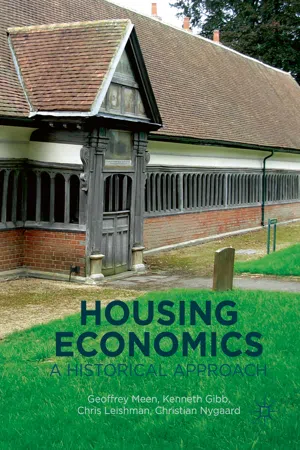
eBook - ePub
Housing Economics
A Historical Approach
- English
- ePUB (mobile friendly)
- Available on iOS & Android
eBook - ePub
About this book
The world has still to emerge fully from the housing-triggered Global Financial Crisis, but housing crises are not new. The history of housing shows long-run social progress, littered with major disasters; nevertheless the progress is often forgotten, whilst the difficulties hit the headlines. Housing Economics provides a long-term economic perspective on macro and urban housing issues, from the Victorian era onwards. A historical perspective sheds light on modern problems and the constraints on what can be achieved; it concentrates on the key policy issues of housing supply, affordability, tenure, the distribution of migrant communities, mortgage markets and household mobility. Local case studies are interwoven with city-wide aggregate analysis. Three sets of issues are addressed: the underlying reasons for the initial establishment of residential neighbourhoods, the processes that generate growth, decline and patterns of integration/segregation, and the impact of historical development on current problems and the implications for policy.
Information
© The Editor(s) (if applicable) and The Author(s) 2016
Geoffrey Meen, Kenneth Gibb, Chris Leishman and Christian A. NygaardHousing Economics10.1057/978-1-137-47271-7_11. Introduction: Why a Historical Approach?
Geoffrey Meen1 , Kenneth Gibb2, Chris Leishman3 and Christian Nygaard1
(1)
Department of Economics, University of Reading, Reading, UK
(2)
School of Social and Political Sciences, University of Glasgow, Glasgow, UK
(3)
School of the Built Environment, Heriot-Watt University, Edinburgh, UK
1.1 History and Modern Housing Problems
At the time of writing in the second half of 2015, the world has still to emerge fully from the housing-triggered Global Financial Crisis (GFC). However, housing crises are not new—nor, arguably, is the post-2007 crash the worst. The history of housing might be described as a process of long-run social progress, littered with regular crises, not all of which have been financial in origin. Given short-term memories and the nature of policy, the progress is often forgotten, whilst the problems hit the headlines.
The short-term volatility of housing markets should not be underplayed, but this book adopts a longer-term perspective than most texts on housing economics. The emphasis is on the dynamics of long-term change, particularly in major cities. We believe that long-term analysis still provides lessons for the short term, but leads to a shift in emphasis in terms of technique and focus. This book is not a chronological history of housing since there are plenty of excellent texts that fill this role. Rather, it attempts to apply economic principles to a selection of key issues in housing, set in a long-run context. The analysis concentrates primarily on British markets, although other parts of the world are also brought into the story.
History can shed light on modern problems, notably the constraints on what can be achieved and possible alternative options. As a first example, in Britain and many other countries, almost all economists believe that higher levels of house building are an essential element in solving long-standing affordability problems. The mainstream view in Britain is that restrictive post-Second World War planning regulations led to a long-run increase in real house and land prices (and there is evidence to support this). However, this presumes that consistently higher levels of construction are feasible in the absence of restrictions. Even before the 1947 Town and Country Planning Act, Britain, typically, failed to build sufficient homes to match population growth. The rapid expansion in house building in the 1930s and after the Second World War was an exception rather than the historical norm. From the mid-nineteenth century until the First World War, Britain only invested between 1 % and 2 % of GDP in housing (Holmans 2005). Housing investment experienced a step-change after the Great War, but it never permanently continued to rise thereafter. Large increases in housing have, generally, been associated with temporary events, such as wars, slum clearance programmes or recessions.
History shows that low levels of construction do not only lead to house price inflation and worsening affordability, but there are also other market outcomes. In terms of nineteenth century housing, this was partly in terms of changes in density—the number of individuals living in each dwelling. In 1851, on average across England and Wales, density stood at 5.2; at the start of the First World War, this had fallen modestly to 4.8 (figures were much higher in major cities). But by 2001, density stood at only 2.3 and this is one indicator of the long-run improvement in housing conditions. Greater densities in the nineteenth century may reflect a high income elasticity of demand for space—since incomes were lower, living at higher densities was more acceptable to the population—or housing supply shortages or, indeed, both. But history teaches us that there is a market outcome in which other factors, in addition to changing real prices, have a role. In recent years it has been the case that household representative rates (the proportion of any age or gender group who are household heads) have fallen for some younger age groups, so a higher incidence of sharing or staying with parents for longer has, to some extent, already occurred. Nevertheless, if further rises in densities in the direction of those in the early twentieth century are considered to be unacceptable, it must be because incomes have risen, the income distribution has widened, social norms have changed or because there are externalities, such as labour market performance, education or health. Even by the mid-nineteenth century, the relationship between overcrowding, sanitation and the transmission of disease was beginning to be understood: for example, in Robert Perry’s 1844 study of epidemics in Glasgow and John Snow’s isolation of the source of cholera in the London water supply in 1854. But history demonstrates that there are alternative policies to new building; the question is whether these are acceptable to modern societies. Densities are considerably higher for some ethnic groups than others, partly because of social norms. Furthermore, all generations, particularly at the early stages of their life cycles, face housing difficulties and despite the very real problems for the current generation of younger households, they are not unique.
A second example comes from international migration. Domestic mobility is quantitatively more important to the structure of local housing markets, but international migrants continue to attract policy and public attention. The effects of migrants on local housing and labour markets were also of concern in the eighteenth and nineteenth centuries and both the House of Commons and House of Lords established enquiries in the late nineteenth century (see Fishman 1988). One of the most striking features of migrant populations is their spatial concentration and the persistence of patterns over long time periods. The break-up of local migrant densities, typically, only takes place in response to large shocks; the Second World War is one case, but history demonstrates the difficulty of producing more integrated communities. Local migrant densities in England can be traced in some detail from the 1850s.
Long-term analysis inevitably gives rise to data problems and historians rightly urge caution in the use of data for the nineteenth and earlier centuries. Arguably, similar caution should be exercised using modern data. Nevertheless, the quality of information improved significantly over the course of the nineteenth century and a variety of rich sources have been under-utilised for formal time-series analysis. On-line access to information has helped considerably, but much still needs to be gleaned directly from public records. Few modern econometricians, used to electronic data retrieval, have the patience or resources for such labour-intensive work. However, in some cases, nineteenth and twentieth century data are more detailed than for the twenty-first century and we show how micro household panel data sets, used to study mobility patterns, can be constructed from the mid-nineteenth century. The study considers three major cities in detail; London, Glasgow and Melbourne. These were three of the largest cities at the height of the British Empire and this provides one reason for their choice.1 Given that London was so much larger than the others, it receives particular attention. A second reason for the choice of cities is that, in different ways, they have detailed longitudinal micro data sets that have never been fully explored. In the case of London, this comes primarily from census material. Melbourne is unusual in that detailed records have been kept from first European colonisation in 1835; electoral rolls, rate books and migration records are particularly useful. These long-run records allow us to delve into the nature of change in a new manner, concentrating on individuals at small spatial scales.
There is an increased acceptance in economics generally that, faced with large shocks, historical experience provides a useful guide for modern policy. For example, Eichengreen (2015) discusses the parallels between the Great Depression and the Global Financial Crisis; Piketty (2014) draws out the implications of very long-run international trends in inequality for policy, including the effects of structural breaks caused by war; Button et al. (2015) examine the implications for regulation of the biggest banking collapse in the UK before the GFC, which was the failure of the City of Glasgow bank in 1878. A conference volume edited by White et al. (2014) adopts a historical approach to US housing and mortgage markets. Nevertheless, historical analyses by economists of housing systems remain scarce. The work of Alan Holmans provides an invaluable exception for the UK and we fully acknowledge our debt to his path-breaking work; Holmans (1986) considers the history of housing policy; Holmans (2005) provides the seminal compilation of historical housing statistics, whereas Holmans (2012) examines the history of household projections.
1.2 A Brief Overview of the Central Issues
At one level, all housing is historical; observation of most cities reveals a rich mixture of architectural styles and property ages. With notable exceptions, the structures of cities are gradually built up over centuries rather than regularly rebuilt from scratch. There is opposition to wholesale change. City dynamics are sometimes characterised by long periods when change is modest, interspersed by infrequent periods when change is rapid and dramatic. In some instances this may be a response to deliberate government policy or technological improvements, in others it may result from major unplanned events, such as wars or natural catastrophes.
Conventional housing economics stresses the importance of spatial and physical characteristics, for example in hedonic analysis, but the role of history in their development is under-explored in the housing literature. An aim of this book is to begin to fill this gap, which leads to an emphasis on different concepts from standard housing models, such as path dependence and phase transitions. Since the focus of the study is on large urban housing systems, with exceptions, the starting point is the beginning of the nineteenth century. England was still primarily a rural economy and, at the time of the first census in 1801, only London had a population in excess of 100,000. But this was the beginning of the century in which both population and mobility expanded enormously. Around the start of the sixteenth century, the capital had a population of approximately 50,000; by 1650, it was the second largest city in Europe (after Paris) with a population of 350,000. But by 1800, London had outstripped Paris with approximately 1 million residents. By contrast, Britain’s next largest cities were Dublin (200,000) and Manchester (84,000) (De Long and Shleifer 1993).
This starting date also has the advantage that, as noted above, the quantity of statistical information increased rapidly. This is sufficient to examine the effects of the sequence of dramatic changes cities subsequently faced. The study does not throw away traditional neo-classical approaches, but integrates these into the historical analysis, also applying modern models of self-organisation. All three provide important insights into the dynamics of housing systems, but the emphasis here is on the historical. As McDonald and McMillen (2007) argue:
Economic history is an important tool for understanding urban economies. The best modern economic historians combine analyses of the institutions and historical context of the urban area and its region, economic analysis, and political economy to provide a convincing narrative of what happened and why. This explanation may also have considerable relevance for current economic development policy. (p. 485)
This book inter-weaves local case studies with city-wide...
Table of contents
- Cover
- Frontmatter
- 1. Introduction: Why a Historical Approach?
- 2. A Tale of Three Victorian Cities: Exploring Local Case Studies
- 3. Key Concepts from the Literature
- 4. Geology and Cities
- 5. Wars, Epidemics and Early Housing Policy: The Long-Run Effects of Temporary Disturbances
- 6. Speculation, Sub-division, Banking Fraud and Enlightened Self-interest: The Making of the Contemporary Glasgow Housing System
- 7. Building Our Way Out of Trouble
- 8. Residential Density Revisited: Sorting and Household Mobility
- 9. Path Dependence, the Spatial Distribution of Immigrant Communities and the Demand for Housing
- 10. Affordability and the Rise and Fall of Home Ownership
- 11. On the Persistence of Poverty and Segregation
- 12. Final Reflections
- Backmatter
Trusted by 375,005 students
Access to over 1.5 million titles for a fair monthly price.
Study more efficiently using our study tools.
Frequently asked questions
Yes, you can cancel anytime from the Subscription tab in your account settings on the Perlego website. Your subscription will stay active until the end of your current billing period. Learn how to cancel your subscription
No, books cannot be downloaded as external files, such as PDFs, for use outside of Perlego. However, you can download books within the Perlego app for offline reading on mobile or tablet. Learn how to download books offline
Perlego offers two plans: Essential and Complete
- Essential is ideal for learners and professionals who enjoy exploring a wide range of subjects. Access the Essential Library with 800,000+ trusted titles and best-sellers across business, personal growth, and the humanities. Includes unlimited reading time and Standard Read Aloud voice.
- Complete: Perfect for advanced learners and researchers needing full, unrestricted access. Unlock 1.5M+ books across hundreds of subjects, including academic and specialized titles. The Complete Plan also includes advanced features like Premium Read Aloud and Research Assistant.
We are an online textbook subscription service, where you can get access to an entire online library for less than the price of a single book per month. With over 1.5 million books across 990+ topics, we’ve got you covered! Learn about our mission
Look out for the read-aloud symbol on your next book to see if you can listen to it. The read-aloud tool reads text aloud for you, highlighting the text as it is being read. You can pause it, speed it up and slow it down. Learn more about Read Aloud
Yes! You can use the Perlego app on both iOS and Android devices to read anytime, anywhere — even offline. Perfect for commutes or when you’re on the go.
Please note we cannot support devices running on iOS 13 and Android 7 or earlier. Learn more about using the app
Please note we cannot support devices running on iOS 13 and Android 7 or earlier. Learn more about using the app
Yes, you can access Housing Economics by Geoffrey Meen,Kenneth Gibb,Chris Leishman,Christian Nygaard in PDF and/or ePUB format, as well as other popular books in Business & Business General. We have over 1.5 million books available in our catalogue for you to explore.