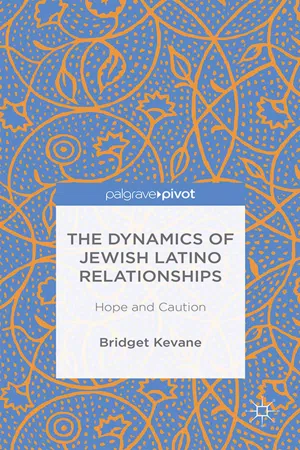
- English
- ePUB (mobile friendly)
- Available on iOS & Android
eBook - ePub
About this book
The Dynamics of Jewish Latino Relationships centers around three themes: immigration, race and identity, and faith and religion. Each chapter explores an encounter that, for various reasons, has brought Latinos and Jews together on the same stage.
Information
1
From Community to Political Action
Kevane, Bridget. The Dynamics of Jewish Latino Relationships: Hope and Caution. New York: Palgrave Macmillan, 2015. DOI: 10.1057/9781137523921.0005.
Two true stories: When I was a graduate student at University of California, Los Angeles, to imagine or conjure an integrated field of Latino studies was not a possibility. The fractured world of identity politics was raging during the nineties and to even suggest that Puerto Ricans might have some commonalities with Mexican Americans was sacrilege. One of the outcomes of these skirmishes, of these ethnic wars about the legitimacy of studying a particular cultural and national identity, was the establishment of the César Chavez Center at UCLA, a center dedicated to the study of Chicano culture, literature, politics, and more, but to the exclusion of other Latino national histories and cultures. I was one of the first graduate teaching assistants in this center teaching Chicano literature, a literature or culture to which I had not been born and, according to some, therefore lacked the credentials to teach. The only reason I was “allowed” to teach in the Center was because the director at the time already had a broader and more inclusive view of the place of Latino literature in America. Heated discussions regarding the creation of the center, which was preceded by a student hunger strike where students lived in tents on campus, centered on the place of Chicano/a studies in academia, on who had proper qualifications to be involved, on what would be the politically correct content of the curriculum, and, on a personal level, on one’s “place” in relation to this literature and culture. The boundaries were drawn around matters such as the place of one’s birth, one’s ethnic identity and culture, and even one’s economic and class background and struggles. The climate was charged and often vitriolic, and I was directly interrogated about my desire to study Chicano literature and culture. What could I, a graduate student from an urban center in Puerto Rico, know of migrant workers in the fields of central California? How could I, a gringa white girl, offer insight into this beleaguered community, its history and cultural expression?
Almost a decade earlier, in the late eighties, I worked as an executive secretary at the Jewish nonprofit New Israel Fund (NIF; founded in 1979) in New York. I was welcomed into the organization as a young Jewish woman intent on reaffirming and reconnecting with her Jewish roots. The New Israel Fund was, and remains, a progressive organization established in the hopes of empowering grassroots organizations in Israel that sought to promote social change and justice by strengthening human rights, women’s rights, religious pluralism, and more. NIF provided seed funds to community organizations that promoted equality for all Israelis.
The most progressive projects funded were those that promoted coexistence between Arab Israeli and Arab Palestinians and Jewish Israelis. During my years at NIF I was admittedly behind the scenes, typing executive letters, making appointments, reaching out to donors, organizing mailings, and welcoming luminaries like David K. Shipler, Avhram Burg, the Bronfmans, and other powerful leaders and intellectuals of the Jewish community. However, I spent a lot of time observing the culture of the organization and what I remember most about NIF was how vigilant the core team was about balancing its ambitious mission statement that earmarked its donations to benefit all Israelis; to some, this was problematic. Did the all include Arab Israelis? The Palestinians? The organization was going to rock the boat but it still tried to keep things safe. There was always a fine line to walk between donors and NIF’s goal and between NIF and the Jewish community at large. Sometimes the dissent was intense, to be sure; eventually the executive director at the time left to join Peace Now, considered at the time more radical, and then left the world of Jewish non-profits all together. But the discord was in-house and prudently, and even shrewdly, left in the vault under lock and key when in public. NIF acted in what had long been held as the gold standard for Jewish organizations in America, a united front with a single voice.
Reflecting on these experiences raises interesting questions about how a diverse ethnic community can best represent itself as a united collective within a dominant Anglo culture. Should a minority community made up of different ethnicities find its identity against or with each other? Can a community make inroads in the dominant majority culture if it is not a collective? And what is lost in name of the collective good? How are national organizations, the symbolic voice of their community, affected by the need to create the appearance of a united voice? At the heart of each anecdote (and each question) is the desire to safeguard a cultural and ethnic minority within a dominant majority. The emotional crux of these situations—anxiety, caution, vulnerability, jealousy, fear—stem from the minority paradox: not allowed to fully assimilate and yet heavily discriminated against because they do not fully assimilate. From this quagmire emerges constant self-doubt about how to belong and how to project belonging. For Latinos in the nineties, to conflate Chicano and Puerto Rican or Cuban concerns in the same breath would have been to smooth over the particularities of each community’s history, social challenges, and ultimate goals. For the New Israel Fund in the eighties, to work toward peaceful coexistence between Israeli Jews, Arabs, and Palestinians was to risk alienating its goals from a large swath of Jewish donors.
But things have changed. The communities have evolved. They are more secure. In fact, a short essay in the Forward celebrated “the benefits of airing our dirty laundry.”1 And interestingly, in that security each group has evolved in opposite directions, one creating a pan-Latino voice, one creating a multiplicity of Jewish ones. The historical sovereign ethnicities—Cubans, Puerto Ricans, Dominicans, and Mexicans, for example—of Latinos groups is now reaching a symbolic powerful “one.” This “one” is politically strategic. The Jewish community, in turn, is moving away from that “one.” Whether these evolutions will lead to the vanishing, fading, or scattering into the dominant culture (or even the transformation of the majority–minority axis) is hard to say, just as it is hard to say which encompasses more of the ideal of how ethnic groups in America succeed. Perhaps Jews are ready to surrender the appearance of their united cultural front because they are more secure in their Americanness, in their sense of belonging. The squabbles, bickering, and quarrels need not be stifled any longer. And perhaps that embedded wariness of Latinos has worn off as they too have become more secure as a collective. Latinos have fundamentally altered American society, from the now-indispensable Latino offshoot of media outlets such as NBC, Huffington Post, Fox News, and more, to their electoral power and their role in D.C. (currently there are three Latino Cuban senators—Republicans Marco Rubio and Ted Cruz and Democrat Bob Menendez).
As I started reaching out to different national Latino and Jewish organizations to explore the “why” of their attempt to partner, I also wondered how these organizations characterize themselves or how they craft an institutional (organizational) cultural identity and whether or not they see each other as equal partners. What historical wounds compelled the birth of the organizations that remain at the center of Jewish or Latino life in America? How do they reconcile competing impulses, on the one hand the desire to be protective of an ethnic group, on the other hand, cultivating consensus within American society? How do they construct their identity, their “us versus them,” and, in turn, how do they bridge the “us versus them”?
Dina Siegel Vann, the director of the American Jewish Committee’s Latino and Latin American Institute, says that the watershed moment where the AJC decided to “ramp up” its outreach to the Latino community in the United States was “the moment when American society in general was awakened to the fact that Latinos were a growing minority.” That moment was the 2000 census. The results on the rapid growth of Hispanics in America exceeded most demographers’ expectations. “For the first time that census explained that Latinos were huge,” she says, “really huge. And for the first time, everybody said, ‘Wow!’ ”2
Michael Salberg, the director of International Affairs at the Anti-Defamation League (ADL), tells a similar story. Salberg, who directs the Hispanic/Latino branch within International Affairs, says the beginning of the 21st century was the turning point for their organization.3 The ADL, soon after the census results, oversampled for Hispanics in their national poll on anti-Semitism. The 2002 poll showed dismaying results: 35% of Hispanics were strongly anti-Semitic (44% of foreign-born and 20% American born; in 2011 the foreign born numbers came down a bit, to 42% but the 20% of US born Hispanics remained steady in their anti-Semitic views).
The reaction of Latino organizations to this watershed moment? Business as usual. The League of United Latin American Citizens (LULAC), in the early years of the new millennium, went to the US Supreme Court in a battle over redistricting based on the new population numbers; it issued the “LULAC Challenge” to candidates for elective office demanding that they establish their positions on the top ten issues of concern for Hispanic Americans; it settled a class action lawsuit against the INS providing a path of permanent legal status to 100,000 immigrants; it created the LULAC Leadership Initiative to revitalize Hispanic neighborhoods and so on. The National Council of La Raza made brief mention in its 2000 Annual Report of the fact that Hispanics now represented the largest majority minority. But although NCLR paused to recognize the historic moment, they also dampened the somewhat celebratory mood by noting in a New York Times article that though they were now the new majority minority surpassing African Americans, it was not a moment to celebrate but rather a moment to take stock: both the African American and Latino community face enormous obstacles to their success in society.4 Despite surpassing African Americans in numbers, the issues for these groups remain similar and, in some ways, an increase in the Latino population was simply going to exacerbate problems in the community such as health, education, or disenfranchisement. The census results only confirmed what both LULAC and La Raza already knew was happening; that the Latino population was exploding and so too were the urgent issues affecting the community.
Building Bridges
Organizations have a history and an identity. They are shaped by the context of their times and many times they are a response to a moment of historical crisis. They evolve. They fall apart. An organization can be a dynamic, fluid entity that adapts to the needs of the times or it can remain an inflexible, rigid entity that eventually disappears. There are four organizations that stand out as having been most active in building inter-ethnic bridges. They are high-profile national organizations founded in the 20th century and still going strong into this century. More to the point, these organizations are involved or committed to each other in partnerships ranging from immigration to Israel to voting rights and health care issues to educational and cultural exchange.
The oldest organization, the American Jewish Committee, is more than one hundred years old, the youngest, National Council of La Raza, is close to 50 years old. Aside from longevity, they share other similarities as well. They were all founded by an anxious desire, almost an urgent plea, to carve out a legitimate space for themselves as equal American citizens in the social and political landscape of the United States. The emotional center of these organizations corresponded to the status of their founding members: ethnic minorities with a fragile sense of their place in American society, with historic grievances, with a great deal of unease and anxiety about that place, a group not quite yet fully part of their social milieu but with the urge for self-determination in the landscape. They sought to fight discrimination, anti-Semitism, prejudice, obstacles to educational or employment opportunities; they fought to eliminate a second-class citizenship bestowed upon them as Jews and Hispanics in an Anglo Protestant majority society. They wanted to improve their lot in America, to receive their rightful shot at the American D...
Table of contents
- Cover
- Title
- Introduction
- 1 From Community to Political Action
- 2 Legal, Illegal: Jewish and Latino Immigration
- 3 Degrees of Whiteness
- 4 Shifting Faiths: Latino and Jewish Religious Identities
- Conclusion: The Sky is the Limit
- Index
Trusted by 375,005 students
Access to over 1.5 million titles for a fair monthly price.
Study more efficiently using our study tools.
Frequently asked questions
Yes, you can cancel anytime from the Subscription tab in your account settings on the Perlego website. Your subscription will stay active until the end of your current billing period. Learn how to cancel your subscription
No, books cannot be downloaded as external files, such as PDFs, for use outside of Perlego. However, you can download books within the Perlego app for offline reading on mobile or tablet. Learn how to download books offline
Perlego offers two plans: Essential and Complete
- Essential is ideal for learners and professionals who enjoy exploring a wide range of subjects. Access the Essential Library with 800,000+ trusted titles and best-sellers across business, personal growth, and the humanities. Includes unlimited reading time and Standard Read Aloud voice.
- Complete: Perfect for advanced learners and researchers needing full, unrestricted access. Unlock 1.5M+ books across hundreds of subjects, including academic and specialized titles. The Complete Plan also includes advanced features like Premium Read Aloud and Research Assistant.
We are an online textbook subscription service, where you can get access to an entire online library for less than the price of a single book per month. With over 1.5 million books across 990+ topics, we’ve got you covered! Learn about our mission
Look out for the read-aloud symbol on your next book to see if you can listen to it. The read-aloud tool reads text aloud for you, highlighting the text as it is being read. You can pause it, speed it up and slow it down. Learn more about Read Aloud
Yes! You can use the Perlego app on both iOS and Android devices to read anytime, anywhere — even offline. Perfect for commutes or when you’re on the go.
Please note we cannot support devices running on iOS 13 and Android 7 or earlier. Learn more about using the app
Please note we cannot support devices running on iOS 13 and Android 7 or earlier. Learn more about using the app
Yes, you can access The Dynamics of Jewish Latino Relationships by Bridget Kevane in PDF and/or ePUB format, as well as other popular books in Social Sciences & Cultural & Social Anthropology. We have over 1.5 million books available in our catalogue for you to explore.