The foundation of a stable democracy in Spain was built on a settled account: an agreement that both sides were equally guilty of violence, a consensus to avoid contention, and a pact of oblivion as the pathway to peace and democracy. That foundation is beginning to crack as perpetrators' confessions upset the silence and exhumations of mass graves unbury new truths. It has become possible, even if not completely socially acceptable, to speak openly about the past, to disclose the testimonies of the victims, and to ask for truth and justice. Contentious coexistence that put political participation, contestation, and expression in practice has begun to emerge. This book analyzes how this recent transformation has occurred. It recognizes that political processes are not always linear and inexorable. Thus, it remains to be seen how far contentious coexistence will go in Spain.
eBook - ePub
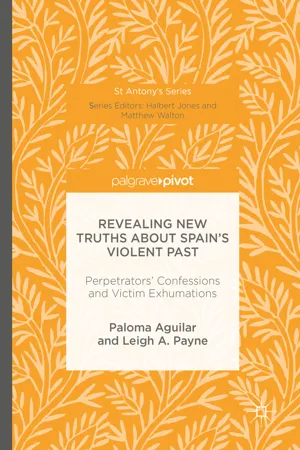
Revealing New Truths about Spain's Violent Past
Perpetrators' Confessions and Victim Exhumations
- English
- ePUB (mobile friendly)
- Available on iOS & Android
eBook - ePub
Revealing New Truths about Spain's Violent Past
Perpetrators' Confessions and Victim Exhumations
About this book
Information
© The Author(s) 2016
Paloma Aguilar and Leigh A. PayneRevealing New Truths about Spain's Violent PastSt Antony's Series10.1057/978-1-137-56229-6_11. Introduction
Leigh A. Payne1 and Paloma Aguilar2
(1)
St. Antony’s College, University of Oxford, Oxford, UK
(2)
Departamento de Ciencia Politica, UNED, Madrid, Spain
Abstract
Spain’s transition from authoritarian rule to democracy – built on the foundation of amnesty and oblivion – was once seen as a model. That model has been challenged around the world and replaced with the demand for justice for and truth about past atrocity. This chapter examines the Spanish transition. It reflects on some of the underlying misconceptions behind the transitional processes and the limitations they imposed in advancing the goals of truth, reparations, and justice adopted in other parts of the world.
It is often forgotten these days that Spain was once viewed as a model transition from authoritarian rule to democracy. Its most praised characteristics were the peaceful and successful transition resulting from moderation and compromise. Spain succeeded in stabilizing a democratic regime, something that many observers thought unlikely at that moment. Yet, in the current global context, with its emphasis on accountability for past human rights abuses, Spain has begun to be seen instead as a relic, a throwback to an era in which peace and democratic stability were thought to depend on amnesty, silence, and oblivion, rather than on justice and truth.
Few recent transitions have followed Spain’s pathway of blanket amnesty for perpetrators without even the creation of a truth commission. In this book we examine the processes that led to that distinctive outcome. We consider the historical and political events that unfolded in Spain’s Civil War, dictatorship, transition, and post-transition. An environment evolved in which silence and oblivion blocked challenges to a national reconciliation narrative. Thus, even when perpetrators came forward to confess to past violence, these confessions were rarely broadcast in the media. When they were, they lacked the audience to challenge interpretations of past violence. Even if the exhumations of executed Republicans and the homages in their honor began a few years after Franco’s death (Aguilar 2016), it is only since 2000, 25 years after the end of the dictatorship that a new generation—the so-called grandchildren of the Civil War—had a profound impact with the exhumations of mass graves. Through these exhumations, and the homages that accompanied them at the local level, they have contested interpretations of past violence in Spain and given visibility to the claims of Francoist victims. They have also demanded the kinds of truth-telling and justice that other countries have adopted.
In our presentation of the processes that led to silence and oblivion, but also to the opening up of debate over the past, we consider the distortions and misunderstanding of the singular Spanish transition process. The mythology of the Spanish transition as a peaceful and exemplary change from dictatorship to democracy, for example, fails to account for the many political killings that took place during this period. Moreover, the emphasis on moderation and compromise since the beginning of the transition tends to ignore the power asymmetries in the negotiating process between the stronger Franco soft-liners and the weaker moderates of the democratic opposition. Thus, when those on the left blame the current ills in Spain’s democracy on the transition’s excessive moderation and overly compromised nature, they disregard two factors: the weak bargaining role of the democratic opposition in shaping the political agenda of the time, and the fact that many contemporary problems have little connection to the transition processes and decisions.
Negotiating the Transition
The success of the Spanish transition is often attributed to a “pact” between the soft-liners in the dictatorship and the moderates of the opposition. The soft-liners primarily comprised young political leaders in the Franco regime. Despite their active collaboration with the dictatorship, they recognized the need to liberalize the regime while also maintaining control over—and retaining a key role in—the new political system. The Unión de Centro Democrático, the political party that won the first democratic elections of 15 June 1977, and its first elected president, Adolfo Suárez, belongs to this group. The moderates of the opposition constituted those political forces that had questioned the legitimacy of the dictatorship—and fought nonviolently against it. The group included mainstream political parties at the time, such as the Partido Socialista Obrero Español (PSOE), the Partido Comunista de España, as well as several regional parties (mainly Basques and Catalans).1
The discussions among the soft-liners and moderate opponents were guided by what has been referred to interchangeably in the literature as the “pact of oblivion,” the “pact of silence,” or the “pact of silence and oblivion.” We have opted for the first term, recognizing nonetheless that silence over the past—often resulting from fear and self-censorship—was one of the most important consequences of deliberate oblivion and the decision to close the books on past violence. The existence of this pact, and its aim to provide a foundation for a stable democracy, are accepted by the great majority of Spaniards. The full dimensions and implications of the pact, however, have often been exaggerated and misleading.
The pact, for example, did not enjoy the same level of commitment or respect in all sectors of society. At the local level, many families of Francoist victims, very early in the transition, seemed to defy the pact by exhuming the remains of their relatives, buried in mass graves. They carried out local public ceremonies and erected visible monuments at cemeteries in the process of reburying the remains of their family members. As discussed below, very early defiance and severe criticism of the pact also emerged among other political and social actors, particularly in cultural and academic spheres.
Paloma Aguilar (2006) describes the pact as an implicit agreement, fundamentally in the political sphere, to leave the past behind, a process that became an end in itself. The main political actors, even if they did not always respect the pact themselves, aimed to keep the past out of political debates and to avoid using it as a political weapon against adversaries.
Aguilar also explains the role that academics and artists played in confronting the pact, showing its uneven resonance and implications throughout Spanish society at the time. In the academic arena, historians debate the degree to which the pact constrained their work. On one hand, some provide evidence of the significant scholarly attention the Civil War received from the beginning of the transition (Juliá 2006). In contrast, others claim that only certain topics from that era were addressed while others were ignored. The latter group of academics stress the limited access to primary sources, the constraints on publishing certain types of books, and particular judicial decisions that had an impact on their work as a result of the pact of oblivion (Espinosa 2009, 2010). In the cultural realm, evidence of projects that defied the pact of oblivion also emerged. Examples can be found in journals of that time, such as Cuadernos para el Diálogo, Cuadernos de Ruedo Ibérico, Hermano Lobo, Por Favor, Interviú, El Papus, and El Viejo Topo. A brave and fascinating documentary dealing in part with thorny issues of the past is Después de, by Cecilia Bartolomé and José Juan Bartolomé (1983). In addition, the fictional film Siete días de enero by Juan Antonio Bardém (1979) appeared in the transition depicting the violence of that era and the Franco legacy.
Early and direct criticism of the pact is also evident. In 1981 José Vidal-Beneyto stated: “We all know that our democracy has been founded on top of a crypt that buries our collective memory.” He blamed the leftists in the moderate opposition for accepting the constraints imposed by the soft-liner Francoists and for trading oblivion for legal status and political inclusion (Vidal-Beneyto 1981: 33). Several leftist critics accused the Socialists and the Communists for betraying the goal of “rupture” with the Francoist regime in working toward its “reform.” They highlighted in particular the legacy of Francoist institutions and personnel, and rejected the project of social demobilization to guarantee a smooth transition. Above all, they scorned the implications of the pact, the sanctioning of an outrageous equivalence between former Francoists and those who had for decades faced severe personal risks in their opposition to the illegitimate dictatorship.2
The assumption behind these criticisms is that the opposition had bargaining power and could have exerted greater control over the transition process. This perspective could find support in the very intense—and unexpected—social mobilization that emerged after Franco’s death, which forced the soft-liners to modify some aspects of their preferred agenda; they had to capitulate on the legalization of the Communist Party, for example, which they had previously resisted.
An alternative view considers the much weaker negotiating power and leverage possessed by the democratic opposition over the soft-liners. Such a view contends that the soft-liners, particularly in the early phase of the transition before the first democratic elections of 1977, possessed sufficient power to design and impose the main guidelines of the transition and, as a result, to limit its scope. Ignacio Sánchez-Cuenca (2014) has demonstrated that in the first stage of the transition the democratic opposition failed to acquire the role of equal partner at the negotiation table. The asymmetry of power questions the notion of compromise; before the first elections, the democratic opposition accepted and tolerated, rather than negotiated, the pace and terms of the transition established by the soft-liners.
Up until the beginning of 1976, the democratic opposition had promoted the total replacement of the Francoist dictatorship with a new democratic regime, a radical demand at the time. Yet it did not occur to those actors to demand what has become the currency in today’s transitions: an official commission of inquiry into the crimes of the Franco era or accountability for those crimes.3 Forces within the democratic opposition and among soft-liners had already reached a broad consensus around a national reconciliation project years before Franco’s death (Aguilar 2008a: 175–187; Juliá 2004: 409–462). This project consisted of building bridges over the great divide between the victors and vanquished in the Civil War. It considered leaving the past in the past to be the most effective way of overcoming the chasm of animosities reinforced throughout the four decades of the Francoist era. Both sides would agree to avoid using the past as a political weapon.
This agreement took on obsessive dimensions. The leaders of the moderate opposition in democratic Spain obsessively avoided any hint or possible accusation of revenge, resentment, or rancor over past violence. The conservative supporters of Franco then and even now had a different kind of obsession: a sacrosanct belief that any threat to the foundational pact of oblivion—including certain initiatives aimed at addressing the demands of the victims of Francoism—would destabilize democracy.
The near consensus behind national reconciliation, constructed on the pact of oblivion, contributes to the interpretation of Spain’s transition as a moderate compromise among equals.
The Pact of Oblivion in the Democratic Era
Although the democratic opposition failed to win the first democratic elections of 1977, it nonetheless obtained considerably more negotiating power than it had previously possessed. It still had to contend with various political and social forces, however, such as the soft-liners of the dictatorship who, victorious in the elections, controlled the government; key actors, such as the armed forces, the police, and significant sectors within the judiciary and the Catholic Church, who formed a conservative block against social and political transformation; a Spanish civil society that was much more moderate than the opposition had predicted; and prevailing widespread fear of a new Civil War owing to very high levels of violence during and immediately after this period, which further constrained the democratic opposition in its efforts to promote change. The opposition, recognizing its inability to win over these forces, modified some of its most daring demands. It had already conceded prior to the elections other important opposition demands, such as the restoration of a republic in Spain4 and the establishment of an interim government to make a radical break with the dictatorship.
The process behind the Amnesty Law of 1977 illustrates both the opposition’s power and the limitations on it. This was the first law passed by the first democratic Parliament in Spain. It can be seen as a clear victory for the opposition because it had persistently and actively demanded an amnesty for a long time. After Franco’s death, massive social mobilizations erupted to defend amnesty for the political opposition. Those who mobilized did so at great personal risk, as shown by the number of deaths and injuries in amnesty demonstrations (Sánchez-Cuenca and Aguilar 2009). Against widespread opposition from the regime’s supporters, and notwithstanding the army’s accusations of deliberate provocation, the opposition nonetheless managed to include recent blood crimes in the Amnesty Law.5
The law, however, also exemplifies the weakness of the opposition. In its final version it included impunity for the repressive agents of the dictatorship. Although the democratic opposition’s original projects did not promote justice for repression, neither did they close off that possibility. The democratic opposition never intended the law to benefit the dictatorship. The law, while providing amnesty for the dictatorship, excluded other groups that the opposition had intended it to cover. Two such groups were members of the former Republican Army and of the clandestine democratic opposition organization Unión Militar Democrática (UMD) organized within the army during the dictatorship. The members of these groups, as a result of exclusion from the Amnest...
Table of contents
- Cover
- Frontmatter
- 1. Introduction
- 2. Unsettling Accounts
- 3. Heroic Historic Confessions
- 4. Few, Fleeting, and Fugitive Confessions
- 5. Unsettling the Balance
- 6. Preposterous Denial
- 7. Unsettling Bones as Unsettling Accounts
- 8. Conclusion
- Backmatter
Trusted by 375,005 students
Access to over 1.5 million titles for a fair monthly price.
Study more efficiently using our study tools.
Frequently asked questions
Yes, you can cancel anytime from the Subscription tab in your account settings on the Perlego website. Your subscription will stay active until the end of your current billing period. Learn how to cancel your subscription
No, books cannot be downloaded as external files, such as PDFs, for use outside of Perlego. However, you can download books within the Perlego app for offline reading on mobile or tablet. Learn how to download books offline
Perlego offers two plans: Essential and Complete
- Essential is ideal for learners and professionals who enjoy exploring a wide range of subjects. Access the Essential Library with 800,000+ trusted titles and best-sellers across business, personal growth, and the humanities. Includes unlimited reading time and Standard Read Aloud voice.
- Complete: Perfect for advanced learners and researchers needing full, unrestricted access. Unlock 1.5M+ books across hundreds of subjects, including academic and specialized titles. The Complete Plan also includes advanced features like Premium Read Aloud and Research Assistant.
We are an online textbook subscription service, where you can get access to an entire online library for less than the price of a single book per month. With over 1.5 million books across 990+ topics, we’ve got you covered! Learn about our mission
Look out for the read-aloud symbol on your next book to see if you can listen to it. The read-aloud tool reads text aloud for you, highlighting the text as it is being read. You can pause it, speed it up and slow it down. Learn more about Read Aloud
Yes! You can use the Perlego app on both iOS and Android devices to read anytime, anywhere — even offline. Perfect for commutes or when you’re on the go.
Please note we cannot support devices running on iOS 13 and Android 7 or earlier. Learn more about using the app
Please note we cannot support devices running on iOS 13 and Android 7 or earlier. Learn more about using the app
Yes, you can access Revealing New Truths about Spain's Violent Past by Paloma Aguilar,Leigh A. Payne in PDF and/or ePUB format, as well as other popular books in History & European History. We have over 1.5 million books available in our catalogue for you to explore.