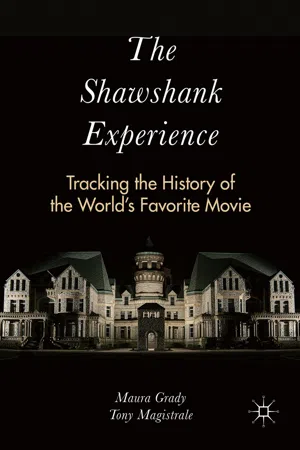
This book features an in-depth analysis of the world's most popular movie, The Shawshank Redemption, delving into issues such as: the significance of race in the film, its cinematic debt to earlier genres, the gothic influences at work in the movie, and the representation of Andy's poster art as cross-gendered signifiers. In addition to exploring the film and novella from which it was adapted, this book also traces the history of the Ohio State Reformatory in Mansfield, Ohio, which served as the film's central location, and its relationship to the movie's fictional Shawshank Prison. The last chapter examines why this film has remained both a popular and critical success, inspiring diverse fan bases on the Internet and the evolution of the Shawshank Trail, fourteen of the film's actual site locations that have become a major tourist attraction in central Ohio.
Maura Grady and Tony MagistraleThe Shawshank Experience10.1057/978-1-137-53165-0_1
Begin Abstract
1. Introduction
Maura Grady1 and Tony Magistrale2
(1)
Ashland University, Ashland, USA
(2)
University of Vermont, Burlington, Vermont, USA
End Abstract
Over the course of Labor Day weekend, August 29–31, 2014, the community of Mansfield, Ohio, commemorated the twenty-year theatrical release of The Shawshank Redemption, a film that was shot in and around the city. Local events were planned to coincide with this tribute, including lectures about the film’s making and meaning; tours of the Ohio State Reformatory (OSR), the retired former prison at the center of the movie; and a theatrical screening of Shawshank on Friday night in downtown Mansfield’s Renaissance Theatre, the venue where the movie premiered on Tuesday, September 13, 1994, almost exactly twenty years earlier.
Fans of the film, both local and those traveling from out of town and state, were encouraged to indulge in a wide range of movie-related memorabilia. As an aid, they made use of the Shawshank Trail, a guide and roadmap to visiting fourteen of the actual shooting locations and major attractions associated with the film’s production in Mansfield and its surrounding communities. Shawshank aficionados toured the Brewer Hotel (also known as the haunted Bissman Building) in downtown Mansfield where Brooks Hatlen and Red share the same apartment and the prison woodworking shop where Red and Tommy are employed, located in neighboring Upper Sandusky; drove out to the intersection of Snyder Road and Hagerman Road in Bellville, Ohio, where Red walked the highway to the hayfield in Buxton; met and took photographs with Renee Blaine (Linda Dufresne) and Scott Mann (Glenn Quentin) at the Pugh Cabin at Malabar State Farm, the log cabin where Mrs. Dufresne and her “golf pro lover” open the film; and paid homage to the famous oak tree (minus the rock wall leading up to it, which was removed postproduction) where Andy asked his wife to marry him and later instructs Red to visit in his last conversation with Andy.
Fans following the Trail viewed artifacts from the film itself, such as Shawshank prison uniforms and badges, the actual prison bus that transported Andy and the fresh fish to Shawshank, the red pickup truck that gives Red a lift to Buxton, and the Trailways bus that Red rides to start his journey to Mexico, and before and after the screening of the film at the Renaissance Theater, they obtained autographs from and interacted with several of the actors who starred in Shawshank, including Scott Mann, Renee Blaine, the bank manager Andy visits on his way out of town (James Kisicki), Fat Ass (Frank Medrano), and Warden Norton (Bob Gunton). But Ohio State Reformatory, which served as the location for all the outside shots of Shawshank State Prison as well as Warden Norton’s office, Red and Brooks’ apartment, the corridor that Tommy mops, the room where Gilda is screened for the inmates, and Red’s three parole board hearings was indubitably the biggest star of the weekend, the place fans most wanted to see and explore.
This book was born, appropriately, over the course of this anniversary weekend. It was conceived in response to a set of questions specifically relevant to the Shawshank experience: Why has this movie maintained such enormous popularity (its twenty-year anniversary commemoration was provided major publicity in the New York Times, Pittsburgh Post-Gazette, Washington Post, and on Cleveland, Columbus, and Toledo television stations)? Why does Shawshank resonate, over two decades later, as a work of art? Why does this film continue to draw such a diverse range of critical attention from musicologists, criminal justice experts, sociologists, film and cultural studies scholars, in addition to English and media studies teachers at both the high school and college levels? In what ways does Frank Darabont’s authored screenplay and directed film differ substantially from the original Stephen King narrative, Rita Hayworth and the Shawshank Redemption (RHSR), published as the first of four short novellas1 in the 1982 collection Different Seasons? What is the relationship between the real OSR and the fictional Shawshank Prison—where do their narratives intersect and diverge, and what insights, if any, do their respective histories provide about American penology? How accurately did the portrait of long-term incarceration in the movie reflect the experience in real life? Finally, how do we explain the fan phenomenon that this film engendered and still retains? Is it possible, and even prudent, to distinguish among the various fan bases—Stephen King’s, Shawshank’s, and OSR’s—that invariably intersect along the Shawshank Trail? Why did so many people wait in long lines to obtain autographs from the actors who starred in this film and to tour many of the actual location sites and artifacts featured on the Shawshank Trail? Fans traveled long distances with friends and family to visit the movie’s filming sites on this special weekend. Was there something about the film itself that inspired these pilgrims to come in small groups or with at least another person, for we observed few visitors touring these sites alone? These are the main topics we have endeavored to address in this book. However, since so many of these questions have their origins in Stephen King’s novella, perhaps the most appropriate place to commence The Shawshank Experience is to discuss where Rita Hayworth and the Shawshank Redemption belongs in the prolific canon of America’s storyteller (Fig. 1.1).
Fig. 1.1
Actor Bob Gunton introduces himself to Warden Samuel Norton (also Bob Gunton) during the cocktail party held at OSR during The Shawshank Redemption Twentieth Anniversary Event in 2014
The King Corpus and Shawshank
The task of trying to categorize the career output of any author is made more difficult when that writer has been publishing over a book a year for nearly half a century. If we grant ourselves room to maneuver among some broad generalizations, the earliest Stephen King novels—including most of his fiction published in the late 1970s and the 1980s, the “first phase” of his writing career—were typically large tomes, epic in their narrative size and scope, and revolved around recognizable genre plots (sometimes conflating two or more into a single hybrid text): horror, dystopian technology, political paranoid thriller, epic fantasy, and the journey quest. The Shining, The Stand, ‘Salem’s Lot, The Talisman, The Dead Zone, The Tommyknockers, and IT, for example, present macrocosmic views of postmodern America, providing the reader with a journey to the center of a post-Watergate/Viet Nam heart of darkness. These are books solidly centered on the adventures of boys and men, while, in part because of the resulting criticism King received, in the late 1980s and throughout the 1990s his novels tended to focus more on women. Many of the books that appeared in this “second phase” of his career show evidence of King’s ability to produce highly circumscribed, tightly wrought narratives bearing few of the epic tendencies we find in The Dark Tower or The Stand. If the novels from King’s “first phase” can best be described as stories of epic proportion played out across a big screen to accommodate an interfacing with history, America’s interstate highway system, the existence of multiple parallel universes, and a broad discussion of social-political dynamics, as each contains an enormous cast of characters and subplots, then books such as Misery, Dolores Claiborne, Gerald’s Game, Rose Madder, and Bag of Bones are more like classical Greek dramas played out on deliberately circumscribed stages, employing consistent scenic backdrops, a narrow time frame, and a small cast of characters shaping a much more intimate storyline. In addition to being generally shorter and more compact, the work in the “second phase” of King’s career is strongly feminist orientated, preoccupied with women’s issues, forsaking supernatural monsters and replacing them with monster-husbands of everyday reality—domestic tragedies of entrapment, endurance, and survival.
King’s most recent works, those novels and tales that have emerged in the new millennium, have tended to reflect many of the writer’s earliest concerns—a return, for example, to an adult Danny Torrance and The Shining in Doctor Sleep (2013), the apocalyptic vision of The Stand revisited without any of its hopeful potentiality in Cell (2006), and strong female characters capable of self-rescue in the psychological terror tales “The Gingerbread Girl” in Just After Sunset (2008) and A Good Marriage and Big Driver from the collection Full Dark, No Stars (2010). Another element that characterizes King’s writing during the post-millennium stage of his publishing also revisits a genre that has interested this novelist throughout his career: the detective story. Crime fiction has always occupied an important place in King’s library,2 since he is as a voracious reader who has frequently acknowledged publicly his affection for the stories of Ed McBain, Raymond Chandler, John D. MacDonald, Thomas Harris, and Cormac McCarthy; and as an author who utilizes crime elements to greater or lesser degrees in earlier novels as diverse as The Dead Zone, Needful Things, and Dolores Claiborne. More recently, Mr. Mercedes (which won the Edgar Award for best crime novel of 2014 from the Mystery Writers of America) and Finders Keepers are even more overtly indebted to the crime genre. In fact, King’s typical narratological structure—with its emphasis on action-driven plots and protagonists who are forced to problem-solve their way out of threatening situations—is highly reminiscent of detective fiction; he even published a short story, “The Doctor’s Case,” that employed Arthur Conan Doyle’s characters from the Sherlock Holmes series. The presence of actual detective-police characters in King’s canon is, ironically, oddly rare; as in Hitchcock’s films, King’s archetypical protagonist-narrators, everyday working men and women who are often pulled into situations against their better judgment and will, come to operate in the role of the detective. As is often the case in crime fiction, the narrator-protagonists in the majority of King’s post-millennium novels—Joyland, 11/22/63, Dr. Sleep, Mr. Mercedes, Revival, and Finders Keepers—not only occupy central roles in the storyline, they also control the flow of the plot itself, leaving the reader to uncover events at the same time as the characters.
There are many places where gothic fiction and detective fiction interface. The detective crosses narrative space in multiple genres, as evident in role of Deckard in the cyborg-horror film Blade Runner. So, too, does the gothic infiltrate genres that appear at first glance to exist outside the realm of horror art in moments when boundaries are blurred that distinguish good from evil, health from perversity, monstrosity from normality, crime from punishment. Shawshank technically begins where most detective tales end: a double homicide has been commissioned; the criminal apparently responsible for the two murders has been apprehended, convicted, and now will serve time in a penitentiary without the possibility of parole. This is all the audience knows when the film and novella introduce us to Andy Dufresne, the “wife-killing banker” serving two life sentences in Shawshank Prison. The remainder of the narrative not only reveals Andy’s innocence but also the paradoxical deepening of his character even as it descends into criminality, as he confesses to Red: “I had to come to prison to learn how to be a crook.” Since it is only through Red’s flashback narration that both the reader and filmgoer attain relief and insight into the true nature of Andy’s wrongful convictions and escape, Red serves in the role of a quasi-detective, often an intentionally unreliable narrator, providing us with slices of information he has deliberately withheld and even used to mislead, and only eventually clarifies. Within both the gothic and detective genres, multiple interpretations are frequently embedded within a single text, as is the case with Robert Louis Stevenson’s The Strange Case of Dr. Jekyll and Mr. Hyde (1886), and part of the experience for the audience comes from suturing together the individual parts that the narrative affords into a satisfying, or at least comprehensible, whole. Red may prefer checkers to chess, but he is an absolute master strategist/storyteller who remains in command of when and how the various plot twists of his first-person account unfolds. It is natural for readers and film audiences to overlook that Red is always in possession of Andy’s complete history from the moment Red’s voice initiates the narrative’s presentation and, presumably, until the reunion of the two men in Mexico (or, in the case of the novella, Red’s decision to commence the journey there). Only then does Red give up absolute control over the plot, abandoning the history of its telling to a “conclusion [that] is uncertain” (RHSR, 101) because its final unfolding will take place in Mexico and in “real time.” Like Sherlock Holmes at the end of one of his mystery tales, Red alone is in possession of a complete knowledge, and the way in which he presents this information often resembles the detective’s revelation of false leads that unfold into a final resolution of the case and an explanation of its various mysteries. In the case of Shawshank: the ultimate purposes of the rock hammer and those “big goddamn posters” up on Dufresne’s wall, Andy’s legal innocence and his choice to escape from Shawshank instead of using Heywood’s rope to commit suicide, the change that occurs to Red as a result of his friendship with Andy, and Red’s own decision to “break parole” in order to journey down to Mexico to join him, rather than commit a crime that would put Red back in Shawshank.
Many of the film’s enthusiasts make a sharp distinction between Shawshank and those King novels and films that contain his “typical” scary subject matter that has largely been responsible for making him an international bestseller (even though Shawshank is not the only King narrative that eschews such material); indeed, in the more than two decades since the release of the movie, a surprisingly large percentage of its disparate fan base remains unaware that Frank Darabont’s adaptation was based on a Stephen King novella. Within this percentage, there are those who are thoroughly shocked when they discover this fact, as many aficionados of the film disavow any interest in horror art—some claiming repugnance towards the entire genre. There exist people who have never read a Stephen King novel or watched a film adaptation of one of his books, and have no intention of ever doing so, but they have watched the film version of Shawshank twenty times. Rob Reiner, a founder and executive of Castle Rock Entertainment, the production company that has adapted several of King’s novels, including Shawshank, into movies, “finds it interesting that two of the most talked-about film adaptations of Stephen King’s work [Stand By Me and Shawshank] came from the same collection of novellas and don’t rely on classic horror or supernatural elements of storytelling” (qtd. in Heidenry, par. 18). As George Beahm has argued frequently, “King’s enduring popularity stems in part from his refusal to write only supernatural horror, in which the monsters are external. Those books can be highly entertaining fiction, and popular in their own right … but the stories in which the monsters are mortal are often more frightening because they are real” (193). To continue this line of argument, further distinctions separate the King fictional world and Shawshank: there are no literal doorways leading to parallel universes or alternative realities; the story is a long-developing narrative featuring two men in the absence of women characters; both novella and film are low on action and high on sentiment; and while there is a fair amount of violence, particularly early on, Shawshank contains no gore and is quite discrete in how much of its violence actually takes place on either the page or the screen. In marketing the film, Castle Rock Entertainment, especially initially, avoided associating it with King’s fiction and the rest of the King film-adaptation canon (as was also the case in marketing Stand By Me). The studio heads decided not to use King’s name for fear that the writer’s reputation would alienate mainstream filmgoers who would dismiss the film without giving it a fair viewing (Beahm 481).
These differences notwithstanding, Shawshank is actually a highly representative text within the King canon. In addition to resembling other King novels via its connections to crime fiction narratology, the novella also features a character who is the archetypical King protagonist: Andy Dufresne is an ordinary man who finds himself suddenly trapped in extraordinary circumstances; he must find a way, relying primarily on his wits and independent spirit, to survive. Several of King’s most notable male protagonists harbor secrets that result in their undoing. Male secrets unify the plots o...
Table of contents
Cover
Frontmatter
1. Introduction
2. In the Belly of the Beast: Ohio State Reformatory and The Shawshank Redemption
3. Interpreting Shawshank
4. Fandom and the Shawshank Trail (research contributions by Richard Roberson, Jr.)
Backmatter
Trusted by 375,005 students
Access to over 1.5 million titles for a fair monthly price.
Study more efficiently using our study tools.
Frequently asked questions
Yes, you can cancel anytime from the Subscription tab in your account settings on the Perlego website. Your subscription will stay active until the end of your current billing period. Learn how to cancel your subscription
No, books cannot be downloaded as external files, such as PDFs, for use outside of Perlego. However, you can download books within the Perlego app for offline reading on mobile or tablet. Learn how to download books offline
Perlego offers two plans: Essential and Complete
Essential is ideal for learners and professionals who enjoy exploring a wide range of subjects. Access the Essential Library with 800,000+ trusted titles and best-sellers across business, personal growth, and the humanities. Includes unlimited reading time and Standard Read Aloud voice.
Complete: Perfect for advanced learners and researchers needing full, unrestricted access. Unlock 1.5M+ books across hundreds of subjects, including academic and specialized titles. The Complete Plan also includes advanced features like Premium Read Aloud and Research Assistant.
Both plans are available with monthly, semester, or annual billing cycles.
We are an online textbook subscription service, where you can get access to an entire online library for less than the price of a single book per month. With over 1.5 million books across 990+ topics, we’ve got you covered! Learn about our mission
Look out for the read-aloud symbol on your next book to see if you can listen to it. The read-aloud tool reads text aloud for you, highlighting the text as it is being read. You can pause it, speed it up and slow it down. Learn more about Read Aloud
Yes! You can use the Perlego app on both iOS and Android devices to read anytime, anywhere — even offline. Perfect for commutes or when you’re on the go. Please note we cannot support devices running on iOS 13 and Android 7 or earlier. Learn more about using the app
Yes, you can access The Shawshank Experience by Maura Grady,Tony Magistrale in PDF and/or ePUB format, as well as other popular books in Media & Performing Arts & Film & Video. We have over 1.5 million books available in our catalogue for you to explore.