eBook - ePub
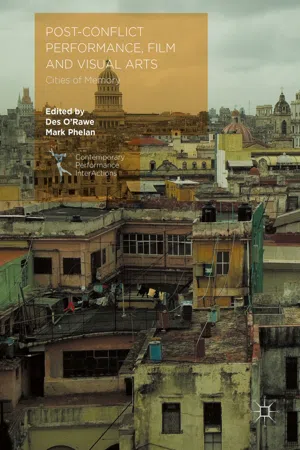
Post-Conflict Performance, Film and Visual Arts
Cities of Memory
- English
- ePUB (mobile friendly)
- Available on iOS & Android
eBook - ePub
Post-Conflict Performance, Film and Visual Arts
Cities of Memory
About this book
Drawing on a range of cities and conflicts from Europe, Africa and the Middle East, the collection explores the post-conflict condition as it is lived and expressed in modern cities such as Berlin, Belfast, Bilbao, Beirut, Derry, Skopje, Sarajevo, Tunis, Johannesburg and Harare. Post-Conflict Performance, Film and Visual Arts: Cities of Memory investigates how the memory of conflict can be inscribed in historical monuments, human bodies and hermeneutic acts of mapping, traversing, representing, and performing the city. Several essays explore the relations between memory, history and urban space; where memory is located and how it is narrated, as well as various aspects of embodied memory; testimonial memory; traumatic memory; counter-memory; false memory; post-memory. Other essays examine the representations of post-war cities and how cultural imaginations relate to the politics of reconstruction in places devastated by protracted urban warfare. Post-Conflict Performance, Film and Visual Arts: Cities of Memory offers a comparative survey of the complex and often controversial encounters between public art, political memory and commemoration in divided societies, as well as offering insights into the political and ethical difficulties of balancing the dynamics of forgetting and remembering.
Information
Subtopic
Historiography© The Editor(s) (if applicable) and The Author(s) 2016
Des O'Rawe and Mark Phelan (eds.)Post-Conflict Performance, Film and Visual ArtsContemporary Performance InterActions10.1057/978-1-137-43955-0_11. Introduction: Cities of Memory
Des O’Rawe1 and Mark Phelan2
(1)
School of Creative Arts, Queen’s University Belfast, Belfast, UK
(2)
School of Languages, Literatures and Performing Arts, Queen’s University Belfast, Belfast, UK
This collection explores the phenomenon of the post-conflict city through the work of contemporary performing and visual arts. It makes no claim to be encyclopaedic or exhaustive, but attempts instead to develop a comparative framework for the study of a complex coincidence of expressive forms and cultural practices. At the crux of this enterprise is the question of the post-conflict condition as it is lived and expressed in modern cities.
Inevitably, these issues are shaped by memory, whether individual or collective, civic or corporate, embodied or instrumentalised, personal or political, traumatic or testimonial. Although Memory Studies has expanded exponentially in recent years as a field of interdisciplinary scholarship, 1 memory has shaped the arts from time immemorial, just as it has also haunted the histories of conflict and cities. The mutability of memory means it takes shape in myriad forms, many of which are explored in this collection with a range of essays investigating how the memory of conflict can be inscribed in historical monuments, human bodies and hermeneutic acts of mapping, traversing, representing and performing the city. Several essays explore aspects of embodied memory; testimonial memory; traumatic memory; counter-memory; false memory; post-memory; the relations between memory, history and urban space; where memory is located and how it is narrated. Certain essays examine the representations of post-war cities and how cultural imaginations relate to the politics of reconstruction in places decimated by protracted urban warfare, while other contributors reflect on how the traumatic memory of political violence influences conflict transformation and urban regeneration. Collectively, these chapters offer a comparative survey of the complex and often controversial encounters between public art, political memory and commemoration in divided societies, as well as offering insights into the political and ethical difficulties of balancing the dynamics of forgetting and remembering.
Cities and memories seemingly conjugate material and abstract entities—the former appearing concrete and fixed, the latter chimerical and fugitive—but as these essays collectively explore, cities are in a constant process of renewal, ceaselessly changing what they inscribe and erase, create and contest. These associations are all the more resonant in post-conflict contexts, as the post-war reconstruction of urban spaces often strives to efface the history and memory of recent conflict. Such tendencies can emanate from triumphalist motivations that seek to annihilate the memory of the vanquished other, but they can also physically reproduce psychological trauma, as in the aftermath of atrocity there can be a collective desire to forget; to chase a mirage of closure. In other instances, processes of conflict transformation as enacted in urban regeneration (or rehabilitation) are part of larger narratives of nation-building or state-formation founded on mythologised pasts that silence the memories of minorities, while in other cities, the imperative to erase history from urban regeneration functions as a politically expedient form of amnesia. All the essays in this collection, however, attest to how performing and visual arts can resist such totalising official and institutional narratives, demonstrating how post-conflict regeneration and investment should also be applied to the reconstruction of selves and societies, not simply to urban space.
In this way, post-conflict cities act as material and metaphysical metaphors for nations and regions emerging from conflict. As contested sites, they are repositories of memory; urban archives of violent histories. The prefix ‘post’, with its inference that conflict has ended, is necessarily problematic, especially in relation to cities that remain sites of continuing violence in spite of official claims that conflict is over. The aftermath of conflict is always unsettling; even in urban centres of relatively stable and peaceful countries or regions, traumatic memory can disturb the settled surface of daily life. In other cities, where ethnic, political and national conflicts are merely contained rather than concluded, political violence is simply surrogated into proxy conflicts over history and memory, territory and identity, culture and commemoration, what is remembered and what is forgotten. In such settings, the possibility of shared history seems elusive and utopian, given that remembrance and commemoration have become sites of further trauma. Many of the artistic forms and practices considered in this collection suggest how art can complicate collective memory and imagine alternative possibilities. The performing and visual arts can offer meaningful and effective ways of creating shared narratives, as well as contesting hegemonic, institutional ones, providing a participatory public forum for recording stories and memories inimical with the ‘progress’ of official narratives, and representing those who have been occluded and absented from public space.
The international and interdisciplinary scope of this collection is reflected in the diverse geographical range of urban centres from Europe, Africa and the Middle East. Although this may not include work from Latin America and Asia, the collection offers a comparative approach that hopefully extends its conceptual remit beyond its geographical purview as these essays collectively explore the role that visual and performance arts play in creating alternative processes of conflict transformation, remembrance and commemoration in such a diverse range of cities.
It is ironic that the corner of a small island on the periphery of Europe continues to occupy a central role in disciplines such as Peace (and Conflict) Studies, Politics, International Relations, etc. However, in spite of countless studies of political conflict in Northern Ireland, there is a paucity of scholarship exploring the roles played by the arts in conflict transformation. Moreover, when colleagues in the Social Sciences do consider the arts, they invariably do so within paradigms incapable of capturing its aesthetic complexities, relying as they do on critical strategies that cannot convey the polyvalent, playful nature of the arts, nor epistemologically engage with its performative evanescence and affect. This failure is all the more frustrating given the extent to which the arts intervene in everyday life, through architecture, sculpture, film and visual media, monuments, memorials, galleries and theatres, as well as storytelling forms and performances that shape civic spaces and cultural identities.
One of the aims of the Cities of Memory project has been to situate post-conflict arts in Northern Ireland within an interdisciplinary and international context. This is not necessarily inspired by our provenance or institutional affiliation, but from a shared conviction that Northern Ireland offers a refractory lens for examining how post-conflict urban cultures perform, commemorate and interrogate the past. Hence, the central section of this collection comprises essays relating to Northern Ireland, with the first and final sections exploring European and Middle Eastern/African cities, conflicts and contexts. Although there are obvious and implicit points of convergence between these sections, we have been reluctant to schematise or over-determine their significance, recognising that readers will doubtless approach this collection with different interests and expertise. Post-Conflict Performance, Film and Visual Arts: Cities of Memory has been organised to allow engagement from a wide range of perspectives so that—insofar as possible—new comparative possibilities can develop organically as opposed to being imposed editorially.
Thomas Elsaesser’s opening chapter discusses cinema ‘as a time-machine’: a mode of joining perception, temporality and memory, which makes it an ideal medium for exploring conflict and its aftermath. Elsaesser argues that cinema slips the bonds of realist representation showing things ‘how they really were’ (for either side), and allows conflicting, even incompatible realities to be accommodated within the same physical location, the same frame of reference or within the same field of representation. Provocatively, he suggests that ‘representation’ itself—and the recurrent trope of ‘representation of …’ as it constitutes the dominant Cultural Studies approach to identity and the articulation of diversity—may have reached its (city) limits. Elsaesser questions if there are other ways of figuring incompatible truths competing for place and space. What does it mean to use a medium like film in order to inaugurate a dialogue that all parties consider impossible? This chapter’s argument, as expressed in the form of such questions, suggests at least one way of understanding the problem differently, and is already the first step towards an answer.
Miriam Paeslack examines photographs from Berlin’s Foundation Era after 1871, and the ‘post-wall’ period after 1989. Drawing on the theoretical work of figures such as Henri Lefebvre and Roland Barthes, her chapter concentrates on images of the most central site in Berlin, the Palace of the Republic (Palast der Republik), and its dramatic transformation from former Hapsburg castle, to socialist Palace of the Republic, to the ongoing reconstruction of the castle that is projected to finish in 2018. Paeslack is especially concerned with how this site’s historic and emotional charge is manifested in, and generated by, photography, and she interrogates this post-conflict phenomenon as it relates to three moments in the history of the city: its foundation as Germany’s capital; becoming the capital of a new post-GDR Germany; and its contemporary negotiation of urban and national identity.
Moving beyond the frame of photography and video art, Rob Stone explores the issues that can accompany the reception of public artworks, in this case Jeff Koons’s Puppy (1992, Guggenheim Bilbao Museoa). Stone traces the curious, parallel histories of Koons’s living sculpture and the city that eventually adopted it; a city with a troubled history that has experienced the effects of an intermittent, uncertain peace process since the 1990s. Making wide reference to cinematic representations of Bilbao and Basque culture, Stone discusses how Puppy has served as a source of controversy and a force for social harmony, reminding us that it first came to prominence as the site of an ETA attack, which resulted in the death of a policeman. In the ensuing years, its presence became magically integral to the identity of the city: ‘Puppy evokes the ornate topiary of the eighteenth-century formal European garden as well as the “huggability” of a peluche or fluffy toy […] It is both tended to perfection and simultaneously out of control.’ Elena Caoduro’s essay also explores the relations between a history of political violence and the function of art, in this case how different forms of cultural memory commemorate the 1969 terrorist attack on Piazza Fontana in Milan. This massacre inaugurated the most violent decade in the history of the Italian republic: the anni di piombo (‘Years of Lead’), in which Italy experienced waves of social conflict and unprecedented acts of terrorism carried out by both right- and left-wing paramilitary groups. Caoduro analyses how the city of Milan monumentalises the victims of this massacre and searches for reconciliation between conflicting truths, since the last trial proved inclusive and provided no closure. In particular, she examines depictions of the urban territory in Marco Tullio Giordana’s film Romanzo di una strage/Piazza Fontana: The Italian Conspiracy (2012), and how a memory without resentment is possible in Luca Zingaretti’s performance of Mario Calabresi’s memoir, Spingendo la notte più in là/Pushing Past the Night: Coming to Terms with Italy’s Terrorist Past (2008). Drawing on Paul Ricoeur’s seminal Memory, History, and Forgetting (2004), Caoduro attempts to discern when it is right to remember and when it is better to forget, or indeed how much we should remember. Although arguing that cathartic narration can assist national reconciliation, she cautions against political amnesty being accompanied by cultural amnesia.
Zoran Poposki and Marija Todorova’s chapter examines the state-sponsored public art project ‘Skopje 2014’, launched by the Macedonian government shortly after the cessation of ethno-national conflict in the region. Incorporating neoclassical public buildings and monuments, equestrian statues, fountains and even a Triumphal Arch, Poposki and Todorova interrogate how these enormous projects are part of the newly formed state’s effort to re-establish Macedonian identity in relation to European, Christian and bourgeois values, while concomitantly denying its Oriental and Islamic past. The authors explore how these monuments of Macedonian historical figures, culminating in a colossal thirty-metre statue of Alexander the Great, have deliberately transformed the main square of Skopje into a symbolically charged, if politically contested, site of memory as these resurgent nationalist narratives of imagery and identity reignite animosities and divisions between the different communities of Macedonia’s capital. Poposki and Todorova investigate various acts of creative resistance devised to counter these nationalist narratives in the work of some Macedonian new media artists, whose work resists the transformation of Skopje’s public space into a place of spectacular power.
This first part of the collection draws to a close with Des O’Rawe’s chapter on Jean-Luc Godard’s responses to representations of the Bosnian War, especially those associated with Sarajevo. For Godard, the reluctance of Europe’s advanced liberal democracies to intervene meaningfully in Bosnia—their insistence that humanitarian aid rather than protective military intervention was the order of the day—was tantamount to supporting Serbian fascism, and pursing a policy of appeasement reminiscent of the days of the Munich Agreement in 1938. Although Godard’s support for intervention placed him against some of his compatriots on the left, it is unwise to make simplistic assumptions about his politics. It is in his filmmaking, in his vision of cinema, and how it relates to other histories of the image, that Godard’s sensibility can be most keenly felt and understood. As the essay points out, even his recent contribution to the compilation film Bridges of Sarajevo/Les Ponts de Sarajevo (2014, 114 min.) persists in posing questions about how the past continues to shape the present, and how Sarajevo and its history still delineates the identity of contemporary Europe.
The second part of the collection focuses on the two key cities in Northern Ireland, Belfast and Derry. Mark Phelan’s essay explores how institutional theatre and performance as a cultural practice in Belfast is increasingly pressed into performing the peace, staging normality, signifying the success of the peace process in the North of Ireland. Phelan also considers how the politics and performance of urban regeneration in Belfast self-consciously stages the economic and cultural rehabilitation of the city, further underwriting the hegemonic narrative of the peace process. He argues that this telos of change and its promissory appeal to the future is one reliant on a pernicious and damaging denial of the past.
Phelan observes that Northern Ireland’s lack of any formal institutional or international body tasked to investigate the past or undertake any form of truth recovery has precipitated a rich commemorative culture of memorials in Belfast and beyond. He argues, however, that in a divided city like Belfast this commemorative landscape is in fact deeply problematic given that the majority of memorials are partisan, valorising paramilitary cultures at the expense of vast numbers of innocent victims. Acknowledging the political and practical difficulties of creating a shared memorial in any physical form, Phelan argues that performance can offer an alternative commemorative mode of remembrance, drawing on its affective and experiential registers to provide an ethical and effective form of remembrance.
Emma Grey discusses John Duncan’s Trees From Germany (2003), an exhibition commissioned by Belfast Exposed Photography to ‘produce a photographic work of Belfast post-conflict on the threshold of progress’. Grey examines how this project builds on Duncan’s previous work documenting the planned redevelopment of Belfast and the idealised visions of its post-conflict future. Trees From Germany extends and updates his investigation of these architectural and spatial developments. Grey traces the fault lines of post-conflict Belfast, between the recalcitrant traces of a past that the peace process seeks to eradicate and a future it aspires to achieve. Drawing on Duncan’s images, she addresses how the peace process’s consignment of traumatic events to the archive of history and its desire for a ‘fresh start’ is underscored (and undermined) by its reliance on selective forgetting. According to Grey, Trees From Germany—through its unrelenting gaze on the architectural outcomes of the peace process and how the city is being rapidly overwritten—frames post-conflict Belfast to reveal its impact on how people live their lives in a radically changed urban environment.
Paul Devlin’s essay investigates Derry’s year-long festival in 2013 as a series of extended acts of memory-making, following its successful bid to become the UK’s first City of Culture. Devlin argues that the City of Culture Festival was an elaborate performance of memories in transition, helping to frame a city synonymous with conflict as now emblematic of a new, agreed Northern Ireland. Examining the intersections of culture, memory and space as enacted by the City of Culture Festival, Devlin believes this reflects the wider transitional processes shaping post-conflict culture and politics in Northern Ireland. Although he critiques the politics and praxis of the festival—especially those elements redolent of social engineering and suspect commercial rebranding—he also cautions against dismissing the huge variety of cultural outputs and outreach of the festival as state-sponsored propaganda. Although artworks and urban regeneration have invariably been instrumentalised in this process to ‘reimage’ the post-conflict city (and region), in contrast with other transitional peace-building processes and more regressive commemorative practices, the City of Culture opened up utopian possibilities of civic communitas to a population still divided by generations of conflict.
Concluding the Northern Ireland section of this book, Paula Blair argues that intensive surveillance activity and media attention throughout the Troubles not only affected psychologies but altered landscapes. She notes that the UK currently has one of the highest concentrations of monitoring activity in the world, a legacy of the conflict in Northern Ireland, which served as a testing ground for the development of observation technologies. Blair notes that surveillance activity emerged mainly in the militarised zones of Belfast and Derry and her chapter explores how video installations by the Derry-born artist Willie Doherty deal with the complex representations of place and community created by these surveillance activities. Blair argues that Doherty’s videos often deal with memory and testimony, and that his installation environments radically challenge the passivity of the spectator. These installations subtly denote the invisible state control over our movements by constructing his own panopticon within the monitored gallery space, denying the spectator a return gaze. Drawing on a wide range of Doherty’s works—including the CCTV inversions of Derry City, Control Zone (1999) and Blackspot (1997), and the film noir-esque Drive (2003) and Re-Run (2002)—Blair discusses how this important contemporary visual artist confronts issues of iden...
Table of contents
- Cover
- Frontmatter
- 1. Introduction: Cities of Memory
- 1. Part I
- 2. Part II
- 3. Part III
- Backmatter
Trusted by 375,005 students
Access to over 1.5 million titles for a fair monthly price.
Study more efficiently using our study tools.
Frequently asked questions
Yes, you can cancel anytime from the Subscription tab in your account settings on the Perlego website. Your subscription will stay active until the end of your current billing period. Learn how to cancel your subscription
No, books cannot be downloaded as external files, such as PDFs, for use outside of Perlego. However, you can download books within the Perlego app for offline reading on mobile or tablet. Learn how to download books offline
Perlego offers two plans: Essential and Complete
- Essential is ideal for learners and professionals who enjoy exploring a wide range of subjects. Access the Essential Library with 800,000+ trusted titles and best-sellers across business, personal growth, and the humanities. Includes unlimited reading time and Standard Read Aloud voice.
- Complete: Perfect for advanced learners and researchers needing full, unrestricted access. Unlock 1.5M+ books across hundreds of subjects, including academic and specialized titles. The Complete Plan also includes advanced features like Premium Read Aloud and Research Assistant.
We are an online textbook subscription service, where you can get access to an entire online library for less than the price of a single book per month. With over 1.5 million books across 990+ topics, we’ve got you covered! Learn about our mission
Look out for the read-aloud symbol on your next book to see if you can listen to it. The read-aloud tool reads text aloud for you, highlighting the text as it is being read. You can pause it, speed it up and slow it down. Learn more about Read Aloud
Yes! You can use the Perlego app on both iOS and Android devices to read anytime, anywhere — even offline. Perfect for commutes or when you’re on the go.
Please note we cannot support devices running on iOS 13 and Android 7 or earlier. Learn more about using the app
Please note we cannot support devices running on iOS 13 and Android 7 or earlier. Learn more about using the app
Yes, you can access Post-Conflict Performance, Film and Visual Arts by Des O'Rawe, Mark Phelan, Des O'Rawe,Mark Phelan in PDF and/or ePUB format, as well as other popular books in Media & Performing Arts & Historiography. We have over 1.5 million books available in our catalogue for you to explore.