- English
- ePUB (mobile friendly)
- Available on iOS & Android
eBook - ePub
About this book
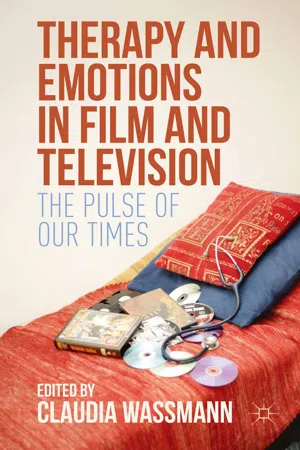
Therapy and Emotions in Film and Television explores, from an interdisciplinary perspective, the shifts in our emotional preferences, styles, and 'emotional regimes' in western societies from the 1920s to today, as viewed through the lens of film and television.
Information
1
An Introduction: Therapy and Emotions in Film and Television
Claudia Wassmann
Therapy and Emotions in Film and Television: The Pulse of Our Times probes the emotional climate of contemporary Western societies through the lens of movies and TV productions. From our vacation culture to the ban on anger in contemporary American society, to emotional management, fear, and psychotherapy in the movies, and to the emotionally charged debate on the aging population and issues of care, leading scholars attempt a genuinely transdisciplinary exploration of emotions, film, and therapy as cultural forces that shape and create our emotional and cultural identities. Contextualizing what movies put on screen for entertainment, historians contribute to our understanding of emotions, for instance, how positive emotions, such as happiness emotions and self-enjoyment, and negative emotions, such as anger and emotional management that anger called for, created norms of behavior and patterns of social interaction over the course of the twentieth century. These developments were intertwined with audio-visual representations in complex ways. Scholars in film and TV studies and communication sciences supplement this picture by investigating the therapeutic potential of movies and their relationship with psychotherapy.
Linking the perspectives of scholars from humanities and social sciences working in Europe, Canada, and the United States, this collected volume explores on both an individual and a societal level how emotions shaped broad outlooks of our contemporary culture, social norms, and emotional identities. Why movies, therapy, and emotions? Emotions, audio-visual media, and psychotherapy represent three pivotal elements of contemporary culture through which cultural concerns of contemporary societies can be articulated – taken together, they constitute a privileged venue for transdisciplinary debate. Emotions determine and indicate how we relate to ourselves and to the society we live in, and understanding their complex nature and functions has been the central aim of many academic disciplines since the turn of the twenty-first century. Additionally, movies and psychotherapy are two cultural techniques, which have informed our emotional identities since the beginning of the twentieth century. Movies are a good starting point for analysis, because they both shape and reflect the emotional concerns of our present world. As Robin Kurilla reminds us in this volume, the producers of mass media are themselves subjected to the mass media discourse. Movies and television films give an almost physically palpable texture to emotions and since emotions play such a crucial role both in psychotherapy and in the audio-visual media, movies and therapy naturally share a special relationship. As Miguel Huerta put it, ‘the importance of psychoanalysis in the film praxis goes beyond its explicit use in storylines’ (Chapter 7). Finally, over the course of the twentieth century, therapy became the dominant trope by which we make sense of ourselves and deal with our anxieties in social relations.
Movies can be used not only as a kind of cultural thermometer to probe the emotional climate of our times, but also as a historical source. Movies are a medium by which we reflect our culture and personal feelings, as well as creating, transgressing, and reviewing social norms. They may even create our identities. They are also a repository for historians: like literature, they conserve and create forms of expressions and norms of feeling, both through the themes they choose to address and through the ways in which they represent emotions, and they generate emotions in the viewers at different moments in time. Indeed, movies and TV-film narratives are understood as potentially transmitting ‘shared positive values’ and ‘disciplinary models of social control (including hierarchies, norms, and discriminating standards) on the societies that share them’ (Keen, 2011: 2). Proceeding from a general historical perspective on emotions as cultural forces and a look at how this is reflected in audio-visual media productions to a more intimate analysis of emotions (such as anger, fear, anxieties, and love) on an individual level by a psychologist and by a pioneering scholar in aging studies, the volume aims to offer a new perspective on film, emotions, and society. After looking at broader societal implications from a historical and a personal perspective, the book turns to the intricate relationship of emotion, movies, and psychotherapy. The moving image represents emotions, elicits emotions, and works through emotions in a unique way. As Stella Bruzzi points out, moving images are more powerful than still images; they are ‘moving’ indeed. Past emotions are brought into our present, and trauma, which we have not experienced first hand, is part of our lived present in the moment when we watch a film. Past and present, historical events and personal memories come together in time in audio-visual productions. Audio-visual media productions can have a therapeutic and a cathartic effect on the viewer.
Emotions have been a key concern in many academic disciplines since the turn of the twenty-first century (Scheer et al., 2014; Bainbridge, 2014; Dixon, 2003). Scholars in the social sciences even speak of an ‘emotional turn’ to describe the shifting framework of analysis (Plamper, 2010) and historians study the ways emotions shaped the outlook of our societies. There is debate as to what can be considered an emotion at a given time in history, as well as what in fact constituted emotions such as anger (Frevert, 2011; P. N. Stearns, 1994). Film studies also took an emotional turn (Clough & Halley, 2007; Pribram, 2011; Gorton, 2009).
However, while emotions are commonly addressed within each of these disciplines respectively, the explicit aim of this collected volume is to shatter those boundaries. Emotions can only be understood from a transdisciplinary perspective. For transdisciplinarity to be more than a word, it is important to actually bring scholars from the different disciplines together in discussion. This kind of intellectual exchange is the basis of the present collective volume, the fruit of an international workshop that brought together historians, psychologists, and scholars from literature, communication sciences, and film and media studies at the University of Navarra in November 2014. This distinguished group of scholars opened up the dialog not only with regard to their respective methodologies but also to a broad range of sources, in particular, movies and TV productions, as the starting point for analysis. While it is important to raise awareness of the fact that terms such as emotion, feeling and ‘affect’ are used in different ways in the different academic disciplines such as physiology, cognitive psychology, or the social sciences, our goal here is to keep those existing differences in terminological conventions in mind, all the while opening up to the respective methodologies and arguments (Russell et al., 2012; Wassmann, 2012). Therefore, here we propose a new form of transdisciplinary scholarship, by factually bringing the respective perspectives of scholars from different disciplines together in one volume. Furthermore, we urge readers to engage with the audio-visual materials that various authors have selected to augment the printed text. Rather than spending our time in debate as to how ‘emotion’ shall be defined and what counts as an emotion, we invite readers to open themselves up to the perspectives of the different disciplines and engage with emotions in multi-disciplinary contexts.
The remainder of this chapter gives a detailed introduction to the structure of this collective volume. The book begins with two chapters by historians who show how happiness and positive emotions and anger and negative emotions have shaped contemporary culture in Western societies and informed cultural norms, conventions, and concepts. Then the analysis turns to more intimate views on emotions provided by a psychologist’s perspective on anger and emotional management, followed by a wonderful contribution by a pioneering scholar in aging studies who points out our conflicting relationship to old age and care as reflected in cinematic productions. The three following chapters investigate the therapeutic potential of movies, the relationship of movies and psychotherapy through the cinematic lens of Woody Allen, and more broadly in audio-visual productions in multiple contexts. The volume closes with a chapter on affective storytelling in the new media.
Let me introduce the contributions of this collected volume in more detail. Starting with a historical analysis, Sandra Trudgen Dawson of Northern Illinois University first shows how happiness and self-enjoyment once conceptualized as a right, rather than a luxury, have shaped our vacation culture (Dawson, 2011). Here a major shift occurred in the outlook of what was considered recreational in the mid-twentieth century and today. Then we look at how negative emotions, such as anger, came to be considered as undesirable in American society. Peter N. Stearns shows how our relationship to anger shifted over time and asks if the ban on anger in American society is altogether beneficial (see also, C. Z. Stearns & Stearns, 1986).
Anger and emotional management are also addressed from the perspective of cognitive psychology. We begin with positive emotions. In Chapter 2, ‘The Big Holiday, Work and the British Family, 1930–Present’, Dawson traces the ‘transformation of holiday ideology’ and assesses the ‘emotional impact of holidays on family life and social groups as well as considering the significance of the increasing reliance on technology as an essential component of leisure.’
The ‘Big Summer Holiday’, which developed over the course of the twentieth century, is an important aspect of contemporary culture in Western societies. Coming into its own right before the World War II in Britain, the vacation industry joined forces with the military in the use of infrastructures shaping large aspects of popular culture and self-understanding in Western societies during the war and postwar years. Dawson traces the origins of paid holidays and holiday camps for British workers back to the 1930s. In her previous work, Holiday Camps in Twentieth Century Britain Dawson nicely showed how emotions of happiness, relaxation and feelings of wellbeing were once considered a right, a necessity, a need for the health of the individual and for the wellbeing of the Nation. Beginning with a charismatic individual, Bill Butlins, who created the first vacation colonies for the working class in Britain in the 1930s with the explicit goal of making people feel happy and relaxed for a week, the vacation culture abounds with emotions. The British vacation camps gave rise to several movies and TV-film productions, which became cultural icons. Many movies were made in the 1970s when the culture of ‘all-inclusive’ vacation camps was coming to an end. Movies also made the vacation locations and the vacation culture and the holiday spirit well known through the satirical rock opera Tommy performed by The Who. Here, Dawson treats in particular Summer Holiday (1963), which tells the story of four friends who transform a double-decker bus into a traveling hotel and travel to Athens, picking up three girls in France along the way. The movie starred Cliff Richard, who expressed the holiday spirit in a song, ‘We’re going where the sun shines brightly, We’re going where the sea is blue, We’ve seen it in the movies, now let’s see if it’s true ... ’ (as cited in Chapter 2). Not coincidentally, vacation culture and the movies also gave expression to and shaped the ‘youth culture’ of the 1960s and 1970s (Dawson, 2011, 220–3). We should also mention the classic French–Italian movie Les Grandes Vacances (1967) starring Louis de Funès, a tumultuous comedy, which told the story of a French teenager sent on summer vacation to a British host family to improve his English. The movie, a great success that also aired many times on French and German television, was still being broadcast as recently as 2014. While in the 1960s young people went on travel tours to unknown locations to make their ‘dreams come true’ for a week or two, the nature of vacations changed radically over time from the ‘all inclusive holiday’ tradition of the 1930s, to the 1970s’ ‘youth culture’, and the ‘exotic travel destinations’ of the 1990s.
Holidays in the early twentieth century were a working-class pleasure: by the late twentieth century they became a luxury again, accessible only to the happy few, and with ever more exotic destinations. Not only did the locations for vacation shift, but also what people sought on holidays underwent a radical change. The desire to disconnect from one’s daily routine gave way to the desire to maintain one’s daily routine and stay connected by means of social media on computers and mobile phones, even while on holiday. And while the culture of tourism was once shaped by the need and right to relax, holidays, health, and happiness, blue skies, sun and the right to relaxation and free time are no longer considered necessary for the health of the individual, let alone ‘the Nation’.
The shift in the nature of our work, and of our relation to work and free time is reflected in the recent decisions on vacation time. What has happened to our vacation culture? Dawson asks. She questions whether the huge shift in attitudes to paid time off work heralds the end of the big annual summer holiday so celebrated in the press and on film and so much a part of the 1960s and 1970s, as the recent economic recession altered worker perceptions of the meaning of work and leisure. Has technology effectively severed the relationship between private life and work? The recent BBC TV series, The Big Vacation reflects the shift in both holiday culture and in our relationship with privacy since the advent of ‘social media’ and the Internet. In particular, Dawson brings the troubling violation of privacy to our attention, questioning what the increase in reality shows that reveal the intimate details of teenagers on holiday suggest about the relationships within families.
Emotions make history, and emotions have a history (Frevert, 2011). Historians study the ways emotions have shaped the outlook of our societies. They debate what constitutes emotions, such as anger, at a given time. In Chapter 3, ‘American Anger Control and the Role of Popular Culture’, Peter N. Stearns, historian and Provost Emeritus at George Mason University, Washington DC, examines the complex culture toward anger that began to emerge in the United States from the 1920s onward. While expressions of anger were previously not sanctioned but were rather regarded as a means of getting ahead in competition, the new culture, Stearns holds, which first developed as part of workplace controls, quite generally disapproved of anger and sought more systematic control. Anger now meets with disapproval in both the family and in the workplace.
The United States’ uneasy relationship with anger finds expression in movies such as Anger Management (2003) with Jack Nicholson, which was taken up in the successful TV series Anger Management (2012). As Stearns argues, the new anger culture raised interesting challenges for entertainment media, caught between seeking to provide symbolic outlets for anger and reinforcing the basic new standards. Movies like Anger Management testify to the great unease American society has with this explosive emotion. Stearns concluded that the film fundamentally if somewhat circuitously illustrates the core standards (Chapter 3). Earlier standards are reflected in the audio-visual genre of the Western; in the United States there exists ‘a long popular cultural tradition, going back to the classic Western, of valuing heroes who keep careful control over their emotion, who respond firmly but rationally to any provocation.’ The historically contingent shift in attitudes to an emotion like anger deeply influenced the way in which people relate to each other, in particular, creating double standards of behavior and social rules in contemporary America. As Stearns showed, the new approach spread widely, in recommended family life but also in politics. However, this culture created standards of emotional regimes and codes of expression, which allow people on the higher echelons of the hierarchy to freely express their anger towards their subordinates, who, in turn, are required to suppress their emotions, and apply ‘emotional management’.
Anger can be analyzed as a historically contingent phenomenon, a historical force shaping our personal behavioral standards and social norms, but also on a personal level from the perspective of cognitive psychology. This is what Ursula Oberst, Professor of Psychology at the University of Ramon Llull in Barcelona, Spain does in Chapter 4, ‘Beyond Emotional Intelligence: Anger, Emotional Stupidity and Lifestyle Issues’. Like Stearns, she addresses the ambiguous attitude towards so-called negative emotions in contemporary society. Reviewing briefly how emotions are conceptualized from a psychological point of view and presenting some findings on emotional regulation, Oberst looks closely into emotional intelligence and emotional management and discusses the merits and pitfalls of these concepts.
From a psychological point of view, emotions can be helpful because they provide ‘crucial information about the state of one’s interactions with the world’ and because they ‘speed up our responses’ in life-threatening situations. Thus, emotions have an ‘adaptive value’. However, in many situations strong emotions have to be managed if people want to get along with others or keep their careers. Therefore psychologists train people who seemingly have difficulty regulating their emotional reactions in techniques of emotion regulation. Oberst illustrated her arguments with examples taken from the Star Wars movie, the Star Trek series and movies, and the movie Anger Management. For her, as for Stearns, the movie Anger Management reflects ‘the common view in contemporary society’ that anger is an emotion, which is ‘not politically correct’ and therefore has to be ‘managed’, like a company. As Oberst put it, in Anger Management, friendly and easy-going businessman Dave is supposed to have TAS, toxic anger syndrome, a disease that can be treated by appropriate therapy (Chapter 4). However, Oberst cautions against society’s attitude of countering all negative emotions, and anger in particular, by therapy: This reflects a tendency in contemporary society to consider all kinds of unwanted or uncomfortable behavior and conditions as disorders an...
Table of contents
- Cover
- Title
- 1 An Introduction: Therapy and Emotions in Film and Television
- 2 The Big Holiday, Work, and the British Family, 1930Present
- 3 American Anger Control and the Role of Popular Culture
- 4 Beyond Emotional Intelligence: Anger, Emotional Stupidity, and Lifestyle Issues
- 5 Empty Husks: Age, Disability, Care, Death, and Amour
- 6 Re-enacting Trauma in Film and Television: Restaging History, Revisiting Pain
- 7 The Relationships between Therapy Culture, Psychology and Cinema: The Case of Woody Allen
- 8 Therapy Cultures in Society: A Polycontextual Approach
- 9 The Emotional Framing of Terrorism in Online Media: The Case of Charlie Hebdo
- 10 A Tentative Conclusion: The Pulse of Our Times
- References
- Filmography
- Index
Trusted by 375,005 students
Access to over 1.5 million titles for a fair monthly price.
Study more efficiently using our study tools.
Frequently asked questions
Yes, you can cancel anytime from the Subscription tab in your account settings on the Perlego website. Your subscription will stay active until the end of your current billing period. Learn how to cancel your subscription
No, books cannot be downloaded as external files, such as PDFs, for use outside of Perlego. However, you can download books within the Perlego app for offline reading on mobile or tablet. Learn how to download books offline
Perlego offers two plans: Essential and Complete
- Essential is ideal for learners and professionals who enjoy exploring a wide range of subjects. Access the Essential Library with 800,000+ trusted titles and best-sellers across business, personal growth, and the humanities. Includes unlimited reading time and Standard Read Aloud voice.
- Complete: Perfect for advanced learners and researchers needing full, unrestricted access. Unlock 1.5M+ books across hundreds of subjects, including academic and specialized titles. The Complete Plan also includes advanced features like Premium Read Aloud and Research Assistant.
We are an online textbook subscription service, where you can get access to an entire online library for less than the price of a single book per month. With over 1.5 million books across 990+ topics, we’ve got you covered! Learn about our mission
Look out for the read-aloud symbol on your next book to see if you can listen to it. The read-aloud tool reads text aloud for you, highlighting the text as it is being read. You can pause it, speed it up and slow it down. Learn more about Read Aloud
Yes! You can use the Perlego app on both iOS and Android devices to read anytime, anywhere — even offline. Perfect for commutes or when you’re on the go.
Please note we cannot support devices running on iOS 13 and Android 7 or earlier. Learn more about using the app
Please note we cannot support devices running on iOS 13 and Android 7 or earlier. Learn more about using the app
Yes, you can access Therapy and Emotions in Film and Television by Claudia Wassmann in PDF and/or ePUB format, as well as other popular books in Psychology & Film & Video. We have over 1.5 million books available in our catalogue for you to explore.