
- English
- ePUB (mobile friendly)
- Available on iOS & Android
eBook - ePub
About this book
In this exciting work, Link and Scott summarize more than a decade of their research on public support of R&D in small, entrepreneurial firms, concluding public R&D investments, primarily funded by the U.S. Small Business Innovation Research (SBIR) program, are indeed bending the arc of innovation. Firms that receive SBIR project funding would not undertake the projects in the absence of SBIR's support. SBIR support has had a positive impact on the employment trajectory of firms and their ability to commercialize innovations.
Bending the Arc of Innovation offers a theoretical model of the effects of the SBIR program. Link and Scott demonstrate that with SBIR support of R&D often comes contractual commercial agreements with other firms to sell the rights to the technology generated by the public support. These agreements between another firm and a small firm with a SBIR-award enable an effective transfer of knowledge created with the small firm's publicly-supported research. Both parties to the agreement have better access to the knowledge resources of the other. Link and Scott show how these agreements allow the dedication of resources and organizational efforts necessary for the commercially successful access to and use of external knowledge.
Information
1
Introduction
Abstract: This chapter introduces the monograph as a summary of our research over the past decade on the U.S. Small Business Innovation Research (SBIR) program. The remaining chapters in the monograph are briefly summarized.
Link, Albert N. and Scott, John T. (2013). Bending the Arc of Innovation: Public Support of R&D in Small, Entrepreneurial Firms, New York: Palgrave Macmillan, 2013. DOI: 10.1057/9781137370884.
Entrepreneurial firms are “the engines of American innovation and our [nation’s key to] economic success” (White House, 2013a).
Entrepreneurs embody the promise of America: the idea that if you have a good idea and are willing to work hard and see it through, you can succeed in this country. And in fulfilling this promise, entrepreneurs also play a critical role in expanding our economy and creating jobs.
Research and development (R&D), notably R&D conducted in small, entrepreneurial firms, is fundamental to the development of new technology, and new technology is the driver of innovation. It is well known that private-sector firms—small, entrepreneurial firms, in particular—underinvest in R&D, and thus public support of R&D is both warranted and generally provided.1
In this monograph we overview a key national program that supports the development of new technology and innovation in small, entrepreneurial firms. The Small Business Innovation Research (SBIR) program was established by the Small Business Innovation Development Act of 1982 (Public Law 97–219; hereafter, the 1982 Act). In 2000, the National Research Council (NRC) of the National Academies conducted an evaluation study of the economic benefits achieved by the SBIR program. The NRC study was instrumental in bringing about, after several years of temporary extensions of the program, the December 31, 2011 reauthorization of the program.
As part of the NRC study, an extensive and balanced survey of completed SBIR projects was undertaken. We have had the privilege of being able to study the SBIR program over the past decade and to analyze in detail the NRC data over the past seven years. Herein we summarize, for a general audience and for those academics seeking an introductory overview of the SBIR program,2 many of the findings and conclusions from our extensive analysis.3 This body of research defines much of the extant literature—certainly all of the recent literature—related to what may be called the economics of the SBIR program.4
We conclude from our years of study of the SBIR program that it is indeed bending the arc of innovation. The majority of firms that received SBIR project funding reported that they would not have undertaken the project in the absence of SBIR support. And, it seems clear to us that the SBIR support has had a positive impact on the employment trajectory of firms and on their ability to commercialize innovations resulting from their funded research.
Before overviewing the remaining chapters of this monograph it is important to draw attention to our use of the term entrepreneurial with reference to the firms that received SBIR funding and that we have studied extensively. Throughout intellectual history as we know it, the entrepreneur has worn many hats and played many roles. Thus, a single and well-defined definition of an entrepreneur, or of entrepreneurship meaning what an entrepreneur does, or of a firm being characterized as exhibiting entrepreneurial behavior, is somewhat a matter of debate.
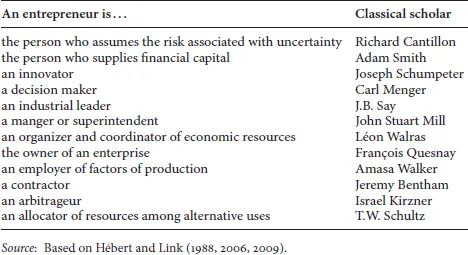
As Hébert and Link (1988, 2006, 2009) have carefully chronicled, the entrepreneur has been thought of variously as: the person who assumes the risk associated with uncertainty, the person who supplies financial capital, an innovator, a decision maker, an industrial leader, a manager or superintendent, an organizer and coordinator of economic resources, the owner of an enterprise, an employer of factors of production, a contractor, an arbitrageur, and an allocator of resources among alternative uses. These are not mutually exclusive characterizations; see Table 1.1 for the names of classical scholars associated with each characterization. The perspective we have adopted when considering firms that have received SBIR funding as being entrepreneurial firms—they are small firms by legislative mandate of the size of a firm that is eligible to apply for a SBIR award—builds specifically on Cantillon’s (1931) view of entrepreneurship as action that embraces uncertainty and risk taking, and on Schumpeter’s (1928) view of entrepreneurship that embraces innovative action.5,6
TABLE 1.1 Characterizations about ‘who the entrepreneur is’
The remainder of this monograph is outlined as follows. In Chapter 2, we discuss in general terms market failure as an economic argument for public support of R&D.
In Chapter 3, we motivate the passage of the 1982 Act in terms of a public response to the productivity slowdown in the United States in the early, and then again in the late, 1970s.
Chapter 4 reflects on the early academic research related to small, entrepreneurial firms. Elsewhere (e.g., Link and Scott, 2012a), we have relied on this academic foundation as one motivating factor for the study of small, entrepreneurial firms as well as for the creation of the SBIR program.
The history of the SBIR program is outlined in Chapter 5, and in Chapter 6, we discuss the economic role of the SBIR program.
The foundation for our collective research on the SBIR program comes from economic theory and from our empirical analysis of the NRC database, which is discussed in Chapter 7.
In Chapter 8, we draw directly on our previously published studies related to (1) the probability of a firm commercializing the technology from its SBIR-funded project, (2) employment growth of firms that conducted a SBIR-funded project, and (3) relationships forged with other firms as a result of the developed SBIR-funded technology.
We emphasize in Chapter 8 the findings and conclusions from this body of our research.7
We observe in Chapter 9 that there has not yet been a systematic evaluation of the entire SBIR program, the NRC study notwithstanding, and we suggest a method to employ for such an undertaking. We illustrate the method with our evaluation, as a part of an earlier NRC study, of the Department of Defense’s (DoD’s) SBIR program.
The monograph ends in Chapter 10 with concluding observations about public support of R&D in entrepreneurial firms.
Notes
1See Martin and Scott (2000) for a discussion that places such underinvestment in the general context where “[l]imited appropriability, financial market failure, external benefits to the production of knowledge, and other factors suggest that strict reliance on a market system will result in underinvestment in innovation, relative to the socially desirable level. This creates a prima facie case in favor of public intervention to promote innovative activity” (Martin and Scott, 2000, p. 438).
2For one introductory overview, see Link and Scott (2012e).
3We thank Dr. Charles Wessner of the NRC for graciously making the NRC data available to us in support of our academic research.
4Lerner (1999) provides an important, early examination of the SBIR program.
5See specifically, Cantillon (1931) and Schumpeter (1928).
6Link and Link (2009) argued that the establishment of the SBIR program is an example of government acting as an entrepreneur. Government acts as an entrepreneur when its involvement in establishing a technology infrastructure is both innovative and characterized by uncertainty.
7We refer the reader to our original research for a detailed discussion of the econometric details underlying the general findings that we summarize herein, as well as for complete sets of specific empirical results. Although we draw directly from the text of the original research on a number of occasions, we encourage the learned scholar to refer to the original research for subtle details.
2
Market Failure and Public Support of R&D
Abstract: This chapter summarizes the economic arguments for public support of private-sector R&D activity. The econo...
Table of contents
- Cover
- Title
- 1 Introduction
- 2 Market Failure and Public Support of R&D
- 3 The Productivity Slowdown in the United States
- 4 An Emphasis on Small, Entrepreneurial Firms
- 5 The SBIR Program
- 6 The Economic Role of the SBIR Program
- 7 The National Research Council Database
- 8 Studies Conducted Using the National Research Council Database
- 9 Toward an Evaluation of the SBIR Program
- 10 Concluding Observations about Public Support of R&D in Small, Entrepreneurial Firms
- Appendices
- References
- Index
Trusted by 375,005 students
Access to over 1.5 million titles for a fair monthly price.
Study more efficiently using our study tools.
Frequently asked questions
Yes, you can cancel anytime from the Subscription tab in your account settings on the Perlego website. Your subscription will stay active until the end of your current billing period. Learn how to cancel your subscription
No, books cannot be downloaded as external files, such as PDFs, for use outside of Perlego. However, you can download books within the Perlego app for offline reading on mobile or tablet. Learn how to download books offline
Perlego offers two plans: Essential and Complete
- Essential is ideal for learners and professionals who enjoy exploring a wide range of subjects. Access the Essential Library with 800,000+ trusted titles and best-sellers across business, personal growth, and the humanities. Includes unlimited reading time and Standard Read Aloud voice.
- Complete: Perfect for advanced learners and researchers needing full, unrestricted access. Unlock 1.5M+ books across hundreds of subjects, including academic and specialized titles. The Complete Plan also includes advanced features like Premium Read Aloud and Research Assistant.
We are an online textbook subscription service, where you can get access to an entire online library for less than the price of a single book per month. With over 1.5 million books across 990+ topics, we’ve got you covered! Learn about our mission
Look out for the read-aloud symbol on your next book to see if you can listen to it. The read-aloud tool reads text aloud for you, highlighting the text as it is being read. You can pause it, speed it up and slow it down. Learn more about Read Aloud
Yes! You can use the Perlego app on both iOS and Android devices to read anytime, anywhere — even offline. Perfect for commutes or when you’re on the go.
Please note we cannot support devices running on iOS 13 and Android 7 or earlier. Learn more about using the app
Please note we cannot support devices running on iOS 13 and Android 7 or earlier. Learn more about using the app
Yes, you can access Bending the Arc of Innovation: Public Support of R&D in Small, Entrepreneurial Firms by A. Link,J. Scott in PDF and/or ePUB format, as well as other popular books in Business & Entrepreneurship. We have over 1.5 million books available in our catalogue for you to explore.