eBook - ePub
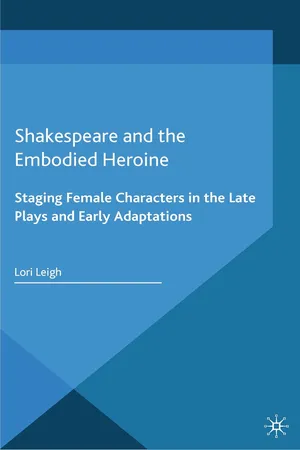
Shakespeare and the Embodied Heroine
Staging Female Characters in the Late Plays and Early Adaptations
- English
- ePUB (mobile friendly)
- Available on iOS & Android
eBook - ePub
Shakespeare and the Embodied Heroine
Staging Female Characters in the Late Plays and Early Adaptations
About this book
Shakespeare and the Embodied Heroine is a bold new investigation of Shakespeare's female characters using the late plays and the early adaptations written and staged during the seventeenth and eighteenth century.
Information
1
Other Worldly Desires: The Jailer’s Daughter and Emilia in Fletcher and Shakespeare’s The Two Noble Kinsmen and Davenant’s The Rivals
Introduction: women’s parts in The Two Noble Kinsmen and The Rivals
Little has been written regarding John Fletcher and William Shakespeare’s 1613 tragicomedy The Two Noble Kinsmen and William Davenant’s 1668 (performed in 1664) adaptation, The Rivals.1 This is likely due to the history of contempt for Restoration adaptations of Shakespeare plays in general (see the Introduction), but also because for many years scholarly discussions of The Two Noble Kinsmen centered on questions of authorship, primarily the question of Shakespeare’s involvement in the play. The most comprehensive account of The Two Noble Kinsmen and The Rivals that I have found appears in Arthur Colby Sprague’s Fletcher and Beaumont on the Restoration Stage (1926). Sprague regards Fletcher’s collaborator as a “riddle” and goes on to give a concise but detailed account of the changes Davenant made to the original play (Sprague 129). He is interested in “the contrasting dramatic ideals of the Jacobean and Restoration eras” (xv), and the section on The Rivals opens Part II of his study, “Alterations and Adaptations,” where Sprague compares 20 Restoration plays to their Jacobean sources. Following many adaptations of Renaissance plays, Davenant cut the text considerably, Sprague observes, removing almost the entire first and fifth acts. Additionally, Davenant imposed the unities of action, time, and place, and he ensured love became the dominant theme of the play (129–31; cf. Introduction p. 17, above). As discussed in the Introduction and as others demonstrate, love usually becomes central in the Shakespearean adaptations. Finally, as Sprague also notes, The Rivals removed the tragic elements from The Two Noble Kinsmen and added farcical characters to the play, planting it firmly in the realm of comedy rather than tragicomedy (263; cf. Chapter 3’s discussion of Garrick’s removal of Mamillius from The Winter’s Tale, thereby removing death and tragedy from the end of that play).
Partly to achieve such structural and thematic changes, Davenant made many alterations to individual characters in the play. Given the broad scope of his project, Sprague devotes little attention to what I want to focus on in The Two Noble Kinsmen and The Rivals: the female characters in the two plays. Given that female roles occupy such a central position in The Two Noble Kinsmen, The Rivals must be included in any examination of the dramaturgy of female characters in early modern English theatre. In this introductory section, I demonstrate how women’s parts are integral to The Two Noble Kinsmen and then go on to explore the character of the Jailer’s Daughter by reference to her counterpart, Celania, in The Rivals. Likewise, in the final section, I will center my analysis on the other female in The Two Noble Kinsmen and The Rivals, Emilia (Heraclia), while linking the two original female characters structurally and thematically.
The Two Noble Kinsmen is unusual in its large number of female roles, in terms of both actual stage presence and quantity of female characters. The third-largest part in the play belongs to Emilia (368 lines), and the Jailer’s Daughter follows closely with 324 lines, nearly as many as Theseus’ 326 lines (Potter 134). Additionally, the play contains all the three major Renaissance stereotypes of women: maid, wife, and widow, which are present from the first scene of the play. As David Bradley notes in From Text to Performance in the Elizabethan Theatre, the female roles in The Two Noble Kinsmen require a cast of ten boy players (239). A scan of Bradley’s chart on “Cast-lists of public theatre plays from 1497 to 1625” reveals that ten boys is well above the average requirement (230–43). If we count the Five Countrywomen (Morris dancers), which Bradley omits from his tally, there are potentially 15 roles in The Two Noble Kinsmen for boy actors, perhaps more if we count the nymphs in 1.1.
Commenting on the typical requirements for Shakespeare’s plays in particular, Stanley Wells in “Boys Should be Girls: Shakespeare’s Female Roles and the Boy Players” writes, “By my calculations, and allowing for doubling, thirty of Shakespeare’s plays—well over two-thirds of the total, written from the beginning to almost the end of his career—call for no more than four boy actors” (174). To further demonstrate The Two Noble Kinsmen as being somewhat of an anomaly for Shakespeare, the play opens with at least nine boy players playing eight female roles on stage (Boy, three nymphs, Hippolyta, Emilia, Three Queens), and possibly ten boy players are necessary if the vague “another” who holds the garland over Hippolyta’s head in the wedding procession is a woman. Similarly, 3.5 demands eight boy actors to portray women: the Jailer’s Daughter, Five Countrywomen, Hippolyta, and Emilia. Therefore, even if we consider the possibility of doubling, more than twice the number of boys are required compared to most of Shakespeare’s other plays. Lois Potter notes, “If all [female parts] were played by boys, as T.J. King assumes in his Casting Shakespeare’s Plays (King 252), The Two Noble Kinsmen had more speaking roles for boys than any Shakespeare play since Richard III” (64). Fletcher’s plays, on average, require more boys than do Shakespeare’s, but they never call for more than nine boys (Women Pleased, Rule a Wife and Have a Wife, and Fair Maid of the Inn all call for nine boys) (Bradley 241–3).
The issue of boy players did not factor into The Rivals or any of Davenant’s plays since he had actresses available to play the female parts. Furthermore, in an age when playwrights were eager to show off the “new” actresses and frequently wrote additional female roles as part of the adaptations—as was done in the Davenant and Dryden adaptation of The Tempest—Davenant might well have been drawn to The Two Noble Kinsmen for its female roles.2 He did remove some female roles when condensing the cast in general, however. Notably, he cut the three Queens and Hippolyta, although he retained the Countrywomen who dance the Morris and added four huntresses (probably played by the same women as the Countrywomen). He retained Emilia’s woman but gave her the proper name of Cleone (she is never named in The Two Noble Kinsmen). He also included a minor role for a nurse and a larger role for a maid (waiting-woman), Leucippe, who with her love-interest, Cunopes, forms a large part of the low comedy. Only Celania (the Jailer’s Daughter), Heraclia (Emilia), Leucippe, and the ever vague “attendants” appear in the dramatis personae or “Actors Names” in the front matter of The Rivals, thus making it impossible to determine the exact number of women used in his cast.
Whether or not the number of its female parts attracted Davenant to The Two Noble Kinsmen, certainly the scope of, and dramatic possibilities inherent in, particular female roles in the play would have attracted his attention. Davenant was most interested in the Jailer’s Daughter, who becomes Celania in his version, and in Emilia, whom he renames Heraclia. These two women become central characters in The Rivals, and their roles are expanded to match those of the two kinsmen, Arcite (Theocles in The Rivals) and Palamon (Philander). Davenant gives roughly 227 lines to Heraclia and 278 to Celania. This is all the more significant given that Davenant’s play is about half the length of The Two Noble Kinsmen. In the latter, Palamon is the largest part, comprising 589 lines, while his counterpart in Davenant’s play, Philander, has approximately 337 lines. Recalling Emilia’s 368 lines and the Daughter’s 324 lines in the original play, we can observe that in Davenant’s adaptation the Daughter’s role becomes larger than Emilia’s and only 59 lines shorter than Palamon’s.
I belabor this line counting to help demonstrate that certainly, the Jailer’s Daughter is the starring role in The Rivals. In addition to the aforementioned lines, she performs eight songs (some of them with three stanzas) or snippets of songs on stage. The expansion of the Daughter’s role becomes even more intriguing when we consider that it was common practice for Restoration adaptations to cut subplots entirely. The remainder of this chapter concerns the Jailer’s Daughter and Emilia, the only prominent female roles retained in The Rivals.
The Jailer’s Daughter in The Two Noble Kinsmen and The Rivals
Why did Davenant choose to expand the role of the Jailer’s Daughter and make her the protagonist of The Rivals? Potter remarks that Davenant may have seen performances of The Two Noble Kinsmen before the Civil War, and his adaptation “shows how the text was understood by someone who may have drawn on recollections of its pre-war staging” (75). Often repeated is the anecdote that Davenant may have been responsible for Thomas Betterton’s success in the role of Hamlet (and other roles as well)—he supposedly coached Betterton to play the role as it had been passed down to him, advice that originated with Shakespeare himself. Less frequently discussed is the success of Mary Saunderson (Mrs Betterton) in the role of Ophelia, which Colley Cibber also attributes to Davenant, who “gave her such an idea of it [the part of Ophelia] as he could catch from the boy-Ophelias he had seen before the civil wars” (Davies, Dramatic Miscellanies 131). It is fascinating to consider this idea in light of the connections between the two mad women: Ophelia and the Jailer’s Daughter. Did Davenant “coach” the actress(es) playing the Jailer’s Daughter in the same manner as he did Saunderson when she played Ophelia, recollecting what was notable about the role in the original staging? Whether or not he had seen early performances, Davenant certainly comprehended what the role of the Jailer’s Daughter had to offer both actress and audiences. The success of (Mary) Moll Davis, the actress who portrayed Celania in The Rivals, corresponds to the success of actresses who play the Jailer’s Daughter in modern productions. In Roscius Anglicanus, John Downes says of The Rivals, “all the women’s parts admirably acted; chiefly Celia, a shepherdess, being mad for love; especially in singing several wild and mad songs; ‘My Lodging it is on the Cold Ground’, &c. She performed that so charmingly, that not long after, it rais’d her from her bed on the cold ground, to a Bed Royal” (Roscius Anglicanus, or, an historical review 33). Though Downes mistakenly calls the Daughter “Celia” rather than “Celania” and labels her “a shepherdess” when she is actually the daughter of the keeper of the prison, the substance of the story is likely true.3 The popularity of “My Lodging it is on the Cold Ground” is further attested to by its multiple publications and parodies.4 Davis’ performance of it in The Rivals, which supposedly catapulted her to the status of King Charles’ mistress, is also discussed in connection with the song’s reprinted version in an eighteenth-century songbook, Old Ballads (1784), where it is titled “The Mad Shepherdess” (Evans 285). These two references, in unrelated sources, to Celania (the Jailer’s Daughter) as a “shepherdess” are noteworthy, and I return to the point below in discussing the character’s madness. First, however, I examine the circumstances crafted for the Jailer’s Daughter by Fletcher and Shakespeare that bring about and develop her madness. These circumstances reveal why audiences feel so connected to this character and therefore why Davenant thought she was so crucial to his adaptation of The Two Noble Kinsmen. Finally, this section explores the defining characteristics of feminine madness, how feminine madness is staged, and how “distraction” offers agency by affording an avenue for expression—sexual and physical as well as verbal. These liberties of expression were not always available to women in the Renaissance and clearly Davenant was uncomfortable with giving them to his heroine in the Restoration.
The hopelessness and isolation of the Jailer’s Daughter
In The Two Noble Kinsmen, Fletcher and Shakespeare create a world of isolation for the Jailer’s Daughter that is provoked by an impossible romance. These circumstances distinguish her from the rest of the characters in the play and also foster a strong relationship with the audience. Additionally, the Jailer’s Daughter’s situation establishes her independence and the path to her madness. Davenant recognized the range and complexity afforded by such a role and thus chose to make Celania (the Jailer’s Daughter) the central figure in his adaptation, The Rivals. When comparing Celania in The Rivals to the Jailer’s Daughter in The Two Noble Kinsmen, however, it becomes evident that Davenant, while capitalizing on her madness, removed most of the underlying reasons for it.
An important attribute of the Jailer’s Daughter is her class. As with Violante in Double Falsehood (which may contain remnants of another Fletcher and Shakespeare collaboration and is discussed in Chapter 4), the social status of the Jailer’s Daughter is somewhat ambiguous, but nevertheless the key to understanding the conditions which propel her madness as well as her relationship with the audience. The most important point about the Jailer’s Daughter’s class is that although she is not the lowest on the social scale, Palamon still is out of her reach socially. She says, “Why should I love this gentlemen? ’Tis odds / He never will affect me: I am base, / My father the mean keeper of his prison, / And he a prince. To marry him is hopeless” (TNK 2.4.1–4). Later, she adds that Palamon does not care for her because, “I have nothing / But this poor petticoat and two coarse smocks” (TNK 5.2.83–4). The Daughter is a plebeian, low in the social scale compared to a prince. This is vital, and it must be the basis for an alteration Davenant made in The Rivals. Celania’s father is no longer the “jailer”— he is elevated to Provost. He is given a man, Cunopes, who maintains the prisoners and holds the keys of the prison (Act 2; pp. 17–18).5 In fact, it is Cunopes who is referred to as the keeper in The Rivals. Such a rise in class foreshadows that the odds against Celania (the Daughter) marrying Philander (Palamon) are not insurmountable, whereas in The Two Noble Kinsmen, as the Jailer’s Daughter says, marriage is “hopeless.” Compare Celania’s parallel speech wherein she questions her love for Philander: “Why shou’d I love this Gentleman? ’Tis odds, / Hee’l never find a feature in my face; / To tempt so much as a kind look from him” (The Rivals Act 2; p. 18). Adjectives like “mean” and “base” are gone; that Philander will surely not find her attractive is now the only issue. What was once a class barrier now becomes a problem of mere fancy or taste in facial “features.” Tastes can easily be swayed but the same is not true for the rank into which one is born. In contrast, the futile desire of the Jailer’s Daughter in The Two Noble Kinsmen fosters her isolation, her connection with the audience, and the feeling of entrapment (lack of a proper outlet for her love of Palamon and sexual frustration) that ultimately ushers in her madness.
The audience often sees the Jailer’s Daughter alone in The Two Noble Kinsmen. Her confession of love to Palamon begins with the stage direction, “Enter the Jailer’s Daughter ...
Table of contents
- Cover
- Title
- Copyright
- List of Illustrations
- Acknowledgements
- List of Abbreviations
- Introduction
- Chapter: 1 Other Worldly Desires: The Jailer’s Daughter and Emilia in Fletcher and Shakespeare’s The Two Noble Kinsmen and Davenant’s The Rivals
- Chapter: 2 No Woman Is an Island: Female Roles in Dryden and Davenant’s The Tempest, Or The Enchanted Island and Shakespeare’s The Tempest
- Chapter: 3 Silence and Sorcery, Sexuality and Stone: Absent Parts to Understanding Hermione and Paulina in Shakespeare’s The Winter’s Tale and Garrick’s Florizel and Perdita
- Chapter: 4 Transformation, Transvestism, and Lost Text: Violante’s Rape and Cross-Dressing in Lewis Theobald’s Double Falsehood and Fletcher and Shakespeare’s Cardenio
- Conclusion
- Appendix: The Plays in Performance
- Notes
- Bibliography
- Index
Trusted by 375,005 students
Access to over 1.5 million titles for a fair monthly price.
Study more efficiently using our study tools.
Frequently asked questions
Yes, you can cancel anytime from the Subscription tab in your account settings on the Perlego website. Your subscription will stay active until the end of your current billing period. Learn how to cancel your subscription
No, books cannot be downloaded as external files, such as PDFs, for use outside of Perlego. However, you can download books within the Perlego app for offline reading on mobile or tablet. Learn how to download books offline
Perlego offers two plans: Essential and Complete
- Essential is ideal for learners and professionals who enjoy exploring a wide range of subjects. Access the Essential Library with 800,000+ trusted titles and best-sellers across business, personal growth, and the humanities. Includes unlimited reading time and Standard Read Aloud voice.
- Complete: Perfect for advanced learners and researchers needing full, unrestricted access. Unlock 1.5M+ books across hundreds of subjects, including academic and specialized titles. The Complete Plan also includes advanced features like Premium Read Aloud and Research Assistant.
We are an online textbook subscription service, where you can get access to an entire online library for less than the price of a single book per month. With over 1.5 million books across 990+ topics, we’ve got you covered! Learn about our mission
Look out for the read-aloud symbol on your next book to see if you can listen to it. The read-aloud tool reads text aloud for you, highlighting the text as it is being read. You can pause it, speed it up and slow it down. Learn more about Read Aloud
Yes! You can use the Perlego app on both iOS and Android devices to read anytime, anywhere — even offline. Perfect for commutes or when you’re on the go.
Please note we cannot support devices running on iOS 13 and Android 7 or earlier. Learn more about using the app
Please note we cannot support devices running on iOS 13 and Android 7 or earlier. Learn more about using the app
Yes, you can access Shakespeare and the Embodied Heroine by L. Leigh in PDF and/or ePUB format, as well as other popular books in Literature & European Literary Criticism. We have over 1.5 million books available in our catalogue for you to explore.