- English
- ePUB (mobile friendly)
- Available on iOS & Android
eBook - ePub
About this book
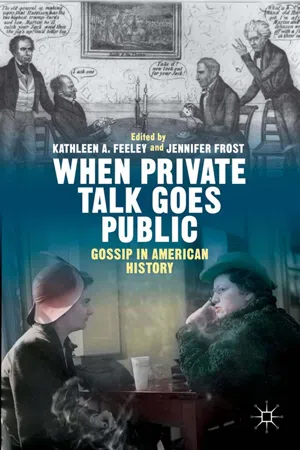
Gossip is one of the most common, and most condemned, forms of discourse in which we engage - even as it is often absorbing and socially significant, it is also widely denigrated. This volume examines fascinating moments in the history of gossip in America, from witchcraft trials to People magazine, helping us to see the subject with new eyes.
Information
1
“They make one very handsome Mirkin amongst them”: Gossip and Church Politics in Mid-Seventeenth-Century Virginia
Christine Eisel
In October 1658, Elizabeth Woods, along with Johanna Poynter and Elianor Cooper, plotted to post a libelous document on the Marston parish church door. As recorded by the county court clerk, Woods wrote:
Gentlemen this is to give you all notice that we have a new fine trade come up amongst us. One of our Vestrymen is turned Mirkin maker. Thomas Bromfield by name, and also his wife and goodwife Cobbs, one of our Churchwarden’s wife, they make one very handsome Mirkin amongst them and sent it to ye neighbors.1
The trio maligned Thomas Bromfield, Robert Cobbs (by implication), and their wives by accusing them of making mirkens. Mirken was a slang term used to describe a “pubic wig” for women.2 The device was designed to hide the deformities that could occur from mercury treatment for syphilis and/or gonorrhea, or to temporarily replace pubic hair that was shaved due to body lice; thus, the device was associated with prostitutes and sexually promiscuous women. The women did not accuse anyone of wearing mirkens; they accused them of making mirkens, an accusation that carried layers of meaning. They did not imply that the Bromfields and Cobbses engaged in loose sexual activity themselves; rather, they implied that the Bromfields and Cobbses associated with people who were beneath the standing of proper vestrymen. The women also implied that the Bromfields and Cobbses insulted their neighbors by sending mirkens to them. Further, Woods and her conspirators implied that the vestrymen were covering up some improper and ugly activity, just as a mirken was designed to cover or disguise a deformity.
Elizabeth Woods intended to garner the attention of other parishioners through her choice of words. Her accusations questioned the men’s fitness for duty. Anyone in the community could report moral offenses to the churchwardens, but the churchwardens determined if accusations were justified and presented moral offenders to the county court.3 Parishioners expected their vestrymen to be “the most sufficient and selected men” of the community.4 For the English, accusations that a man in a position of authority behaved in a derelict or disorderly manner created suspicions in the community and “robbed them of their ‘natural’ authority,” an authority men possessed because of their sex and status.5 The gossips expressed their concerns about Thomas Bromfield and Robert Cobbs by accusing them of behavior unacceptable for men entrusted to enforce community mores.6
In his documentation of the court case that resulted from Elizabeth Woods’s gossip, the court clerk never used the word “gossip” itself. In fact, the word never appears in the court records of seventeenth-century York County, Virginia. In the sparsely settled county on the peninsula bounded by the James River to the north and the York River to the south, court clerks used other terms, including “scandalous,” “slanderous,” and “depraved.”7 Even the colonial legislature described “brabling women” and “babbling words” but never “gossip.” Perhaps record-keepers and lawmakers did not consider gossip an actionable offense in the same legal language they considered slander or libel and, therefore, did not enter the word into the official record. Clearly, though, seventeenth-century English subjects understood the word “gossip” since it appeared throughout the medieval and early modern period in religious tracts, ballads, and literature. Despite the absence of the word “gossip” in the official court record, the potential power of gossip, especially women’s gossip, was evident. York County leaders’ concern with Elizabeth Woods’s words provides an excellent example of the power of women’s gossip in the early colonial period. In this essay, I use the term “gossip” to describe the women who were accused of disorderly speech—as well as their talk. When I use the term gossip in reference to an individual, I am using the term to describe how the accused women were viewed culturally within their community at that time.
This case represents the blurring of public and private in seventeenth-century Virginia. While Virginia’s political and institutional histories have assumed a distinction between public and private spheres, episodes like this represent women’s less-formal participation in political issues. Elizabeth Woods and her female associates gossiped about their displeasure with church officials and in doing so informally exercised their political voices during a time when Virginia’s leaders excluded women from formal political participation.8 In early colonial Virginia, women’s informal activities, including those in which they policed their communities, were as significant as men’s formal activities of policy-making and enforcement. In my related work, I have focused particularly on women’s voices, revealing their centrality in ensuring stability and order in their communities. Virginia’s ruling elite viewed women’s gossip as disorderly, but the function of their gossip actually reinforced community order and marked a relatively stable Chesapeake region. The case of Elizabeth Woods, though, emphasizes elite male authority figures’ concern over disruptions to the sociopolitical order in their community. To them, women’s gossip was disruptive and divisive, qualities that several historians have applied to seventeenth-century Virginia.9 Gossip was an important and meaningful activity, especially for women, that could both uphold and undermine the status quo.10
Elizabeth Woods, Johanna Poynter, and Elianor Cooper formed an informal institution: a gossip network. Culturally, gossip networks had their own customary rules through which gossips competed for honor, held the community together by maintaining shared values, and gave control to one group (in this case women) over competing groups. In 1658, class gradations were subtle and social mobility was possible in York County. Elizabeth Woods and her fellow gossips used the power of their words to enforce whatever subtleties existed, to reinforce the notion that Thomas Bromfield had not achieved enough to justify his position, and to reveal that Robert Cobbs was, by association, unfit for his office.11
The activities of these networks often resulted in the participants finding themselves at odds with the formal institution of the county court. Officials recognized the power of these gossip networks; women’s words intimidated male authority figures because they were central to the way seventeenth-century society functioned. Elizabeth Woods, Johanna Poynter, and Elianor Cooper represented the many women who participated in gossip networks. Women created their own sense of power in their communities through their networks and through their intent. Like the French peasant women in Natalie Zemon Davis’s The Return of Martin Guerre, the women of early Virginia continuously negotiated their place within hierarchies of power.12 Women’s speech frequently challenged local authority figures, but it also supplemented their authority by informing the court and the wider community of goings-on that might have otherwise been unknown or ignored. So, even as women were punished for their scandalous speech, they brought to light other infractions of community standards, resulting in punishment not just for the gossips but also for the subject(s) of their “idle talk.” Gossips were treated less harshly than women convicted of other forms of disorderly speech (slander, verbal abuse of a court justice). Perhaps this relative leniency indicates the court’s dependency on such informants and the existence of a delicate balance between informal and formal institutions.
Throughout the seventeenth century, Virginia residents demonstrated their understanding that words could be as injurious as physical blows as they used gossip against their neighbors. Elizabeth Woods targeted neighbors who were also local officials; through her gossip she spat on them in their official roles. Her words reveal the close connection between parish vestry and county court in a time when vestries developed into powerful local governing bodies elected (although irregularly) by eligible parishioners, making them particularly vulnerable to rumor and innuendo. Factions of vestrymen could, and did, develop in York County’s early parishes. Woods’s words represent a historically unacknowledged faction of women who vigorously opposed their elected officials.
Woods wanted immediate and wide notice of her claims. She wrote the indictment against these parish leaders and intended to post them in one of the most public of places in the county. The parish church, like the county court, was a place where people gathered regularly, but since church services were held weekly while court sessions generally convened only monthly, important notices, including county levy announcements, were posted on the church door.13 Parishioners tarried about the churchyard to catch up on the latest gossip.14 Surely Marston’s parishioners would have had much to gossip about had Woods been successful in posting her scandalous note.
The depositions of several witnesses detailed for the court commissioners Woods’s role in the women’s plot. Elizabeth Hall ackno...
Table of contents
- Cover
- Title
- Introduction
- 1 “They make one very handsome Mirkin amongst them”: Gossip and Church Politics in Mid-Seventeenth-Century Virginia
- 2 “The Time When There Was So Much Talk of the Witchcraft in this Country”: Gossip and the Essex County Witchcraft Crisis of 1692
- 3 Governed by Gossip: The Personal Letters and Public Purpose of Philip Ludwell in Early-Eighteenth-Century Virginia
- 4 The Infamous Anne Royall: Jacksonian Gossip, Scribbler, and Scold
- 5 “Gadding,” “Gainsaying,” and Negotiating Gossip in the Antebellum Black Press
- 6 Gossip Law
- 7 Diplomacy and Gossip: Information Gathering in the US Foreign Service, 1900–1940
- 8 “As Told By Helen Ferguson”: Hollywood Publicity, Gender, and the Public Sphere
- 9 Gossip in the Women’s Pages: Legitimizing the Work of Female Journalists in the 1950s and 1960s
- 10 The Smearing of Joe McCarthy: The Lavender Scare, Gossip, and Cold War Politics
- 11 Gossip Goes Mainstream: People Magazine, the National Enquirer, and the Rise of Personality Journalism
- 12 Is Charles Trippy Famous? Twenty-First-Century Celebrity Gossip on Internet Killed Television
- About the Contributors
Trusted by 375,005 students
Access to over 1.5 million titles for a fair monthly price.
Study more efficiently using our study tools.
Frequently asked questions
Yes, you can cancel anytime from the Subscription tab in your account settings on the Perlego website. Your subscription will stay active until the end of your current billing period. Learn how to cancel your subscription
No, books cannot be downloaded as external files, such as PDFs, for use outside of Perlego. However, you can download books within the Perlego app for offline reading on mobile or tablet. Learn how to download books offline
Perlego offers two plans: Essential and Complete
- Essential is ideal for learners and professionals who enjoy exploring a wide range of subjects. Access the Essential Library with 800,000+ trusted titles and best-sellers across business, personal growth, and the humanities. Includes unlimited reading time and Standard Read Aloud voice.
- Complete: Perfect for advanced learners and researchers needing full, unrestricted access. Unlock 1.5M+ books across hundreds of subjects, including academic and specialized titles. The Complete Plan also includes advanced features like Premium Read Aloud and Research Assistant.
We are an online textbook subscription service, where you can get access to an entire online library for less than the price of a single book per month. With over 1.5 million books across 990+ topics, we’ve got you covered! Learn about our mission
Look out for the read-aloud symbol on your next book to see if you can listen to it. The read-aloud tool reads text aloud for you, highlighting the text as it is being read. You can pause it, speed it up and slow it down. Learn more about Read Aloud
Yes! You can use the Perlego app on both iOS and Android devices to read anytime, anywhere — even offline. Perfect for commutes or when you’re on the go.
Please note we cannot support devices running on iOS 13 and Android 7 or earlier. Learn more about using the app
Please note we cannot support devices running on iOS 13 and Android 7 or earlier. Learn more about using the app
Yes, you can access When Private Talk Goes Public by Kathleen Feeley,Jennifer Frost in PDF and/or ePUB format, as well as other popular books in Languages & Linguistics & North American History. We have over 1.5 million books available in our catalogue for you to explore.