eBook - ePub
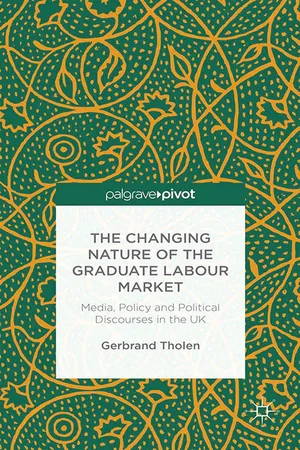
The Changing Nature of the Graduate Labour Market
Media, Policy and Political Discourses in the UK
- English
- ePUB (mobile friendly)
- Available on iOS & Android
eBook - ePub
The Changing Nature of the Graduate Labour Market
Media, Policy and Political Discourses in the UK
About this book
The assumptions made in the media regarding graduate skills and occupations are no longer valid within the changing educational context. This book traces seven key trends that shape the graduate labour market and reveals that their effects contradict the conceptualisation of the graduate labour market which dominates media and policy discourses.
Information
1
The Representation of the Graduate Labour Market: Media and Political Discourses
Abstract: This chapter outlines the representation of the graduate labour market in media and political discourses. It shows that the UK media has a strong normative stance towards the graduate labour market, assuming that the graduate labour market should be able to provide young people with successful futures. The chapter also shows through three political debates that there is a similar idealised version of the graduate labour market on display. The representation of graduate worker is aligned with different political projects that rely on a performative discourse that positions university-educated workers as a central force in improving social justice and economic prosperity.
Tholen, Gerbrand. The Changing Nature of the Graduate Labour Market: Media, Policy and Political Discourses in the UK. Basingstoke: Palgrave Macmillan, 2014. DOI: 10.1057/9781137479075.0006.
The nature of the graduate labour market and the effect the recession has had on graduates are not expressed uniformly. Various actors and stakeholders will have their own understanding of how higher education and the labour market are related. This chapter reviews how the graduate labour market tends to be represented within two distinct contexts. First, it will cover perspectives within the popular media on graduates, focusing mostly on the fate of recent graduates within the labour market. Then, it will look at the political context, examining three separate debates in which graduate skills and employment play a central role. I will show that within both contexts there are explicit and implicit foci and assumptions being placed regarding what constitutes graduate work, skills and careers, and how graduates should be rewarded.
Graduates in the media: doom and gloom
In recent years, the popular media has been awash in news stories that the graduate labour market has been affected hard by the recession. Headlines such as ‘Graduate job opportunities shrink amid economic uncertainty’ (Walker, 2013) are frequently to be found in major newspapers. Numerous studies and reports on the effect of the recession on job opportunities of fresh graduates receive wide attention in Britain’s broadsheets, smaller newspapers and other news channels. Early in July 2012 the Guardian website dedicated a segment of the ‘Comment is Free’ section to stories and opinions on the troubled prospects of new graduates. Titled ‘The graduate without a future’, it provided many stories of fearful graduates as well as stories of those who created a successful career. Paul Mason (2012) kicked off the series with an opinion piece titled ‘The graduates of 2012 will survive only in the cracks of our economy’, arguing that the UK has created an economic model that does not provide a prosperous future for many new graduates. This pessimism is illustrated by the views of experts like Michael Barnard, product manager at Milkround:
Graduates can’t expect to just walk into a decent job any more. If you want to work in London – God forbid, it’s the hardest place to find a job in the world – you will have to accept that you probably need to live in a house-share with five strangers, work in a café to pay the bills and start at the bottom with a big employer. (Quoted in Peacock, 2012)
There have been frequent opinion pieces with alarming messages about the lack of jobs for graduates. For example, Nelson (2012) predicted that those in the current generation of graduates would ultimately feel extremely disillusioned when they found out that their degree was not worth what they thought it would be. Within an unequal and unmeritocratic educational system the lack of fairness combined with high fees will make the competition for graduate jobs a disastrous battle. The financial pressure of repaying increased university fees is also a common theme in news stories about graduates (e.g., Chesworth, 2012).
Other articles have described graduates having great difficulty finding any kind of employment (Taylor, 2011; Cohen, 2012; Langley, 2012; Mohamed, 2012; Smith, 2012) or carrying out unskilled work in order to survive. They range from University of Oxford graduates pulling pints (Henry and Ensor, 2011) to an arts graduate working as a living scarecrow (Garland, 2012) to a story of a desperate media graduate who, after hundreds of failed job applications, decided to pay for a billboard that read, ‘I spent my last £500 on this billboard. Please give me a job’ (Duggan and Hamilton, 2013). Other news articles with titles such as ‘Graduates stuck in low-skilled positions’ (Woolcock, 2012) or ‘More graduates become shelf stackers as economy slides’ (Patton, 2012) cover research or data on skills mismatch. The risk of skills mismatch is often linked to a particular degree, such as media studies, as there is little demand for graduates in these subjects. In one article an employer is quoted saying, ‘Some degrees have no career opportunity at the end and the graduate ends up working in a coffee bar’ (Wooding, 2012).
The court case of Cait Reilly, a University of Birmingham geology graduate who was required to work for free in a branch of Poundland in order to keep her unemployment benefits, was well publicised. Although her case centred on her claim that such back-to-work schemes are a form of slave labour, much of the media coverage emphasised the dissonant fact that a university student was stacking shelves. The problem of graduates moving into relatively unskilled occupations is deemed problematic without explicitly being linked to other issues such as social mobility.
The desperate situation of the graduate labour market is underlined by stories about students who decide to choose apprenticeships over a university degree after sixth form (Shepherd, 2011), or to pursue a professional degree in a specially designed alternative corporate programme such as exist, for example, within some accountancy firms (Dalton, 2012).
The stories of declining fortunes for graduates do not come out of the blue. Current research supports many of the stories that appear in the popular media. These studies have received wide attention in all types of media and rely on popular interest linked to a wider interest in the prospects of young people, the role of universities in the economy and the overall health of the UK economy as a whole. Yet the special attention to doom-and-gloom stories does paint a particular image of graduate labour market entrants. At least two distinct representations of graduates are put forward in the media stories: the graduate as a victim and the graduate as a responsible agent.
Graduates as victims
Some commentators see graduates as basically being unlucky (Mohamed, 2012). Many are seen to do everything right but fail to get a fair chance. One architecture graduate described her efforts to get a job: ‘I’ve made more than 250 applications for an entry-level position as a designer, architect’s assistant, surveyor or something in the housing construction sector but all I’ve managed is three unsuccessful interviews’ (Cohen, 2012).
This failure of graduates to get a fair chance to hold down a job is an essential part of many of the reports. The labour market lacks an efficient allocation process between human capital provided by graduates and employers looking for the staff with the right skills and characteristics. The labour market is failing to give those who want to work a fair chance of showing their potential and achievements because of the great number of applicants for every job.
As a result, unemployment for those who indeed try hard to obtain work is seen as unfair. Peter Box, leader of Wakefield Council, expressed his concerns as follows: ‘Young people who are trying to get on the career ladder are instead finding themselves without a job and potentially falling into long-term unemployment. This can have scarring effects that last a lifetime and have a huge cost to the taxpayer in welfare and benefits’ (quoted in Doward, 2012). Graduates are sometimes seen to have made a wrong choice and chosen a career path that is no longer there or guaranteed. US college lecturer Patricia Park (2013) writes in the Guardian that the association between university degrees and well-paid white-collar jobs is no longer applicable. According to Park, blue-collar occupations give more rewarding employment opportunities than white-collar ones: ‘We cannot afford to ignore the reality that a college degree is becoming a luxury: one that no longer translates directly to success. It is time we shed our stigmas towards “menial” workers. The irony is that their salaries – and accompanying lifestyles – are anything but.’
Graduates as responsible agents
In contrast to the stories that are generally supportive of graduates seeking work are those that hold graduates responsible for their failure in the labour market. Heawood (2012) writes that graduates do not need our pity and should be realistic about the labour market prospects of certain degrees (like those in the arts). Cooksely (2012) also links subject degree choices to UK graduate unemployment and wonders why ‘media, art, history and other related subjects cannot just be hobbies which you do in your spare time’; the author is convinced that graduates are not doing everything they can. Jackson (2012) writes that in harsh economic circumstances graduates need to lower their expectations: ‘Legions of bright young graduates now need to be more open-minded, less fussy, less precious and rather more energetic and ingenuous when it comes to applying for jobs.’
Entrepreneur James Caan (2010) tells students that they cannot expect opportunities to come to them on a plate. Instead graduates could work for free to obtain the desired work experience. Other advice usually involves advocating work experience, internship or extracurricular activities (Clark, 2012; Garner, 2013; L’Anson, 2013). One article tells graduates that in order to ‘bag’ a graduate job, they should ‘stay positive, the graduate job market is fiercely competitive and don’t be too disheartened if you get rejected’ (Bonney, 2012).
The role of graduates in the media
The angle of most media stories is that there is a deviation from the natural state of the labour market, in which those with a university degree make up the top segment and through their natural gifts and advanced training deserve and should expect high-skilled, well-paid jobs. The reality that many graduates cannot find the right jobs, do not have the right skills and do not earn high wages is seen to be the result of either employer decisions or market forces. Since the recession the demand for skilled labour has decreased, and there are signs of over-education in the labour market: graduate unemployment, graduates being over-skilled and individual experiences of hardship and disappointment.
Unlike other countries, in the UK there has not been a real backlash against the idea that participation in tertiary education is a desired goal for as many (young) people as possible. In the US, for example, a few sceptical academics and business people have questioned the expansion of higher education and the real value of a college degree. These include economists Richard K. Vedder and Robert I. Lerman, political scientist Charles Murray, educationalist James E. Rosenbaum and venture capitalists Peter Thiel and James Altucher. These views have received considerable media attention in the US (e.g., Kaufman, 2010; Steinberg, 2010). In the UK the argument that there are too many graduates for the number of jobs available has been around for some time (e.g., Bowers-Brown and Harvey, 2004) but has never received any strong proponents in the media. In recent years occasionally there are news items that tentatively suggest support for this view. The Confederation of British Industry (CBI) stated in 2008 that there were enough graduate-level jobs for all graduates but suggested that there were not enough graduates with the qualities to take them (Curtis, 2008). In 2010 the Association of Graduate Recruiters stated that the government’s push to get 50 per cent of people under 30 into higher education has ‘driven down standards and devalued the currency of a degree and damaged the quality of the university experience’ (BBC, 2010).
Graduates in politics
There are many political debates on the role of education, skills and knowledge. Political and policy-focused discussions can overlap as the demarcation between the political and the policy domain is sometimes nebulous. I will outline three current debates and demonstrate how ‘graduates’ are applied and categorised within a discursive and polemical context.
Social mobility and the competition for livelihoods
The first area in which graduate employment, career and employability are widely debated is within the discussion around social mobility. Social intergenerational mobility is low compared with other Western European countries1 (OECD, 2010), and this can be attributed to more than one cause. Those in the Conservative Party believe they include family breakdown, ineffective schools, lack of skills development, welfare provision and lack of work ethic (Conservative Party, 2008)2; those in the Labour Party might suggest that education and lack of access to it, ‘closed circles’ in elite professions and inequality are the main culprits (Miliband, 2012). Education is not only seen as an important barrier but also as a policy area in which politicians and political actors think the government can make a difference. Indeed, the idea that education is the means to social mobility has been around for a very long time. New Labour made education a key lever to provide opportunities to children of all social strata and to spur economic growth, summed up in Tony Blair’s oft-quoted slogan ‘education, education and education’. One of the functions of education in general is to promote equal opportunities. The idea that increasing access to higher education in particular can improve social mobility is therefore not strange but has been especially prominent in the last two decades and actively helped encourage the growth of higher education participation in the UK.
The central idea behind widening access to education is that it gives everyone able and willing the opportunity to reap its benefits, which are often defined in financial terms. The lifetime benefits of university education on the whole remain strong. Participation in higher education therefore will give those previously unable to compete for better-paid jobs the skills and qualifications to do so and thus reduce social inequalities in society. Here, equality in opportunity rather than outcome is emphasised. Individuals are provided with the means to become socially mobile. The responsibility of becoming socially mobile is shifting to the individual, taking away the government’s need to redistribute wealth and the need to maintain an extensive social safety net as citizens provide their own labour market security.
The current government has continued to support the link between education and social mobility. This was demonstrated most clearly when the Office for National Statistics calculated that more than two million adults with university qualifications have wealth of over one million pounds. Universities minister David Willetts responded to these figures by stating that it provides ‘more evidence of why going to university is a very good deal’. For Willetts, the higher wealth of people with degrees justifies Coalition policies to charge higher tuition fees and push more school-leavers to go to university showing “why it’s fair to ask graduates to pay back the cost of their higher education, and why increasing the number of people who go to university will spread wealth and opportunity.” This is a quintessential Coalition argument regarding the relationship between university education and future income. It treats higher education as a private good and presents higher education as the conduit to wealth and social repositioning.
Deputy Prime Minister Nick Clegg (2012) promotes the idea that ‘social mobility is the central social preoccupation of the Coalition Government’ and believes that removing unfair barriers to access (top) universities is key in this. As part of his social-mobility strategy, launched in April 2011, Clegg created a partnership between business and government to ‘spread opportunities across our society and, crucially, to create culture change in other companies’ (Libdems, 2012). Clegg states that ‘ability and drive should trump connections and privilege’ (Cabinet Office, 2012). At both ends of the economic spectrum there is a special interest in the role higher education can and should play in promoting social mobility. Independent reviewer on social mobility Alan Milburn (2012) wrote about universities:
They are the gatekeepers of opportunity and the main pathway into careers in the professions. As the British economy becomes ever more knowledge-based and professionalised, the role universities play will assume greater importance. Who gets into university, and how they get on once they have left, will have a critical role in determining whether Britain’s sluggish rates of social mobility can be improved. (p. 14)
In the debate, fair access to professional careers and the role of internships in particular are scrutinised and highlighted in various media stories about how unpaid interns gain access to particular graduate occupations (e.g., Snowdon, 2011; Bright, 2012). The coalition government intends to remo...
Table of contents
- Cover
- Title
- Introduction
- 1 The Representation of the Graduate Labour Market: Media and Political Discourses
- 2 Seven Trends Shaping the UK Graduate Labour Market
- 3 Where Has It Gone Wrong?
- References
- Index
Trusted by 375,005 students
Access to over 1.5 million titles for a fair monthly price.
Study more efficiently using our study tools.
Frequently asked questions
Yes, you can cancel anytime from the Subscription tab in your account settings on the Perlego website. Your subscription will stay active until the end of your current billing period. Learn how to cancel your subscription
No, books cannot be downloaded as external files, such as PDFs, for use outside of Perlego. However, you can download books within the Perlego app for offline reading on mobile or tablet. Learn how to download books offline
Perlego offers two plans: Essential and Complete
- Essential is ideal for learners and professionals who enjoy exploring a wide range of subjects. Access the Essential Library with 800,000+ trusted titles and best-sellers across business, personal growth, and the humanities. Includes unlimited reading time and Standard Read Aloud voice.
- Complete: Perfect for advanced learners and researchers needing full, unrestricted access. Unlock 1.5M+ books across hundreds of subjects, including academic and specialized titles. The Complete Plan also includes advanced features like Premium Read Aloud and Research Assistant.
We are an online textbook subscription service, where you can get access to an entire online library for less than the price of a single book per month. With over 1.5 million books across 990+ topics, we’ve got you covered! Learn about our mission
Look out for the read-aloud symbol on your next book to see if you can listen to it. The read-aloud tool reads text aloud for you, highlighting the text as it is being read. You can pause it, speed it up and slow it down. Learn more about Read Aloud
Yes! You can use the Perlego app on both iOS and Android devices to read anytime, anywhere — even offline. Perfect for commutes or when you’re on the go.
Please note we cannot support devices running on iOS 13 and Android 7 or earlier. Learn more about using the app
Please note we cannot support devices running on iOS 13 and Android 7 or earlier. Learn more about using the app
Yes, you can access The Changing Nature of the Graduate Labour Market by G. Tholen in PDF and/or ePUB format, as well as other popular books in Economics & Labour Economics. We have over 1.5 million books available in our catalogue for you to explore.