eBook - ePub
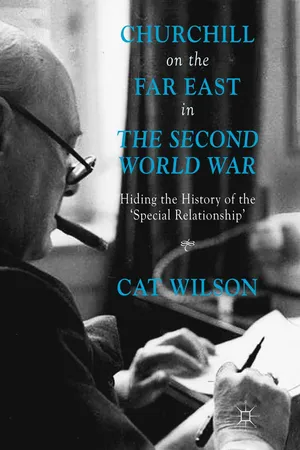
Churchill on the Far East in the Second World War
Hiding the History of the ‘Special Relationship’
- English
- ePUB (mobile friendly)
- Available on iOS & Android
eBook - ePub
Churchill on the Far East in the Second World War
Hiding the History of the ‘Special Relationship’
About this book
Cat Wilson brings together two strands of historical scholarship: Churchill's work as a historian and the history of WWII in the Far East. Examining Churchill's portrayal of the British Empire's war against Japan, as set down in his memoirs, it ascertains whether he mythologised wartime Anglo-American relations to present a 'special relationship'.
Information
Topic
StoriaSubtopic
Storia dell'Asia1
From Memoir to History
During his ‘wilderness years’ Churchill had been subjected to criticism, scorn and, at times, quite barbed derision in the Commons.1 Six weeks after the outbreak of war, and having returned to the Admiralty, Churchill received a letter of apology from Colin Thornton-Kemsley (the Conservative MP for Kincardine and West Aberdeenshire), who expressed regret at having opposed Churchill for as long and as hard as he had, and for not having listened to his repeated warnings about the ‘German danger’.2 With typical magnanimity, Churchill replied how ‘Englishmen ought to start fair with one another from the outset in so grievous a struggle’, and that for him, ‘the past’ was ‘dead’.3 As far as personal animosity was concerned, this was certainly so, but in another sense the past was never really dead for Churchill. At the same time as he sent his reply, Churchill was being approached by publishers who were vying for his attention (and signature) over what they expected would be a great piece of writing.4 Churchill may have been 65 years old and unsure as to whether he would survive the war, and no one was sure whether he would retain his position in the Admiralty for the duration, but what was certain was that he would write about his role in the fight – and he would write it well. This chapter contextualises Churchill’s literary empire, outlines the interplay between memoir and history in relation to his Second World War, and illustrates how his six volumes moved from memoir to history.5
Although Churchill maintained that his memoirs of the Second World War were not history but rather his ‘case’, he knew that as time progressed, the ‘flickering lamp’ of history would probably throw a different light on his own life and career.6 Conscious that ‘fierce and bitter controversies’ had haunted Neville Chamberlain, both in life and after his death, Churchill acknowledged that his own reputation might easily be plagued by equally contentious episodes which had occurred throughout his own career.7 In order, therefore, to help counteract any wartime controversies whilst he was alive, and to smooth his hoped-for return to 10 Downing Street, Churchill wrote his memoirs. His wife Clementine once remarked that ‘when History looks back your vision & your piercing energy coupled with your patience & magnanimity will all be part of your greatness’.8 Indeed it would, but if Churchill could embellish that greatness through his writing – if he could enforce that he had been and still remained the ‘essential man’ – so much the better.9
Throughout his life, Churchill earned a sizable proportion of his income from writing.10 His literary career began at the end of the nineteenth century when he became a wartime correspondent in Cuba in 1895. This career continued a year later in Egypt, and then in South Africa during the Boer War. His articles were favourably received and this prompted him to view writing as not only a way of bolstering his constantly fluctuating income, but also of proselytising his own opinions. Writing about the reviews his Malakand Field Force had received, Churchill noted
That was the stuff! I was thrilled. I knew that if this would pass muster there was lots more where it came from, and I felt a new way of making a living and of asserting myself, opening splendidly out before me.11
The money he earned from writing meant that even though he constantly complained of being ‘oofless’ (cash poor), he had nonetheless a reasonably regular source of income.12 As his inability to be parsimonious with his own funds became habitual, he ‘resolved to build a small literary house’ to supplement what he saw as a meagre income.13 Without a doubt, money was ‘a prime motive’ in all of Churchill’s literary works, and he ‘probably made more in real terms than any non-fiction author in the twentieth century’.14 Yet there was a more valuable reason for continuing his literary career alongside his evolving political career: Churchill’s writing afforded him a platform from which he could vent his opinions, justify his beliefs and actions, or present alternative scenarios to those which he felt were historically inaccurate. His talent as a writer, when coupled with his interest in history, led Churchill to see how historical perspectives were not only apt to change, but also could have change forced upon them.15 As he himself once expressed, and probably with a hint of a smile, ‘give me the facts . . . and I shall twist them to suit my argument’.16
Churchill first experienced the power that historical writing held when he attempted to silence his late father’s detractors by means of writing his biography.17 Whilst not entirely successful in his remit, Churchill did at least quell some of the harsher criticisms which had been levelled against Lord Randolph Churchill. One reviewer went so far as to write that Churchill’s biography, would ‘have to be read – nay, even more than read – it would have to be carefully studied by all’ who wished to be ‘well versed’ in British political history of the latter part of the nineteenth century.18 That being said, as a vindication of his father’s reputation Lord Randolph Churchill did not succeed, but as a great political history it did.19 Churchill’s most forceful encounter with the power of history, however, was his multi-volume narrative on the First World War – The World Crisis.20 To date only one historian has tackled the context behind and the inaccuracies within The World Crisis, and Robin Prior concluded that whilst the commitment Churchill needed to complete such a work was immense, and its ‘thread of humanity’ reflected its author’s awareness of the horrors of the new age of warfare, it was nonetheless a piece of historical writing which contained ‘distortions and lack of balance’.21 The first line of Churchill’s preface to the fourth volume, entitled The Aftermath, noted that it had taken him almost ten years to write his ‘contemporary contribution to the history of the Great War’.22 While Churchill clearly thought of his narrative of the First World War as a ‘contribution’ to history, a phrase which he would use once again in the preface to his first volume of memoirs on the Second World War,23 the ‘distortions’ within the narrative suggest that Arthur Balfour was perhaps correct to describe the World Crisis as Churchill’s autobiography disguised as world history.24
Churchill wrote the World Crisis between 1919 and 1926. During this time his political career had regained almost all of its pre-Dardanelles vigour: he had been Secretary of State for War and Minister of Air (15 January 1919–14 February 1921 and 1 April 1921 respectively), Secretary of State for the Colonies (14 February 1921–October 1922), out of office for almost two years, and then Chancellor of the Exchequer (7 November 1924–30 May 1929). Perhaps his desire to justify his role in the Dardanelles strategy increased the verve with which he wrote his narrative, and this possibly accounts for the relatively short period before the first volume was published. Despite his protestation to the contrary, Churchill’s literary output seems not to have been unduly affected by his political offices – a quite remarkable feat.25 His rate of literary production, however, increased exponentially when he entered the ‘political wilderness’ in 1931.26
It was during the period from 1931 to 1939 that he ‘undertook his greatest literary task’, the four-volume Marlborough.27 The intention behind this study of his ancestor was to ‘give a more just and generous judgement’ on John Churchill, First Duke of Marlborough.28 Churchill was ‘determined from the first to make the best case he could’ for Marlborough, and exclusive access to papers and documents in the muniment room at Blenheim Palace helped Churchill’s narrative become a cohesive historical tale.29 Yet Churchill cleverly wrote more than a political biography of his ancestor, for Marlborough was also a description of ‘how the harsh and excessive demands of the victors [had] produced innumerable and unforeseen consequences for the defeated nations’.30 In other words, Marlborough was Churchill’s warning from history – it was arguably his implicit treatise against the consequences of the 1919 Treaty of Versailles. The volumes received ‘critical acclaim’, and Churchill succeeded in restoring Marlborough’s ‘good name’.31 As one contemporary reviewer wrote, the ‘persistently vilified’ Marlborough had found, in his own descendent, a ‘sharp, tireless, brilliant pen to defend him’.32 Concluding her review of Marlborough, Barbour wrote that even though Churchill was ‘here and there more rasher and more partisan than the professional historian’, it did not mean that he had ‘flouted the professional historian’s virtues’.33 Indeed, as it was for Marlborough that Churchill was made Honorary Vice-President of the Royal Historical Society in 1936.
Churchill’s literary career preceded his entry into parliament by four years. He honed his journalistic and literary skills to help establish his political position, to rally support for whatever cause he subscribed to, and to augment his constantly fluctuating personal finances. Yet none of this explains why Churchill’s memoirs of the Second World War acquired the status of semi-official history, let alone the way in which they indelibly shaped the history of the Second World War.
Anyone who researches Churchill’s Second World War owes a debt to David Reynolds, whose In Command of History clarified why Churchill wrote his memoirs, explained how they were physically constructed, and set them against the contextual background of a hot war turning into a cold one.34 Churchill did not write his memoirs due to the vanity of age: he wrote them (although compiled and edited are perhaps more apt terms) to increase his chances of a return to 10 Downing Street.35 In writing his ‘contribution to history’, Churchill hoped that he would either appease or silence his critics before they could hinder his return to power.36 One historian wrote that Churchill’s political actions after his defeat in the general election of July 1945 ‘added little to his stature’ but that ‘his history’ of the war ‘lent lustre to his fame’.37 It was this lustre which (if he embellished it enough) would possibly help him become a peacetime prime minister. Having recovered from his landslide defeat in the general election of July 1945,38 having revived his international presence on a lecture tour of America in early 1946,39 and having successfully negotiated the all-important tax position regarding any profits he would make by picking up a pen again,40 Churchill resolved to compose his memoirs.41 His intention to do so had been evident much earlier than the aftermath of what his wife deemed to be perhaps ‘a blessing in disguise’.42 In spite of Churchill having instructed one of his secretaries, in August 1945, to respond politely but negatively to several quite persistent telegrams enquiring as to not whether he would write his memoirs but when he would start them, Churchill had already indicated his intention to record his memoirs within a month of becoming Prime Minister.43 After France had fallen, Churchill told the Commons that Britain could ill afford any ‘utterly futile and even harmful’ recriminations regarding the evacuation of the British Expeditionary Force from Dunkirk. In this speech, Churchill expressed the view that the whys and wherefores of Operation Dynamo (the codename for the Dunkirk evacuation) had to be put aside. It had to be ‘put on the shelf, from which the historians, when they have time, will select their documents to tell their stories’.44 Churchill, however, thought that he would be one of the historians.45
Churchill’s concept of ‘history’ was ‘essentially a personal and family affair’.46 He believed that history was irrevocably entwined with politics, and was made by great individuals, who were, more often than not, men of destiny operating under a grand theme. Churchill’s grand theme was the British Empire. The 1920s and 30s were a gold...
Table of contents
- Cover
- Title Page
- Copyright
- Contents
- Acknowledgements
- Author’s Note
- Introduction
- 1. From Memoir to History
- 2. Churchill’s British Empire
- 3. Churchill’s Imperial War with Japan
- 4. Churchill’s Imperial Losses: Hong Kong, Malaya, Singapore
- 5. Churchill’s India, 1942 to 1943
- 6. Churchill’s Indian Army and the Reconquest of Burma
- 7. From Memoir to History, Part II
- Conclusion
- Dramatis Personae
- A Note on Sources
- Notes
- Select Bibliography
- Index
Trusted by 375,005 students
Access to over 1.5 million titles for a fair monthly price.
Study more efficiently using our study tools.
Frequently asked questions
Yes, you can cancel anytime from the Subscription tab in your account settings on the Perlego website. Your subscription will stay active until the end of your current billing period. Learn how to cancel your subscription
No, books cannot be downloaded as external files, such as PDFs, for use outside of Perlego. However, you can download books within the Perlego app for offline reading on mobile or tablet. Learn how to download books offline
Perlego offers two plans: Essential and Complete
- Essential is ideal for learners and professionals who enjoy exploring a wide range of subjects. Access the Essential Library with 800,000+ trusted titles and best-sellers across business, personal growth, and the humanities. Includes unlimited reading time and Standard Read Aloud voice.
- Complete: Perfect for advanced learners and researchers needing full, unrestricted access. Unlock 1.5M+ books across hundreds of subjects, including academic and specialized titles. The Complete Plan also includes advanced features like Premium Read Aloud and Research Assistant.
We are an online textbook subscription service, where you can get access to an entire online library for less than the price of a single book per month. With over 1.5 million books across 990+ topics, we’ve got you covered! Learn about our mission
Look out for the read-aloud symbol on your next book to see if you can listen to it. The read-aloud tool reads text aloud for you, highlighting the text as it is being read. You can pause it, speed it up and slow it down. Learn more about Read Aloud
Yes! You can use the Perlego app on both iOS and Android devices to read anytime, anywhere — even offline. Perfect for commutes or when you’re on the go.
Please note we cannot support devices running on iOS 13 and Android 7 or earlier. Learn more about using the app
Please note we cannot support devices running on iOS 13 and Android 7 or earlier. Learn more about using the app
Yes, you can access Churchill on the Far East in the Second World War by C. Wilson in PDF and/or ePUB format, as well as other popular books in Storia & Storia dell'Asia. We have over 1.5 million books available in our catalogue for you to explore.