eBook - ePub
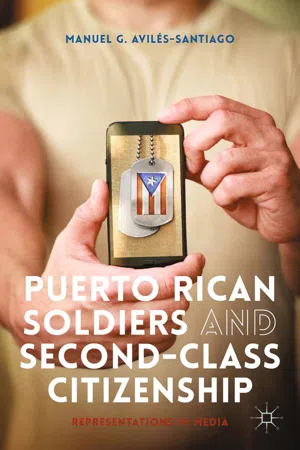
Puerto Rican Soldiers and Second-Class Citizenship
Representations in Media
- English
- ePUB (mobile friendly)
- Available on iOS & Android
eBook - ePub
About this book
Puerto Rican soldiers have been consistently whitewashed out of the narrative of American history despite playing parts in all American wars since WWI. This book examines the online self-representation of Puerto Rican soldiers who served during the War on Terror, focusing on social networking sites, user-generated content, and web memorials.
Information
Chapter 1
Saving Pvt. Fulano de Tal: Representations of Puerto Rican Soldiers in Television and Film
In my search for some documentation that would indicate the way the Puerto Rican soldier has figured in the American public imaginary, I came upon a WWII editorial in Yank,1 a US Army weekly propaganda magazine, published in 1944. Here, for a fleeting instant, the 55,000 Puerto Ricans who served in the war are recognized by Lou Stouten, a sergeant, who states:
In addition, Pvt. Fulano de Tal, Puerto Rico’s Pvt. John Doe, is a good soldier. He usually stands two or three inches shorter than his Americano brother. He is stocky, high-cheeked, muscular, bronzed and hardened by training in the tropical sun. He’s a crack shot and handy with the bayonet. He knows his jungle warfare [. . .] Fulano loves his rice and beans, and to the great happiness of any soldado Americano who may mess with him, he eats these staples once or twice a day. He also loves to sing and dance, mostly rumba. [. . .] The Puerto Rican GI has a real sense of humor but, like all Latinos, is proud and touchy about his honra of his beloved island. His blood is of the Spanish conquistadores, of the ancient Borinquen Indians and of various European nationalities that have visited his island since its discovery by Columbus in 1493. Spanish is still the language of most Puerto Ricans. But Fulano is a citizen of the U.S. by act of Congress, like all his people [. . .] respects American efficiency, education and high standard of living, and he has a hankering to see the States after the war is over, just as the average soldado Americano down here plans to pay a return visit to La Isla del Encanto (the isle of Enchantment) someday. [. . .] He [the Puerto Rican soldier] and his island have grown in maturity and stature by playing their part in this war, by their sacrifices in discomfort, hunger, and blood. (June 23, 1944, p. 9)
The author’s rhetoric, immersed in the New Deal liberalism that was, for the most part, the official discourse of the war, engages in a process of othering at different semantic levels. On the level of nature, the soldier’s physiognomy is shorter and his skin darker. His “blood” is a compound of different historical influences. On the level of communication, his language is Spanish and not English, which is not only directly stated, but also performed by Stouten’s insertion of certain key words in Spanish. On the level of culture, his singing and dancing skills are noted, as is his cuisine of rice and beans, which is treated half jocularly as a cultural feature that leads to the “great happiness of any soldado Americano who may mess with him. . . .” The master trope behind this upbeat vision is about a subaltern subject who is on the way to assimilation. Into a history that is other oriented—from the Spanish conquistadors to the Indian inhabitants of the island—intruded a US Congress that voted in citizenship for Puerto Ricans. In this narrative, “Pvt. Fulano de Tal”—and by implication, the island itself—has come to a certain point in his civilizational trajectory that is naturalized as a sort of physical growth spurt, in which the Puerto Rican soldier—and through him the island—will add both to his physical and psychological stature by standing side by side with US soldiers, which presages the closer relations between the mainland and “La Isla del Encanto.” These relations are vaguely adventurous and seemingly symmetrical; Fulano de Tal wants to “see” the States presumably as a tourist, while the soldado Americano will make Puerto Rico his own tourist destination after the war. Stouten deliberately names the Puerto Rican everyman “Fulano de Tal” [the Spanish equivalent to “John Doe”] as a sort of democratic gesture in line with the New Deal ideology of government for the common man. Interestingly, both John Doe and Fulano de Tal exist as a sort of promise of signification once they are out of the army. Within it, they exist as void signifiers. And indeed, given the omnipresent forgetting of Fulano de Tal in mainstream media and histories, he never did acquire a signifier in the US imaginary.
The stock of images portraying Puerto Rican soldiers and/or veterans is severely limited by the refusal to grant them any attention space. When they assume some marginal mention, the images range from a funny, chubby, inept soldier to the crazed Vietnam veteran who cannot adjust to society and from dysfunctional soldiers who return home after their failed mission in the War on Terror to multiple cases of post-traumatic stress disorder (PTSD). In this chapter, I will survey these representations in national television and film during the last 60 years, as it is here that the figure of the soldier has been burned into the public consciousness, both on the mainland and, to an extent as I will show, in Puerto Rico.2 Television came to Puerto Rico during the late 1950s, after WWII and Korea, but just in time to capture Vietnam and the two Middle East wars. My argument is that many current self-representations that occur in digital/social media environments are informed not only by the existential experiences of the soldier but also by their heuristic use of the few images of the Puerto Rican soldier that are circulated in the traditional media. Even the blank left to mark where the soldier must have been lends to the soldier’s experience of certain resentment.
I will begin this chapter with a survey of literature on the articulation of Puerto Rican identity and the media. The initial section will focus on the configuration of the Puerto Rican identity in both local and US media outlets. I am indebted in my analysis to a triumvirate of cultural theorists: Frances Negrón-Muntaner (2004), Arlene Dávila (1998), and Yeidy M. Rivero (2005). This section will bring into conversation transnational understandings of the Puerto Rican identity in US media. The argument shared by these three scholars rests on the assumption that Puerto Rican identity was shaped within the colonial/racial dynamic that was always mediated by an ambiguous, problematic, and contested political status. I connect this thesis to insights offered by such scholars as Jorge Duany (2002), Lillian Jiménez (1990), Richie Pérez (1997), Alberto Sandoval (1994), and Miriam Jiménez-Román (2008). Through their larger sense of media thematics, we can see that Puerto Rican identity did not emerge in splendid insularity, but rather incorporated and adapted itself to the circular migration between the island and the mainland.
On this basis, I will mount my analysis of the articulation of what I refer to as the “Jíbaro Soldier” in Puerto Rican TV. This character embodies the archetype of the jíbaro who, underneath his military uniform, preserves the comforting essence of the supposed characteristics of Puerto Rican white rural workers, such as humbleness and innocence. The mythical white Puerto Rican peasant, according to Guerra (1998), has become “the central figure of Puerto Rican nationalism” (p. 3), which expresses the race-coded marginalization of other Puerto Ricans on the island. For this reason, I will discuss the character Soldado Manteca (interpreted by Jose Miguel Agrelot), a Gomer-Pyle-like3 character that first appeared on the late 1960s Puerto Rican televisual landscape. Then I will discuss the articulation of two comedic characters portraying mentally ill veterans from the Vietnam generation: “Herminio Domínguez” (interpreted by Raul Carbonell) and “El Veterano” (interpreted by Juan Manuel Lebrón), who appeared in a number of situation comedies produced by Puerto Rico’s commercial television networks4 throughout the 1980s and early 1990s, with sporadic appearances in more contemporary television shows and stand-ups. Even though both characters are veterans from the same war, they have completely opposite views about the military. Through these characters, the imaginary of the Puerto Rican soldier is articulated in comedic roles, which neutralizes the more explicit discussion of war, colonial subjectivity, masculinity, race, and imperialism. My interest is to position these characters in the political unconscious of the televisual space of comedy in Puerto Rico, which I can assume is familiar from childhood to most of the soldiers who served in Iraq and Afghanistan.
I want to interpret, as well, more contemporary representations made by public broadcasting television in Puerto Rico (Puerto Rico Public Broadcasting Corporation, also known as TUTV), such as Las Guerreras (2007) (WIPR-TV), which take the soldier figure out of the comic framework. The miniseries is the first and only TV show to focus on the role of Puerto Rican service women from several angles, including mother, wife, and veteran. This production was made in response to a call for proposals for programs by TUTV. In this chapter, I will focus on television, mostly because as Dávila (1998) tells us, on the island, television is “a primary tool in the growth of modern consumer society and in the imagining of a Puerto Rican national community” (p. 454). For the sake of completeness, however, it is worth noting that a few films have also portrayed Puerto Rican soldiers.
In 1967, a film was made about a Puerto Rican veteran returning from the Korean War titled La Noche de Don Manuel [Don Manuel’s Night] (1967). This 40-minute film was produced by DIVEDCO, a government agency created in the mid-1940s that was given the task of introducing modern culture to the rural population, which was confronting the increasing industrialization and urbanization of Puerto Rico, with all the changes this entailed for the island’s human geography. The film stages a confrontation between a “cacique del barrio” [rural community leader] and a young Korean War veteran. In striking juxtaposition to the handful of films produced after the 1980s that portrayed Puerto Rican soldiers, this film did not take a critical stance to the war the soldier fought in, but portrayed its protagonists with solemn social realism.
In 1998, Puerto Rico produced its first full-length film solely dedicated to war: Héroes de Otra Patria [Heroes from Another Land] (Ortiz, 1998). The film, written and directed by Iván Dariel Ortiz, follows the life trajectories of two Puerto Rican soldiers, with opposing views on war, who get lost together in the middle of jungle combat in Vietnam. Later in the 2000s, two feature films about the occupation of Iraq were produced under limited budget constraints—Irak Vive en Mí [Iraq Lives within Me] (Ramos-Perea, 2008) and El Lenguaje de la Guerra [The Language of War] (Sued, 2009). The films openly criticize militarization, the War on Terror, and US occupation policies.
I must admit that surveying soldier representations in television was challenging. Changes in Puerto Rican government and local bureaucracy made access to visual texts like Las Guerreras impossible. The audiovisual media archive at University of Puerto Rico’s School of Communications, however, did provide me with clips of El Veterano and Soldado Manteca. I was also able to access additional material of Soldado Manteca and Herminio Domínguez through digital/social media archives, particularly those from user-generated-content sites like YouTube.
My interpretation attempts to take into account the cultural and industrial aspects that shaped these representations. For example, Soldado Manteca, El Veterano, and Herminio Domínguez are all comedic characters about and from the Vietnam generation, while Las Guerreras and The Borinqueneers mark themselves as “serious” and came into the small screen as part of the programming strategies conducted by local and national public television. This chapter’s ultimate argument is that the Puerto Rican soldier’s self-representational practices in social media do not occur in a cultural imagery vacuum, but instead reference a limited stock of images that have been in circulation in the popular media for more than three decades.
Puerto Rican Identity and the Media
There is an immense literature on the representation of US wars and soldiers in television and film, but this literature is strikingly lacking in any exploration of the representation of Puerto Rican soldiers in either traditional or new forms of digital/social media. Perhaps this is due to the divide between those who deal with the sociology and literature of Puerto Rico and those who are interested in the Puerto Rican military subculture. Thus, while there is a critical literature that provides an analysis of mass-media coverage of the war and of the military (Maniaty, 2008), and discusses the construction of the white, male hero in war narratives (Studlar & Desser, 1990), there is much less examination of the difference it makes when the protagonist is either brown or black. Only a few articles destabilize the idea of the white, male hero and...
Table of contents
- Cover Page
- Half Title Page
- Title Page
- Copyright
- Dedication
- Contents
- List of Figures
- Foreword
- Acknowledgments
- Introduction
- 1 Saving Pvt. Fulano de Tal: Representations of Puerto Rican Soldiers in Television and Film
- 2 Digital Bodies at War: The Boricua Soldier in Social Networking Sites
- 3 Broadcasting Puerto Ricanness: Mash-up Identities in the User-Generated-Content Zone
- 4 Digital Epitaphs: Web Memorializing Puerto Rican Soldiers in the Twenty-first Century
- Conclusions
- Notes
- References
- Index
Trusted by 375,005 students
Access to over 1.5 million titles for a fair monthly price.
Study more efficiently using our study tools.
Frequently asked questions
Yes, you can cancel anytime from the Subscription tab in your account settings on the Perlego website. Your subscription will stay active until the end of your current billing period. Learn how to cancel your subscription
No, books cannot be downloaded as external files, such as PDFs, for use outside of Perlego. However, you can download books within the Perlego app for offline reading on mobile or tablet. Learn how to download books offline
Perlego offers two plans: Essential and Complete
- Essential is ideal for learners and professionals who enjoy exploring a wide range of subjects. Access the Essential Library with 800,000+ trusted titles and best-sellers across business, personal growth, and the humanities. Includes unlimited reading time and Standard Read Aloud voice.
- Complete: Perfect for advanced learners and researchers needing full, unrestricted access. Unlock 1.5M+ books across hundreds of subjects, including academic and specialized titles. The Complete Plan also includes advanced features like Premium Read Aloud and Research Assistant.
We are an online textbook subscription service, where you can get access to an entire online library for less than the price of a single book per month. With over 1.5 million books across 990+ topics, we’ve got you covered! Learn about our mission
Look out for the read-aloud symbol on your next book to see if you can listen to it. The read-aloud tool reads text aloud for you, highlighting the text as it is being read. You can pause it, speed it up and slow it down. Learn more about Read Aloud
Yes! You can use the Perlego app on both iOS and Android devices to read anytime, anywhere — even offline. Perfect for commutes or when you’re on the go.
Please note we cannot support devices running on iOS 13 and Android 7 or earlier. Learn more about using the app
Please note we cannot support devices running on iOS 13 and Android 7 or earlier. Learn more about using the app
Yes, you can access Puerto Rican Soldiers and Second-Class Citizenship by M. Avilés-Santiago in PDF and/or ePUB format, as well as other popular books in Social Sciences & Social History. We have over 1.5 million books available in our catalogue for you to explore.