- English
- ePUB (mobile friendly)
- Available on iOS & Android
eBook - ePub
About this book
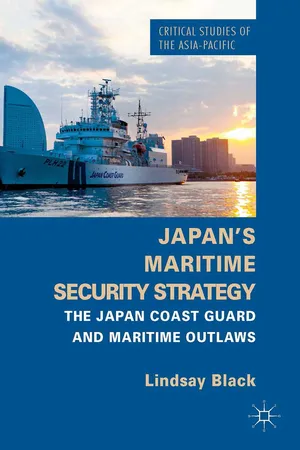
Since the late 1990s, the Japan Coast Guard (JCG) has countered a myriad of 'outlaw' threats at sea including piracy, terrorism, the proliferation of Weapons of Mass Destruction (WMD) and the threat posed by 'rogue states'. Japan's innovative strategy has transformed maritime security governance in Southeast Asia and beyond.
Information
1
Introduction
In September 1998, pirates hijacked the Japanese-owned Tenyu cargo ship carrying 3,000 tons of aluminium ingots worth USD 3 million after it left the Indonesian port of Kuala Tanjung bound for Inchon, South Korea. Chinese police located the Tenyu three months later in Zhangjiagang port, Jiangsu Province. It had been renamed the Sanei 1, its fourth name since being hijacked, had an Indonesian crew and a cargo of palm oil. The members of the original crew remain missing, presumed dead. Such dramatic piratical attacks had become prevalent in Southeast Asian waters by the late 1990s, prompting an international response that successive Japanese governments would lead. The safety of maritime shipping was not just at risk from pirates, but from a myriad of ‘outlaws’ of international society. The terrorist attacks of 11 September 2001, as well as on the USS Cole a year earlier, heightened concern over any vulnerable potential targets and raised the possibility of catastrophic strikes on international shipping that could close vital waterways or destroy major ports. The ensuing ‘war on terror’ emphasized the dangers of the proliferation of Weapons of Mass Destruction (WMD) and the threat posed by rogue states, such as North Korea (Yamada 2003: 25, 31–6; Richardson 2004: 102–7). Within the context of the ‘war on terror’, US-led efforts sought to transform the laws and norms of international society in response to these maritime security threats.
Considering the substantial risk to Japanese shipping, as well as to Japan’s national interests, particularly as regards energy and the economy, it is no surprise that the Japanese government has been at the forefront of international responses to maritime security threats. Japan is a major maritime power and an island nation, whose economy (the world’s third largest) and trade are reliant upon the safe passage of shipping. In particular, Japan transports 80 per cent of its oil resources through the Malacca Straits (Yamada 2003: 143–4), and a blockage of this sea lane caused by an intentional terrorist incident or an accident resulting from a piratical incident would significantly damage Japan’s economic interests (Graham 2006: 1–7). The cost of deterring would-be pirates or terrorists alone is substantial for the Japanese shipping industry. For example, avoiding conflict zones like Somalia means extending the distances ships travel, which in turn costs freight companies more in terms of wages and fuel (ICC 2005a, 2005b). Alternatively, the price of installing anti-piracy devices, such as ShipLoc – a location device (ShipLoc 2013) – or Secure Ship – an electric fence that runs around the deck of a ship (SecureMarine 2013) – or indeed hiring armed guards must be borne by ship-owners. These costs are ultimately passed down to the consumer. Furthermore, piracy and maritime terrorism puts the lives of Japanese seafarers at risk and, in the case of terrorism, potentially creates a threat to Japanese ports and harbours.
Since the late 1990s, successive Japanese governments have actively responded to a number of maritime security threats. A rise in maritime piracy in Southeast Asia encouraged the Obuchi Keizō administration to begin implementing a broad anti-piracy strategy that focused on building maritime policing capabilities, establishing institutions to monitor and analyse maritime security issues, and amending domestic and international law. Subsequent Japanese prime ministers developed this anti-piracy approach into a model which the Asō Tarō administration reproduced to confront the growing number of piratical incidents off the Somali coast, including the passage of an Anti-Piracy Law in March 2009. Japan’s entrepreneurship in responding to piracy has had significant repercussions in the domain of maritime security.
In order to confront maritime security challenges, Japanese governments have repeatedly turned to the Japan Coast Guard (JCG), not least because of the legacy of Japan’s imperialist expansionism and the anti-militarist norm that evolved in the wake of defeat in the Second World War. The reliance upon the JCG stems in part from the responses of both the Obuchi and Koizumi Junichirō administrations to incursions into Japanese waters by North Korean ‘suspicious ships’ in March 1999 and December 2001, respectively. Whereas in the 1999 case, the Obuchi administration ordered the Maritime Self-Defence Forces (MSDF) to take maritime security action and chase the suspicious ships out of Japanese maritime territory, and in the latter case, the JCG pursued a North Korean ‘suspicious ship’ into China’s Exclusive Economic Zone (EEZ) where the ‘suspicious ship’ sank under mysterious circumstances. Despite its more dramatic climax, the 2001 case entrenched a dual strategy in Japan’s foreign maritime security policy whereby the JCG would tackle non-traditional security threats, whereas the MSDF would defend Japanese territory and support US-led missions in the ‘war on terror’ in an auxiliary role. Even in the defence of Japan’s sovereign territory, the deployment of the JCG to police disputed territories, such as the Daioyu/Senkaku Islands,1 and to defend against incursions by North Korean suspicious ships are examples of the Japanese government’s preference to rely on a law enforcement organization rather than a military one at sea.
As successive Japanese administrations were developing their dual maritime security strategy, the 11 September attacks on New York and Washington led the George W. Bush administration to launch a series of initiatives to counter maritime threats posed by terrorist networks and rogue states (Scott 2010: 80). These US-led efforts represented an alternative form of norm entrepreneurship in the field of maritime security that has sought to transform international law, such as with the amendments to the Suppression of Unlawful Acts (SUA) Convention and Protocols, the International Ship and Port Security (ISPS) Code (Rothwell and Klein 2010: 22–3), and the Proliferation Security Initiative (PSI) to tackle the illegal transportation of WMD. The George W. Bush administration compelled international society to agree to these initiatives or face delays when exporting to or even exclusion from the US market. In the case of the PSI, the United States formed a ‘coalition of the willing’ that would employ naval forces to interdict suspect vessels at sea. Whilst Prime Minister Koizumi readily accepted these US-led proposals, when it came to actively participating in PSI exercises, Japanese administrations have tended to dispatch the JCG rather than the MSDF in line with Japan’s dual maritime strategy.
This book therefore traces the development of Japan’s dual maritime strategy with an emphasis on the role of the JCG. In doing so, this work challenges accounts by scholars, such as Leheny and Samuels, who have emphasized the importance of maritime security threats in developing the Self-Defence Forces’ (SDF) mission to realize Japan’s ambitions of ‘normal’ statehood. Leheny first proposed the metaphor of ‘the canary in the coal mine’ to describe how the JCG were deployed to tackle incursions by ‘suspicious ships’ to gauge domestic and regional public opinion regarding expanding the SDF’s role (Leheny 2006). Samuels (2007, 2008) embraced Leheny’s argument by elaborating upon the JCG’s involvement in tackling piracy and maritime terrorism. In addition, a number of other writers have argued that Japan’s contribution to tackling maritime piracy in the Gulf of Aden marks a further erosion of Japan’s anti-militarist identity (Penn 2009; Green 2010: 487) and enables the SDF to showcase its prowess amongst peer competitors in the Indian Ocean (Ginkel et al. 2008; Penn 2009: 6–8; Valencia and Khalid 2009: 4). For these realist-inspired writers, Japan’s proactive response to maritime security threats is an indication of Japan’s aspiration to become a ‘normal state’ that ‘makes full use of its material capabilities, both military and economic, to provide international public goods and uphold … multilateral global institutions’ (Hook et al. 2005: 73–4).
Central to Samuels’s argument is his assertion that the JCG is a ‘quasimilitary’ force and Japan’s ‘second navy’ (Samuels 2008). This conflation of the MSDF and JCG is problematic, as it fails to acknowledge the different roles performed by the JCG and MSDF (Black 2012). First, the JCG is a civilian maritime police and rescue force administratively situated within the Ministry of Land, Infrastructure, Transport and Tourism (MLITT) (Ogawa 2002: 106–15, 165–6; Terashima 2009; Yamada 2009). The MSDF by contrast is Japan’s de facto navy and falls under the purview of the Ministry of Defence (MOD) (Black 2012). Second, as Henmi (2006: 10–6, 87–9) notes, whereas the JCG responds to maritime emergencies and crime, the MSDF defends Japan’s sovereign maritime territory; both organizations are governed by separate legislation, and the JCG’s patrol vessels are more lightly armoured and equipped than MSDF warships. Third, concerns about Japan’s remilitarization in the East Asian region leading to a return to imperialism have constrained the dispatch of the MSDF abroad to counter maritime security threats (Satō 2007: 3). Indeed, British and Russian concerns about Japan’s remilitarization in the post-Second World War era underlie the rationale behind establishing the JCG, previously the Maritime Safety Agency (MSA), as a law enforcement body with limited firepower and equipment to combat rampant smuggling and illegal fishing in Japanese waters (Auer 1973). As a result, East and Southeast Asian states have welcomed the JCG as a neutral law enforcement organization with which their maritime authorities can cooperate and learn from (Bateman 2006: 43–5; Satō 2007: 8; He 2009). Furthermore, as Bateman (2006: 50–1) argues, the JCG has provided a model that has encouraged other states in the region to clearly distinguish between the roles of their naval and newly formed coast guard organizations. Even in the case of Japan’s response to piracy off the coast of Somalia since 2009, the Japanese government ensured that the JCG performed a central role in the mission and replicated Japan’s anti-piracy approach in Southeast Asia by creating an anti-piracy institution in the Gulf of Aden and by supporting capacity-building measures amongst maritime law enforcement bodies in the region (Black 2012).
One of the key contributions of this book is to demonstrate through an analysis of Japan’s response to maritime security threats that the anti-militarist norm in combination with regional and international norms has shaped how policy makers respond in terms of favouring the JCG over the MSDF. The dispatch of the JCG to tackle piracy, maritime terrorism, and North Korean suspicious ships has enabled successive Japanese governments to advance innovative solutions that have reshaped approaches to maritime security in international society. The power of innovation is by no means unique to Japan; all foreign policy actors act in accordance with their constructed self-identities and look to reproduce these through their international relations to elaborate new approaches to global problems, thereby shaping the norms and rules of international society over time. For a state’s norm entrepreneurship to be successful, both material power and acceptance amongst members of international society are required, as the Japan Coast Guard’s response to maritime security threats demonstrates. The nature of Japanese responses to maritime security threats requires rethinking how Japan’s international security contribution is understood.
Japan’s international security contribution
Japan has frequently been castigated as ‘an economic giant, but a political pygmy’ (Miyashita 2003: 180) that fails to uphold international order. Though the Japanese economy rose to become the second largest in the latter half of the 20th century, Japan’s international security role remained comparatively meagre and constrained. Certain scholars characterize Japan as a passive actor to explain the state’s limited international security contribution (Calder 1988; Inoguchi and Jain 2000; Calder 2003). Inoguchi and Jain (2000) describe Japan’s international relations in terms of karaoke diplomacy whereby US administrations decide the policy and leave Japanese officials to implement it in their own style. Kent Calder (1988, 2003) similarly depicts Japan as reactive, asserting that Japan relies on foreign pressure (gaiatsu) to overcome bureaucratic in-fighting and pork-barrel interests in a political system that lacks a strong executive. Others, such as Berger (2007) and Suzuki (2008), perceive Japan as merely a follower of international norms rather than an actor able to transform global politics. For Berger, Japan is an adaptive or pragmatic liberalist state which ‘contributes to a progressive shift in international relations by building strong multilateral institutions, promoting international trade and commerce, and fostering the spread of democracy and human rights’ (2007: 268). Echoing Berger, Suzuki (2008) describes Japan as seeking recognition as a legitimate great power through its limited security contributions to international society. Finally, Johnson (1982) portrays Japan as a strategic state led by the triumvirate of business, government, and politicians (the ‘iron triangle’) which channels financial resources to core internationally orientated businesses whilst avoiding major expenditure on security, the so-called Yoshida Doctrine. In this vein, Pyle (2007) and Lind (2003) perceive Japan as having deftly manipulated the international system to realize its national economic interests since the end of the Second World War leaving its US ally with the burden of upholding international order.
In addition to these accounts, constructivist-inspired literature on Japan’s international security contends that the anti-militarist norm restricts the Japanese government’s capacity to contribute to international order. Over the course of the Cold War, Japanese governments maintained a ceiling of 1 per cent of Gross Domestic Product (GDP) spent per annum on the SDF, imposed strict arms export restraints on Japan’s arms industry, refrained from developing nuclear weapons, opposed the use of weapons in space, and did not dispatch the SDF abroad. The roots of these policies lie in Article 9 of Japan’s Constitution, which states:
… the Japanese people forever renounce war as a sovereign right of the nation and the threat or use of force as means of settling inter-national disputes … The right of belligerency of the state will not be recognised.
(Kantei 2013)
The Japanese Constitution, imposed by the United States in the wake of the Second World War, aimed to prevent the remilitarization of Japan and thereby contributed to what has been termed Japan’s anti-militarist norm, meaning a public renunciation of ‘the government’s use of military force as a legitimate instrument of state policy’ (Hook et al. 2005: 74). This public renunciation stemmed not only from the popular acceptance of the Constitution, but also in the Japanese experience of the death and devastation inflicted upon the Japanese population by the allied forces and carried out by the Japanese Imperial Army in the Asia-Pacific theatre of the Second World War (Dower 1999). Numerous studies have thereby examined the influence of this anti-militarist norm upon Japan’s foreign security policy and the extent to which this norm has shaped Japan’s self-identity as an anti-militarist state (Hook 1996; Katzenstein 1996; Hook et al. 2005; Ashizawa 2008; Oros 2008). Whilst these scholars do recognize the incremental nature of changes to the SDF’s role and mission, they emphasize the extent to which core elements of the anti-militarist norm remain in place. There are still numerous restraints placed upon the exercise of military force by the SDF: the Japanese budget remains limited to 1 per cent of GDP ceiling and is decreasing; Japan remains a non-nuclear state even though some politicians and pundits have proposed that change; strict laws pertaining to the SDF’s dispatch on overseas United Nations Peacekeeping Operations (UNPKO) and use of weapons remain in place. Even though Prime Minister Koizumi Junichirō ordered the SDF to take part in operations in Iraq in 2003, the SDF mandate was limited to civilian assistance in Samawah, a comparatively peaceful part of Iraq where the Japanese troops were constantly guarded by the Dutch army.
Contending realist-inspired studies of Japan’s security policy have focused on the expanding role of the SDF, such as in UNPKOs (Green 2001; Hughes 2004; Samuels 2007). By focusing on the SDF, Japan’s de facto military forces, such studies have emphasized Japan’s shift towards becoming a ‘normal’ (Hughes 2004) or a ‘reluctant realist’ state (Green 2001) that is committed to upholding international order. From the perspective of these authors, Japan has progressively abandoned the anti-militarist norm in the post-Cold War era in order to increasingly contribute to international order.
In sum, all these accounts tend to perceive Japan’s foreign policy as inadequate, whether because of a cunning strategy to shirk responsibility (Lind 2003; Pyle 2007), a failure to become ‘normal’ (Green 2001; Hughes 2004; Samuels 2007), or because of its conformity with international norms (Berger 2007; Suzuki 2008) rather than norm entrepreneurship. Constructivist writers emphasize the continued salience of Japan’s anti-militarist norm in constraining Japanese contributions to international security (Hook 1996; Katzenstein 1996; Ashizawa 2008; Oros 2008; Midford 2011).2 These accounts do not consider how Japan has made an innovative contribution to the maintenance of international order since the late 1990s. In responding to maritime security threats, the JCG has helped establish and train new maritime law enforcement organizations, financed the construction of multilateral maritime security institutions in East Asia and around the world, and contributed to the development of international maritime law and security. These efforts continue to have important policy implications in terms of regulating transnational maritime security issues through non-military means. Japanese administrations have repeatedly turned to the JCG to meet a variety of maritime challenges, not least because of the legacy of Japan’s imperialist expansionism and the anti-militarist norm that evolved in the wake of defeat in the Second World War. This book therefore supports constructivist accounts of Japan’s international relations (Hook 1996; Katzenstein 1996; Hook et al. 2005; Ashizawa 2008; Oros 2008), but argues that rather than norms merely imposing constraints on Japan’s foreign security policy, they can also enable norm entrepreneurship (Finnemore and Sikkink 1998).
Japan’s norm entrepreneurship in international society
Japan’s norm entrepreneurship in the field of maritime security derives from how policy makers perceive their state’s identity in international society. Proponents of the English School theory of International Relations stress that policy makers are constrained by the rules and norms of the global and regional international societies of which they are members and are expected by their peers to maintain order in international society. In particular, great powers, including Japan (Buzan 2004b: 70–1), have a duty to uphold the laws and norms of international society when an actor abrogates these laws and norms (Bull 2002; Buzan 2004a; Hurrell 2008). Actors constantly seek confirmation by their peers in international society that their state’s foreign policy is legitimate and recognition that they are contributing to keeping international order (Suzuki 2008). Similarly, should a member of international society break an international law, its leaders will go to great lengths to explain its behaviour and uphold its reputation (Bull 2002: 131–6). At the same time, policy makers are guided by a sense of their state’s identity. This identity is discursively constructed and reproduced by actors in both domestic and international realms over time. In Japan’s case, for example, the anti-militarist norm together with the legacy of Japan’s past imperialism informs Japanese policy makers as to how they should act in the maritime security sector. Japanese policy makers act in accordance with this identity in order to remain ontologically secure (Steele 2005), but in doing so they may develop innovative approaches to international security threats that other actors would not normally select based on their sense of self.
Whilst a foreign policy actor’s sense of their state’s identity in international society is generally stable, as international society is a social realm, no identity is completely fixed. Instead, foreign policy actors constantly debate international issues and in doing so may evolve a policy response that shifts how they perceive their state’s identity in international society. Actors may also be under pressure from their peers to respond to global challenges in ways that do not conform with their state’s identity. These issues and challenges may emerge from a number of sectors, including economic, environmental, political, societal, and strategic, and require international action to adjust the laws and norms of international society to preserve order. Whilst this book focuses on threats posed by outlaws within the maritime security sector, it also problematizes how these threats are interconnected with...
Table of contents
- Cover
- Title Page
- Copyright
- Contents
- Acknowledgements
- Conventions
- List of Acronyms
- 1. Introduction
- 2. Japan: An Innovative Power?
- 3. Defining Outlaws
- 4. The Root Causes of Outlaw Behaviour
- 5. North Korean ‘Suspicious Ships’
- 6. Piracy in Southeast Asia and the Gulf of Aden
- 7. Counter-Terrorism and Proliferation at Sea
- 8. Conclusion
- Appendices
- Notes
- Bibliography
- Index
Trusted by 375,005 students
Access to over 1.5 million titles for a fair monthly price.
Study more efficiently using our study tools.
Frequently asked questions
Yes, you can cancel anytime from the Subscription tab in your account settings on the Perlego website. Your subscription will stay active until the end of your current billing period. Learn how to cancel your subscription
No, books cannot be downloaded as external files, such as PDFs, for use outside of Perlego. However, you can download books within the Perlego app for offline reading on mobile or tablet. Learn how to download books offline
Perlego offers two plans: Essential and Complete
- Essential is ideal for learners and professionals who enjoy exploring a wide range of subjects. Access the Essential Library with 800,000+ trusted titles and best-sellers across business, personal growth, and the humanities. Includes unlimited reading time and Standard Read Aloud voice.
- Complete: Perfect for advanced learners and researchers needing full, unrestricted access. Unlock 1.5M+ books across hundreds of subjects, including academic and specialized titles. The Complete Plan also includes advanced features like Premium Read Aloud and Research Assistant.
We are an online textbook subscription service, where you can get access to an entire online library for less than the price of a single book per month. With over 1.5 million books across 990+ topics, we’ve got you covered! Learn about our mission
Look out for the read-aloud symbol on your next book to see if you can listen to it. The read-aloud tool reads text aloud for you, highlighting the text as it is being read. You can pause it, speed it up and slow it down. Learn more about Read Aloud
Yes! You can use the Perlego app on both iOS and Android devices to read anytime, anywhere — even offline. Perfect for commutes or when you’re on the go.
Please note we cannot support devices running on iOS 13 and Android 7 or earlier. Learn more about using the app
Please note we cannot support devices running on iOS 13 and Android 7 or earlier. Learn more about using the app
Yes, you can access Japan's Maritime Security Strategy by L. Black in PDF and/or ePUB format, as well as other popular books in Politics & International Relations & Asian Politics. We have over 1.5 million books available in our catalogue for you to explore.