- English
- ePUB (mobile friendly)
- Available on iOS & Android
eBook - ePub
About this book
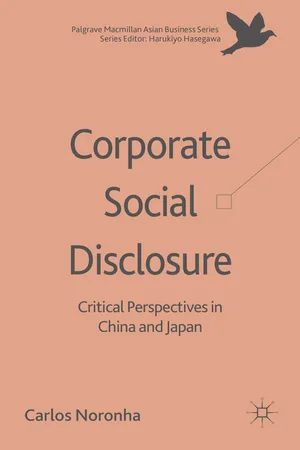
Corporate Social Disclosure focuses on China and Japan as two countries for critical observations of the latest CSD issues. This volume consists of 12 chapters written by scholars from these two countries, addressing the latest observation of CSD in general as we as in different industries based on their latest research findings.
Information
1
Corporate Social Disclosure in China and Japan: An Introduction
Carlos Noronha
Introduction
Corporate social disclosure (CSD), an important branch of social accounting (Gray, 2002), has been widely examined since the 1970s. Gray et al. (1996: 3) define social accounting as “the process of communicating the social and environmental effects of organisations’ economic actions to particular interest groups within society and to society at large”. During that time, managers were under pressure to disclose the wider consequences that corporate activities may have on the environment, human resources and consumer policies (McKie, 1974). Rapid globalization in the 1980s and 1990s forced corporations to realize that their operations and activities do not take place in a vacuum but have immense consequences both locally and globally (Macintosh et al., 2000). Consumers started to have an increased awareness of corporate social responsibility (CSR) and expected more transparency in corporate affairs. The disclosure of CSR information became very much in demand by various stakeholder groups, including governmental agencies and pressure groups. This was especially the case after the 2001 US accounting scandals of Enron and Arthur Andersen when CSD and reputation risk were seen to be related (Bebbington et al., 2008). Nowadays, CSD is still voluntary in most countries, although some European countries have mandatory requirements on environmental disclosure (Oxfam Hong Kong, 2010). Even so, given the fierce competition among global business players and the increased knowledge and demands of the various stakeholders, in order to continue to obtain their legitimate license (Deegan, 2002) to operate in society companies cannot avoid CSD.
China and Japan: Marathon runners
This volume has chosen China and Japan as two countries in which to observe the latest CSD issues. The first reason is that it allows comparison as if in a linear marathon. Japan has a rather mature approach to CSD as its development started quite early, together with its Western counterparts. Environmental pollution issues in the 1960s and 1970s were the primary trigger for corporate Japan’s engagement in social responsibility (Takagaki, 2010). Further affected by the burst of the economic bubble in the 1990s, which was followed by the so-called “lost decade”, a series of shocking corporate scandals were revealed to the public. These included food poisoning of Snow Brand milk products, concealed product recall at Mitsubishi Motor Company, the bankruptcy of Sogo department store and deceptive food product labeling at Nippon Ham (Kawamura, 2005). All these scandals led the Keizai Doyukai (Japan Association of Corporate Executives) to issue the new Corporate Evaluation Standards 2003. The objective was to restore trust in corporate Japan and to instill ethics and morality in business operations; to turn corporate scandals into corporate ethics and to transform the company-centered approach to a stakeholders-focused approach (Kawamura, 2005). The timing of this was crucial, as it coincided with the Enron and WorldCom incidents in the US, which brought global attention to bear on corporate business ethics and social responsibility. These experiences have caused many changes in the governance of Japanese firms, in essence changing it from a relational-based system to a more market-oriented system (Colpan et al., 2007). As such, the year 2003 was often labeled as the “CSR gannen” (the first year of CSR) (Fukukawa & Teramoto, 2009). Therefore we can state that Japan’s CSR development started roughly 50 years ago. According to KPMG (2005), in 2005, 90% of the companies in Japan were already participating in voluntary CSD, outdoing the UK (71%) and the US (32%). China, on the other hand, is in the initial stages of CSR and CSD (Noronha et al., 2013) but the speed at which it has been catching up with developed countries during the past few years is quite surprising: there has been full support and directives from central government and other agencies, such as the Shanghai and Shenzhen Stock Exchanges. According to KPMG (2011a), the number of CSR reports issued by listed companies in China increased from one in 2001 to 663 in 2010. Therefore, these countries provide us with two vivid cases for comparative analysis.
China and Japan: Pragmatism versus idealism
The second reason for looking into China and Japan is inspired by prior literature about the cultural influence on corporate financial disclosure. A number of studies have employed Hofstede’s (1980) four cultural dimensions to explain different countries’ accounting practices, including their levels of disclosure of accounting information. For example, Gray’s (1988) accounting subculture model suggested an important dimension related to the disclosure issue, that is the “secrecy versus transparency” continuum. Subsequent research found that Hofstede’s cultural dimensions had an important influence on voluntary disclosure (Gray & Vint, 1995; Salter & Niswander, 1995). Building on the basis of these studies, Chow et al. (1995) indicated that China’s disclosure practices appeared to tend toward the secrecy side of the continuum. Nevertheless, coupled with the development of China in recent years, some incremental improvements could be seen in terms of voluntary disclosure of, for example, certain corporate governance issues (Qu & Leung, 2006). Given China’s large power distance (80), low uncertainty avoidance (30), high collectivism (individualism 20), masculinity (66) and long-term orientation (118), its disclosure tends toward secrecy. On the other hand, Japan’s comparatively smaller power distance (54), lower collectivism (individualism 46), very much higher masculinity (95), extremely high uncertainty avoidance (92) and lower long-term orientation (80) (http://geert-hofstede.com) appear to put Japan more on the transparent side of the continuum.1 If this relationship holds for voluntary disclosure of financial information, does it equally apply to CSD in these two countries? For Japan, we can say so yes without too much doubt, given the country’s leading position in CSD worldwide. In China, there has been a rapid increase in the number of CSR reports during the last ten years. Is the country really improving this quickly, and emerging from the secrecy side of the disclosure continuum? This volume takes a critical perspective, and attempts to use the dichotomy of “pragmatism (sometimes the rejection of moral principles) versus idealism (adoption of moral principles)” to explain the phenomenon of China’s exponential increase in CSD. As will be seen in the chapters revealing China’s situation, the heavy influence by political motivation and the unique institutional factors in this socialist country with market characteristics are the major driving forces of CSR and CSD development. From this perspective, though, Japan serves as a proper counterpart for the purpose of comparison, in terms of the level of advancement in CSD, the cultural influences on accounting disclosure, or the institutional and legal factors surrounding the decision to disclose social information or not and the kind of information that is disclosed. Through the discussions in the chapters that follow, the reader will see how different CSD is viewed and utilized as a corporate tool in order to achieve various ends in these two countries, based on differences in the above-mentioned factors.
China and Japan: Corporate scandals
The third reason for comparing the two countries in this volume is that despite Japan’s maturity in CSR and CSD and China’s emergence in these issues, both countries in recent years have shocked the world with very serious business scandals. In China, the 2008 melamine-tainted milk powder incident which killed six infants and poisoned over 29,000 others was criticized by the World Health Organization as one of the biggest health scandals in history (Zaobao, 2008). In Japan, the 2011 Olympus accounting scandal was described as one of the biggest and most durable loss-concealing scams in the history of corporate Japan (The Wall Street Journal, 2011). Are we seeing Japan coming to its “final year of CSR” and awaiting another cycle, another “CSR gannen”? These incidents have triggered the use of a critical lens to examine the latest evolution of CSR and CSD in these two countries, and to address the recent challenges to morality and ethics under different institutional backgrounds. We also hope to shed light on the performance-disclosure gap in these two countries, where distinct social and political environments and, in particular, different degrees of the execution power of law and judicial independence prevail.
CSD in China: A research lacuna
The final reason for comparing these two countries is in order to help to fill a significant research lacuna in the CSR and CSD agenda. As mentioned at the beginning, CSD has been examined extensively in Western developed countries during the past decades, notwithstanding continued interest in the areas of CSR, sustainability development, and social and environmental accounting. However, CSD has only been studied quite recently in developing countries. Belal and Momin (2009) identified 41 articles related to CSR studies in developing countries or emerging regions that were published during 1983–2008 in English language journals. Surprisingly, none of these articles related to China, the largest in terms of size and strongest in terms of economic power of all developing nations. During the past two years or so, CSR and CSD studies about China have started to emerge gradually in English-speaking academia (e.g. Li & Zhang, 2010; Moon & Shen, 2010; Kuo et al., 2012; Luethge & Han, 2012). Nevertheless, there is much more to be done concerning this second largest economy of the world. Research about CSR and CSD in China is urgently called for (Belal, 2008; Guan & Noronha, 2013).
The present volume consists of 12 chapters written by scholars who specialize in CSR issues in these two countries, and they address the most recent observations of CSD in general and in different industries, based on their latest research findings.
Theoretical lens: Legitimacy
The theoretical lens used by most of the chapters in this volume is based on the legitimacy theory. Gray et al. (1995) pointed out that most studies in social accounting have drawn on social and political theory, in particular “stakeholder theory”, “legitimacy theory” and “political economy theory”. Many people see these as competing, but Gray et al. (1995) suggested that stakeholder theory and legitimacy theory should be viewed as two overlapping theories set within a framework of assumptions about political economy. Under political economy theory, the economic domain cannot be studied in isolation from the political, social and institutional framework within which economic activity takes place (Gray et al., 1995: 52). Political economy theory is therefore consistent with the pluralistic characteristics of CSR, in which the Triple Bottom Line (TBL) dimensions, namely the economic, social and environmental (Elkington, 1998), must coexist and be considered holistically.
Gray et al. (1995: 53) cited the perspective of Roberts (1992), where a corporation’s continued existence requires the support of the stakeholders, and their approval must be sought and the activities of the corporation must be adjusted in order to gain the stakeholders’ approval. In a similar vein, legitimacy theory can also be seen in the same light. Thus, as a variant of stakeholder theory, legitimacy theory argues that organizations can only continue to exist if the society in which they are based perceives the organization to be operating to a value system that is commensurate with the society’s own value system (Gray et al., 2010: 28). This perspective stems from Lindblom’s (1993) analysis of the relationship between the corporation and the “relevant publics”, which depicts the strategies that the corporation uses in order to gain such a state of legitimacy.
Legitimacy can also be understood from a resource-based view (Tilling & Tilt, 2010). Congruent with the resource-dependence theory (Pfeffer & Salancik, 1978), legitimacy can be seen as an organizational resource that is held by other organizations and stakeholders. Thus the corporation and the stakeholders wrestle over the interplay of power for the conferment, loss and re-conferment of legitimacy.
At the organizational level, CSD has been used by the corporation to gain support from the relevant publics and to close any “legitimacy gap” (Sethi, 1978; Lindblom, 1993) through communicating positive organizational behavior information (e.g. Patten, 1992; Deegan et al., 2000; 2002; Milne & Patten, 2002; Campbell et al., 2003; Moerman & Van der Laan, 2005). In this volume, we will see different examples in which CSD is used as a strategy to improve corporate image after a severe industrial incident (e.g. Chapter 4, where milk companies increased CSD after a poisonous milk powder scandal), as well as using CSD as a kind of “greenwashing” technique to “wash away” undesirable information (e.g. Chapter 3, where the company only disclosed positive information and did not disclose the employee suicide incidents which were widely exposed by the public media, and Chapter 11, where the company was blacklisted on environmental violations and used CSD as a strategy to redirect attention). These cases demonstrate vividly the notion of strategic legitimacy theory or instrumental legitimacy theory (Ashford & Gibbs, 1990; Suchman, 1995).
The legitimacy theory can also be applied at the macro or institutional level (Suchman, 1995; Tilling & Tilt, 2010), where emphasis is placed on the industry, the government or the entire field of organization life, what DiMaggio and Powell (1983) termed “collective structuration”. In this volume, cases encompassing the overall CSD of Chinese listed enterprises in relation to the Central Government’s national policies (e.g. Chapter 2) and the unique institutional characteristics of state-owned enterprises that result in CSR engagement and disclosure which are heavily dependent on political directives (e.g. Chapter 5) are illustrated in detail.
Methodology: Content analysis
All the chapters are original works produced for this volume. Most of them are reports of empirical results of CSD studies carried out using content analysis. Content analysis (Holsti, 1969; Krippendorff, 1985) is a research technique widely employed in social accounting studies (Guthrie & Parker, 1990; Gray et al., 1995). Holsti (1969: 14) defines it as “any technique for making inferences by objectively and systematically identifying specified characteristics of messages”. Content analysis is used to determine the presence of certain words, concepts, themes, phrases, characters or sentences within texts. The text is coded into manageable categories at a variety of levels (Busch et al., 2012), and these are evaluated using both quantitative and qualitative methods. The former emphasizes the frequency of certain words...
Table of contents
- Cover
- Title Page
- Copyright
- Contents
- List of Figures and Tables
- Notes on Contributors
- 1. Corporate Social Disclosure in China and Japan: An Introduction
- Part I: Corporate Social Disclosure in China
- Part II: Corporate Social Disclosure in Japan
- Index
Trusted by 375,005 students
Access to over 1.5 million titles for a fair monthly price.
Study more efficiently using our study tools.
Frequently asked questions
Yes, you can cancel anytime from the Subscription tab in your account settings on the Perlego website. Your subscription will stay active until the end of your current billing period. Learn how to cancel your subscription
No, books cannot be downloaded as external files, such as PDFs, for use outside of Perlego. However, you can download books within the Perlego app for offline reading on mobile or tablet. Learn how to download books offline
Perlego offers two plans: Essential and Complete
- Essential is ideal for learners and professionals who enjoy exploring a wide range of subjects. Access the Essential Library with 800,000+ trusted titles and best-sellers across business, personal growth, and the humanities. Includes unlimited reading time and Standard Read Aloud voice.
- Complete: Perfect for advanced learners and researchers needing full, unrestricted access. Unlock 1.5M+ books across hundreds of subjects, including academic and specialized titles. The Complete Plan also includes advanced features like Premium Read Aloud and Research Assistant.
We are an online textbook subscription service, where you can get access to an entire online library for less than the price of a single book per month. With over 1.5 million books across 990+ topics, we’ve got you covered! Learn about our mission
Look out for the read-aloud symbol on your next book to see if you can listen to it. The read-aloud tool reads text aloud for you, highlighting the text as it is being read. You can pause it, speed it up and slow it down. Learn more about Read Aloud
Yes! You can use the Perlego app on both iOS and Android devices to read anytime, anywhere — even offline. Perfect for commutes or when you’re on the go.
Please note we cannot support devices running on iOS 13 and Android 7 or earlier. Learn more about using the app
Please note we cannot support devices running on iOS 13 and Android 7 or earlier. Learn more about using the app
Yes, you can access Corporate Social Disclosure by C. Noronha in PDF and/or ePUB format, as well as other popular books in Business & Business General. We have over 1.5 million books available in our catalogue for you to explore.