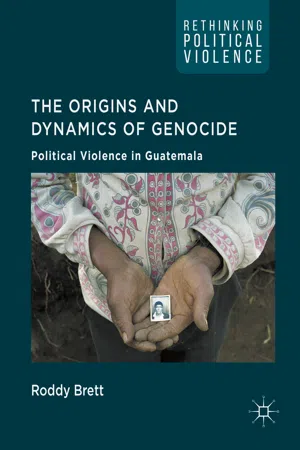
Tiburcio
The Ixil morning was dry, breathless. The sun burnt shadows onto the scorched ground, shadows that seemed to pursue human and animal alike. Her body was surrounded by ebullient flowers, although, by now, the rituals had ceased, and a profound tranquillity had enveloped the heat of the early morning. Tiburcio Utuy’s aunt had died the night before, and he had slept for no more than an hour, as his family and community collectively mourned their dead.
Death was nothing new to the residents of Xix, a small rural hamlet in the Ixil region of northern El Quiché, a principally indigenous department in Guatemala’s highlands; in fact, its shadow had unremittingly stalked the Ixil and other indigenous groups for decades. In spite of the odds stacked against them, Tiburcio and his aunt, and others from their community, had survived the protracted episodes of egregious counterinsurgency violence executed by military and paramilitary forces during the 1970s and early 1980s that sought to eliminate the guerrilla threat. They had escaped the massacres carried out in Xix, and endured their prolonged displacement in the mountains. However, like many indigenous Guatemalans, they had been affected irreversibly by the violence. The military’s ‘scorched earth’ campaign, carried out between 1981 and 1983, under then President General Romeo Lucas García and de facto president, General Efraín Ríos Montt, had changed the terms of history for indigenous Guatemalans. The genocidal strategy had transformed the fundamental structure of indigenous life as it sought to exterminate the guerrilla’s support base, allegedly situated within indigenous and peasant communities, whilst simultaneously seeking to annihilate all vestiges of indigenous selfhood.
Maria Utuy, however, had died of natural causes. Her funeral took place almost uneventfully in April of 2002, six years after Guatemala’s internal armed conflict had been brought to a formal end through the peace accords negotiated between successive Guatemalan governments and the guerrilla army, the Unidad Revolucionaria Nacional Guatemalteca (National Guatemalan Revolutionary Unity—URNG). Nevertheless, the performance of mourning rituals, the burial of their dead, remained far from uneventful for the residents of Xix, who had been subject to the Guatemalan military’s systematic killing campaign only two decades before, whose hamlet had been victim to three massacres and for many of whom protracted, internal displacement in the mountains and jungle had been the only means of survival.
Along with other indigenous regions in the country, the department of El Quiché had borne the brunt of the campaign of massacres, homicides, disappearances and torture that had represented the central tenet of counterinsurgency operations. The ferocity of the military’s strategy had allowed little opportunity for traditional rituals; survivors struggled to inhume their dead amidst the chaos of war and the appalling conditions of violence to which they were continually subjected. In fact, many indigenous actively sought to mask their identity out of fear of being targeted by the military. Concealment of indigenous rituals and identity yielded little success: the onslaught of brutal counterinsurgent violence continued regardless. At the same time, the widespread operationalisation of disappearance as a military tactic to terrorise, punish and silence the civilian population obliterated physical presence, making burial in many cases impossible. Counterinsurgency violence wielded an impact beyond the material, corporeal realm, and hostilities would immediately affect the capacity of indigenous communities to reproduce their culture. The reinstatement of committal rituals in post-conflict Xix then went beyond a mundane occurrence; rather, it evidenced the persistence of a resilient social and cultural order, of a community of survivors recovering from genocide and seeking to repudiate its legacy.
According to Guatemala: Memory of Silence , the final report of Guatemala’s UN-sponsored truth commission, the so-called Historical Clarification Commission (CEH), within the framework of its counterinsurgency campaign, the Guatemalan state committed ‘acts of genocide’ in four regions of the country, including in the departments of Huehuetenango, El Quiché and Baja Verapaz between 1981 and 1983 (CEH, Conclusions and Recommendations 1999a: 19). The ‘acts of genocide’ were perpetrated against five ethnic groups, including the Ixil.1
Tiburcio Utuy had been marked by this brutal violence, its cruelty sculpted indelibly upon his body. Under the shade of his roof, as we talked that morning in the immediate wake of his aunt’s funeral,
Don Tiburcio—a title conferred in Latin American cultures to designate respect—narrated how he and his community had gradually become implicated in the armed conflict and thereafter become victims of the political violence that tore Guatemala apart during Latin America’s ‘long cold war’, as Joseph and Grandin (
2010) have defined it. His story goes beyond disquieting, evidencing survival in the face of grotesque violence.
I was accused of being a guerrilla. They tied my feet and hands behind me, and pulled my head back, leaving my stomach exposed, like a round ball. When I felt I could no longer breathe, they brought the fire, setting it upon me, upon my stomach, my neck, my eyes. My intestines started to fall out, forming a pile on the floor, and I managed to reach out, and push them back in again. Look, these are the scars where the military burnt me.2
Tiburcio Utuy had lived in death’s shadow since the counterinsurgency campaign had decimated his community in 1982, imposing scores of killings and precipitating mass internal displacement. Soon after he and his community had fled collectively from the violence, he had been kidnapped by the military whilst searching for food in the mountains. During his prolonged detention, which continued for almost a year, Tiburcio was repeatedly tortured, beaten, electrocuted, water-boarded and burnt. On two occasions, he ‘narrowly escaped death’: ‘The soldiers realised that they couldn’t kill me, not with knives, not with bullets, no matter how hard they tried; this scared them, made them concerned. And then in time I finally escaped them.’3
As Tiburcio narrated his experience of the armed conflict, its accompanying violence and his resistance to it, he did so with a voice that was not that of a passive victim, of a man paralysed and subsumed by death’s shadow. Rather, what emerged was the figure of a man familiar with loss, with cruelty, with bereavement, but yet capable of outrunning its shadow, of resisting its lure; a man dispossessed of neither his dignity nor his selfhood, as counterinsurgency operations had intended. As we reconstructed the episodes of brutality that had shaped his life two decades before, Don Tiburcio’s resilience, and later that of other indigenous survivors with whom I shared a roof and a fire during years of research, would provoke the question as to whether it had, after all, been death’s shadow that had pursued him all these years. Despite having been besieged by death, Tiburcio had remained peripheral to it, had ultimately resisted and successfully struggled against it and its legacy. Perhaps it would be pertinent to rethink the metaphor; in short, was the shadow pursuing Don Tiburcio, in fact, something other than that of the genocide, his annihilation and that of the Ixil? As the seventeenth-century English poet John Gay eloquently stated, ‘Shadow owes its birth to light.’ The fire set upon indigenous communities would indeed exterminate the guerrilla threat. However, the objective of annihilating indigenous culture, of eliminating indigenous dignity, would be less than conclusive. Resistance would emerge in the aftermath of death and forge light and hope for survivors of the genocide. As indigenous survivors mobilised over time, arising from the pulp of the murdered, as the poet Anna Kamieńska has defined it, they would eventually emerge from their anonymity to challenge their invisibility and put a name to the crimes to which they had been subjected. With names came light.
The General
Auden’s brilliant depiction of the dictator in his poem Epitaph on a Tyrant is poignantly intimate, and disturbing in its proximity to Guatemala’s Cold War reality: ‘When he laughed, respectable senators burst with laughter, And when he cried the little children died in the streets’. As de facto president, and as Commander-in-Chief of the Guatemalan Armed Forces, General Efraín Ríos Montt had commanded Campaign Victory 82, part of the final operational stages of the counterinsurgency strategy in the country’s indigenous highlands, a strategy that led to the slaughter of thousands of non-combatants, including women and children, in massacres and bombing campaigns and their subsequent confinement in concentration camps. Defiant, devout and compelled by hubris, Montt assumed power after initially leading a military junta that had deposed Lucas García, on 23 March 1982. In his nationally broadcast speech on the day of the coup, dressed in combat uniform, and with his characteristically zealous inflection, Montt contumaciously spewed forth his warning to the insurgents and their supporters alike. The General warned that those who were to take up arms against the institution would be killed. He stressed they would be killed in combat, rather than being murdered, a difference Montt believed to be critical.4 In the following weeks, whilst urban violence diminished, rural killing escalated, targeting indigenous communities and those civilians that fled the violence, such as Don Tiburcio, his family and his neighbours. As Montt scorched indigenous lands with ‘justice’, so Don Tiburcio’s life, and the life of the General, would cross for the first time.
Shortly after his assumption as de facto president in 1982, Montt was interviewed by North American journalist Pamela Yates and her team. The journalists questioned Montt with respect to the accusation that the military was perpetrating massacres against rural indigenous communities. Montt’s piety was ardent, as he denied that the army was carrying out repression against peasants in rural Guatemala. The General, moreover, referred to the importance of his own control over the army, and emphasised how the institution possessed a capacity to respond to the chain of command. In what would become a well-known episode in Montt’s own history, and subsequently a part of the body of evidence gathered against Montt, the General stated vehemently on camera that if he himself wasn’t in control of the army, then what was it that he was doing there?5
On 3 April 2013, twenty years after the massacre campaign had extinguished Guatemala’s revolutionary hopes, and a little over a decade after our conversation in the heat of that Ixil morning, I encountered Don Tiburcio once more. Tiburcio sat before General Efraín Ríos Montt in the courtroom designated to hear the case against the former dictator and his former Chief of Intelligence, General José Mauricio Rodriguez Sánchez, brought within the High Impact Tribunal established in the aftermath of the country’s armed conflict. On 19 March 2013, Montt and Rodriguez Sánchez had gone on trial for genocide and crimes against humanity committed in the Ixil region between 1982 and 1983. The prosecution was not an isolated case, but arguably formed part of the ‘justice cascade’,6 characterised in the region by wide-ranging domestic prosecutions for international crimes against former Heads of State and lower-level military officials and truth-telling initiatives that would shed light upon Latin America’s years of darkness.7 In the case of Guatemala, as elsewhere, at least initially, the push to investigate past crimes was not state driven; civil society organisations had filed legal cases for human rights violations in Guatemala, as well as in Spain and Belgium, under the principle of universal jurisdiction. Given the absence of state-led initiatives and the fragility of state institutions, human rights and victims’ organisations assumed the central role in ‘building criminal cases and providing services and security for victims’.8
Don Tiburcio presented his testimony assertively during the hearing, directing his words towards Montt, who from the moment the trial had begun, had sat apparently unmoved by the harrowing testimonies presented by Ixil men and women, many simultaneously translated from their own language, the direct victims of the counterinsurgency. Their lives had crossed once more; this time, however, it was Don Tiburcio who had assumed the role of indicter. Tiburcio narrated the events he had shared with me in Xix a decade before, but something had changed in the interim. As he accused Montt and Rodriguez Sánchez, Don Tiburcio’s words wielded a yet more profound force, resounding with robust legitimacy, his words named what had hitherto been shrouded in silence:
This is why I am telling this to the eyes and ears of the world, this is the suffering we felt. They [the military] shut me up in a room larger than this one. This room was full of blood… The shoes, the belts, were piled two meters high and wide, you could see the traces of people who had been killed there. They tied me up and left me sitting in the blood… This pain, this suffering, I was there in the blood of my dear brothers and sisters who had been killed.
After the declarations of the witnesses called by the defence and the prosecution had been given, Montt presented his closing declaration. At times, the General’s voice appeared to waver, his ‘elderly rubbish’, as the poet W.H. Auden described the dictator’s discourse in his poem Another Time in 1939, evidencing a temporary fissure in his imperious, impenitent persona. As he asked the presiding judge for permission to drink from a plastic bottle of water, the image of the former dictator momentarily assumed a pathetic fragility. Nevertheless, the General was unrepentant, obdurate in his refutation of the charges of genocide and crimes against humanity. In what came to be central to the trajectory of the trial, Montt’s declaration now deviated from the admission of command responsibility that he had so unequivocally offered to Yates as Commander-in-Chief of the Armed Forces three decades earlier. Referring to the military campaign document of Plan Victory 82, Montt argued that no evidence existed that proved his participation in the crimes for which he was on trial. Rather, the accused stated to the trial judges that he had never authorised, signed, proposed or ordered an attack against a race, ethnic group or religion. Astonishingly, Montt’s declaration appeared to write out of history his admission of command responsibility within the framework of the military chain of command that he had given on camera three decades before.9
The Genocide
After fifty-three days of trial proceedings, on 10 May, Rodriguez Sánchez was found innocent of all charges. Montt, however, was sentenced by a panel of three judges presided over by Judge Jazmin Barrios to serve eighty years in prison for genocide and crimes against humanity. The verdict was historic: Montt’s indictment represented the first occasion where a former head of state had been found guilty of genocide by a domestic court in Latin America. The verdict, moreover, dr...