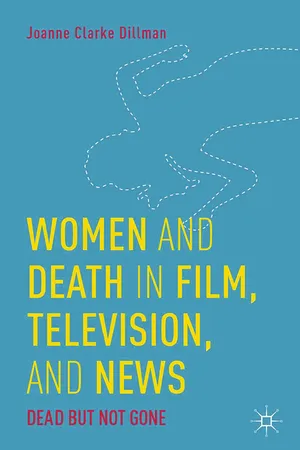
Dead women litter the visual landscape of the 2000s. In this book, Clarke Dillman explains the contextual environment from which these images have arisen, how the images relate to (and sometimes contradict) the narratives they help to constitute, and the cultural work that dead women perform in visual texts.
eBook - ePub
Women and Death in Film, Television, and News
Dead but Not Gone
- English
- ePUB (mobile friendly)
- Available on iOS & Android
eBook - ePub
Women and Death in Film, Television, and News
Dead but Not Gone
About this book
Information
Subtopic
Art GeneralChapter 1
Introduction
Dead women litter the cultural landscapes of the 2000s. Their bodies appear at the beginning of films and television shows, inciting the narratives that follow. The audience might witness a sequence of events leading to the moment of a woman’s violent death; most often the audience sees the aftermath of murder: a woman’s corpse. In an increasing number of cultural products, a dead woman comes back to life, either as a reanimated corpse or as a normally appearing person in a liminal state between life and the afterlife. In other cases—especially in news stories about young women who have disappeared—the dead woman is herself invisible. She has only a spectral presence conveyed through photographs of her when she was alive, repurposed to animate and individualize stories about her death. The dead women in visual texts interact with the living: they look back, talk back, or are championed by those who look and talk back on their behalf. Using examples from three sites across the visual field—film, television, and Internet-mediated news—I make the case that the images and stories of dead women have both a haunting power and a disciplining function.
One of my main arguments is that these images are the vehicles for the cultural trashing of the stand-in body of second-wave feminism, generally considered to be a white, middle-class movement. Particularly in the American domestic arena, the circulation of these images and the stories in which they are embedded express the profound ambivalence to social changes that the women’s movement endorsed and that globalization has accelerated and exploited. Women’s gains in social, political, and economic life have come at a price, and this collateral damage is made visible through a decade full of dead women in the visual sphere. While feminism blossomed as an emergent discourse in the 1960s and 1970s, it failed to become culturally dominant; instead, by the 2000s it had gone partially underground in mainstream cultural sites. Where feminism maintained a presence, it was in the form of an individualistic, apolitical postfeminism. The dead women who saturate our visual landscapes represent a form of masculine anger and resentment at the actual gains women have made. The anger can be seen, but it is not stated as such. By these deaths feminism is undergoing a symbolic destruction in the representational arena of culture.
Another key argument I make in the work that follows is that these dead women’s bodies echo and visually intensify a discourse that posits women as disposable and replaceable in the era of neoliberalism and globalization. Ironically, at the same time that female labor is increasingly vital to the global economy, powerful elites are undervaluing the contributions of women in order to frame them as disposable and exploitable. I propose that the media representations under study facilitate this “myth of disposability”1 by repeatedly depicting women as negligible objects who turn up dead in TV shows, films, and the news. A reverse process is also in effect: the “discourse of disposable women” that scholars such as Melissa Wright, Kevin Bales, and Grace Chang see as pervasive in the globalized world of work reinforces the images and storylines involving dead women that I examine.2 Both processes serve the ends of a still-androcentric social order that produces male power at female expense and the ends of a neoliberal economic order that requires an ever-expandable, exploitable, individualized—and some might say feminized—labor force. In an era of hypermobility and global flows, these images depict the forced immobility of the world’s increasingly mobile women. As Manuel Castells notes in The Power of Identity, “The human landscape of women’s liberation and men’s defense of their privileges is littered with corpses of broken lives, as is the case with all true revolutions.”3 The rancor and ambivalence surrounding the feminist project and our anxieties about the place of women in a changing world are manifest in the surfeit of women who need to be dead before an exploration of their lives, subjectivities, and experiences is authorized in mainstream representations.
Reading Dead Women across Visual Texts
The films, television shows, and news stories that I examine operate via a contradictory logic that recognizes feminist goals and speaks through feminist codes, but that ultimately serves the status-quo, androcentric, dominant culture. The common denominator in all the works under study here is that a woman comes to visibility because she is dead. I call this point of entry or inciting incident a “dead beginning” because figuratively or literally the temporal progression of this character is halted from the start, even though she may feature in the story that follows. This key contradiction in the works that I examine leads to a number of questions, namely: How can a film or television show profess to offer a woman agency if she is positioned as dead from the start? What manner of agency can be claimed for a ghost or spectral presence? Can progressive status be granted to these cultural objects if the central woman character is put under erasure at a narrative’s inception—often through an act of graphic violence—but “lives” on in the film, TV show, or news story through what I call a “dead-but-not-gone” convention? These are questions I seek to answer throughout this book.
I argue that these women’s deaths have deep cultural meaning, even though they are often blamed on random acts of violence, offered as serving a seemingly minor purpose in a longer narrative, or are naturalized as one of the “given” elements in a story. Images of dead women and the stories they help to constitute can be read in more than one way; their meaning is tied to an uncertain social context in the 2000s. On one level, it might be imagined that these dead women are made to stand in for and speak for all the dead women in the news media landscape who cannot speak for themselves. But on another level, the media’s visible rendering and amplification of acts of gendered violence in the arena of representation has consequences for all women.
To watch American entertainment and news in the first decade of the twenty-first century is to wonder whether there isn’t some kind of open season on women. While images of dead women are not a new phenomenon, they are much more graphic and sensationalized in contemporary films and television shows than in mainstream visual texts before the new millennium. In addition, dead women (or presumed-to-be-dead women) are featured more routinely and more prominently in the news than in previous decades. This could plausibly reflect a heightened political recognition of domestic violence and other crimes against women that were ignored in the past. Even if so, I assert that the representational realm in the contemporary moment has “naturalized” the violent deaths of women, with consequences that constrain women and reinscribe androcentrism.
I begin with an examination of dead women in five films: Minority Report (2002), Déjà Vu (2006), Corpse Bride (2005), The Lovely Bones (2009), and Disturbia (2007). I have chosen these films, which were released within seven years of each other, for their graphic acts of gendered violence. In Corpse Bride the violence is implied through some residual effects, such as blackened eyes, and in The Lovely Bones the violence is implied through retrospective framing and unsettling “stand in” imagery. I then turn to dead and “undead” women in the first three seasons of CBS’s television series CSI: Crime Scene Investigation (2000–2003) and in the complete two seasons of Showtime’s Dead Like Me (2003–2004). The attitude of these two shows toward their subject matter could not be more different: the first trafficks in gendered deaths while the second meditates on death as a state of mind that channels the melancholy of post-9/11 America. Next, I link these fictional films and television shows to three news-mediated narratives about Laci Peterson, Chandra Levy, and Natalee Holloway. The disappearance/murder of these three young women circulated in the same historical time and context as the fictional works and played out across the transmedia spectrum. I ground all of the representations of the dead and reanimated-from-the-dead women in the contextual moment of their production and compare the narratives in which they are embedded. My interrogation of these representations finds patterns in which dead women incite narratives or come back from the dead with pseudoagency. In all but the most fantastical or exceptional cases, these deaths cannot be undone.
The linkage of death and agency does not just occur in the specific visual texts I have chosen; it is a prominent trope in contemporary culture and in many fictional and nonfictional cultural products. It can be seen in Steve Brett’s low-budget film My Dead Girlfriend (2006), Chris Severton’s film I Know Who Killed Me (2007), Eric Wright’s graphic novel My Dead Girlfriend (Vol. 1, 2007), and Jeff Lowell’s film Over Her Dead Body (2008). It has played out in a number of popular television shows such as Ghost Whisperer, Medium, CSI: New York, CSI: Miami, Criminal Minds, and Bones—even though in these shows the trope is split (more traditionally) between dead woman victim and avenging woman agent/actant. There are also iterations of this death-agency linkage in news frenzies about missing (and presumed dead) women and the anonymous dead women found during the 2000s in the maquiladora-rife border town Ciudad Juárez in Mexico.
Theories of the Image
This book contributes to the interdisciplinary field of visual culture, which examines the relationships among sight, knowledge, and embodiment.4 Since the mid-1990s, when media and information technologies underwent a synergistic fusion, theorizing the image and the relationship of images to the texts that they help to constitute has become an important concern in image studies.5 While “most artistic traditions mark what persists and is sustaining,” according to Svetlana Alpers, visual culture attends to what is “changing in a culture.”6 The saturation of media with dead women in the 2000s is precisely the change that I am documenting. Visual culture foregrounds the process of looking, the features of cognition that enable us to look, and the codes necessary to our “social” looking. John Berger’s Ways of Seeing is an early text linking gendered images and ideology that naturalize male dominance and privilege male desire, especially in advertising and art.7 Berger’s dictum that “man acts, woman appears” holds true decades later in many films and television shows. In the 2000s, the woman appears as dead; this is the condition for her emergence on film, television, and online news screens. Perhaps the strangest surfacing of this phenomenon was on a November 2007 episode of Tyra Banks’s show America’s Next Top Model that featured models posing as “beautiful corpses.”8
What is special about the image? W. J. T. Mitchell, a key theorist in image studies, argues that the image element of a film or picture was historically slighted in relation to the narrative element; hence, film studies was subsumed under literature programs in the academy.9 Visual culture redresses this original privileging of narrative over image. The tension between the narrative (or syntagmatic) axis and the visual (or paradigmatic) axis is central to my argument. Focusing on these axes as separate registers brings potentially contradictory meanings into view. The image component of a film, for example, can offer a sexualized and sexist rendering, while the narrative storyline can be read as ultimately “positive” or “feminist” if there is resolution or closure. I argue that these different registers can compete in the overall text, rendering films and television shows complex “sites of struggle” over meaning.
Mitchell theorizes that there is an excess to images, a “surplus value.”10 He gives the example of a crossbar over a cigarette—indicating “No Smoking”—to point out that images “cannot say no to what they signify.”11 The implication of this theorizing for my study is that even though a story may reestablish order in the end by having the murderer caught or killed, it cannot undo the work of the images that incite and constitute that narrative. Without a figurative crossbar over a scene of a dead woman—indicating “This Woman Should Not Have Been Killed”—the image assents to what it presents. All’s not well that ends well.
Nicholas Mirzoeff, who also understands the image as aligned with excess, writes,
The visual is not simply the medium of information and mass culture. It offers a sensual immediacy that cannot be rivaled by the print media: the very element that makes visual imagery of all kinds distinct from texts . . . It is this surplus of experience that moves the different components of the visual sign or semiotic circuit into relation with one another.12
In Ideology and the Image, Bill Nichols concurs, referring to a caption below a picture as that which “locks down” or “locks in” meaning. He writes, “The great precision of a digital code like written lang...
Table of contents
- Cover
- Title
- 1 Introduction
- 2 Film Narratives, Dead Women, and Their Meaning in a Changing World
- 3 Family Films Gone Terribly Wrong: The Lovely Bones and Disturbia
- 4 Television Narratives and Dead Women: Channeling Change
- 5 News-Mediated Narratives of Disappearance: Chandra Levy, Laci Peterson, Natalee Holloway, and Conventions of Dead Women in the News
- 6 Conclusion
- Notes
- Bibliography
- Index
Trusted by 375,005 students
Access to over 1.5 million titles for a fair monthly price.
Study more efficiently using our study tools.
Frequently asked questions
Yes, you can cancel anytime from the Subscription tab in your account settings on the Perlego website. Your subscription will stay active until the end of your current billing period. Learn how to cancel your subscription
No, books cannot be downloaded as external files, such as PDFs, for use outside of Perlego. However, you can download books within the Perlego app for offline reading on mobile or tablet. Learn how to download books offline
Perlego offers two plans: Essential and Complete
- Essential is ideal for learners and professionals who enjoy exploring a wide range of subjects. Access the Essential Library with 800,000+ trusted titles and best-sellers across business, personal growth, and the humanities. Includes unlimited reading time and Standard Read Aloud voice.
- Complete: Perfect for advanced learners and researchers needing full, unrestricted access. Unlock 1.5M+ books across hundreds of subjects, including academic and specialized titles. The Complete Plan also includes advanced features like Premium Read Aloud and Research Assistant.
We are an online textbook subscription service, where you can get access to an entire online library for less than the price of a single book per month. With over 1.5 million books across 990+ topics, we’ve got you covered! Learn about our mission
Look out for the read-aloud symbol on your next book to see if you can listen to it. The read-aloud tool reads text aloud for you, highlighting the text as it is being read. You can pause it, speed it up and slow it down. Learn more about Read Aloud
Yes! You can use the Perlego app on both iOS and Android devices to read anytime, anywhere — even offline. Perfect for commutes or when you’re on the go.
Please note we cannot support devices running on iOS 13 and Android 7 or earlier. Learn more about using the app
Please note we cannot support devices running on iOS 13 and Android 7 or earlier. Learn more about using the app
Yes, you can access Women and Death in Film, Television, and News by Kenneth A. Loparo,Joanne Clarke Dillman in PDF and/or ePUB format, as well as other popular books in Media & Performing Arts & Art General. We have over 1.5 million books available in our catalogue for you to explore.