eBook - ePub
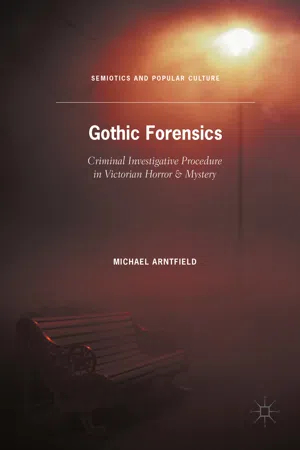
Gothic Forensics
Criminal Investigative Procedure in Victorian Horror & Mystery
- English
- ePUB (mobile friendly)
- Available on iOS & Android
eBook - ePub
About this book
This book explores a number of foundational Victorian Gothic texts that have either predicted or prefigured key investigative methods used by police today. It also critically assesses the legislative, procedural, and forensic implications of crime fiction and horror produced during the Victorian era. Titles ranging from Bleak House to Dracula are demonstrated to be driving forces behind the professional standards and investigative methods used by police departments in the United States and United Kingdom, both then and now. Gothic Forensics explains how and why the Gothic served as the unlikely but irrefutable creative engine for advances in forensics made in the following century—techniques and technologies taken for granted today—as well as the literary progenitor of the prevailing methodologies now used in criminal investigation and profiling, the collection of evidence, and the administration of justice.
Information
© The Editor(s) (if applicable) and The Author(s) 2016
Michael ArntfieldGothic ForensicsSemiotics and Popular Culture10.1057/978-1-137-56580-8_11. Introduction: The Forensic Gothic
Michael Arntfield1
(1)
Western University, London, Ontario, Canada
Dr. Edmond Locard, widely considered the “father” of forensic science, had only one text that was required reading for his first students at the outset of the early twentieth century—Sir Arthur Conan Doyle’s A Study in Scarlet, the novel that debuted Sherlock Holmes. Locard’s theories about the future of sleuthing in which, as his famous adage proclaims, “every contact leaves a trace” (Horswell and Fowler 2004, 48), were not created in a vacuum—they were ripped from the pages of the great Gothic narratives. Before any textbooks, monographs, or other scholarly or scientific materials were widely available on forensic investigation or the set of empirical standards later used to guide criminal inquiries, it was nineteenth-century crime fiction that was the catalyst for police modernization. It was these same nineteenth-century works—the creative engine behind contemporary investigative standards—upon which the first criminalists working under Locard’s mentorship relied as their substantive training material. It turns out that this was just one of many areas where Locard was well ahead of his time as both an investigator and pioneering educator.
The reality is that Doyle’s seminal 1887 novel, widely credited with also being ahead of its time, only scratches the surface in terms of how the Victorian Gothic tradition molded the future of police work and investigative efficacy through literature. Using Locard’s adoption of Holmes’s initially fictive practices and postulates as a proof of concept, it is the aim of this book to go beyond retreading, as others have, temporal coincidences during the Victorian Era with respect to science, crime, and literature while then philosophizing on the obvious significance of this confluence. The objective here is to critically examine and unpack the role of the Victorian Gothic novel in not only shaping the public understanding of forensic science, but also in serving as the driving force—both procedurally and legislatively—behind what are now standardized techniques in criminal investigation, offender profiling, and applied criminological research among actual practitioners, including modern law enforcement professionals.
Dr. Locard, while previously working as a professor in the Lacassagne School of Criminology in the late nineteenth century, saw the value of A Study in Scarlet not only as a didactic narrative to assist students in grasping pedagogical fundamentals with respect to the study of crime and evidence, but also as a text that would later allow crime stories, as examples of what Linda Hutcheon (1988) calls historiographic metafiction, to find real-world applications beyond the ivory tower and during the course of actual investigations. While today, a handful of universities, in many cases partnering with law enforcement agencies, have developed long-overdue centers for “applied” criminology in this same vein, it seems Locard had a certain prescience of a time when criminal investigative work would be elevated to the same degree of exactitude as any other undertaking which employed the scientific method. It was of course a method central to prevailing nineteenth-century European ideologies and the elevated profile of the university. He seemed to foresee an inevitable marriage between fiction, fantasy, and positivism that Frank (2003) would later describe as “a philosophical materialism…a Romantic materialism” (5) that sent a newly reanimated version of the uncanny and mystical world of the Gothic on a collision course with the industrialized world.
Profoundly influenced by A Study in Scarlet and its focus on investigative efficacy and the need for rigorous continuity of exhibits at crime scenes as a matter of credibility, it should also be noted that Locard, like Sir Arthur Conan Doyle as Holmes’s creator, was also a trained and licensed medical practitioner. Both men in some sense thus additionally embodied the enhanced role of pathology in police work during the Victorian Era, with the Gothic novel and detective fiction converging to create what I call the forensic Gothic at a point in history when “the detective story never provides an end to speculation” about the nature of evidence, as well as the human body and human character at once (Frank 2003, 26). With that revelation enabled by the Victorian novel, however, came new beginnings and a torrent of possibilities about the future of police work in both Britain and America.
At the time of Locard’s inaugural class on criminal forensics, criminology was a discipline still in its infancy, and criminal psychology “not a coherent discipline, but rather, a collection of works by writers…writers [who] drew upon creative literature for insight into human behavior” (Vrettos 2002, 69). The now increasingly common practice of assigning a novel or other work of fiction as a companion course text in such disciplines, as part of a fledgling interdisciplinary module Arntfield and Danesi (2016) call the criminal humanities, was largely unheard of in Locard’s day. Before long, however, the real and fictional were to become strangely contiguous and part of a larger symbiosis beyond the scope of Locard’s classroom laboratory. Today, for instance, more than a century after Locard first officially paired Sherlock Holmes with the pedagogy of crime scene science, the Metropolitan London Police’s elite Scotland Yard detective bureau, itself made famous in the Sherlock Holmes canon, relies on a database of reported crimes and known offenders known as the HOLMES. Ostensibly, this is an acronym that stands for Home Office Large Major Enquiry System. In reality, it is just as much a backronym, one that has been reverse-engineered by police brass to credit Sherlock Holmes vis-à-vis Locard as their muse—the fictional yet still very real forebear of modern detective work.
When A Study in Scarlet first appeared in Beeton’s Christmas Annual, later being reprinted as a full book in 1888 concurrent with the Whitechapel murders and ensuing “Ripper” hysteria that swept across London, the morphine-addicted, solitary, but brilliant Holmes quickly proved to be an unlikely prime mover in terms of how the literature might influence real-world procedure. Doyle’s novels and short stories, which went on to total four and fifty-six in number respectively, not surprisingly later set into motion a series of sea changes within the discourse of Industrial Era criminal investigation. They also helped inspire a series of reforms within the world of the fledgling police sciences that actually had their theoretical and philosophical genesis in even earlier literary works, many of which are examined in the chapters to follow. The “examinations,” for instance, of witnesses by Poe’s ingenious investigator, C. Auguste Dupin, established what is today known as cognitive interviewing over a century before the term was coined and appropriated by law enforcement. The veiled discussion of handwriting analysis in Dickens’s Bleak House provided the template for authorship attribution as an area of investigative specialization generations before the Federal Bureau of Investigation’s (FBI) questioned documents unit came into being. The same novel also legitimized suspectology as a means of triaging persons of interest in murder cases some 150 years before the term was coined or the practice adopted by the police in homicide investigations that remain unsolved beyond the critical first two days. Professor Abraham Van Helsing in Bram Stoker’s Dracula—as a literary analog of pioneering criminal psychiatrist Richard von Krafft Ebing—established the criteria for expert witness testimony and helped roadmap future classifications of sexual paraphilias decades ahead of the clinical or forensic literature. These are but a few examples of the forensic Gothic in practice and of the discussions that lay ahead.
While the term “forensic” began appearing in the 1860s in British medical textbooks for what were then known as police surgeons (today more commonly referred to as forensic pathologists), there was for much of the Victorian Era no larger vision of the applied interdisciplinarity of the forensic model, at least beyond the confines of the morgue or beyond murder cases requiring expertise in pathology. Within Locard’s lifetime and largely in response to his parlaying A Study in Scarlet into both a scientific textbook and investigative field manual, the term forensic would be brought closer in line with its Latin root forensis, meaning, quite literally, “before the forum” (Arntfield and Gorman 2014, 6). With courts as the new forum of the Industrial Era—a place of public assembly, inquiry, and spectacle—the forensic sciences would expand from forensic pathology as the bailiwick solely of the police surgeon for use in criminal homicide cases, and would soon be used to describe any area of expertise carried out in service to the courts as the collective Forum Magnum of the modern world. This would eventually include any number of investigative devices and techniques applied to any number of crimes—crimes with which nineteenth-century authors and their readers became increasingly fascinated. As the Victorian Gothic novel was to become “probably the most topical of all literary genres” (Schwarzbach 2002, 228), criminal investigative expertise was thus sublimated into something of a forensic zeitgeist; it seized the imagination of urban dwellers increasingly fascinated and terrified of the criminal element.
Through its ability to merge popular culture, procedural reform, and scientific exploration, A Study in Scarlet would help legitimize this forensic zeitgeist as the roadmap for criminal investigations of the future. Doyle’s lauded novel would also go on to become the linchpin of Locard’s own career and help define his legacy as the pioneer of all things forensic today, his having used Holmes as his investigative exemplar and, in the process, his having made the fictive the real. After eventually leaving the Lacassagne School in 1910, Locard would become immortalized as the Sherlock Holmes of France (Mazévet 2006) as he constructed what is now accepted as being the world’s first criminal laboratory wrought from the story’s lessons. With the help of two assistants, Locard applied the methods used in Doyle’s inaugural novel under strict clinical conditions and ultimately developed a maxim that would change the course of investigative expertise and the collection of evidence for time immemorial—a proposition that would help lay the foundation for what are now nearly universal adequacy standards across all criminal investigations and forensic practices. Today known as Locard’s Exchange Principle, the guiding maxim drawn from this concept and interpolated through various translations is still drilled into the minds of aspiring detectives and crime scene technicians from day one of their training, and states some version of the following:
When he wants it, wherever he touches, whatever he leaves, even without consciousness, will serve as a silent witness against him. His fingerprints and footprints but his hair, the fibers from his clothes, the glass he breaks, the tool mark he leaves, the paint he scratches, the blood or semen he deposits or collects. All of these and more bear mute witness against him. This is the evidence that does not forget. It is not confused by the excitement of the moment. It is not absent because human witnesses are. It is factual evidence. Physical evidence cannot be wrong, it cannot perjure itself, it cannot be wholly absent. Only human failure to find it, study and understand it can diminish its value. (Dr. Edmond Locard as quoted in Horswell and Fowler 2004, 48–50).
Today, “Locard’s Principle,” as it is popularly known (Saferstein 2013, 8), prevails as the veritable gold standard of crime scene procedure and the collection and cataloguing of evidence and has served as both the evidentiary and Cartesian prime meridian from which innumerable other forms of forensic expertise—bloodstain patterning, collision reconstruction, ballistic matching—all stem. The principle at its core holds that where two objects come in contact in space and time, properties belonging to each of them will inevitably and irreversibly be exchanged. It is this exchange and the ensuing transfer of evidence which, properly recovered and identified, will bear “mute witness” as Locard describes. Thus, when a crime scene, perhaps like the vacant house depicted in A Study in Scarlet, is attended by police today, a series of events predictably unfolds which is now generally consistent across the Western world and which, via Locard’s Principle, returns us to Holmes’s amateur but tremendously influential methods first depicted in 1887.
When crime scene tape is used to delineate the outer perimeter of a scene, for example, this is done to establish what is known as the path of approach, or the designated route that investigators will use in traveling to and from the scene to minimize the transfer of contaminants. When a crime scene register is used to determine who arrives at the scene and for what purpose and at what time that person later leaves the scene, this is done to secure the continuity of events at the location of the crime and to reinforce compliance with the designated path of approach. When exhibits found inside the scene are secured using sealed and sequentially numbered evidence bags, this similarly ensures a necessary chain of custody for all pieces of evidence over the course of their itinerary from crime scene to crime lab to courtroom. And when forensic technicians don protective gear or “bunny suits” before entering particularly messy or dynamic scenes, this is not so much to protect them from the biological materials left at a crime scene as much as it is to protect the integrity of the evidence from them. All of these best practices have their origins in the pages of the Victorian Gothic—the forensic Gothic. These same nineteenth-century meditations on criminalistics, criminal investigative procedure, and the architecture of the criminal mind discussed in this book are now reflected in the precise movements of actual criminal investigators today. Like in Locard’s laboratory, they have been mobilized from the fictive pages of Gothic fiction to the reality of practical application in the field. These are principles being applied at the scenes and behind the scenes of homicides, sexual assaults, robberies, kidnappings, burglaries, arsons, and more. Many, if not most, of these same criminal investigators have likely never read nor heard of a number of the works examined in this book. Yet, day after day they unconsciously recreate the actions detailed in those same Gothic narratives, sometimes abstractly, sometimes nearly chapter and verse. This interchange that bridges past with present, the physical with the metaphysical, and fact with fiction, is the quintessence of the forensic Gothic.
The forensic Gothic, it could be argued, is rooted in any text within the Victorian Gothic tradition—and by extension, the concurrent nineteenth-century American tradition that drew upon analogous themes—that either directly or indirectly advances the same types of epistemological queries with respect to crime, criminals, investigative procedure, and the collection of evidence. It is rooted in the same practical, ethical, and theoretical queries about the efficacy of the police sciences one sees in A Study in Scarlet—a title which actually happens to be one of the later texts within the catalogue of relevant works. For our purposes here, the forensic Gothic describes any text that uses the Victorian fascination with crime to revisit or revamp those same literary tropes used in other Gothic traditions. Thus, in marking a departure from its earlier “classic” form, the Victorian Gothic can be principally defined by “the domestication of Gothic figures, spaces and themes [as] horrors become explicitly located within the world of the contemporary reader” (Punter and Byron 2004, 26). Generally thought to have begun in 1818 with the anonymous publication of Mary Wollstonecraft Shelley’s Frankenstein; or, The Modern Prometheus—considered canonical despite its publication predating the official reign of Queen Victoria—and to have ended with no widely agreed-upon date other than perhaps the end of the Victorian Era itself in 1901 (Garrett 2003), the Victorian Gothic rebooted some of the key tropes that defined its foundational collection dating back to Horace Walpole’s 1764 novel The Castle of Otranto. A key distinction during the Victorian Era which marked a departure from earlier Gothic traditions, however, is that these same tropes were examined through the lens of the modern industrial megacity rather than through the perceived grandeur of a primitivistic, agrarian past. The mystical and haunted castles of faraway and fantastical lands as the eighteenth-century standard of the uncanny were thus transformed into the slum tenements of metropoles like New York and Paris in the nineteenth century, while evil aristocrats and mysterious highway bandits on horseback metamorphosed into street urchins, corrupt bureaucrats, and murderous inner-city thieves—antagonists readily familiar to readers of the day.
As the grandeur of the earlier Gothic tradition subsequently found itself transplanted into the crowded streets of modern European and American cities, this newly miniaturized but densified narrative form was, like the Romantic period whose works often cross-pollinated with the Victorian Gothic, very much a response to and rejection of the forces of modernity. It marked a collective turning away from the shadow of industrialization, much like the eighteenth-century Gothic represented a longing for a return to “the ornate and the convoluted…a world that constantly tended to ov...
Table of contents
- Cover
- Frontmatter
- 1. Introduction: The Forensic Gothic
- 2. The House of the Seven Gables: Wrongful Convictions and Secondary Deviation
- 3. Bleak House: Authorship Attribution and Suspectology
- 4. “The Murders in the Rue Morgue”: Forensic Interviewing and Crime Scene Continuity
- 5. “The Mystery of Marie Rogêt”: Holdback Evidence and the Copycat Effect
- 6. Dracula: Criminal Paraphilia and Expert Witnesses
- 7. Strange Case of Dr. Jekyll and Mr. Hyde: Criminal Responsibility and Psychogeography
- 8. The Picture of Dorian Gray: The Psychopathy Checklist and the Dark Triad
- 9. The House by the Churchyard: Forensic Anthropology and Investigative Countermeasures
- 10. Trilby: Forensic Victimology and the Svengali Defense
- 11. Conclusion: Toward a Literary Criminology
- Backmatter
Trusted by 375,005 students
Access to over 1.5 million titles for a fair monthly price.
Study more efficiently using our study tools.
Frequently asked questions
Yes, you can cancel anytime from the Subscription tab in your account settings on the Perlego website. Your subscription will stay active until the end of your current billing period. Learn how to cancel your subscription
No, books cannot be downloaded as external files, such as PDFs, for use outside of Perlego. However, you can download books within the Perlego app for offline reading on mobile or tablet. Learn how to download books offline
Perlego offers two plans: Essential and Complete
- Essential is ideal for learners and professionals who enjoy exploring a wide range of subjects. Access the Essential Library with 800,000+ trusted titles and best-sellers across business, personal growth, and the humanities. Includes unlimited reading time and Standard Read Aloud voice.
- Complete: Perfect for advanced learners and researchers needing full, unrestricted access. Unlock 1.5M+ books across hundreds of subjects, including academic and specialized titles. The Complete Plan also includes advanced features like Premium Read Aloud and Research Assistant.
We are an online textbook subscription service, where you can get access to an entire online library for less than the price of a single book per month. With over 1.5 million books across 990+ topics, we’ve got you covered! Learn about our mission
Look out for the read-aloud symbol on your next book to see if you can listen to it. The read-aloud tool reads text aloud for you, highlighting the text as it is being read. You can pause it, speed it up and slow it down. Learn more about Read Aloud
Yes! You can use the Perlego app on both iOS and Android devices to read anytime, anywhere — even offline. Perfect for commutes or when you’re on the go.
Please note we cannot support devices running on iOS 13 and Android 7 or earlier. Learn more about using the app
Please note we cannot support devices running on iOS 13 and Android 7 or earlier. Learn more about using the app
Yes, you can access Gothic Forensics by Michael Arntfield in PDF and/or ePUB format, as well as other popular books in Social Sciences & Modern Literary Criticism. We have over 1.5 million books available in our catalogue for you to explore.