eBook - ePub
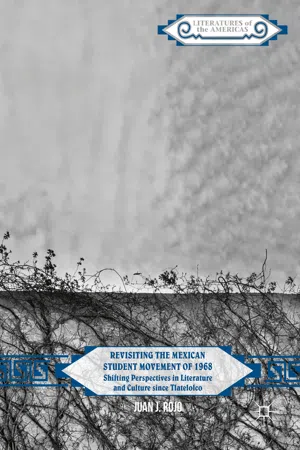
Revisiting the Mexican Student Movement of 1968
Shifting Perspectives in Literature and Culture since Tlatelolco
- English
- ePUB (mobile friendly)
- Available on iOS & Android
eBook - ePub
Revisiting the Mexican Student Movement of 1968
Shifting Perspectives in Literature and Culture since Tlatelolco
About this book
Tracing the evolution of Mexican literary and cultural production following the Tlatelolco massacre, this book shows its progression from a homogeneous construct set on establishing the "true" history of Tlatelolco against the version of the State, to a more nuanced and complex series of historical narratives. The initial representations of the events of 1968 were essentially limited to that of the State and that of the Consejo Nacional de Huelga (National Strike Council) and only later incorporated novels and films. Juan J. Rojo examines the manner in which films, posters, testimonios, and the Memorial del 68 expanded the boundaries of those initial articulations to a more democratic representation of key participants in the student movement of 1968.
Information
Print ISBN
9781137559876
Subtopic
Film & Video© The Editor(s) (if applicable) and The Author(s) 2016
Juan J. RojoRevisiting the Mexican Student Movement of 1968Literatures of the Americas10.1057/978-1-137-55611-0_11. Introduction: Silencing the Storm—The Never-Ending Search for “Truth” After Tlatelolco
Juan J. Rojo1
(1)
Lafayette College, Easton, Pennsylvania, USA
The student movement of 1968 has been regarded as a watershed moment in Mexican literary and cultural history. The name of the site that is now most closely associated with the movement, Tlatelolco, has become shorthand for a number of different signifiers: tragedy, conspiracy, student-heroism, disenchantment, and government cover-ups. While there is a widely accepted version of the events of October 2, 1968, their gravity as well as the manner in which they were covered by the national media and government agencies brought about disillusionment in the Mexican intelligentsia, perhaps best symbolized by Octavio Paz stepping down as Ambassador to India on October 4, 1968. In his letter of resignation, Paz alludes to the state’s almost complete control over the press. He writes that
dialogue has almost completely disappeared from our public life. It is enough to read Mexico’s daily and weekly press nowadays to feel ashamed. In no country with democratic institutions can one find that almost unanimous praise for the Government and that equally unanimous condemnation toward its critics. (Domínguez Michael 182)1
Paz was not alone in his distrust of the national press and, as a result, the literary and cultural production almost immediately following 1968 was widespread and persistent in its search for the “truth” that had been covered up by the state. The manifestos released by the Consejo Nacional de Huelga (National Strike Council or CNH), the poetry in memory of Tlatelolco, the testimonios concerning the 1968 experience, all released in the immediate aftermath, formed a discourse that later incorporated other texts such as novels, documentaries, and, much later, feature films, and, ultimately, a museum that brought together many of the primary actors of the events surrounding the Tlatelolco massacre. All of these came to form the discourse of the student movement. The birth of that discourse, however, was the 1968 experience from which evolved a larger apparatus.
The 1960s was the time of la Onda, a social and literary counterculture movement that developed in Mexico. The members of la Onda’s literary manifestation were a group of young writers who saw their literature as a form of social activism against political as well as literary norms in an exclusively urban setting. They distanced themselves from the approach of writers from previous generations in that their works often included urban slang, drugs, and foreign influences, especially from the United States. Onda writers, the most well known being Gustavo Sainz and José Agustín, used American rock music and other youth themes as integral components in their literary production. As Carol D’Lugo points out, the Onda writers displayed “an ‘importamadrista’ attitude, that is to say, a complete disdain for societal norms and values” (163). It is in the middle of this moment in Mexico’s literary landscape that the 1968 student movement surges and ultimately explodes at Tlatelolco. And part of the Onda aesthetic, this importamadrista attitude that defined Onda writers, is also key in defining the initial literary production after Tlatelolco.
Following the student massacre on October 2, 1968, it was thought that Mexican literature would be reshaped. Literary production ceased to be centered on the Mexican Revolution and the city, as had been the case for decades. The aesthetics of the Onda continued, but now revolved around the student massacre. As one of the key events in modern Mexican history, the literary production after the events of this infamous date was altered to respond to the government’s actions. Cynthia Steele writes:
During the early 1970s Mexican writers and critics tended to see this outpouring of fiction about 1968 as a literary signpost, an indication that the Mexican novel was being renovated by another historic series of events, and that the Novel of Tlatelolco would displace the Novel of the Revolution and the Novel of the City as the principal genre of Mexican fiction. (9)2
And while certainly the literary production after Tlatelolco was considerable, much of it was not fiction but instead manifested itself as testimonio, in some form or other. The most well known of these is Elena Poniatowska’s La noche de Tlatelolco (published in English as Massacre in Mexico 1971) which, as a result of the official silence and censorship immediately following 1968, became a substitute for an official historical account of the time. This much is true of the literary production as a whole in the years that followed. Poniatowska’s text especially has been treated as a referential historical text. This void in the official history meant that those with the ability to tell their story, as were the students imprisoned in Lecumberri and activists within the power structure of the movement, were the only voices able to write this history.
On the other side, Tlatelolco was almost completely unarticulated from Mexico’s official historical record in many ways. History books often glossed over the events of Tlatelolco, some acknowledged the events but failed to explore the details, and others ignored them altogether. The lack of histories specific to Tlatelolco was further compounded by the manner in which it was addressed in the few general histories of Mexico that touched on the events in the years that followed 1968. José Fuentes Mares’s Biografía de una nación. De Cortés a López Portillo (A Nation’s Biography. From Cortés to López Portillo 1982), for example, barely touches on the student massacre which, incidentally, took place under the presidency of Díaz Ordaz, which is well within the scope of his study. In fact, it briefly addresses Díaz Ordaz’s positive qualities in terms of his rise to the presidency following López Mateos’s 6-year term or sexenio. According to Fuentes Mares:
President López Mateos thought of don Gustavo Díaz Ordaz as his successor, an astute, intelligent, energetic poblano and, having served in the Interior Ministry during the previous sexenio, politically experienced. Surely don Gustavo’s only defect as a politician would have been his inability to control his passion, more than once volcanic and always blinding of reason. A politician can be even dumb, but never passionate outside of his intimate relations, although in this private venue he will run the risk that a woman will come to tell us the details of his performance. (291)
Fuentes Mares foreshadows the Tlatelolco massacre by alluding to Díaz Ordaz’s passionate disposition, in essence reducing the tragedy of October 2 to something as insignificant as a lovers’ quarrel. He goes on to conclude that Díaz Ordaz performed his duties as President relatively well and that “at the conclusion of his term would have come out well if the night of Tlatelolco had not crossed his path” (291). Fuentes Mares suggests that Díaz Ordaz’s involvement in the events of 1968 was akin to that of a bystander who reacted to events that had a life of their own and that intersected with his presidency. It should be noted, however, that Fuentes Mares does present some semblance of criticism of the government’s overreactions when he states that Tlatelolco was a “tragedy that [Díaz Ordaz] brought upon himself, in part because of his character, and in part for believing, like all Mexican politicians, that time and not opportune decisions resolve problems” (291). This criticism, however, is somewhat muted by the lack of details concerning any aspect of the student movement or the massacre. More importantly, Fuentes Mares attributes the massacre’s impetus, not to a decision (or lack thereof) by Díaz Ordaz, but to an inherent quality common to all Mexican politicians. It was not so much that the president failed to act or acted in any one particular way, but that he acted just like any other Mexican politician would have acted. In the end, it matters not who held the presidency since the events would have inevitably played out in the same manner in any instance. Fuentes Mares spends the remainder of this section explaining the qualities of the Mexican politician that would have resulted in the Tlatelolco massacre. He further ends the student movement and the tragedy that surrounds it on the night of October 2. He does not address the students who were imprisoned following the massacre nor the reasons for their continued incarceration years later. Fuentes Mares concludes his analysis of the Díaz Ordaz sexenio with the following words: “Tlatelolco made obvious the system’s decrepit nature, filled with inauthenticity, legends, and happy tales. Its great lie of origin devoured it at its core” (292). This is immediately followed in the next chapter by, “On December 1st, 1969, Díaz Ordaz handed the presidency to don Luis Echeverría Alvarez” (293). Fuentes Mares obscures the 14 months following the Tlatelolco massacre with a turn of a page.
Enrique Semo’s eight-volume México, un pueblo en la historia (Mexico, a People in History 1989) manages to include the student movement without a direct mention of the massacre itself. Instead, it includes the “Manifesto for the Nation” released by the CNH in December of 1968. There is no analysis, commentary, or mention of the actual events by the historian himself. The six pages that the Manifesto encompasses are all that is offered as a history of Tlatelolco. These six pages are counterbalanced by the 20 pages of extracts from Díaz Ordaz’s “IV informe de gobierno” (Fourth State of the Union Address) in which he makes his case against the student movement. Semo treats both parties in the same manner, but, much like Fuentes Mares, offers the reader no data concerning the massacre, nor does he engage it with a critical eye. The reader does not know what happened after the massacre and the reader is left with no knowledge that a massacre even took place. It is not until the end of the book in a “Chronology” section that reads like an afterthought or footnote that we are made aware of some of the events surrounding October 2, 1968.
Still, perhaps one of the most intriguing erasures of Tlatelolco is by Alicia Hernández Chávez in her México. Breve historia contemporánea (Mexico. Brief Contemporary History 2000). This volume makes absolutely no mention, allusion, hint, or gesture that might lead the reader to the student movement of 1968 and the massacre that followed. And while it could be argued that Hernández Chávez’s focus on the economic history of Mexico warrants the exclusion of the Tlatelolco massacre, it is nonetheless a mystery why the 1968 Olympics do not enter into her analysis, given the dramatic economic impact they were supposed to have and what the event was meant to signify in Mexico’s entry into the world stage and international markets. What makes this especially perplexing and ironic is her assertion, when speaking of Mexico’s most important general histories, that “the synthesis par excellence is the one that Octavio Paz’s makes in Labyrinth of Solitude and The Other Mexico, works that I have read and reread on more than one occasion and where I learned that to be Mexican is to be a product not just of one’s history, but of a broader history, a universal history” (10). Referencing Paz while at the same time ignoring the Tlatelolco massacre is highly problematic when one considers his stance against the regime under which the massacre occurred.
There are also attempts to minimize the gravity of the events of 1968. The most notable is General Luis Gutierrez Oropeza’s Díaz Ordaz. El Hombre. El Gobernante (Díaz Ordaz. The Man. The Leader 1988). It is important to note that during Díaz Ordaz’s presidency, General Gutierrez Oropeza was the head of the Estado Mayor Presidencial, the president’s official guard. In this work, Gutierrez Oropeza places the blame squarely on the shoulders of the Universidad Nacional Autónoma de México (UNAM) students and administrators. He writes:
There are those who want to make the student disturbances of 1968 appear as a movement in defense of national interests.This is incorrect: the night of October 2nd 1968 will go down in Mexico’s history with two hallmarks. The first, one of disloyalty and treason to the homeland by dishonest politicians and creoles of spirit and of those who live under the protection of foreign ideas and flags, like some of Mexico’s National Autonomous University’s renowned intellectuals, teachers and students who, ignoring their principal mission, entered the tornado of ambitions and self-interests that formed that whole apparatus, exacerbated by mercenaries of the pen.The other hallmark: President Díaz Ordaz’s nobility, who with his energy and opportune decision salvaged Mexico’s fundamental values. (49)
Gutierrez Oropeza frames the 1968 movement as a communist incursion on Mexican soil. Indeed, the book’s dedication by Gustavo de Anda proclaims, “One day it will have to be recognized that we owe to Gustavo Díaz Ordaz that Mexico was saved from falling into the Soviets’ hands. The 1968 subversion, sponsored from abroad, had that end.” This is of course to be expected from a man with loyalties that are not hidden, though it is not clear if Gutierrez Oropeza truly believes these assertions or is attempting to deflect attention from himself. One must consider that Gutierrez Oropeza was also the target of investigations concerning his role in the student massacre. In some respects, his defense of Díaz Ordaz can also be seen as an act of self-defense.
Above all these Mexican Histories are the official documents and histories published by the Partido Revolucionario Institucional (Institutional Revolutionary Party or PRI) itself. There are countless historical publications that deal with the electoral processes of any number of presidential hopefuls, who opposed which candidates, political platforms for any of the presidents’ 6-year terms, and many other topics. But as one might imagine, there are few, if any, that focus on the Tlatelolco Massacre, the political prisoners in Lecumberri, or even the student movement of 1968. There is, for example, the Historia documental de partido de la Revolución (Documentary History of the Party of the Revolution 1981) that, between volumes 8 and 9, has an almost 12-month gap. The final entry for volume 8 is dated February 1968 while the first entry in volume 9 is from 1969. What minimal mention there is of the student movement can be found in a collection of essays titled El partido en el poder. Seis ensayos (The Party in Power. Six Essays 1990). In this collection, there are two essays which, given their focus, ought to have included a mention of Tlatelolco. The first of these, “The Hegemonic Party: 1946–1972” by Jacqueline Peschard, makes a minimal mention of the student movement of 1968. It does, however, deal with the railroad workers and teacher strikes that preceded it. It reads, “In the case of the railroad workers and teachers, the conflict could not be resolved through negotiation; both movements were then stifled and their leadership jailed” (205). The mention of these movements from the late 1950s is brief and somewhat dismissive. There is no serious study of the issues at play in either of them. Instead, there is a mention of a failed negotiation that, unfortunately, and perhaps inevitably, concluded with the imprisonment of the movements’ leadership. The rhetoric hints at the same view expressed by Gutierrez Oropeza who claims that the violence against the students was necessary to preserve Mexican core values, especially considering the involvement of the communist party in these movements. In regard to 1968, Peschard writes, “The movement that constituted a frontal challenge to the regime was the student movement of 1968. Without being an expression of the middle class, per se, it arose from there, particularly from the more enlightened urban groups, but also the least controllable” (209–210). She succinctly characterizes the essence of the movement as a desire to open new spaces of political participation (210) but fails to deal with the movement in more than this synthesis.
The second essay from this collection, “The Difficulty of Change” by Ignacio Marván Laborde, takes a closer look at the student movement in that he contextualizes it along with other student movements in different parts of the country. They are characterized as a symptom of the lack of political representation afforded by the PRI, and glosses over the details, arriving at the conclusion that
For the Institutional Revolutionary Party the years immediately following the repression of the 1968 student movement were marked by tension generated by the growing critique of the Party, the awareness of a breaking point and of a different reality, as well as the need to reaffirm the benefits of the political system and the extreme caution in its internal reevaluation, by virtue of both the resistance to change as well as the radicalization tendencies present in Mexican society at that time. (258–259)
What is striking about this particular approach to the student movement is that it tries to coopt it as a slight deviation on the road of the “Party of the Revolution.” In other words, the student movement is presented as a catalyst for the self-betterment of the Party. This same approach is employed by Rodrigo Sández Parma in ¡El Partido al poder! (The Party on to Power! 1987) who explains that 1964 saw the emergence of guerrilla groups that came into being as a result of the same lack of political liberties that had hindered the political system (the PRI). This mutual victimization by some power outside the reach of either entity continues, “Until arriving, unfortunately, at the events of 1968 and, later, 1971, which is characterized by the beginning of assaults, kidnappings, and the emergence of urban guerrillas, some of them supported by international groups” (52). The essence of Tlatelolco is reduced to a mention of two different years that encompassed many lifetimes of struggle, and hundreds, if not thousands, of these lives being cut short by a system that is presented here as being as much a victim as the dead of Tlatelolco. The section on Tlatelolco is concluded and Mexico moves on better off than it was:
After these events came important juridical and electoral reforms, opening major democratic avenues for participation of all ideologies and for the manifest inconformit...
Table of contents
- Cover
- Frontmatter
- 1. Introduction: Silencing the Storm—The Never-Ending Search for “Truth” After Tlatelolco
- 2. Testimonio as Metahistory in González de Alba’s Los días y los años
- 3. At the Center of the Periphery: Arretche’s El grito and the Rhizomatic Visual Discourse of the 1968 Student Movement
- 4. Cárcel de mujeres: Gender and Gendering in “La Tita” Avendaño’s De la libertad y el encierro
- 5. The Specters Come Back to Life: Rojo amanecer and El Bulto
- 6. Looking Back After 40 Years: El Memorial del 68
- 7. Conclusion
- Backmatter
Trusted by 375,005 students
Access to over 1.5 million titles for a fair monthly price.
Study more efficiently using our study tools.
Frequently asked questions
Yes, you can cancel anytime from the Subscription tab in your account settings on the Perlego website. Your subscription will stay active until the end of your current billing period. Learn how to cancel your subscription
No, books cannot be downloaded as external files, such as PDFs, for use outside of Perlego. However, you can download books within the Perlego app for offline reading on mobile or tablet. Learn how to download books offline
Perlego offers two plans: Essential and Complete
- Essential is ideal for learners and professionals who enjoy exploring a wide range of subjects. Access the Essential Library with 800,000+ trusted titles and best-sellers across business, personal growth, and the humanities. Includes unlimited reading time and Standard Read Aloud voice.
- Complete: Perfect for advanced learners and researchers needing full, unrestricted access. Unlock 1.5M+ books across hundreds of subjects, including academic and specialized titles. The Complete Plan also includes advanced features like Premium Read Aloud and Research Assistant.
We are an online textbook subscription service, where you can get access to an entire online library for less than the price of a single book per month. With over 1.5 million books across 990+ topics, we’ve got you covered! Learn about our mission
Look out for the read-aloud symbol on your next book to see if you can listen to it. The read-aloud tool reads text aloud for you, highlighting the text as it is being read. You can pause it, speed it up and slow it down. Learn more about Read Aloud
Yes! You can use the Perlego app on both iOS and Android devices to read anytime, anywhere — even offline. Perfect for commutes or when you’re on the go.
Please note we cannot support devices running on iOS 13 and Android 7 or earlier. Learn more about using the app
Please note we cannot support devices running on iOS 13 and Android 7 or earlier. Learn more about using the app
Yes, you can access Revisiting the Mexican Student Movement of 1968 by Juan J. Rojo in PDF and/or ePUB format. We have over 1.5 million books available in our catalogue for you to explore.