- English
- ePUB (mobile friendly)
- Available on iOS & Android
eBook - ePub
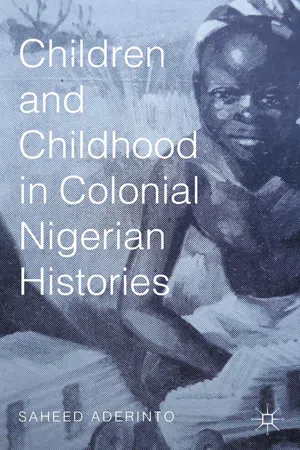
Children and Childhood in Colonial Nigerian Histories
About this book
This book brings together the newest and the most innovative scholarship on Nigerian children—one of the least researched groups in African colonial history. It engages the changing conceptions of childhood, relating it to the broader themes about modernity, power, agency, and social transformation under imperial rule.
Information
C H A P T E R 1
Researching Colonial Childhoods: Images and Representations of Children in Nigerian Newspaper Press, 1925–1950
Saheed Aderinto
Introduction
Despite frequent reference to children in Africanist literature, works that critically place childhood at the center of historical inquiry are few. Indeed, children’s history has yet to take a firm root as a subfield of African history even with the recent appearance of literature dealing with the colonial era.1 Most of works on this aspect of African experience have come from the social sciences: anthropology, psychology, sociology, and political science. And many have been influenced by postcolonial concerns—the phenomenon of the child soldier, child labor, poverty, disease and the HIV/AIDS pandemic, crime, and delinquency.2
As useful as social-science-centered scholarship is, critical knowledge of children’s experience under colonialism and of the changing definition of childhood since the precolonial period is just as important in unveiling the genesis of problems confronting African children today. For instance, through the innovative scholarship of Abosede George and Beverley Grier, we now know of the transformation that “child labor” has undergone since precolonial times; and understand that children have been an integral, albeit “invisible,” category of the workforce.3 Hence capitalist expropriation of children’s labor is not a “new” ethical challenge in postcolonial developing Africa. Laurent Fourchard’s and Simon Heap’s works on youth delinquency have provided much needed exposure of the colonial roots of urban vagrancy and juvenile delinquency in contemporary Nigeria.4 Yet, as we will see, African children’s encounters with colonialism transcended socially constructed problems of labor, delinquency, and vagrancy. Historical research does not simply uncover the origins of some of the postcolonial crises of development; it is capable of rendering systemic solutions grounded in a society’s transformative processes. In addition, research on colonial childhood is capable of helping to bridge the often rigid divide between colonial history and postcolonial ideas about education, health, rights, and identity. Continuity and change in children’s social engagement establish multiple trajectories regarding their existence as active agents in colonial society.
The history of the newspaper industry in Nigeria—one of the few enterprises dominated almost entirely by Nigerians—is as old as the story of colonial incursion into the country.5 The Church Missionary Society established the first newspaper, Iwe Irohin fun awon ara Egba ati Yoruba (Newspaper for the Egba and Yoruba), in 1859 mainly to improve literacy and facilitate evangelism among its early Yoruba converts in Abeokuta, “the bastion of Christianity in Yorubaland.”6 It did not take long, however, for the press to transcend its religious background to become a symbol and tool of the anticolonial movement.7 The scope and intensity of newspaper-based nationalism expanded as the British intensified their exploitation of Nigeria’s enormous human and material resources.8 Although scholars have examined the contributions of the print media to the development of nationalism, decolonization, and Win the War mobilizations, they have largely neglected other significant themes related to the press.9 With the exception of very few studies—such as Ayodeji Olukoju’s work on the cost of living in colonial Lagos and LaRay Denzer’s critical biography of Henrietta Douglas, a female journalist and pan Africanist—which are based almost wholly on newspaper sources, the impression one gets is that the print media revolved mainly around political nationalism and constitutional matters.10
This trend of discourse is not only misleading but also one-sided. It excludes several other themes including but not limited to children/childhood; romantic passion; consumer culture; crime; urban lifestyle; honor and respectability; and religion, faith, and spirituality. Limited attention has been given to the role the print media played in promoting colonial popular culture, which blended the indigenous with Western practices of recreation and leisure.11 E. Ronke Ajayi’s emergence as the first female newspaper editor in 1931 opened the floodgate of representation of diverse aspects of gender—from romance, love, and fashion to courtship, marriage, and family—in the mainstream print media.12 It is a fact that the newspaper press from the 1880s served as the watchdog of the colonialists; but it is also a truism that by the 1930s it had become a major site of literary and artistic production. By this period, its scope and content extended to other aspects of Nigeria’s colonial encounter, not directly related to anti-British sentiments or the rhetoric of decolonization. Unlike in the period before 1920 when newspapers’ primary audience was educated adults, the following decade witnessed the recognition of children as consumers of print media. Children had their own regular columns dedicated to issues appropriate for their age and experience. Yet, the wealth of data in more than 150 newspapers and magazines published during the century of Britain’s imperial presence in Nigeria have gone underutilized by historians.13
I chose the following newspapers—Lagos Daily News (LDN), Nigerian Daily Times (NDT), and West African Pilot (WAP)—for my analysis partly because they were all published daily during the 1920s, 1930s, and 1940s.14 In addition, these outlets held divergent ideological positions, which allowed me to present contrasting and contradictory views about the resilience and adaptation of “traditional” child rearing practices in a rapidly modernizing colonial society. As we will see, while the LDN held neotraditionalist views and tended to condemn British-styled child rearing practices, the NDT and WAP both promoted the idea of modern African childhood. Newspapers regardless of their ideology constructed normative boyhood and girlhood behavior as core components of nation building.15 Hence the proliferation of advice manuals in the print media connected to a broader shared value about productive living that most educated elites thought would help Africans advance on the track of social progress.16 Debates over child rearing reflected the divergent stances of leading nationalists regarding the best means of preparing future generations of Nigerians who in theory and reality would inherit the independent state after the anticipated demise of colonial rule.17 Instead of approaching children’s experience from the well-established standpoints of disease, violence, delinquency, and crime, this chapter examines the following areas of children’s experience that were thoroughly covered in the newspapers of the 1920s–40s: children and education; children and motherhood; and children as consumers. These relatively uncharted areas of Nigerian children’s history bring to light alternative and useful perspectives on agency and the centrality of childhood to the colonial state’s ideas of progress, civilization, modernity, and social stability.
The newspaper sources to be discussed range from highly cogent editorials and columnist debates, to fragmentary entries such as advertisements, photographs/images, and announcements. They could be used to supplement other sources such as official colonial archives, oral histories, and childhood recollections. In all, one would need serious grounding on theories and practices of imperialism and mainstream Nigerian history to fully comprehend the politics of representation of children in the newspapers and the concept of modern childhood, a phenomenon that had a global nexus during the twentieth century.18 The representation of children in the print media offers a useful entry into the intricate politics of class, agency, gender, and race in colonial Nigeria.
Childhood was both a social and a historical construction in colonial Nigeria. If a child was defined in accordance with the culture of each ethnic group in the precolonial era,19 colonialism imposed unitary and incon...
Table of contents
- Cover
- Title
- Introduction: Colonialism and the Invention of Modern Nigerian Childhood
- 1 Researching Colonial Childhoods: Images and Representations of Children in Nigerian Newspaper Press, 1925–1950
- 2 Processing Juvenile Delinquents at the Salvation Army’s Boys’ Industrial Home in Lagos, 1925–1944
- 3 Children’s Masquerade: Performance and Creativity in Benin City
- 4 “500 Children Missing in Lagos”: Child Kidnapping and Public Anxiety in Colonial Nigeria
- 5 “A World of Good to Our Boys”: Boy Scouts in Southern Nigeria, 1934–1951
- 6 The Colonial Office and the Employment of Children in the Nigerian Tin Mines in the 1950s
- 7 Framing the Colonial Child: Childhood Memory and Self-Representation in Autobiographical Writings
- 8 Within Salvation: Girl Hawkers and the Colonial State in Development Era Lagos
- Index
Trusted by 375,005 students
Access to over 1.5 million titles for a fair monthly price.
Study more efficiently using our study tools.
Frequently asked questions
Yes, you can cancel anytime from the Subscription tab in your account settings on the Perlego website. Your subscription will stay active until the end of your current billing period. Learn how to cancel your subscription
No, books cannot be downloaded as external files, such as PDFs, for use outside of Perlego. However, you can download books within the Perlego app for offline reading on mobile or tablet. Learn how to download books offline
Perlego offers two plans: Essential and Complete
- Essential is ideal for learners and professionals who enjoy exploring a wide range of subjects. Access the Essential Library with 800,000+ trusted titles and best-sellers across business, personal growth, and the humanities. Includes unlimited reading time and Standard Read Aloud voice.
- Complete: Perfect for advanced learners and researchers needing full, unrestricted access. Unlock 1.5M+ books across hundreds of subjects, including academic and specialized titles. The Complete Plan also includes advanced features like Premium Read Aloud and Research Assistant.
We are an online textbook subscription service, where you can get access to an entire online library for less than the price of a single book per month. With over 1.5 million books across 990+ topics, we’ve got you covered! Learn about our mission
Look out for the read-aloud symbol on your next book to see if you can listen to it. The read-aloud tool reads text aloud for you, highlighting the text as it is being read. You can pause it, speed it up and slow it down. Learn more about Read Aloud
Yes! You can use the Perlego app on both iOS and Android devices to read anytime, anywhere — even offline. Perfect for commutes or when you’re on the go.
Please note we cannot support devices running on iOS 13 and Android 7 or earlier. Learn more about using the app
Please note we cannot support devices running on iOS 13 and Android 7 or earlier. Learn more about using the app
Yes, you can access Children and Childhood in Colonial Nigerian Histories by S. Aderinto in PDF and/or ePUB format, as well as other popular books in History & African History. We have over 1.5 million books available in our catalogue for you to explore.