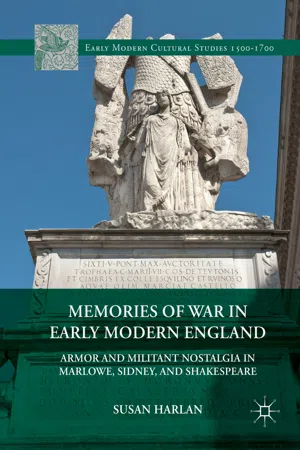
eBook - ePub
Memories of War in Early Modern England
Armor and Militant Nostalgia in Marlowe, Sidney, and Shakespeare
- English
- ePUB (mobile friendly)
- Available on iOS & Android
eBook - ePub
Memories of War in Early Modern England
Armor and Militant Nostalgia in Marlowe, Sidney, and Shakespeare
About this book
This book examines literary depictions of the construction and destruction of the armored male body in combat in relation to early modern English understandings of the past. Bringing together the fields of material culture and militarism, Susan Harlan argues that the notion of "spoiling" – or the sanctioned theft of the arms and armor of the vanquished in battle – provides a way of thinking about England's relationship to its violent cultural inheritance. She demonstrates how writers reconstituted the spoils of antiquity and the Middle Ages in an imagined military struggle between male bodies. An analysis of scenes of arming and disarming across texts by Christopher Marlowe and William Shakespeare and tributes to Sir Philip Sidney reveals a pervasive militant nostalgia: a cultural fascination with moribund models and technologies of war. Readers will not only gain a better understanding of humanism but also a new way of thinking about violence and cultural production in Renaissance England.
Information
© The Author(s) 2016
Susan HarlanMemories of War in Early Modern EnglandEarly Modern Cultural Studies Series10.1057/978-1-137-58012-2_2Chapter 1 “Objects Fit for Tamburlaine”: Self-Arming in Marlowe’s Tamburlaine the Great, Robert Vaughan’s Portraits, and The Almain Armourer’s Album
Susan Harlan1
(1)
Wake Forest University, Winston Salem, USA
Arms and the Man
I begin with Tamburlaine, the quintessential warrior, and the question of how customs—particularly the military subject’s customary self-arming before battle—govern and structure representations of war. In 1.2 of Marlowe’s Tamburlaine the Great, Part 1 (performed late 1587 or 1588), Tamburlaine dresses himself for war and exclaims, “This complete armour and this curtle-axe/Are adjuncts more beseeming Tamburlaine …” than his shepherd’s “weeds” (Part 1, 1.2.41–43). 1 Editors have generally assumed that Tamburlaine strips off his shepherd’s cloak at this moment to reveal his armor beneath, and most have included stage directions that support this reading. I would like to contest this assumption and to revise our sense of the scene, positing instead that by donning his armor onstage, Tamburlaine draws attention to the role that this customary clothing plays in both plays’ military engagements, situates himself in an inherited tradition of self-arming figures from the Bible to epic to romance, and engages with questions of contemporary militarism. Armor anticipates the elite military subject’s participation in war and renders him fit to participate in violent conflict. At war’s end, it must be cast aside. Armor figures prominently in both plays as a site of contestation and violence. It is traditional and novel, common and unique, beautiful and troubling, fortifying and vulnerable. Those who handle it do so according to certain customs, and these customs are emblematic of a militant nostalgia that pervades the play’s treatment of violence, aesthetics, and masculinity.
Military “custom” is an elusive concept in Marlowe’s plays, which have often been read as engaged with the heterodox and the novel, not the inherited and the traditional. 2 “Custom” refers to a habitual or usual practice, a common way of acting, a fashion, or habit. Like “habits” and “habiliments,” “customs” and “costumes” are etymologically related: custom dictates certain modes of personal attire, and these modes of attire participate in, and shore up, customary practices. Ann Hollander argues that “fashion” was an invention of the late Middle Ages that
As a “projection” of custom and a mode of representation, clothing provides a means of examining the customs that govern war and those that govern the early modern English theater more broadly. Armor is the customary clothing of an elite military combatant; it is also a crucial prop in Tamburlaine’s—and the play’s—understanding of war. 4 Marlowe’s plays treat in great detail what I refer to as “the objects of war”: both the material objects that define the militarized self and the objects, in the sense of objectives, of war. Of course, Tamburlaine’s scene of self-arming negotiates a crucial relationship between the customs that govern the dramatic representation of the Other and those that govern the representation of the medieval English knight and the early modern English military leader, asking the audience to consider what the armored subject looks like and what his appearance signifies. 5 His body also raises questions about how the customs of militant masculinity both assure alliance with a group and assert exemplary subjectivity. E.P. Thompson defines “custom” as “sui generis—an ambiance, a mentalite, … a whole vocabulary, a discourse of legitimation and expectation.” 6 In donning his military dress, Tamburlaine both fulfills certain expectations and sets up others.… lifted clothing out of its earlier condition as first-order, unselfconscious symbolic art, and made it into an imaginative and self-reflective visual medium. Fashion has allowed clothing to detach itself from the task of being the stable (and often stabilizing) visual projection of social custom and common belief, and allowed it to become a wayward representational art, something entirely fictional like painting or movies. 3
The unapologetic violence of the Tamburlaine plays has long offended, perplexed, and divided scholars. 7 From the publication of Harry Levin’s seminal study The Overreacher in 1952, critics have often read Marlowe’s central characters as uncommonly ambitious and transgressive. 8 He also attended to the play’s moral universe, asserting that Part 2 contains a moral which exposes as fraudulent the image of romantic success depicted in Part 1. Una Ellis-Fermor’s work anticipated that of Levin, for she printed Desportes’ sonnet “Icare” as an epigraph to her 1927 monograph Christopher Marlowe, thus establishing the connection between Marlowe’s plays and the myth of excessive and unregulated ambition. 9 More recently, Raphael Falco (2000) has examined Tamburlaine’s “charismatic authority” and questioned some of the assumptions that have attended this line of critical inquiry. Falco notes that, from Max Weber onwards, “We speak of charisma as a kind of heightened personal attractiveness, a desirable attribute. Moreover … we regard charisma as a zenith of individuality, a subjectivity so exceptional it stands utterly alone.” 10 Falco himself argues that this understanding of charisma “gives too optimistic an impression of the relation between individuality and charismatic domination.” 11 This charismatic authority and domination relies heavily on the material world of the play. 12
Tamburlaine’s customary donning of his armor in Part 1 establishes him as a member of a legitimate and legitimating cultural tradition of armed figures. 13 His armored body harkens back to past militant models and sets up the audience’s expectations for future theatrical exploits. The promise of these exploits is ethically fraught and bound up in Tamburlaine’s militant nostalgia—his desire to appropriate past militant models for his own ends. In Marlowe’s chief source for the plays, George Whetstone’s 1586 The English Myrror, Tamburlaine is deemed “the ire of God, and the destruction of the world.” 14 In The Mirror for Magistrates, first published in 1559 and reprinted seven times between 1559 and 1587, the depiction of a great ruler—with all his faults—was both a lesson and an admonishment to the audience. 15 Certainly, Tamburlaine is in many ways an anti-hero, but in donning his militant dress, he also claims an existing discourse of militarism that he absorbs into his own identity, rendering himself recognizable as a hero. He spoils his armor as he spoils so many other things in these plays, both objects and subjects. This act of spoiling also operates as a figure for the play’s own dramatic spoiling, or appropriation and reconstitution, of modes of tragedy, and comedy. A discourse of acquisition and rejection governs Marlowe’s treatment of military dress in these plays, and this discourse engages with other modes of acquisition, or spoiling, in the play. 16 As in all things, Tamburlaine claims his military dress by way of a linguistic performance. When he self-arms, he also narrates the significance of his armor, an undertaking that suggests the importance of language in establishing ownership of the objects of war. Military dress is consistently characterized as astonishingly beautiful in the Tamburlaine plays; it is also an object of desire that paradoxically presents and conceals the violence for which it prepares the subject. It is important to note that for all of Marlowe’s engagement with war and militarism, the plays do not place a high premium on the representation of battles. Much of the plays’ violence unfolds in scenes of torture and humiliation, as well as in epic encounters between solitary antagonists. But military dress becomes the means by which Marlowe engages with the problems that attend the representation of military violence and the representation of the past. 17 By examining Robert Vaughan’s 1622 The Pourtraitures at Large of Nine Moderne Worthies of the World, in which the armored Tamburlaine makes an appearance, and The Almain Armourer’s Album, a sumptuous early modern English catalogue of military dress designed for the aristocracy, I will demonstrate how the armed body of the elite combatant is a fraught aesthetic object: an object of desire. I will also explore how armor engages with another form of desire—battlefield nostalgia—in compelling ways. Armor not only anticipates combat; it also plays a role in mourning and banqueting. In Part 1, armorial helmets play a crucial role in the humiliating banquet for Bajazeth. In Part 2, Tamburlaine and his followers mourn Zenocrate’s death by erecting a memorial pillar. They also discuss their post-war banqueting activities in great detail. By examining the role of armor in mourning and feasting, I will establish how armor negotiates relationships between present and absent violence, between ruler and ruled, and—most importantly—between present and past.
The Emperor’s New Clothes
Tamburlaine’s ceaseless conquest of lands begins with a conquest of clothing. His rejection of his shepherd’s robes and his self-arming as a “deed” constitute a dramatic contract with his playhouse audience and, ultimately, an act of aggression that positions him in a liminal space between foreign Other and familiar English chivalric knight. 18 In 1.2 of Part 1, Tamburlaine enters with Zenocrate, Techelles, Usumcasane, Magnetes, Agydas, as well as a several lords and soldiers. The scene opens with Zenocrate’s plea to Tamburlaine that he “pity [her] distressed plight” (Part 1, 1.2.7). Tamburlaine’s followers carry the spoils of their conquest of Damascus, and Zenocrate begs that Tamburlaine not claim her as another spoil “by lawless rapine” (Part 1, 1.2.10). Tamburlaine’s self-arming is in part a performance for her; she is his chief onstage audience. Two actions occur in this scene: first, he casts aside his shepherd’s clothing, and then he dons his armor. When Tamburlaine strips off his shepherd’s “weeds,” he claims his identity as a “lord”:
By casting off his shepherd’s clothing, Tamburlaine creates a divided self, and the presence of both his shepherd’s “weeds” and his armor onstage is emblematic of this dual subjectivity. He begins his speech in the first person and then shifts to the third person when he invokes “his bed that conquers Asia” and “the limits of his empery.” This change in pronouns suggests a shift in Tamburlaine’s perception of himself: he moves from speaking of himself as himself to speaking of himself as an observer, an outsider. Peter Donaldson notes that Tamburlaine wants to be looked at. 19 Here, Tamburlaine becomes the object of his own gaze and of that of his audience. Further, in rejecting his “parentage,” he stages his own rebirth, his own mythic self-creation by way of military “deeds” that displace his unsuitable civilian “weeds.” His robes are not described in any detail: they are simply “weeds,” a general name for clothing that is distinctive of one’s profession, state of life, or sex. Orsino draws on the latter meaning of the term when he says to the cross-dressed Viola at the end of Twelfth Night: “Give me thy hand,/And let me see thee in thy women’s weeds” (TN 5.1.264–5). Tamburlaine draws primarily on the first meaning, for he rejects the profession of the shepherd in favor of that of the military leader, the life of the pastoral swain in favor of that of the knight. 20 His shepherd’s “weeds” are deemed unsuited to his new military self and to the play itself. As Charles Carlton has noted, “the origins of kingship, the first form of hierarchical leadership, lie in war.” 21 Tamburlaine’s rejection ...I am a lord, for so my deeds shall prove,And yet a shepherd by my parentage.But, lady, this fair face and heavenly hueMust grace his bed that conquers AsiaAnd means to be a terror to the world,Measuring the limits of his emperyBy east and west as Phoebus doth his course.Lie here ye weeds that I disdain to wear! (Part 1, 1.2.34–41)
Table of contents
- Cover
- Frontmatter
- Introduction
- Chapter 1 “Objects Fit for Tamburlaine”: Self-Arming in Marlowe’s Tamburlaine the Great, Robert Vaughan’s Portraits, and The Almain Armourer’s Album
- Interlude–Epic Pastness: War Stories, Nostalgic Objects, and Sexual and Textual Spoils in Marlowe’s Dido, Queen of Carthage
- Chapter 2 Spoiling Sir Philip Sidney: Mourning and Military Violence in the Elegies, Lant’s Roll, and Greville’s Life of the Renowned Sir Philip Sidney
- Interlude-Scatter’d Men: Mutilated Male Bodies and Conflicting Narratives of Militant Nostalgia in Shakespeare’s Henry V
- Chapter 3 The Armored Body as Trophy: The Problem of the Roman Subject in Shakespeare’s Julius Caesar, Antony and Cleopatra, and Coriolanus
- Coda: “Let’s Do’t After the High Roman Fashion”: Funeral and Triumph
- Backmatter
Trusted by 375,005 students
Access to over 1.5 million titles for a fair monthly price.
Study more efficiently using our study tools.
Frequently asked questions
Yes, you can cancel anytime from the Subscription tab in your account settings on the Perlego website. Your subscription will stay active until the end of your current billing period. Learn how to cancel your subscription
No, books cannot be downloaded as external files, such as PDFs, for use outside of Perlego. However, you can download books within the Perlego app for offline reading on mobile or tablet. Learn how to download books offline
Perlego offers two plans: Essential and Complete
- Essential is ideal for learners and professionals who enjoy exploring a wide range of subjects. Access the Essential Library with 800,000+ trusted titles and best-sellers across business, personal growth, and the humanities. Includes unlimited reading time and Standard Read Aloud voice.
- Complete: Perfect for advanced learners and researchers needing full, unrestricted access. Unlock 1.5M+ books across hundreds of subjects, including academic and specialized titles. The Complete Plan also includes advanced features like Premium Read Aloud and Research Assistant.
We are an online textbook subscription service, where you can get access to an entire online library for less than the price of a single book per month. With over 1.5 million books across 990+ topics, we’ve got you covered! Learn about our mission
Look out for the read-aloud symbol on your next book to see if you can listen to it. The read-aloud tool reads text aloud for you, highlighting the text as it is being read. You can pause it, speed it up and slow it down. Learn more about Read Aloud
Yes! You can use the Perlego app on both iOS and Android devices to read anytime, anywhere — even offline. Perfect for commutes or when you’re on the go.
Please note we cannot support devices running on iOS 13 and Android 7 or earlier. Learn more about using the app
Please note we cannot support devices running on iOS 13 and Android 7 or earlier. Learn more about using the app
Yes, you can access Memories of War in Early Modern England by Susan Harlan in PDF and/or ePUB format, as well as other popular books in Literature & European Literary Criticism. We have over 1.5 million books available in our catalogue for you to explore.