- English
- ePUB (mobile friendly)
- Available on iOS & Android
eBook - ePub
About this book
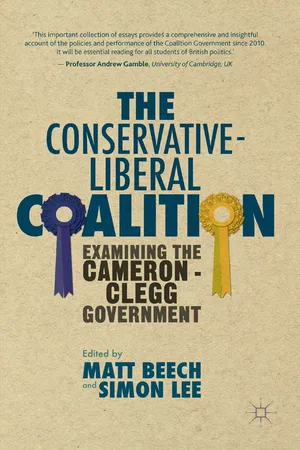
This book offers a unique full term analysis of the Cameron-Clegg Government. From austerity to gay marriage, the Scottish referendum to combating IS, it brings together expert academic voices to provide rigorous yet readable insights on the key areas of government politics and the debates which will shape the 2015 general election.
Information
1
The Ideology of the Coalition: More Liberal than Conservative
Matt Beech1
The Conservative Party exists to conserve; it is the party of the status quo. Unfortunately for it and its adherents all things change – ‘the flower withereth and the grass fadeth’.
(Charmley, 1996: 1)
Introduction
For those who study British politics from a contemporary history or political science perspective the role of ideology is notable. British party ideology is diverse, fluid and contains contradictory strands. At certain times a particular expression dominates, usually from the podiums occupied by the party leadership. Of course, the role and significance of ideology is never the full story. The politics of personalities, internal management, path-dependent policy commitments and a host of external factors – chief of which is electoral calculus – all contribute to the story of a government. The work of Jim Bulpitt in relation to the primacy of statecraft in the domestic politics of Margaret Thatcher has been influential and widely cited within academic circles (Bulpitt, 1986). But Mark Garnett and Kevin Hickson are surely right to point out that ideology is a key contributing factor in the statecraft of elite politicians, including those at the apex of the oldest political party in Europe: ‘[W]e can see that the statecraft of the Conservative Party was not fixed but rather changed over time in the light of changed circumstances and the beliefs of the Party’s leaders. On this view, ideology has always been an integral element in Conservative “statecraft”.’ (Garnett and Hickson, 2009: 3)
To add ballast to this point, one needs only a brief glance at post-war Conservative history from R.A. Butler’s Education Act; Winston Churchill’s cultivation of the ‘special relationship’; Harold Macmillan’s establishment of the National Economic Development Council or ‘Neddy’; Edward Heath’s ‘Selsdon Man’ manifesto; Thatcher’s deregulation of the City of London; John Major’s privatisation of British Rail; George Osborne’s Emergency Budget and the following politics of austerity, to sufficiently demonstrate that ideology is central to British politics in general, and to Conservative statecraft, in particular.
There has been considerable academic attention to issues relating to ideology and the Coalition (McAnulla, 2010; Beech, 2011a; Hall, 2011; Kelly, 2011; Kerr et al., 2011; Buckler and Dolowitz, 2012; Crines, 2013; Heppell, 2013; Lakin, 2013; Griffiths, 2014; Hayton, 2014). This essay’s hypothesis suggests that the ideology of the Conservative–Liberal Coalition owes more to the well-spring of liberal political thought than conservative political thought. Due to the confines of a single essay I have selected three data points which unite the Coalition. The data are in the form of substantive policy areas and ordered in terms of import: economic liberalism, social liberalism, foreign policy (liberal interventionism). Before we proceed it is important to insert some caveats. First, the data points are areas of overlapping agreement between the two camps making Coalition possible and ideologically liberal. However, the breadth and depth of disagreement which separates Clegg’s Orange Book2 Liberal Democrats from Cameron’s liberal Conservatives is self-evident: the European Union, immigration, defence of the realm, the constitution, aspects of environmental policy and press regulation. Second, the argument of the essay is not that the elites in both Coalition parties are of one mind. On the contrary, their frequent, ill-tempered public disagreements throughout this parliament denote two different political traditions (Ross, 2014). In addition, such disputes illustrate the electoral need to be seen to disagree with each other by their activists who can be described as partisan ‘die-hards’. Without the support of such card-carrying members – ‘true believers’, if you will – the prospect of mounting an effective election campaign is distant.
A tale of two liberalisms rebooted
In our previous book, The Cameron–Clegg Government: Coalition Politics in an Age of Austerity (Lee and Beech, 2011) my focus was to explain and understand the philosophical feasibility of partnership between the Conservatives under Cameron and the Liberal Democrats under Clegg. In other words, why should it work? This I characterised as ‘a tale of two liberalisms’ (Beech, 2011a: 268). In the majority partner, a modernising Conservatism comprising an economic liberal political economy passed down the generations from the materfamilias is combined with a social liberalism indicative of the metropolitan elite and, in the minority partner, Orange Book politics which re-emphasise the Manchester economics of old sit with the ever-present Liberal Democrat advocacy of liberal morality (ibid.: 269–70). I continue to believe that this is an accurate ideological summary of the Conservative–Liberal Coalition. In that essay I noted that Cameron’s political thought is essentially a form of liberalism albeit communicated to the electorate as liberal Conservatism. This too I maintain. My argument has expanded to include a third liberal perspective of Cameron’s Conservatives; that of liberal interventionism in British foreign policy (Beech, 2011b; Beech and Oliver, 2014). Other scholars have sought to explain and understand the role played by liberalism in Cameron’s Conservatism and, relatedly, liberalism’s role within the Coalition. Stuart Hall remarked that:
Coalition set the neo-liberal-inclined Orange Book supporters, who favoured alliance with the Conservatives, against the ‘progressives’, including former social democrats, who leaned towards Labour … The Lib Dems provided the Cameron leadership with a ‘fig leaf’, and the banking crisis with the ‘alibi’ it needed. It grasped the opportunity to launch the most radical, far-reaching (and irreversible?) social revolution since the war. (Hall, 2011: 718)
For Hall, then, a neo-liberal partnership is the way to comprehend the Conservative–Liberal Coalition; with the detrimental impact of the Global Financial Crisis (GFC) on the UK ‘proof’ that ‘emergency surgery’ was required. In his piece in British Politics, Matthew Lakin takes a contrasting perspective on the ideological motivations of the Conservative–Liberal Coalition: ‘[T]he Coalition is more “muscular”, or conservative, than liberal. Cameron’s Conservatives, with the aid of the Liberal Democrats, have begun the process of trying to create a broad-church Centre-Right hegemony in Britain’ (Lakin, 2013: 488). Lakin is correct that the partnership of Cameron and Clegg is ‘broad-church Centre-Right’ but off the mark with his interpretation of a ‘“muscular”, or conservative’ politics. It is difficult to identify conservative elements in Liberal Democrat policy. Even if one looks closely at the different Liberal Democrat expressions from the Orange Book liberals to the social liberals to the SDP liberals. While Cameron’s Conservatives exhibit some traditional conservative attitudes, compared in relation to a sizable portion of the Parliamentary Conservative Party, and many grassroots activists, they are consistently liberal. The notion of contempt felt towards Conservative activists by Cameron’s coterie was given ‘voice’ by a source quoted by Telegraph journalist James Kirkup over the Conservative split on gay marriage. The source described the associations as, ‘all mad swivel-eyed loons’ (Kirkup, 2013). The politics of the Conservative–Liberal Coalition is essentially a right-wing liberalism.
Economic liberalism
Economic liberalism has long been the favoured economic doctrine of the Conservative Party. The DNA link between Thatcherism and the ideology of the Coalition is neo-liberalism or, emphasised slightly differently, economic liberalism. This economic liberalism is a policy continuity which trickled down the years from Thatcher’s administrations to Major to Blair to Brown (before the rebirth and short second life of Keynesianism in 2008–2010) and then to the Coalition. Here, then, lies a foundational tenet of liberalism still influencing contemporary politics. Following in the footsteps of his predecessors since Thatcher, and continuing to dwell in the economic paradigm of Conservative Party thinking, Cameron too is clearly an advocate of economic liberalism (Beech, 2009). In his Commons tribute to Thatcher, on 13 April 2013, Cameron’s economic liberal sympathies for her philosophy were evident:
The air was thick with defeatism; there was a sense that the role of government was simply to manage decline. Margaret Thatcher rejected this defeatism. She had a clear view about what needed to change. Inflation was to be controlled – not by incomes policies, but by monetary and fiscal discipline. Industries were to be set free into the private sector. Trade unions should be handed back to their members. People should be able to buy their own council homes. (Cameron, 2013)
The Conservative–Liberal Coalition has sought, like Thatcher, to reduce the size of the state and cut public expenditure. The result is a slightly leaner state with the politics of austerity embedded as the modus operandi of our time. The authors of the austerity are equally fervent economic liberals, one a Conservative and the other a Liberal Democrat: George Osborne and Danny Alexander. The Orange Book Liberal Democrats who occupy key positions in the Coalition are not reluctant partners in the politics of austerity as their voting record clearly indicates. Their leader was an Orange Book essayist and has given speeches where he trumpets economic liberalism as part of his party’s heritage (Clegg, 2008). For their part, these Liberal Democrats desired Coalition to demonstrate that their party was fit for office and that their interpretation of liberalism possessed the economic liberal principles that were necessary to counter the profligate state that the Labour Party had used to the detriment of balanced fiscal policy. The Orange Book liberals were confident that – because of their commitments to a smaller state, market forces, lower taxes, entrepreneurship and less bureaucracy – their hour in British politics had come.
Therefore, it can be clearly understood that the Coalition is a project predicated on the economic (not social or foreign policy) nostrums set out in Thatcherism but they have arguably gone further in rolling-back Britain’s welfare capitalism. Reductions in public expenditure, reductions of direct taxation, privatisation, and the scaling back of welfare provision are all consistent with the economic liberal conception of how to shrink the size and influence of the state and, by so doing, attain greater liberty for individuals. Some notable clues which further point to the economic liberalism of the Coalition include the scrapping of the 50p band of income tax and replacing it with a 45p band for those earning over £150,000 per annum (which is a tax cut for the most financially successful); the introduction of the spare-room subsidy or ‘bedroom tax’; the rapidly increasing privatisation of NHS England services;3 and the abolition of a range of measures, designed over many years, to support the poorest and most vulnerable citizens: the abolition of the Educational Maintenance Allowance, Community Care Grants, Crisis Loans, the Council Tax Rebate Scheme4 and cuts to civil legal aid.
The need to reduce the deficit to sustainable proportions is uncontroversial. However, the means that are employed; the speed of the fiscal retrenchment; and the ends motivating such action are the subjects of much contestation and bitter argument. The Conservative–Liberal narrative has long been that ‘Labour did not fix the roof whilst the sun was shining’. It is true that there was a deficit before the emergency measures of the Brown government to prevent the recession slipping into depression. But not only was the level of deficit manageable it was a period of reinvestment in capital infrastructure: schools, hospitals, transport, universities, social services, policing and the armed forces. Also, with a domestic reinvestment plan, the Labour governments expanded the relevant professions to staff the public services. While not every pound was spent judiciously and Labour’s penchant for Public–Private Partnerships yielded poor value for taxpayers and many public sector employees were ground down by the incessant target culture of New Labour’s managerialism, hundreds of thousands of jobs were created and ten years of consecutive growth ensued. In short, the deficits were manageable. The explosion in the deficit from 2008–2010 was, unsurprisingly, caused by the ramifications of the Great Financial Crisis. When the Conservative–Liberal Coalition was formed in 2010 the goal of deficit reduction by the end of the parliament was its priority:
We recognise that deficit reduction, and continuing to ensure economic recovery, is the most urgent issue facing Britain. We will significantly accelerate the reduction of the structural deficit over the course of a Parliament, with the main burden of deficit reduction borne by reduced spending rather than increased taxes. (HM Government, 2010b: 15)
Without immediate action, Britain’s future wealth and competitiveness would greatly suffer and the stability of the economy was precariously balanced. The Treasury set about making aggressive economies in public expenditure across the departments of Whitehall. Front-line provision of social care, policing, schools, social security, and to a lesser extent the NHS have all been structurally altered in the new era of austerity. According to the Institute for Fiscal Studies (IFS), Coalition cuts to Whitehall departmental spending from 2010 to the end of 2014–15 has been £35 billion, with an estimated further £55 billion of cuts to come between 2015–16 and 2019–20 (Johnson, 2014: 4). In 2010, the Treasury forecast that in 2014–15 the deficit would be less than £40 billion, that it is now predicted to exceed £90 billion (ibid.: 2–3). Paul Johnson, the Director of the IFS, states that: ‘It is important to understand why the deficit hasn’t fallen. It is emphatically not because the government has failed to impose the intended spending cuts. It is because the economy performed so poorly in the first half of the parliament, hitting revenues very hard’ (ibid.: 3).
Why was this? The performance of an economy (particularly one such as the UK’s) is a multifarious and complex thing. The Eurozone crisis has played a role. However, the scale of the cuts to public expenditure necessarily led to significant job losses and the knock-on effect rippled through the supply chain. This increased the welfare bill, reduced revenue from tax receipts and, simultaneously, removed much demand from an anaemic economy in the first half of the parliament. According to figures from the Office for National Statistics (ONS), published on 21 January 2015, t...
Table of contents
- Cover
- Title
- Copyright
- Contents
- List of Tables and Figures
- Notes on Contributors
- The Centre for British Politics
- Acknowledgements
- 1. The Ideology of the Coalition: More Liberal than Conservative
- 2. Indebted and Unbalanced: The Political Economy of the Coalition
- 3. Education Policy: Consumerism and Competition
- 4. The Big Bang: Health and Social Care Reform under the Coalition
- 5. The Coalition, Poverty and Social Security
- 6. The Coalition: How Green was My Tally?
- 7. Immigration and Housing
- 8. Justice, Home Affairs, Civil Liberties and Human Rights
- 9. Parliament and the Constitution: The Coalition in Conflict
- 10. The Condition of England under the Coalition
- 11. The Coalition’s Impact on Scotland
- 12. The Coalition’s Impact on Wales
- 13. The Coalition’s Impact on Northern Ireland
- 14. Defence Under the Coalition: Maintaining Influence Under Continuing Austerity
- 15. Foreign Policy and International Development
- 16. The Coalition and the European Union
- 17. The Coalition: A Transformative Government?
- Index
Trusted by 375,005 students
Access to over 1.5 million titles for a fair monthly price.
Study more efficiently using our study tools.
Frequently asked questions
Yes, you can cancel anytime from the Subscription tab in your account settings on the Perlego website. Your subscription will stay active until the end of your current billing period. Learn how to cancel your subscription
No, books cannot be downloaded as external files, such as PDFs, for use outside of Perlego. However, you can download books within the Perlego app for offline reading on mobile or tablet. Learn how to download books offline
Perlego offers two plans: Essential and Complete
- Essential is ideal for learners and professionals who enjoy exploring a wide range of subjects. Access the Essential Library with 800,000+ trusted titles and best-sellers across business, personal growth, and the humanities. Includes unlimited reading time and Standard Read Aloud voice.
- Complete: Perfect for advanced learners and researchers needing full, unrestricted access. Unlock 1.5M+ books across hundreds of subjects, including academic and specialized titles. The Complete Plan also includes advanced features like Premium Read Aloud and Research Assistant.
We are an online textbook subscription service, where you can get access to an entire online library for less than the price of a single book per month. With over 1.5 million books across 990+ topics, we’ve got you covered! Learn about our mission
Look out for the read-aloud symbol on your next book to see if you can listen to it. The read-aloud tool reads text aloud for you, highlighting the text as it is being read. You can pause it, speed it up and slow it down. Learn more about Read Aloud
Yes! You can use the Perlego app on both iOS and Android devices to read anytime, anywhere — even offline. Perfect for commutes or when you’re on the go.
Please note we cannot support devices running on iOS 13 and Android 7 or earlier. Learn more about using the app
Please note we cannot support devices running on iOS 13 and Android 7 or earlier. Learn more about using the app
Yes, you can access The Conservative-Liberal Coalition by M. Beech, S. Lee, M. Beech,S. Lee in PDF and/or ePUB format, as well as other popular books in Politics & International Relations & American Government. We have over 1.5 million books available in our catalogue for you to explore.