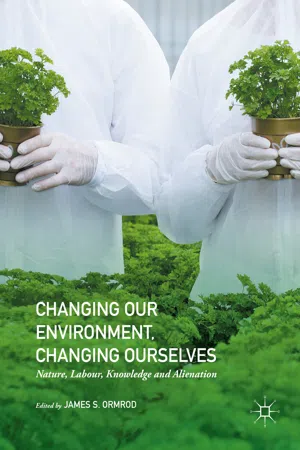
eBook - ePub
Changing our Environment, Changing Ourselves
Nature, Labour, Knowledge and Alienation
- English
- ePUB (mobile friendly)
- Available on iOS & Android
eBook - ePub
Changing our Environment, Changing Ourselves
Nature, Labour, Knowledge and Alienation
About this book
In this book, a celebration of the work of the sociologist Peter Dickens serves as the catalyst for exploring the relationship between human 'internal nature' (our health and psychological well-being) and 'external nature' (the environment on which we depend and which we collectively transform). Across contributions from Ted Benton, James Ormrod, Kate Soper, John Bellamy Foster and Brett Clark, Graham Sharp, James Addicott, Kathryn Dean and Peter Dickens himself, the book draws attention to alienation associated with the promotion of different knowledges in late capitalist production. But it also highlights the possibilities for generating less alienated relations with our environment in the future. As well as discussing the philosophical and theoretical issues involved, the book contains contemporary case studies of ultra-processed food, satellite farming, computerised thinking and dark tourism.
Information
© The Editor(s) (if applicable) and The Author(s) 2016
James S. Ormrod (ed.)Changing our Environment, Changing Ourselves10.1057/978-1-137-56991-2_11. Introduction: Changing Our Environment, Changing Ourselves
James S. Ormrod1
(1)
School of Applied Social Science, University of Brighton, Brighton, UK
‘Changing Our Environment, Changing Ourselves’ was the subtitle to Peter Dickens’s award-winning 2004 book, Society and Nature, as well as the title of a 2003 paper. This relationship has been his central concern across many wide-ranging texts. This book celebrates his interest in how human subjectivity, health, and psychological well-being are changed as we work collectively on our environment.
A few years ago, Dickens was asked to select his favourite sociological quotation. This is the quote he chose:
Labour is first of all a process between man and nature, a process by which man, through his own actions, mediates, regulates and controls the metabolism between himself and nature. He sets in motion the natural forces which belong to his own body, his arms, legs, head and hands, in order to appropriate the materials of nature in a form adapted to his own needs. Through this movement he acts upon external nature and changes it, and in this way simultaneously changes his own nature … [The labour process] is the universal condition for the metabolic interaction between man and nature, the ever-lasting nature-imposed condition of human existence. (Marx cited in Dickens 2004, p. 62)
As Marx makes clear, conceiving of ‘our environment’ and ‘ourselves’ in dualistic terms is highly problematic. Marx refers to nature as our ‘inorganic body’ (see Dickens 2004, p. 72). That is to say that the human body is constituted only in relation to nature beyond its boundaries (1992, see also 2009); ‘the central idea being that nature is continuous with and an integral part of persons, albeit not part of their organic being’ (1996, p. 57). Marx and Engels both understood that work on this external nature necessarily constitutes our internal nature—our biological and psychological constitution, our health and well-being (Dickens 2004, p. 22; Dickens 1992). With the ‘new biology’, Dickens (1996) asserts the importance of recognising that humans do not merely encounter their environment, but actively make, or ‘reconstruct’ it (here emphasising the significance of human powers, whilst elsewhere noting the same principle is true of all organisms, Dickens 1992). In this respect they ‘colonise’ or ‘humanise’ nature (Dickens 2000, p. 69; see also Dickens 1992, where he recognises Parsons’s work). The relationship between ourselves and our environment must be understood in dialectic terms (as the late Andrew Collier also emphasised, see Dickens 1992).
Dickens refers to both the Hegelian notion that reflection on nature changes the subject (2001) and the materialist version of dialectics found in Engels’s (1959) Dialectics of Nature. The tradition of dialectics in Hegel and Marx was interested in ‘how the subject (the person) interacts with the object (nature) and thereby makes the object part of the subject’ (2001). There was, therefore, no subject without nature. Though finding Engels’s dialectics overly mechanistic (1996), what Dickens takes from it is his acknowledgment of ‘the interactions, especially between humans and nature, in which, because of their intimate relationship, a change in one caused a change in the other as the two become intertwined’ (2001, p. 3). Dickens’s central argument is, therefore, as follows:
As societies interact with nature, human beings start changing themselves. Put in more sociological and material terms, as societies observe and modify external nature they start modifying their own, internal, nature. And this is a dialectical process. The kind of internal nature made in the process of environmental study and transformation has important effects on how external nature is in turn considered and therefore treated. (Dickens and Ormrod 2007, p. 3)
As becomes clear in this book, the processes of ‘observing’ and ‘modifying’ nature cannot be treated separately either. It is in the process of transforming nature that knowledge is both tested and generated. In particular interactions with nature, lay, tacit, and practical knowledges provide the grounds for the subject’s reflexive relationship with nature—a type of relationship associated with eudaimonia and human flourishing.
True to Marx, Dickens frequently reminds us that the relationship between internal and external nature is never determined at the individual level, nor at a purely cultural level, but is always anchored in productive relations;
Modes of production, and in particular the relationships made between people in the labour process therefore dominate the way in which social formations as a whole interact with nature—internal as well as external. (2000, p. 101)
Understood this way, ‘both internal and external nature now seem fully infused with, and influenced by, social and political processes’ (Dickens 2004, p. 17). Like other environmental sociologists, Dickens is adamant that economic, social, and environmental issues are inextricably linked (see, for example, his discussion of Chipko ‘tree-huggers’ and rights to the forest in Dickens 1996).
The fundamental premise of a socially organised dialectic between external and internal nature is to be found in the work of many thinkers with whom Dickens has engaged. But, he argues, its origins are to be found at the very heart of the Enlightenment movement so often associated with pitting humanity against nature. Francis Bacon is a figure to whom Dickens repeatedly returns as a philosopher who believed in the mastery of nature for human use. The enclosure and cultivation of land was to make improved, rational beings from the blank sheets of human nature. ‘As humans modify the external world, went the thinking, they upgrade their own nature’ (Dickens 2004, p. 3). The science of nature and the science of ‘Man’ (of internal nature) were therefore conceived of as inherently connected from the beginning, and both were believed essential in the elevation of the human condition (see Dickens 2004, p. 35).
But this Enlightenment optimism has proved harder and harder to sustain in a world in which the development of scientific and technological capabilities has continued apace, but so often brought with it the degradation of our external and internal nature. Under capitalist relations of production, our alienation from nature seems greater than ever. Of particular concern to Peter Dickens has been the impact on human well-being of the marginalisation of lay knowledge by forms of abstract knowledge more conducive to capital accumulation. Such changes are also intimately connected with climate change, loss of biodiversity, and so on, and thus have had devastating effects on both internal and external nature (though the manifestations of this vary tremendously across different spaces and social groups).
One intellectual response to the ‘Anthropocene’ era has been to dissolve the boundaries between the human and external nature, and to reduce nature to an object produced by human culture. Dickens accepts that ‘the distinction between internal and external nature is increasingly difficult to maintain’ (1996, p. 112). But in order to retain a concept of nature as an analytically distinct category, Dickens’s critical realist philosophy asserts that the causal mechanisms of nature operate at a more foundational level than psychological and social mechanisms. He has refused to abandon the sense that human beings, for their increasing permeation of external nature, remain dependent on its powers. With the contributors to this book, he remains hopeful that through recognising the dialectic between internal and external nature we can both recover and discover distinctly human capacities that will enable us to live more harmoniously with ourselves and with our environment.
Outline of This Book
Part I of the book is focused on the work of Peter Dickens and his contributions to the development of green social theory. It should serve as an introduction for those new to his writing and as an elaboration of its core arguments to those more familiar.
In Chap. 2, Ted Benton first situates Peter Dickens’s work within its historical political and intellectual context. Benton introduces Dickens’s writing as an attempt to transcend the then stale conflict between structuralist and humanist Marxism (and the latter’s legacy in the critical theory of the Frankfurt School), with which Benton and so many other Western Marxists had been grappling. He suggests that Dickens’s engagement with critical realism was what allowed him to move forwards from both this debate within Marxism and the stand-off between positivist—empiricist and interpretivist—hermeneutic sociology. He notes, however, that arguing for the necessity of biological knowledge in understanding human social relations has meant that Dickens has had to negotiate the troubled history of such a project. Second, Benton outlines some of the ways in which Dickens’s work has picked up major contemporary social issues of theoretical and moral concern over its duration, whilst remaining committed to a coherent set of humanistic values and motivated by a concern with alienation and estrangement. Dickens’s starting point, it is noted, is an appreciation of the historical variability of human subjectivity. Benton discusses recent sociology’s fascination with consumerism, and Dickens’s abiding concern with its psychological consequences, often turning to psychoanalysis as a loose theoretical base. Benton suggests this approach still has fruit to bear when discussing current sociological and environmentalist concerns with climate change. He then turns his attention to Dickens’s interventions in arguments regarding the development of ‘cognitive capitalism’ and emotional labour. Here, he introduces the distinction between formal and substantive (or real) subsumption, explored in different contexts by Sharp, Addicott, and Dean later in this volume, as well as Dickens’s foundational concern with the mental/manual division of labour. He finishes by pointing to the ongoing productive tension in Dickens’s work, as he acknowledges at once both the difficulties and opportunities for resistance in the world of late capitalism.
In Chap. 3, I attempt to add detail to Benton’s overview, providing a summary of what I see as the main themes across Peter Dickens’s substantive work. The chapter begins by situating his work in relation to critical realism. It argues that his work hinges on the distinction between construing and constructing nature, the concept of latent biology, a belief in the underdetermination of human nature, and a critique of the metaphor in science. I then proceed to outline five interrelated main arguments to Dickens’s ecosocialism. The first concerns the effects of the mental/manual division of labour—buttressed, but not caused, by capitalism—on lay and tacit knowledge. Leading on from this is the argument, originating with Marx and developed by others such as John Bellamy Foster, that humans are alienated from nature. This alienation takes the form of a metabolic rift, manifested particularly in our understanding of nature. Third, to the extent that capitalism deepens this alienation and threatens to undermine human psychological well-being, Dickens refers to the ‘third contradiction of capitalism’. Fourth, and turning to psychoanalytic theory, Dickens examines the ways in which this contradiction shapes unconscious defences and fantasies and how these are manifest in the erection and maintenance of social and spatial divisions. It is these divisions that prevent us from developing the kinds of communal relationships with external nature capable of improving our well-being. And finally, the chapter looks at how Dickens envisages the rift in human–nature relations being healed. This takes the form of prefigurative politics that are at once to be celebrated and continually critically interrogated. These projects must be progressive and outwards facing, else they run the risk of becoming insular, middle-class preoccupations.
The chapters in Part II of the book elaborate ongoing philosophico-theoretical debates at the heart of our attempts to understand human relationships with nature.
In Chap. 4, Kate Soper provides some important salutary warnings about how environmental alienation might be conceived. She begins by noting Dickens’s reservations about embracing the notion of human ‘species being’ in Marx’s early work. For her, such an absolute concept of what it is to be human lends itself to a critical-normative project that cannot be defended on philosophical grounds. She therefore embraces Dickens’s arguments that human nature is better considered ‘underdetermined’, that is, shaped by social forces as much as biological ones. Her main focus in the chapter is on the concept of alienation, and in particular ‘environmental alienation’. Soper notes that she shares with Dickens an ethical concern for many of the features of contemporary social life Dickens and others describe under the heading of environmental alienation. And yet, she remains sceptical about the possibility of identifying what she calls an ‘authentic’ non-alienated relationship with nature that might act as a basis from which to attempt to rebuild this relationship. Like Dickens, Soper appreciates that external nature is as historically variable as human internal nature, given their dialectic relationship. The problem, then, lies finding a philosophical framework that acknowledges that nature is ‘made’ by humans, both materially and discursively, but that also holds onto a nature that stands outside of this and which can ground discussions of human–nature interactions. The route Soper takes runs through Adorno. In particular, she endorses his call to ‘retain the alien as alien’. That is to say that the preconceptual in nature both transcends and compels language, and that in the aesthetic contemplation of nature our conceptualisation of it dissolves. By Soper’s own admission, the second half of the paper presents a break from the first. Here, she temporarily fixes the term alienation so as to offer a more normative critique of the growth economy and its damaging effects on internal and external nature. In what she terms ‘avant-garde nostalgia’ (a notion influenced, as in Dickens, by Raymond Williams’s arguments about the need to resist the antipathies of nostalgia and industrial progress) she sees the de-alienating potential in thinking about what is pre-empted by the growth economy. This concept of alienation is based on unrealised possibilities for what Dickens refers to as eudaimonia. And in her brief discussion of craftivism (as a blending of craftwork and activism involving a great deal of lay and tacit knowledge) she illustrates what an ‘alternative hedonism’ might look like in practice—one that rejects both the consumer lifestyle and austere counter-consumerism.
In Chap. 5, John Bellamy Foster and Brett Clark explore conceptualisations of the relationship between human society and nature, like Soper taking the work of the Frankfurt School, and, more specifically, Horkheimer and Adorno’s Dialectic of Enlightenment, as their starting point. They are critical of the Frankfurt School-inspired work of Alfred Schmidt, and in particular his pessimistic reading of Marx. Marx’s later work is here seen as resigned to a ‘domination of nature’ perspective (as also addressed by Soper). It was on these grounds that first wave ecosocialists, such as Benton and Gorz, rejected Marx’s views of the relationship between humans and nature. Foster and Clark are keen to salvage Marx’s ecology. But to do so they must also defend him from a very different tradition of Marxian environmentalism. More in line with Marx’s early work, Neil Smith and others argue that rather than humans confronting nature as an opposing or limiting force, we have thoroughly ‘capitalised’ nature, such that we can no longer speak of nature existing outside of capitalism. Foster and Clark wish to resist both alternatives on offer—a dualism that pits humans against nature, and a monism that insists there is no nature outside of society. They advocate a return to Marx’s own writing on ecology, and from this develop three interrelated concepts—the universal metabolism of nature, the social metabolism, and the metabolic rift—central to what they see as a second wave of ecosocialism (to which they themselves, as well as Peter Dickens, belong). They argue that these concepts allow us to better understand the coevolution and corevolution of society and nature, pointing to the need for ‘a new order of social metabolic reproduction rooted in substantive equality’.
In Part III, the contributors each take up themes exp...
Table of contents
- Cover
- Frontmatter
- 1. Introduction: Changing Our Environment, Changing Ourselves
- 1. The Work of Peter Dickens
- 2. Philosophical and Theoretical Debates
- 3. Emerging Issues
- Backmatter
Trusted by 375,005 students
Access to over 1.5 million titles for a fair monthly price.
Study more efficiently using our study tools.
Frequently asked questions
Yes, you can cancel anytime from the Subscription tab in your account settings on the Perlego website. Your subscription will stay active until the end of your current billing period. Learn how to cancel your subscription
No, books cannot be downloaded as external files, such as PDFs, for use outside of Perlego. However, you can download books within the Perlego app for offline reading on mobile or tablet. Learn how to download books offline
We are an online textbook subscription service, where you can get access to an entire online library for less than the price of a single book per month. With over 1.5 million books across 990+ topics, we’ve got you covered! Learn about our mission
Look out for the read-aloud symbol on your next book to see if you can listen to it. The read-aloud tool reads text aloud for you, highlighting the text as it is being read. You can pause it, speed it up and slow it down. Learn more about Read Aloud
Yes! You can use the Perlego app on both iOS and Android devices to read anytime, anywhere — even offline. Perfect for commutes or when you’re on the go.
Please note we cannot support devices running on iOS 13 and Android 7 or earlier. Learn more about using the app
Please note we cannot support devices running on iOS 13 and Android 7 or earlier. Learn more about using the app
Yes, you can access Changing our Environment, Changing Ourselves by James S. Ormrod in PDF and/or ePUB format, as well as other popular books in Biological Sciences & Environmental Science. We have over 1.5 million books available in our catalogue for you to explore.