- English
- ePUB (mobile friendly)
- Available on iOS & Android
eBook - ePub
About this book
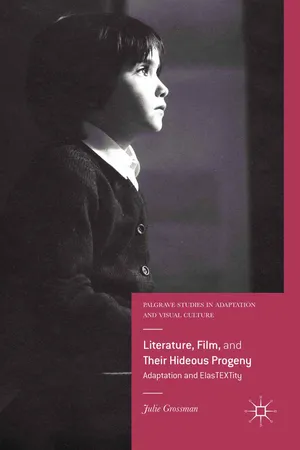
This book posits adaptations as 'hideous progeny,' Mary Shelley's term for her novel, Frankenstein . Like Shelley's novel and her fictional Creature, adaptations that may first be seen as monstrous in fact compel us to shift our perspective on known literary or film works and the cultures that gave rise to them.
Information
Subtopic
Art GeneralPart I
Journeys and Authorship
1
“It’s Alive!”: The Monster and the Automaton as Film and Filmmakers
If hideous progeny and the mutating narrative of the Frankenstein story can be considered a critical lens for understanding adaptation, the films Gods and Monsters and Hugo demonstrate an obsession with artistic progeny and offer an analogy between textual adaptation and the ability to shift perspectives on earlier life and work. In the narrative of Gods and Monsters (1998) and Hugo (2011), filmmakers are seen as refashioning materials in life and art. In fact, the films are strikingly similar: They both fictionalize the life of an important director in cinema history, James Whale (Ian McKellan) and George Méliès (Ben Kingsley) respectively. These directors are, as the stories told in these films begin, lost—alienated and depressed. Having repressed the experiences of their early filmmaking successes as these gave way to personal trauma, the two men are brought back to life by the workings of another male figure who has his own personal psychological agenda; Clay Boone (Brendan Fraser) and Hugo (Asa Butterfield) seek meaning in their lives after having been left or abandoned by their fathers. Redeemed and revivified by their relationship with the boys they encounter, Whale and Méliès come to terms with their past: they “rejoin the living,” in the case of Méliès, and rest in peace, in the case of Whale, who commits suicide after confronting his guilt and regret surrounding past (Barnard) and present (Clay) “creatures” he has loved. However, as I hope to show, both films explore the relationship between the magical and the monstrous, affirming the power of “hideous progeny” to reveal new ways of seeing the past and the present.
An adaptation of Christopher Bram’s novel Father of Frankenstein, Bill Condon’s Gods and Monsters cites James Whale’s Frankenstein (1931) and Bride of Frankenstein (1935), inviting “a complicated audience response through allusion to a string of media images and cultural memories” (Tsika 47). Bram’s 1995 novel fictionally renders the final days of James Whale before his (real-life) suicide in 1957. The book was later renamed Gods and Monsters after the success of the 1998 film apparently warranted a retitling of the novel, an illustration of how commercial interests can guide the fate of a literary or film text or adaptation.
Like the winding course of the myth of Frankenstein, Scorsese’s Hugo is about changes in personal and textual identity and thus functions nicely to supplement a discussion of “monstrous” changes in the human and cinematic worlds. Both Gods and Monsters and Hugo invite a critical practice of examining works in dialogue that offer different perspectives on known stories or canonic works. They also exemplify a unique conception of what constitutes sources for adaptations, following Kyle Meikle’s provocative essay “Rematerializing Adaptation Theory”:
Films can and do draw from materials ... intertexts need not be texts at all. Expanding the category of source texts to include different matter makes way for an intermaterial model of adaptation to complement the intertextual and intermedial models already at play in the field of adaptation study. (175)
The film Hugo “[rematerializes] celluloid in the form of the automaton” (178), according to Meikle, offering a model for imagining different kinds of material as sources. It is cinema itself that is adapted into a figure of technology, art, and the filmmaker himself. If, in Hugo, “Scorsese reminds his audience that films adapt sources other than texts, or that ‘texts’ must mean materials and matter, too” (180), in Gods and Monsters, Shelley’s and the 1930s Hollywood version of the Creature are sources not only for the story of James Whale but also for the redemption of Clay Boone, the gardener to whom Whale is drawn in the final days before his suicide.
Interwoven into the figures of the cinematic Automaton and Creature, in Hugo and Gods and Monsters, Méliès and Whale are seen themselves as adaptations, mash-ups of their films and the modern transformations their movies represented and helped to marshal in. That is, both films illuminate George Méliès and James Whale as a very material part of the modern machinery they historically helped to advance. In this sense the biographical interest of these films is subordinated to the non-human materials they adapt. In Hugo, for instance, alongside a fairly sentimental story of redemption and two children’s coming of age is the central figure of the film, a machine infused with human artistic will, the Automaton. An unlikely focus of the values of artistic creativity and human bonds, the Automaton becomes—as does the Creature in the Frankenstein stories—the mechanistic yet central consciousness of the film and the fundamental means by which we are forced to reorient ourselves as viewers to the shifting perspectives these figures of adaptation foreground.
Condon’s film not only adapts Bram’s novel but also Whale’s own “hideous progeny,” his Frankenstein films. Gods and Monsters repeats specific motifs, character patterns, and mise-en-scène from the 1931 and 1935 films. Scenes of camaraderie between the Creature and the Blind Man, Whale’s expressionist camera work, title sequences, and the comic maid figure exemplify the film’s material reworkings of Whale’s films. In one of the most visceral elements of the film’s adaptation of Frankenstein and Bride of Frankenstein, Gods and Monsters uncannily evokes the body and makeup of Boris Karloff in Clay Boone’s appearance and affect. The character of Clay is derived from the filmic composition of the Creature. In the story, Whale’s desires are projected onto Clay, who is thus like a piece of emulsified celluloid. Even the character’s given name points to the film’s figuration of him as pure matter to be adapted, “clay” to be molded into whatever story will be assembled from its disparate pieces.
Clay Boone is, from the start of the film, a Creature in the sense that he is unformed: child-like, “alternately boisterous and petulant” (Tsika 157). “You’re a big fun kid,” Lolita Davidovich’s character says to Boone. And yet Clay is also potentially the monster that the increasingly disabled James Whale wishes to create and incite to kill him because of his terminal illness. Dangerous, neglected, and child of an absentee father—like the Creature in Shelley’s novel and Shelley herself—the gardener Boone, with his flat top, looks like a Karloff creature. Whale himself threatens to become the cruel father-creator, who puts his own concerns (dying with dignity) ahead of the creature and the aptly named Clay he seeks to mold.
But Condon’s film presents other variations on the monster figure. The mental deterioration of James Whale is presented as a monstrosity, a degenerative disease afflicting his mind and imagination. Further, the dead bodies of the First World War, the result of a monstrous devastation to which James Whale had himself been traumatically exposed, haunt the film as one of its major backdrops. Even Hollywood appears as a kind of monster figure in its fiendish way of exploiting artists like Whale. Alongside Scorsese’s adventurous rematerializing of early cinema in the Automaton,1 then, Gods and Monsters similarly explores a broader “procession of quasi-objects” (Meikle 181) as sources for adaptation.
As just suggested, one major concern of Gods and Monsters is Whale’s own war-time experience, adapted from Bram’s novel and Whale’s biography. Having served (and been a POW) in “The Great War,” Whale watched his peers die in vast numbers and suffered survivor guilt and isolation. In his DVD commentary on Gods and Monsters, Bill Condon observes that casting the actor Ian McKellen as Whale created a resonance because of the AIDS epidemic (McKellen’s activism is fairly well-known)—a catastrophic historical reality almost replicating the Great War and the devastating influenza epidemic that followed, resulting in a literally rather than merely literary Lost Generation. Gods and Monsters also rewrites the Mexican maid in Bram’s novel. Hanna, played by Lynn Redgrave, not only recalls the bravura performance of Una O’Connor as the clucking, comic maid Minnie in Bride of Frankenstein; she also evokes the idea of Germany, which had played such an important role in Whale’s life. With Whale’s Frankenstein films released as the Nazis begin to gain power in the early 1930s, one can imagine these adaptations gesturing toward a fascism inherent in the kind of monster-making Victor engages in. These resonances provide clarity in a new historical moment, and a new set of cultural concerns and preoccupations—for instance, the connection Bill Condon forges between AIDS and “The Great War” through the idea of monstrous isolation. While in Gods and Monsters (as well as Hugo), technology is seen as responsible for filmmaking magic, it is also significantly related to the horrors of war. In Gods and Monsters, references to failed or sick bodies evoke the mechanized mass death that World War I brought to bear on human society and experience. This is seen not only in Whale’s flashbacks to the war but also in the gas mask Whale asks Clay to wear to dehumanize him to the extent that he might kill Whale in a homophobic rage.
References to WW1, though clearly in part derived from Whale’s biography, refer back to Peggy Webling’s 1927 play An Adventure in the Macabre, which strongly influenced Whale’s 1931 Frankenstein. Lester Friedman recounts Steven Forry’s discussion of the monstrous face of modern warfare in Frankenstein, also exemplifying the force of intertextuality in constituting adaptation:
Forry maintains that Webling’s play strikes different notes from previous stage adaptations due to the “general disillusion following World War I and preceding the Great Depression,” concluding that her version “must be viewed in terms of an age frightened by a spectre of its own creation” and that her work “presages the most popular modern theme associated with the novel: society’s ability to destroy itself.” (Forry 93, Friedman and Kavey)
Perhaps most important, in Webling’s play, the creature is portrayed more sympathetically and (according to Forry) the doppelganger theme is introduced, though, as Friedman and Kavey observe, Thomas Edison had done this more than a decade earlier, in 1910. According to the script of Edison’s 12-minute kinetogram film (written by director J. Searle Dawley), “the evil in Frankenstein’s mind creates a monster,” a deformed creation who “disappears” (with Elizabeth still alive) when Victor’s “better self asserts itself,” and evil is “overcome by love.” In the redemptive finale, when Victor looks in the mirror in which the monster had just been reflected, he sees—himself. The monster in Webling’s play, a role performed by Hamilton Deane, would have been intertextually influenced by the actor’s portrayal of Dracula on alternate nights, anticipating Cumberbatch and Miller almost 90 years later.
In Hugo, World War I is also figured as desolation, but its destruction is specifically linked to the death of the artist figure, since it is the War that has shifted public attention from Méliès’s “magic” to more worldly concerns. Méliès’s films are melted into chemicals and used to make shoe heels. Amidst this darkened industrial world, cinema appears to be the light projected by Hugo to redeem the social and historical devastation the War and modernity have caused. The flashback sequences of Méliès’s discovery of special effects and the beautiful glass structure in which he made his films suggest a brilliant cinema past devastated by the machine of war; in the film, the character Méliès narrates a flashback in which Scorsese cuts from the magical sparks of film special effects directly to images of the explosions of war, conflagrations that made Méliès’s magic tricks irrelevant: “But then the war came.”
In Hugo, the trauma of World War I, as in Gods and Monsters, is seen in its massively mechanized form of destruction. Modern warfare is defined by its efficiency, which is linked in Hugo to anxiety about clockworks and the efficiency of the train station. Indeed, the station is presented as a fully pragmatic space; as Gustave the Station Master (Sacha Baron Cohen) says, “We are here to get on trains and to get off them.” The station can in this context be seen as a utilitarian Victorian workplace, with Gustave as the pragmatic unsympathetic warden, like Mr. Bumble, who threatens poor orphans in Oliver Twist. With his prosthetic leg, Gustave is himself a victim of the war’s devastation, but he has sublimated his own postwar trauma into attempting to control the potentially chaotic urban space of the station. Forces of modernity include postwar trauma; the institution of the police or stationmaster to regulate urban populations; and technologized time in the form of clocks that help to organize the workings of the station but also (it must be added) make it possible for Hugo to remain hidden in the station’s clock tower. As for the juggernaut of the train: I will return to that below. These are a bludgeoning counter to the worlds of literature and film, indeed, to all imaginatively creative minds striving to find meaning in their world.
And yet, ironically, in Hugo it is a machine—the Automaton—that becomes the catalyst for resistance. The Automaton represents the hopes of technology, not the machine of war but, like the tools of cinema Méliès cultivated, a defining element in creative processes. A figure assembled in concert with Méliès’s invention of his camera (“I built my own camera, using left over pieces from the automaton,” he says), the Automaton is allied with Frankenstein’s Creature as a unique source of the film’s insights into the necessity of the creative arts in order to sustain human happiness and relationships.
Adaptations can similarly transform our perceptions. The 1930s Hollywood Frankenstein movies are certainly in some sense adapting Mary Shelley’s Frankenstein but they are also the “hideous progeny” of their “creator” James Whale, as well as of modern Hollywood’s fascination with the horror picture. The films were also strongly influenced, as suggested above, by Peggy Webling’s 1927 British stage adaptation of Shelley’s novel and by the work of screenwriter William Hurlburt, with whom Whale collaborated closely in making Bride of Frankenstein in 1935. Friedman and Kavey have recently charted the journey of Mary Shelley’s Frankenstein through its stage adaptations and Edison’s pioneering 1910 film version to land in Hollywood in 1931 and 1935. Friedman discusses three important theatrical sources of Whale’s films beyond Shelley’s novel: Richard Brinsley Peake’s Presumption; or, The Fate of Frankenstein (1823), which Mary Shelley saw eight years before the 1831 edition of her novel was released; Henry M. Milner’s 1826 play, The Man and the Monster; or, The Fate of Frankenstein; and Webling’s Frankenstein: An Adventure in the Macabre, mentioned above. Webling’s play was first performed in England in 1927 but premiered in London in 1930, the year before Whale’s Frankenstein was made in Hollywood. In America, Friedman and Kavey note, John Balderston was set to adapt Webling’s play to the American stage—an adaptation never performed though it was sold to Universal, be...
Table of contents
- Cover
- Title
- Copyright
- Contents
- List of Figures
- Acknowledgements
- Introduction
- Part I Journeys and Authorship
- Part II Textual and Marginal Identities
- Part III Immersive Theater and the Monstrous Avant-Garde
- Epilogue
- Notes
- Works Cited
- Index
Trusted by 375,005 students
Access to over 1.5 million titles for a fair monthly price.
Study more efficiently using our study tools.
Frequently asked questions
Yes, you can cancel anytime from the Subscription tab in your account settings on the Perlego website. Your subscription will stay active until the end of your current billing period. Learn how to cancel your subscription
No, books cannot be downloaded as external files, such as PDFs, for use outside of Perlego. However, you can download books within the Perlego app for offline reading on mobile or tablet. Learn how to download books offline
Perlego offers two plans: Essential and Complete
- Essential is ideal for learners and professionals who enjoy exploring a wide range of subjects. Access the Essential Library with 800,000+ trusted titles and best-sellers across business, personal growth, and the humanities. Includes unlimited reading time and Standard Read Aloud voice.
- Complete: Perfect for advanced learners and researchers needing full, unrestricted access. Unlock 1.5M+ books across hundreds of subjects, including academic and specialized titles. The Complete Plan also includes advanced features like Premium Read Aloud and Research Assistant.
We are an online textbook subscription service, where you can get access to an entire online library for less than the price of a single book per month. With over 1.5 million books across 990+ topics, we’ve got you covered! Learn about our mission
Look out for the read-aloud symbol on your next book to see if you can listen to it. The read-aloud tool reads text aloud for you, highlighting the text as it is being read. You can pause it, speed it up and slow it down. Learn more about Read Aloud
Yes! You can use the Perlego app on both iOS and Android devices to read anytime, anywhere — even offline. Perfect for commutes or when you’re on the go.
Please note we cannot support devices running on iOS 13 and Android 7 or earlier. Learn more about using the app
Please note we cannot support devices running on iOS 13 and Android 7 or earlier. Learn more about using the app
Yes, you can access Literature, Film, and Their Hideous Progeny by Julie Grossman in PDF and/or ePUB format, as well as other popular books in Media & Performing Arts & Art General. We have over 1.5 million books available in our catalogue for you to explore.