eBook - ePub
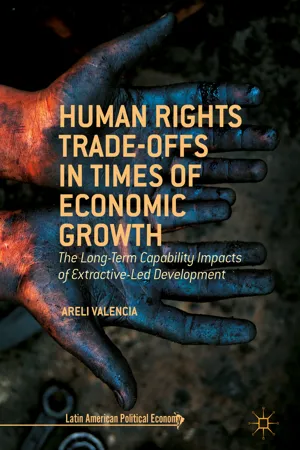
Human Rights Trade-Offs in Times of Economic Growth
The Long-Term Capability Impacts of Extractive-Led Development
- English
- ePUB (mobile friendly)
- Available on iOS & Android
eBook - ePub
Human Rights Trade-Offs in Times of Economic Growth
The Long-Term Capability Impacts of Extractive-Led Development
About this book
This book uncovers a historical dependency on smelting activities that has trapped inhabitants of La Oroya, Peru, in a context of systemic lack of freedom. La Oroya has been named one of the most polluted places on the planet by the US Blacksmith Institute. Residents face the dilemma of whether to defend their health or to preserve job stability at the local smelter, the main source of toxic pollution in town. Valencia unpacks this paradoxical human rights trade-off. This context, shaped by social, historical, political, and economic factors, increases people's vulnerabilities and decreases their ability to choose, resulting in residents' trading off their right to health in order to work. This book shows the deep connection of this local dilemma to the country's national paradox, arising out of Peru's vision of natural resource extraction as the main path to secure economic growth for the entire country at the expense of some groups.
Information
© The Author(s) 2016
Areli ValenciaHuman Rights Trade-Offs in Times of Economic GrowthLatin American Political Economy10.1057/978-1-137-48868-8_11. Introduction: Human Rights Trade-offs in Times of Economic Growth: A Tale from Peru
Areli Valencia1
(1)
Human Rights Research and Education Centre (HRREC), University of Ottawa, Ottawa, Ontario, Canada
This introduction reproduces some arguments from my article: “Human Rights Trade-offs in a Context of ‘Systemic Lack of Freedom’: The Case of the Smelter Town of La Oroya, Peru,” Journal of Human Rights 13:4 (2014), 456–479. I am thankful to the journal editors for authorizing the use of this material.
Keywords
Human rightsTrade-offsEconomic growthContext of unfreedomPolitical economy of extractivismBackground
In 2006, the Annual Report of the Blacksmith Institute, a US-based non-profit organization, named the city of La Oroya, located in the Province of Junín, Central Andes-Peru, as one of the ten most polluted places in the planet. 1 High levels of lead, arsenic, and cadmium contamination in children’s blood as a result of smelting activities in town prompted the nomination. As La Oroya gained greater visibility internationally, a massive wave of journalists and activists from all over the world flew to La Oroya to report on the situation. Academics started to pay attention to the La Oroya case as well. A transnational human rights network developed and effectively contributed in denouncing the situation of environmental crisis and health deprivation in La Oroya, pressuring governmental authorities and the smelting company, US-based Doe Run Company, to reverse the predicament. But this movement downplayed a contentious aspect of the La Oroya case: the confrontation in the local population between the protection of the human right to health in La Oroya and simultaneous demands for employment stability. 2 Despite their own systematic exposure to dangerous toxic metals along with the entire population, smelter workers and their families claimed that the demands for environmental and health protection threatened their main source of employment and, hence, their right to work. 3 From this broader perspective, the La Oroya case portrays not only a scenario of environment and health deprivation but also a seemingly intractable case of human rights trade-offs.
How are we to understand people’s compliance to sacrifice health for work? How to make sense of the fact that while the grassroots in this community organizes under the cry “The health of a child is a treasure that is worth more than gold ,” 4 another important segment of the population contests, “If contamination were as strong as people say, then the children would not be smart and committed to their studies.” 5 The La Oroya trade-offs predicament is deeply puzzling. Indeed, on the one hand, human rights literature often characterizes these rights as indivisible, interrelated, and interdependent. 6 This broadly means that there should be no hierarchy among them and that they all deserve the same level of respect, protection, and fulfillment. 7 Nevertheless, the reality of cases like La Oroya shows how far away we are from the practical attainment of such aspirations. In La Oroya, community members were faced with the dilemma of choosing between two essential components of human well-being: health and work. At the same time, those intrigued by the La Oroya case often framed the problem in a dichotomized way as one in which we have to deliberate: “What is more important in life: to have health or to secure a job?” This question, although mirroring the crude reality of La Oroya, is both dangerously simplistic and ethically deceptive. It inevitably throws the responsibility of decision onto members of the community without considering how and why this community is confronted with such a dilemma in the first place and without offering any alternative options of protection for both of these rights.
This book aims to provide an explanatory account about the La Oroya trade-offs from a multidisciplinary perspective that advances a critical approach to human rights and international development. In doing so, it examines the impacts of almost a century of mining and smelting activities in the life of La Oroya’ residents. The book arose from an initial intuition that one can hardly provide an accurate assessment of people’s perception of environmental harm, and the value of health and job stability in polluted communities, without a thorough study of historical, politico-economic, and sociological processes as well as of how such processes shape the micro, meso, and macro spheres of people’s live over time. From a broader view, this book also wants to enhance awareness of the extent to which the “local” human rights trade-offs in La Oroya resemble, and are also deeply interconnected to, a “national” trade-off resulting from the promotion of natural resource extraction as a path to secure economic growth for the entire country at the expense of some groups. The historical background of the La Oroya case—linking the very origins of capitalist development based on large-scale mining in Peru—demonstrates the wider economic forces that have structured and reinforced this system of trade-offs over time, forces that have scaled down and up from national to local interests. We must not overlook the consequences of this reality on marginalized individuals and groups’ human rights or on the shaping of governments’ institutional aptitude in designing an economy. 8
The Puzzle
The complexity inherent in the dilemma faced by this community speaks, at first glance, to what Martha Nussbaum describes as a tragic choice resulting from a tragic question. 9 This refers to a question for which all possible solutions are morally unacceptable: there are simply no right answers to such a question. Tragic dilemmas leading to tragic questions are, as Nussbaum posits, “blots on a decent society … [and] we should do everything in our power to arrange things so that we are not confronted with such choices.” 10 In the case of La Oroya, struggling to choose between defending one’s “health” (and sacrificing access to work or employment stability) and defending one’s “work” (and sacrificing community health) drives the community to equally unfair solutions. Our inquiry about the La Oroya case should avoid reinforcing the tragedy of the situation by automatically assuming that the dilemma of trade-offs is inevitable or unavoidable. The question is therefore, to what extent do existing methods that assess human rights trade-offs or rights in conflict assist us in fully understanding the complexities inherent in the La Oroya dilemma? The answer is, very little. As most of these methods are grounded on the legal discipline, they are primarily designed as tools meant to resolve legal controversies rather than to unveil the historical, economic, political, and social causes behind a human rights trade-offs situation. 11 Citing examples of rights in conflict, such as the right to free speech versus individual privacy, authors have previously assumed that human rights trade-offs are inevitable and that reasonable solutions can be found simply by counterweighing correlative duties, 12 or they have treated human rights in conflict as a matter of normative inconsistencies. In these latter cases, solutions depend upon how legal practitioners interpret the content of rights or how judges rule on the necessity to prioritize the protection of one right over the other. 13 Without wishing to undermine the rigor and relevance of such studies in certain contexts, the need for a solution to the La Oroya trade-offs predicament surpasses the realm of the legal discipline. What is in fact at stake goes beyond the necessity for prescriptions based on pure normative reasoning or de-contextual legal engineering. Rather, we need to understand the human rights trade-offs dilemma as symptomatic of structural problems, located in a particular politico-economic context, with identifiable root causes.
A context-based analysis on human rights and root causes, thus, should move our inquiry in a different direction. 14 Rather than uncritically judging community members for their choices to defend either “health” or “work,” we should instead ask why smelter workers, their families, and other supporters have refrained from supporting mobilization efforts aimed at overcoming health deprivation as a whole in the community. And, most importantly, why did these individuals accept to support what has been referred to as the smelter company’s environmental malpractices when their own children were at risk from smelter pollution?
The Conceptual Framework
Pushing forward the type of inquiry proposed in this book upholds several conceptual and methodological implications. A first hypothesis is that to fully understand the complexities behind tragic choices leading to human rights trade-offs, we need to move beyond the perpetrator-victim-remedy model commonly used by activists and practitioners to analyze such situations (see Chap. 3). According to this model, particularly dominant within the legal discipline, the production of human rights violations is the result of a concrete, visible act of harm perpetuated by an identifiable actor, the unjust outcome of which deserves immediate redress. Under the lens of a perpetrator-victim-remedy model, or what is otherwise considered to be a naming and shaming strategy, our analysis would stop once Doe Run and the Peruvian state accept joint responsibility for the public health crisis of La Oroya and legal actions are in place for immediate remediation. Although actions and omissions of both actors are indisputably related to the human rights trade-offs in this community, their roles only disclose one explanatory layer behind the La Oroya conundrum. As it will be elaborated in this book, we have yet to undertake an analysis of the causes of causes. This inquiry would allow us to dig deeper and wider into the socio-historical roots and politico-economic dimensions that allowed the Doe Run Company to continually contribute to human rights abuses in La Oroya and explain the alarming inaction by the Peruvian state to address such abuses. A thorough analysis will lead us to better understand how the politics of extraction in Peru, influenced by the international discourse of development, along with a history of smelting in La Oroya have shaped social structures, personal values, and perceptions of health and environm...
Table of contents
- Cover
- Frontmatter
- 1. Introduction: Human Rights Trade-offs in Times of Economic Growth: A Tale from Peru
- 2. The La Oroya Conflict: The Intractable Conflict Between Health and Work
- 3. A Systemic Human Rights Model of Analysis: An Integrated Approach
- 4. Systemic Lack of Freedom in La Oroya: The Socio-historical Roots and the Political-Economic Background
- 5. Experiencing Systemic Lack of Freedom: The Voice of La Oroya
- 6. Examining the Trade-offs Between Health and Work in La Oroya: The Long-Term Capability Impacts of Extractive-Led Development
- 7. Conclusion: La Oroya at the Crossroads
- Backmatter
Trusted by 375,005 students
Access to over 1.5 million titles for a fair monthly price.
Study more efficiently using our study tools.
Frequently asked questions
Yes, you can cancel anytime from the Subscription tab in your account settings on the Perlego website. Your subscription will stay active until the end of your current billing period. Learn how to cancel your subscription
No, books cannot be downloaded as external files, such as PDFs, for use outside of Perlego. However, you can download books within the Perlego app for offline reading on mobile or tablet. Learn how to download books offline
Perlego offers two plans: Essential and Complete
- Essential is ideal for learners and professionals who enjoy exploring a wide range of subjects. Access the Essential Library with 800,000+ trusted titles and best-sellers across business, personal growth, and the humanities. Includes unlimited reading time and Standard Read Aloud voice.
- Complete: Perfect for advanced learners and researchers needing full, unrestricted access. Unlock 1.5M+ books across hundreds of subjects, including academic and specialized titles. The Complete Plan also includes advanced features like Premium Read Aloud and Research Assistant.
We are an online textbook subscription service, where you can get access to an entire online library for less than the price of a single book per month. With over 1.5 million books across 990+ topics, we’ve got you covered! Learn about our mission
Look out for the read-aloud symbol on your next book to see if you can listen to it. The read-aloud tool reads text aloud for you, highlighting the text as it is being read. You can pause it, speed it up and slow it down. Learn more about Read Aloud
Yes! You can use the Perlego app on both iOS and Android devices to read anytime, anywhere — even offline. Perfect for commutes or when you’re on the go.
Please note we cannot support devices running on iOS 13 and Android 7 or earlier. Learn more about using the app
Please note we cannot support devices running on iOS 13 and Android 7 or earlier. Learn more about using the app
Yes, you can access Human Rights Trade-Offs in Times of Economic Growth by Areli Valencia in PDF and/or ePUB format, as well as other popular books in Politics & International Relations & Civil Rights in Law. We have over 1.5 million books available in our catalogue for you to explore.