- English
- ePUB (mobile friendly)
- Available on iOS & Android
eBook - ePub
About this book
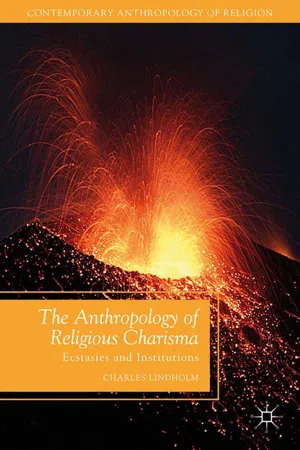
According to Max Weber, charisma is opposed to bureaucratic order. This collection reveals the limits of that formula. The contributors show how charisma is a part of cultural frameworks while retaining its ecstatic character among American and Italian Catholics, Syrian Sufis, Taiwanese Buddhists, Hassidic Jews, and Amazonian shamans, among others.
Information
Part I
Performing Charisma
Chapter 1
Performing the Charismatic Ritual*
Keping Wu
What role does ritual play in establishing charismatic authority, producing states of transcendence in believers, and strengthening the bond between the leader and the follower? To answer this question I analyze the ritual language and body techniques of a Catholic charismatic priest and his prayer group in suburban New England to show how deeply embodied personal religious experience is intertwined with the construction of charismatic leadership.1 Through detailed description of each step of the ritual performance, I reveal how the theatricality, spontaneity, and communality of ritual are carefully carved out and manipulated to amplify the charisma of the leader, creating an oscillation between formal structure and rapture that stimulates the followers’ immersion into transformative states of “collective effervescence” (Durkheim 1965). Within this setting, spiritual ecstasy, as I shall show, is indeed institutionalized—and vice versa. Indeed, far from being opposed to all forms of structure, as Weber (1972) argued, charisma (in this case, at least) relies on a framing order for its realization.
The Charismatic Catholics in the United States
The Catholic Charismatic Renewal (CCR), also called the Catholic Pentecostal movement, is a postwar and post-Vatican II movement that has incorporated many elements of the Protestant and Pentecostal practices. Although the CCR originated in the 1960s as a largely lay movement, increasing number of clerical members, usually priests, are involved in the leadership structure of the charismatic Catholic groups today (Csordas 1997:17). Those priests often become popular as gifted healers and/or prophets. Although they may be controversial figures within the Church, they secure their positions by establishing a steady group of followers who proclaim a strong Catholic identity. Many parishes conduct prayer groups that meet regularly, but it is common for people to travel to camp meetings, domestic, and international conferences in order to listen to charismatic leaders speak, to pray and to be prayed upon,2 and to participate in spirited worship services with thousands of people exhibiting “spiritual gifts” or “charisms.” These “charisms” or “gifts of grace” may include the gift of speaking in tongues (glossolalia), the gift of healing, the gift of discernment, the gift of prophecy, and so on.
The community I studied was formed by people from various parishes and dioceses and is a voluntary group under the leadership of a single charismatic priest called Father Tom. In his younger days, Father Tom was an active lay leader of the CCR camp meetings, but in the 1980s he joined the seminary and became a priest. Ever since his ordination, Father Tom has hosted charismatic prayer meetings in his own church, despite the hostility from the parish authorities. Self-described as one of the least favored priests of the archdiocese due to his outspoken character and somewhat eccentric style, Father Tom nonetheless has slowly expanded his influence, and now draws a large crowd to his prayer meetings from all over New England. Among them, many are critical of their former selves as “Sunday Catholics” or “nominal Catholics” increasingly disconnected to the Church. Moreover, the recent crisis in the Catholic Church, especially the child-abuse scandals in the Archdiocese of Boston in 2002, has made many of his followers all the more invested in maintaining their faith. Father Tom’s personal charisma together with the invigorated worship services provides a spiritual space for Catholics who are critical of and disillusioned by the Church but sincere about their faith.
Unlike the earlier CCR movement, which had a relatively young, well-educated and upper-middle-class following (Bord and Faulkner 1983:6), current charismatic prayer groups, such as the one I studied, attract working class and older people. Most congregants are women, only 10 to 15 percent are men. Around 20 percent are between age 20 to 40 and the rest are over 50 years old. Their motivations include seeking healing from terminal illnesses such as cancer or chronic diseases such as arthritis, diabetes, allergies, et cetera; searching for solutions to intractable personal issues, such as obesity, career and school problems, relationship and family issues; and, not the least, a quest for a stronger spiritual commitment and religious experience. In other words, the participants in the weekly prayer meetings are in search of individual transformations, either physically or spiritually. To achieve this, they have to rely on both the personal charisma of the priest, who channels God’s Grace due to his “anointed” nature, and the congregation, whose collective prayer brings the Holy Spirit to work through them.
The Charismatic Rituals
Two main types of ritual occur in Father Tom’s congregation. The first, on which this chapter focuses, are the prayer meetings that take place every Wednesday and Sunday evening. The second type of ritual is the annual retreat that normally lasts three days. The latter is an extended version of the former but attracts more people from outside of the regular prayer group. Since membership is signified by attendance at the prayer meetings, participation in these rituals has become essential for the group solidarity. Core members who have been long-term followers of Father Tom rarely miss a single prayer meeting. Healing, which many scholars deem central to the charismatic experience (Csordas 1997), often takes place in those prayer meetings. Moreover, followers often distinguish Father Tom’s prayer meetings from other healing services as possessing what they call a “flow,” which ensures a more potent experience of healing and inspires recognition of the priest’s charisma. As I shall show, the two processes are intertwined and mutually constitutive.
The weekly ritual of Father Tom’s prayer group can roughly be divided into three parts: Rosary, Mass, and “Praise and Worship.” Normally a “prayer meeting” in the Catholic Charismatic Renewal only refers to the third segment. However, in Father Tom’s prayer group, a standard weekly ritual must contain all of the three parts, which form a coherent and patterned ritual process that creates a unique religious experience.
Saying a set of prayers with Rosary beads, usually dedicated to the Virgin Mary, has become a symbol of Catholic identity (Mitchell 2009) since its popularized usage in the Catholic Church in Europe in the Middle Ages (Winston-Allen 1997). However, many contemporary Catholics, especially younger ones, no longer regard praying the Rosary as imperative for their faith. Father Tom, in contrast, encourages his devotees to pray the Rosary. In fact, some of his followers carry Rosary beads everywhere they go and give them out to people when they proselytize. It has also become the standard practice to start each prayer meeting. In a van Gennepian sense, the Rosary creates the “separation” stage in the rite of passage (van Gennep 1960). It signals a departure from the world of mundane life, prepares people physically and mentally for the prayer mode, and paves the way for intense emotional engagement.
The second part of the ritual process is Mass, which comes after the Rosary and before the prayer meeting. Although celebration of Mass prior to prayer meetings (which are usually held in the basement of the Church, conference halls, or the retreat centers in the evenings) is not required in other charismatic prayer services, Father Tom insists on celebrating Mass before the praise and worship and points out that “it tells people what they are praising and worshipping.” The Mass contains much longer sermons by Father Tom, who demonstrates the “charisma” of his oratory power. The communion, celebrated in the Mass, connects the congregation to the sacred in a corporeal sense, preparing them for further bodily engagement with the Holy Spirit later. Through Mass, the congregation enters the “liminal” stage, where the vertical ties between the charismatic priest and individual followers are established.
The peak of liminality comes at the “Praise and Worship” segment of the ritual. This is the ecstatic period where people experience healing and conversion as expressed by speaking in tongues, prophesying, singing, dancing, laughing, crying, clapping, jumping, rolling, stamping on the floor, and other expressive effusions. Father Tom calls these actions “imitating what people do in heaven.” During this climactic moment, the congregation seeks and attains extraordinary transformative and transcendental experiences through unifying with the leader as well as one another. In this “collective effervescence,” not only is the community consolidated, but the personal charisma of Father Tom is also accentuated in his orchestration of the rhythm of the performance. If the followers are both performers and observers of the ritual, the charismatic priest is both the performer and conductor. It is in the midst of the ecstasy collectively created by the words, songs, and deeds of the congregants and the charismatic priest that the merger of the leader and followers (Lindholm 1990) is completed, epitomized in Father Tom’s laying on of the hands and followers’ falling down to the ground in a state of ecstatic release, which occurs at the last stage and culmination of the ritual.
The three segments are integral parts of one coherent transformative experience. No matter how freely the collective bliss of the Holy Spirit flows, the personal charisma of the leader plays a crucial role in orchestrating and intensifying the ritual process. The follower’s success in achieving a transcendental experience is wholly contingent upon the charismatic intervention of the leader. To clarify, transcendence in this context has a particular meaning. It refers to a subject’s direct personal corporeal connection with God, which results in the total transformation of the individual, physically and spiritually. The former makes healing possible and the latter makes the devotee a more faithful Catholic. The only way that this transcendental experience can be experienced is to enter communion with the charismatic priest, who not only exemplifies his own “charisms”—gifts of grace—but also possesses the power to lead the entire group to a state of ecstatic communion comparable to Eliade’s account of shamanistic healing (1972).3 To see how this is accomplished, let me turn now to a more detailed description of the three segments of Father Tom’s prayer meetings.
The Rosary
The Rosary session of the prayer meeting is not a simple recitation of prayers with beads. It involves a much more complex array of activities, such as singing, dancing, and sharing of stories. In a regular prayer meeting in Father Tom’s group, the Rosary starts roughly around 6:30 in the evening and goes on for about an hour. Around a third of the congregation attends the session. The Rosary prayer is composed of several of “mysteries” of Jesus’ life. Usually someone in the congregation says the introductory prayer and the rest of the group automatically follow by reciting the rest of the prayers after making the sign of the cross. When one prayer is finished, another person in the room spontaneously leads the group in recitation of the next. It is remarkable how repetitive the Rosary prayers are. For instance, in each mystery, the prayer “Hail Mary” is repeated ten times. And every mystery is concluded with recitation of the same Fatima prayer.4 In between these highly standardized and repetitious sequences of prayers, the music ministry (about which more later) leads a song concluding that section, and then a different person leads the next mystery. The rounds of the Rosary are interspersed by songs, some of which are familiar songs to any Catholic ear, such as “Ave Maria,” but many are particular to the CCR movement or are improvised by the music ministry. While most of the attendees know the CCR songs by heart, others who had never been to charismatic Catholic services remarked that the songs, like the prayers, were simple, repetitious, easy to follow, and easy to learn. The same was true of the improvised songs, which followed familiar patterns and were quickly grasped and sung along with by the congregants.
Like the simple and catchy tunes invented by the music ministry, some followers also experimented with collective forms of improvisation during the Rosary. For instance, during my fieldwork several Irish ladies began to dress up in the liturgical color of the particular day (which is the color of the priest’s scapular) and to dance around the chapel, waving silk scarves, their heads covered with white linen. Their dancing and waving added a visual echo to the auditory rhythm of the music and prayer. As Edward Hall remarks, rhythm “is one of the ...
Table of contents
- Cover
- Title
- Introduction: Charisma in Theory and Practice
- Part I Performing Charisma
- Part II Gendering Charisma
- Part III Religious Charisma and Politics
- Part IV Posthumous Charisma
- Notes on Contributors
- Index
Trusted by 375,005 students
Access to over 1.5 million titles for a fair monthly price.
Study more efficiently using our study tools.
Frequently asked questions
Yes, you can cancel anytime from the Subscription tab in your account settings on the Perlego website. Your subscription will stay active until the end of your current billing period. Learn how to cancel your subscription
No, books cannot be downloaded as external files, such as PDFs, for use outside of Perlego. However, you can download books within the Perlego app for offline reading on mobile or tablet. Learn how to download books offline
Perlego offers two plans: Essential and Complete
- Essential is ideal for learners and professionals who enjoy exploring a wide range of subjects. Access the Essential Library with 800,000+ trusted titles and best-sellers across business, personal growth, and the humanities. Includes unlimited reading time and Standard Read Aloud voice.
- Complete: Perfect for advanced learners and researchers needing full, unrestricted access. Unlock 1.5M+ books across hundreds of subjects, including academic and specialized titles. The Complete Plan also includes advanced features like Premium Read Aloud and Research Assistant.
We are an online textbook subscription service, where you can get access to an entire online library for less than the price of a single book per month. With over 1.5 million books across 990+ topics, we’ve got you covered! Learn about our mission
Look out for the read-aloud symbol on your next book to see if you can listen to it. The read-aloud tool reads text aloud for you, highlighting the text as it is being read. You can pause it, speed it up and slow it down. Learn more about Read Aloud
Yes! You can use the Perlego app on both iOS and Android devices to read anytime, anywhere — even offline. Perfect for commutes or when you’re on the go.
Please note we cannot support devices running on iOS 13 and Android 7 or earlier. Learn more about using the app
Please note we cannot support devices running on iOS 13 and Android 7 or earlier. Learn more about using the app
Yes, you can access The Anthropology of Religious Charisma by C. Lindholm in PDF and/or ePUB format, as well as other popular books in Social Sciences & Religion. We have over 1.5 million books available in our catalogue for you to explore.