eBook - ePub
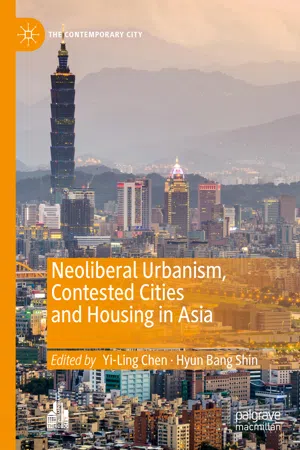
Neoliberal Urbanism, Contested Cities and Housing in Asia
- English
- ePUB (mobile friendly)
- Available on iOS & Android
eBook - ePub
Neoliberal Urbanism, Contested Cities and Housing in Asia
About this book
Considering Asian cities ranging from Taipei, Hong Kong and Bangkok to Hanoi, Nanjing and Seoul, this collection discusses the socio-political processes of how neoliberalization entwines with local political economies and legacies of 'developmental' or 'socialist' statism to produce urban contestations centered on housing. The book takes housing as a key entry point, given its prime position in the making of social and economic policies as well as the political legitimacy of Asian states. It examines urban policies related to housing in Asian economies in order to explore their continuing alterations and mutations, as they come into conflict and coalesce with neoliberal policies. In discussing the experience of each city, it takes into consideration the variegated relations between the state, the market and the society, and explores how the global pressure of neoliberalization has manifested in each country and has influenced the shaping of national housing questions.
Information
© The Author(s) 2019
Yi-Ling Chen and Hyun Bang Shin (eds.)Neoliberal Urbanism, Contested Cities and Housing in AsiaThe Contemporary Cityhttps://doi.org/10.1057/978-1-137-55015-6_11. Centering Housing Questions in Asian Cities
Yi-Ling Chen1 and Hyun Bang Shin2, 3
(1)
University of Wyoming, Laramie, WY, USA
(2)
London School of Economics and Political Science, London, UK
(3)
Kyung Hee University, Seoul, South Korea
Hyun Bang Shin acknowledges the support from the National Research Foundation of Korea Grant funded by the Korean Government (NRF- 2017S1A3A2066514) for the writing of this Introduction.
End AbstractIntroduction
Housing has increasingly become one of the key areas of urban contestations in recent years. Globally, it was a key contributor to the global economic recession, precipitated by the 2008 subprime mortgage crisis (Larsen et al. 2016). Placed under the mounting pressure of commodification, privatization, and financialization, housing as a commodity is a major contributor to the exacerbation of urban crises that encompass intensifying inequality, economic and racial segregation, spatial inequality, and entrenched poverty (Forrest et al. 2017; Sayer 2016). Severe affordability problems resulting from a winner-take-all process of neoliberal urbanization create unequal cities, begging for an answer to the question of whose city we produce and inhabit.
Housing often tops policy agendas, as it is considered to be one of the key government measures to resurrect crisis-ridden economy. Brick-and-mortar subsidies are offered to builders to increase their supply in the market when the economy is sluggish. Deregulation is sought to facilitate housing supply in the name of curbing soaring housing prices, even if supplied new units are snatched by non-resident absentee landlords. As Rolnik (2013, p. 1059) succinctly puts, ‘[h]ousing represented one of the most dynamic new frontiers of late neoliberalism during the decades of economic boom, and at the outset of the crisis was converted into one of the main Keynesian strategies to recover from it.’
Although UN-Habitat (2016, pp. 11–14), in its World Cities Report,1 places housing as a key policy instrument of the new urban agenda to bring about social inclusion and environmentally sustainable human settlements, the intrinsic conflict between housing’s use and exchange value would continue to place housing at the forefront of political contestations. Such deeply entrenched problems of urban crisis have compelled someone like Florida (2017), a long-term protagonist of urban creative economy that has been exploited by neoliberal interests, to critically question the concentration of wealth and to admit that ‘the very same clustering force that generates economic and social progresses also divided us’ (ibid., p. 186).
In Asia,2 housing has also been a major field of urban contestations. Asian economies have experienced rapid and condensed economic growth, having substantially reduced absolute poverty. However, worsening inequality is also a widespread trend in the region (Kanbur et al. 2014). Many of the urban housing projects are targeting the upper- and middle-class populations. In those economies such as mainland China where public housing provision used to be the norm under the socialist Party State , housing is increasingly commodified and privatized (Wang and Murie 1998). Housing affordability has become a serious problem in Asian cities. Based on price-to-income ratios around the globe, Forbes (Sheng 2017) reports that among the top five most expensive cities in the world, four are in Asia, namely, Hong Kong, Mumbai, Beijing, and Shanghai.
Housing in Asia has also become a heavily contested field, but in a political-economic context that somewhat differs from that of the Western Europe or North America where post-Keynesian welfare statism and neoliberalization prevailed. Asia, especially the industrialized economies of the East and Southeast Asia, is a fast-paced society, having experienced a highly condensed nature of urbanization and industrialization in the late twentieth century. According to a study by Dunford and Yeung (2011), late-industrialized Asian economies such as South Korea, Singapore, Hong Kong, Taiwan, and mainland China have all taken around 25 years or less to experience a fivefold increase in their real gross domestic product per capita from the moment of their economic take-off. This was in stark contrast with the experiences of other developed economies such as the United Kingdom, Germany, and the United States, which spent about 100–160 years to achieve the same degree of economic development. Such a rapid pace of development entails accelerated societal transformation and changes to the fortunes of individuals and families whose average wealth over time has also increased relatively swiftly.
Housing in Asia, placed in such contexts, comes to take on multiple meanings and significance, especially when Asia’s economic growth came with a highly unequal redistribution of societal wealth. Contrary to the belief of development experts who praised the rapid economic development without widening inequalities (for example, The World Bank 1994), Asia’s economic prosperity has not been without deepening wealth inequalities. Housing has been not only a major source of wealth generation for the super-rich and middle classes in Asia but also a source of deeply embedded inequalities (see, for example, Chua 2017; Forrest et al. 2017; Park and Hwang 2017; Yang 2018). Non-property (real estate) assets occupy a prominent position in individuals’ asset portfolio. According to the Credit Suisse Global Wealth Report 2016, many Asian economies exhibit heavy dependence on non-financial assets in the individual asset portfolio. Such a situation also makes housing a heated area of urban aspirations but also of contestations.
For making enquiries into housing in Asia, the state question becomes prominent. The condensed experience of Asian development has been led by what critics refer to as the developmental state (Doucette and Park 2019; Park et al. 2012; Woo-Cumings 1999). This is a particular version of the state that is understood to have prioritized national resources for investment in nurturing targeted industries through bureaucratic systems while maintaining state-led development of the market. Asia’s condensed development was accompanied by severe challenges for ‘collective consumption’ such as urban housing, which was addressed in a variegated way by the Asian developmental states (Castells et al. 1990; Doling and Ronald 2014). For some such as the Singaporean and Hong Kong city-states, public housing provision with heavy state intervention was taken as a mantra for its own public policy, while the South Korean state depended on the private sector with the heavy subsidy of the public sector (Chua 2017; Park 1998). Taiwan’s state has utilized mortgage subsidies as a major policy tool since 2000 (Chen and Li 2012).
This edited volume includes contributions that discuss how a range of Asian cities under the influence of developmental statism (Park et al. 2012; Shin and Kim 2016) have responded to economic crises by employing neoliberal urban policies that fused with the persistent traits of developmental statism. The experience of each city, as discussed in this volume, takes into consideration the variegated relations between the state, the market, and the society, which cannot do away without asking how the global pressure of neoliberalization has manifested in Asia and has influenced the shaping of housing questions in the region. We provide further introduction to these questions.
Neoliberalization and Asian Cities
Following the global-scale revelation of its internal contradictions of accumulation, neoliberal capitalism was thought to have entered a ‘zombie phase’ that is seen to have died but still dominant (Peck 2010). However, neoliberal urban politics have continued to remain strong and persistent, questioning if Peck’s (2010) prescription was rather premature and too optimistic. The tenets of neoliberalism include a strong penchant for the market and the rule of law, the free flow of capital without barriers, self-regulation by free-market entities, deregulation, the supremacy of private property rights (and, if state ownership is dominant, privatization), state intervention only to remove barriers to the free flow of capital, and reduced public expenditure/tax cuts. David Harvey in his book, A Brief History of Neoliberalism, calls for our attention to neoliberalism as a ‘global hegemonic project,’ emanating from the dominant global forces that include various transnational organizations, companies, and nation-states of significant influence, such as the United States of America (Harvey 2005).
Brenner and Theodore (2002) emphasize that the hegemony of neoliberalism has been closely associated with the core strategies such as deregulation, liberalization, and state retrenchment, which were consolidated from the early 1980s. Neoliberalization, like globalization, may be localized in a numb...
Table of contents
- Cover
- Front Matter
- 1. Centering Housing Questions in Asian Cities
- 2. ‘Re-occupying the State’: Social Housing Movement and the Transformation of Housing Policies in Taiwan
- 3. Displacement by Neoliberalism: Addressing the Housing Crisis of Hong Kong in the Restructuring of Pearl River Delta Region
- 4. When Neoliberalization Meets Clientelism: Housing Policies for Low- and Middle-Income Housing in Bangkok
- 5. Neoliberal Urbanism Meets Socialist Modernism: Vietnam’s Post-Reform Housing Policies and the New Urban Zones of Hanoi
- 6. Beyond Property Rights and Displacement: China’s Neoliberal Transformation and Housing Inequalities
- 7. Development and Inequality in Urban China: The Privatization of Homeownership and the Transformation of Everyday Practice
- 8. Weaving the Common in the Financialized City: A Case of Urban Cohousing Experience in South Korea
- 9. Contesting Property Hegemony in Asian Cities
- Back Matter
Trusted by 375,005 students
Access to over 1.5 million titles for a fair monthly price.
Study more efficiently using our study tools.
Frequently asked questions
Yes, you can cancel anytime from the Subscription tab in your account settings on the Perlego website. Your subscription will stay active until the end of your current billing period. Learn how to cancel your subscription
No, books cannot be downloaded as external files, such as PDFs, for use outside of Perlego. However, you can download books within the Perlego app for offline reading on mobile or tablet. Learn how to download books offline
We are an online textbook subscription service, where you can get access to an entire online library for less than the price of a single book per month. With over 1.5 million books across 990+ topics, we’ve got you covered! Learn about our mission
Look out for the read-aloud symbol on your next book to see if you can listen to it. The read-aloud tool reads text aloud for you, highlighting the text as it is being read. You can pause it, speed it up and slow it down. Learn more about Read Aloud
Yes! You can use the Perlego app on both iOS and Android devices to read anytime, anywhere — even offline. Perfect for commutes or when you’re on the go.
Please note we cannot support devices running on iOS 13 and Android 7 or earlier. Learn more about using the app
Please note we cannot support devices running on iOS 13 and Android 7 or earlier. Learn more about using the app
Yes, you can access Neoliberal Urbanism, Contested Cities and Housing in Asia by Yi-Ling Chen, Hyun Bang Shin, Yi-Ling Chen,Hyun Bang Shin in PDF and/or ePUB format, as well as other popular books in Politics & International Relations & Development Economics. We have over 1.5 million books available in our catalogue for you to explore.