eBook - ePub
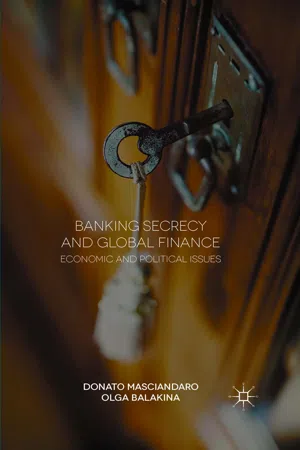
Banking Secrecy and Global Finance
Economic and Political Issues
- English
- ePUB (mobile friendly)
- Available on iOS & Android
eBook - ePub
About this book
A 2009 G20 official document stated that the era of banking secrecy is over but is it? If banking secrecy is the result of market mechanisms, it suggests that worldwide demand and supply are likely to remain for a long time to come.
Since the Global Financial Crisis, many countries have fought to combat banking secrecy, yet it permeates both national and international industries, and global efforts to prevent banking secrecy have been ineffective or at worst counterproductive.
In this book, the authors show how the growth of criminal activity has systematically generated a demand for banking secrecy. They explore how national politicians and international banks have been motivated to supply banking secrecy through economic and political incentives, and shed light on the economics and politics of banking secrecy. This book takes a multidisciplinary approach to reveal the variety of behaviours and processes involved in making dirty money appear clean, providing an in-depth study of financial transactions which are characterized by a special purpose: hiding the originally illegal sources.
This work will be of interest to students and scholars of economics and finance, and those with an interest in banking secrecy, global finance, international banking, and financial regulation.
Information
1
Banking Secrecy: Economics and Politics
1.1 Introduction
It is only in recent times that economic analysis has focused on the financial aspects of illegal activities, and it is a topic which has thus far been completely absent in the academic literature. The basic theoretical reason lies in the absence of special treatment of monetary and financial aspects within the traditional Becker model. Furthermore, the complexity of the topic also creates the need to adopt a multidisciplinary approach by using cognitive instruments associated with different disciplines: economics, law, politics and social sciences.
In this part of the book we propose a simple approach to analyzing the economics of banking secrecy. We define banking secrecy as the use of the monetary, banking and financial services to hide the sources and/or the destinations of money flow in order to reduce the probability of its complete identification. In other words, banking secrecy is the device used to implement money laundering operations via the financial system. Furthermore, we assume that the level of banking secrecy depends on the demand and supply of such economic activity.
Our line of reasoning is organized as follows. Initially we deal with the microeconomics of banking secrecy. In particular, we analyze the demand and the supply of banking secrecy that is implemented through financial channels.
Attention to the study of banking secrecy has progressively increased as the importance of banking secrecy in the development of any law violation that generates revenues has been recognized. In fact, the conduct of any illegal activity may be subject to a special category of transaction costs, linked to the fact that the use of the relative revenues increases the probability that the crime will be discovered and therefore the likelihood of incrimination.
Those transaction costs can be minimized through effective banking secrecy action, a means of concealment that separates financial flows from their origin. The specific economic function of this instrument is to transform potential income into effective purchasing power using banking operations.
Having defined the key features of the economic demand for banking secrecy we can examine the supply. The latter is based on the political cost and benefit analysis of the policymaker that regulates the banking system. Establishing the micro foundations of the phenomenon enables us to formulate a macroeconomic framework that explains the overall aggregate effects of banking secrecy: that is, the increase of both the hidden economy and the economic system as a whole.
Chapter 1 is organized as follows. In Sections 1.2 and 1.3 we set the microeconomic model of banking secrecy by discussing its theoretical and empirical features. The model represents the foundations for the basic aggregate framework, described in Section 1.4, which identifies the so-called “white” macroeconomics of banking secrecy and highlights the consequences of banking secrecy on growth, employment and inflation. In Sections 1.5 and 1.6 the “black” macroeconomics of banking secrecy is presented. Here we investigate the pollution caused by allowing effective opaque banking activity to take place; such activity increases the income and wealth of the illegal and criminal sector. Section 1.7 concludes this section by intertwining white and black macroeconomics and analyzing the relationships between the legal economy, banking secrecy and illegal sectors: in other words, gray macroeconomics.
1.2 Banking secrecy: microeconomics
First of all, we need a definition of banking secrecy that points out its peculiarity with respect to other economic activities involving accumulation and/or reinvestment:
Banking Secrecy is any financial activity aimed to hide the origin and/or the destination of a flow of money in order to reduce the probability of its complete identification. Banking secrecy is the device to implement money laundering operations via the financial system, i.e. banking laundering.
The rationale of our definition is simple: given that the conduct of any hidden activity may be subject to a special category of transaction costs, which are linked to the fact that the use of relative revenues increases the probability of its discovery, those transaction costs can be minimized through an effective banking secrecy action, a means of concealment that separates financial flows from their origin and/or destination.
In other words, whenever a given flow of potential purchasing power – so-called because it cannot be used directly for consumption or investment as it is the result of illegal accumulation activity – is transformed into actual purchasing power, banking secrecy has occurred.
Obviously we acknowledge that secrecy can be obtained by using other channels, but we will focus on the banking and financial sectors because of their one common and very important feature: information asymmetry. Information asymmetry is crucial since it has endemically spread throughout the financial industry and, as a result, it has intertwined with the monetary nature of every exchange in modern economic systems.
Focusing our attention on the concept of costs’ disclosure enables us to grasp not only the distinctive nature of this hidden economic activity but also its general features. The definition we have adopted maintains basic unity among three aspects which, according to other points of view, represent three different objects of banking secrecy action: the financial flows; the wealth and goods intended as terminal moments of those flows; and the principal actors, or those who have the wealth and goods at their disposal.
In our scheme of analysis there will always be an agent who, having committed a law violation that has generated accumulation of hidden proceeds, moves the flows to be laundered. By doing that, she/he (hereafter “he”) subsequently increases her/his (hereafter “his”) financial assets through investment in the legal sector, or reaccumulation in the hidden sector. The agent can be an individual or an organization.
In general, following the classic intuition à la Becker, we maintain that an economic agent’s choice of whether or not to invest resources in hidden activities – of which banking secrecy is one – depends, ceteris paribus, on two peculiar variables, given the possible returns: the probability of being discovered and the related punishment costs.
Assigning a monetary utility to banking secrecy activity by giving it a unitary expression actually summarizes the values of a series of more general services; these services stimulate the growth of demand for banking secrecy services on the part of the agents accumulating illegal resources which have to remain hidden. Banking secrecy, in fact, produces for its users:
1.An economic value, in the strict sense, by minimizing the expected discovery costs, transforming the liquidity derived from a wide range of hidden activities into purchasing power. In this way, banking secrecy performs the transformation function.
Transformation, in its turn, produces two more utilities for the agent, which are:
2.The possibility of increasing the agent’s rate of penetration in the legal sectors of the economy through successive phases of investment; in other words, banking secrecy is a device to implement the investment function.
3.The possibility of increasing the degree to which the actors and organizations are integrated in the legal system as a whole; thus, banking secrecy facilitates the integration.
Having defined the demand for banking secrecy in the most general terms, we can investigate the features of the supply of banking secrecy, which depends prima facie on how the banking regulation and supervision are designed. Here we adapt a framework introduced and developed in Masciandaro (1999), (2005) and (2008).
While discussing the optimal characteristics of the financial rules aimed at promoting an influx of hidden funds into a given country, we will focus on the actions of a national policymaker in what we shall call a banking secrecy (BS) country.
Let us assume that our policy...
Table of contents
- Cover
- Title
- Introduction
- 1 Banking Secrecy: Economics and Politics
- 2 Banking Secrecy, Regulation and Supervision
- 3 Banking Secrecy and International Financial Markets
- Appendix: Financial Intelligence Units around the World
- Index
Trusted by 375,005 students
Access to over 1.5 million titles for a fair monthly price.
Study more efficiently using our study tools.
Frequently asked questions
Yes, you can cancel anytime from the Subscription tab in your account settings on the Perlego website. Your subscription will stay active until the end of your current billing period. Learn how to cancel your subscription
No, books cannot be downloaded as external files, such as PDFs, for use outside of Perlego. However, you can download books within the Perlego app for offline reading on mobile or tablet. Learn how to download books offline
Perlego offers two plans: Essential and Complete
- Essential is ideal for learners and professionals who enjoy exploring a wide range of subjects. Access the Essential Library with 800,000+ trusted titles and best-sellers across business, personal growth, and the humanities. Includes unlimited reading time and Standard Read Aloud voice.
- Complete: Perfect for advanced learners and researchers needing full, unrestricted access. Unlock 1.5M+ books across hundreds of subjects, including academic and specialized titles. The Complete Plan also includes advanced features like Premium Read Aloud and Research Assistant.
We are an online textbook subscription service, where you can get access to an entire online library for less than the price of a single book per month. With over 1.5 million books across 990+ topics, we’ve got you covered! Learn about our mission
Look out for the read-aloud symbol on your next book to see if you can listen to it. The read-aloud tool reads text aloud for you, highlighting the text as it is being read. You can pause it, speed it up and slow it down. Learn more about Read Aloud
Yes! You can use the Perlego app on both iOS and Android devices to read anytime, anywhere — even offline. Perfect for commutes or when you’re on the go.
Please note we cannot support devices running on iOS 13 and Android 7 or earlier. Learn more about using the app
Please note we cannot support devices running on iOS 13 and Android 7 or earlier. Learn more about using the app
Yes, you can access Banking Secrecy and Global Finance by Donato Masciandaro,Olga Balakina in PDF and/or ePUB format, as well as other popular books in Economics & Business General. We have over 1.5 million books available in our catalogue for you to explore.